Sprint Retrospective SWEN-261 Introduction to Software Engineering - - PowerPoint PPT Presentation

sprint retrospective
SMART_READER_LITE
LIVE PREVIEW

Sprint Retrospective SWEN-261 Introduction to Software Engineering - - PowerPoint PPT Presentation

Sprint Retrospective SWEN-261 Introduction to Software Engineering Department of Software Engineering Rochester Institute of Technology From 7 Ways to Make Retrospectives Fun and Engaging by Vibhu Srinvasan Team retrospectives are all about


slide-1
SLIDE 1

SWEN-261 Introduction to Software Engineering

Department of Software Engineering Rochester Institute of Technology

Sprint Retrospective

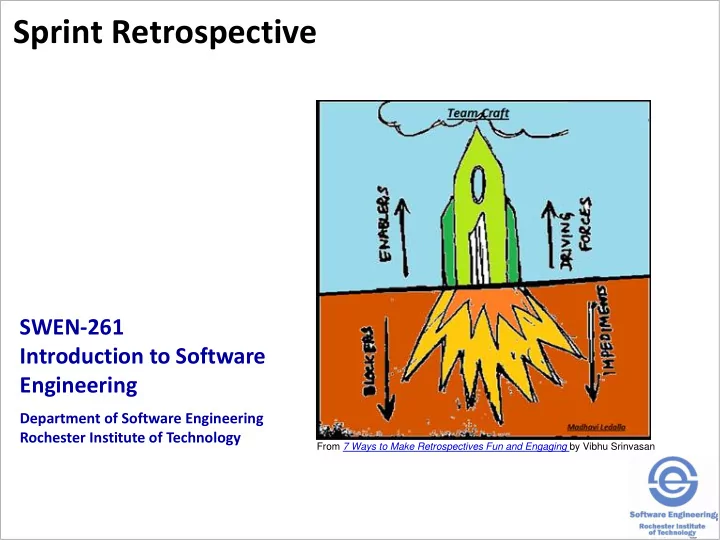
From 7 Ways to Make Retrospectives Fun and Engaging by Vibhu Srinvasan
slide-2
SLIDE 2

Team retrospectives are all about improving the team and your process.

  • The team reflects (introspects) on three main

questions:

  • What went well?
  • What didn't go well?
  • What can we do to improve?
  • Do a retrospective on each sprint.
  • This allows a team to make frequent course

corrections (aka improvements)

  • Iterative and incremental is a principle to be applied to

your process (as well as the product)

  • There are dozens of specific retrospective

techniques; we'll teach you one.

2

slide-3
SLIDE 3

The starfish technique uses five categories of issues.

  • Keep doing
  • These issues highlight an activity that worked well
  • No change necessary
  • More of
  • These issues request more of an activity
  • Start doing
  • These issues request the start of a new activity
  • Less of
  • These issues request less of an activity
  • Stop doing
  • These issues request stopping an activity that isn't

serving the team, the product or the stakeholders

3

slide-4
SLIDE 4

The process of a retrospective follows these steps.

  • 1. Every member creates issue cards
  • 2. Members place each card on the starfish chart
  • 3. A facilitator reads aloud each issue and groups

common issues together

  • 4. Every member votes for five issues on the chart
  • 5. The facilitator picks top three issues
  • 6. The team brainstorms on solutions to each of

these top issues

  • 7. The team creates action items for the next sprint

to satisfy the top issues

4

slide-5
SLIDE 5

Keep your issues concise yet complete.

  • Here's an example:

5

slide-6
SLIDE 6

Issues run the gamut from process, design, teamwork and communication.

  • Adding, removing or improving processes:
  • backlog refinement
  • sprint planning
  • calculating team capacity (velocity)
  • daily standups
  • sprint review/demo
  • sprint retrospective (the meta process)
  • Adding, removing or improving reviews:
  • code reviews
  • reviewer engagement
  • pre-development design reviews
  • pre-planning design reviews

6

slide-7
SLIDE 7

Issues run the gamut from process, design, teamwork and communication.

  • Adding, removing or improving testing:
  • unit testing
  • unit testing code coverage
  • integration testing (esp for web apps)
  • acceptance (manual) testing
  • Adding or improving developer or team skills:
  • better use of Spikes
  • addition of tech talks
  • formal member training
  • Adding or improving team communication:
  • more or better use of communication tools
  • more or better face-to-face meetings
  • more or better discussions with the Product Owner
  • better virtual (distributed) teaming practices

7