CS314 Software Engineering Sprint 5 - Release! Dave Matthews - - PDF document

cs314 software engineering sprint 5 release
SMART_READER_LITE
LIVE PREVIEW

CS314 Software Engineering Sprint 5 - Release! Dave Matthews - - PDF document

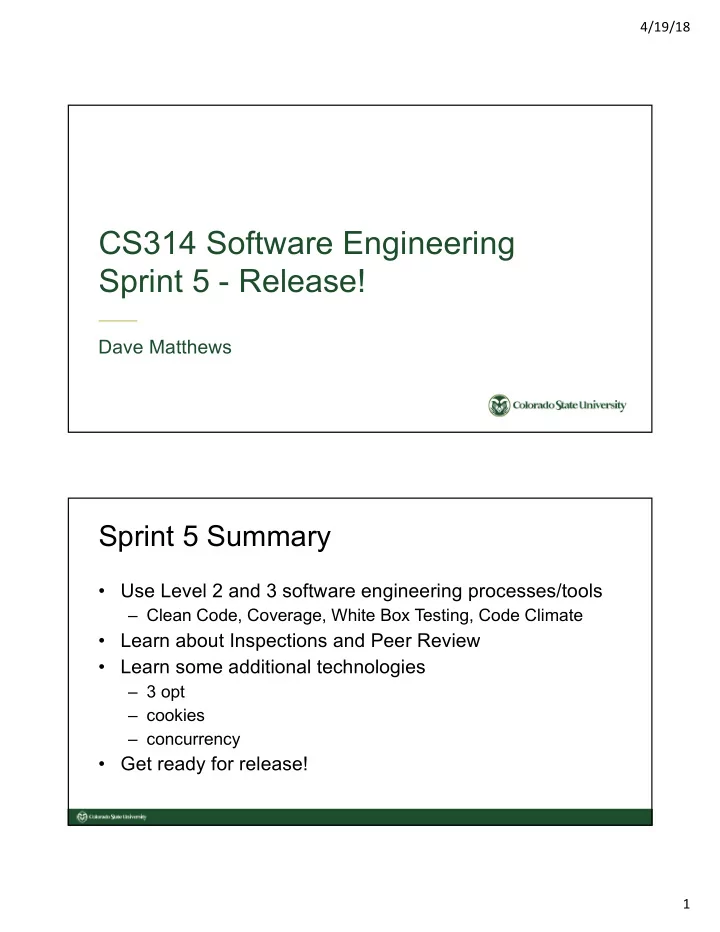
4/19/18 CS314 Software Engineering Sprint 5 - Release! Dave Matthews Sprint 5 Summary Use Level 2 and 3 software engineering processes/tools Clean Code, Coverage, White Box Testing, Code Climate Learn about Inspections and Peer


slide-1
SLIDE 1

4/19/18 1

CS314 Software Engineering Sprint 5 - Release!

Dave Matthews

Sprint 5 Summary

  • Use Level 2 and 3 software engineering processes/tools

– Clean Code, Coverage, White Box Testing, Code Climate

  • Learn about Inspections and Peer Review
  • Learn some additional technologies

– 3 opt – cookies – concurrency

  • Get ready for release!
slide-2
SLIDE 2

4/19/18 2

Build process maturity to level 3

Maturity Organization Project Engineering Support

5

  • Organizational Performance

Management

  • Causal Analysis

and Resolution

4

  • Organizational

Process Performance

  • Quantitative Project

Management

3

  • Organizational

Process Definition

  • Organizational

Process Focus

  • Organizational

Training

  • Integrated Project

Management

  • Risk Management
  • Requirements

Development

  • Technical Solution
  • Product Integration
  • Verification
  • Validation
  • Decision Analysis

and Resolution

2

  • Requirements

Management

  • Project Planning
  • Project Monitoring

and Control

  • Supplier Agreement

Management

  • Configuration

Management

  • Process and Product

Quality Assurance

  • Measurement

and Analysis http://cmmiinstitute.com/sites/default/files/documents/CMMI-DEV_Quick_Ref-2014.pdf

Scrum, Zenhub GitHub, Maven, Travis, WebPack Scrum

Internship Plan

Sprint Processes Tools Technology TripCo Epics

1

  • Configuration Management
  • Project Management
  • Scrum, Planning Poker
  • GitHub, ZenHub
  • CodePen
  • Unix
  • Bootstrap 4
  • HTML
  • JavaScript
  • ReactJS
  • Make a mobile resume
  • Calculate geographic

distances

2

  • Continuous Integration
  • Test Driven Development
  • Black Box Testing
  • Maven, Travis-CI
  • Webpack, Node.js
  • JUnit, IntelliJ
  • Java Spark
  • REST API/HTTP
  • JSON, SVG
  • Accept destination file
  • Show map and

itinerary

3

  • Clean Code
  • Code Coverage
  • White Box Testing
  • Code Climate
  • Emma, Jacoco, …
  • nearest neighbor
  • SQL Select
  • Plan shorter trips
  • Modify destination list
  • Show useful

information

4

  • System Testing
  • Jest
  • 2 opt
  • SQL joins
  • KML
  • Plan shorter trips
  • Worldwide
  • Interactive map

5

  • Peer Reviews
  • Inspections
  • Metrics
  • Concurrency
  • Plan shorter trips
  • Plan trips faster
  • Finalize your resume
slide-3
SLIDE 3

4/19/18 3

Sprint 5 Epic priorities

  • TFFI updates (query limit, …)
  • Interop
  • Optimization (none, NN, 2-opt, 3-opt)
  • Staff page
  • Saved options (client side cookies)
  • System Testing
  • Branding and improved user experience
  • View trip in other tools
  • Concurrency

TFFI - query

  • Client indicates the maximum number of responses to a

query request.

"limit":100 "limit":0 (return all results)

  • If not specified in the query, the server is free to choose

it's own default for limit.

  • 100 vs "100" - integer or string?
slide-4
SLIDE 4

4/19/18 4

Interop

  • Allow client configuration of server hostname and port

– HTTP header to allow mixed client/server – SP5 Deploy1

  • Each student will be assigned another team to test

interoperability and user experience

– test your client to their server – test their client to your server – provide an interop report, resolve issues – provide a user experience report

Traveling Salesman Problem

  • Find the shortest hamiltonian cycle in a graph.

– O(n!) – heuristic algorithms gain speed at cost of tour quality – construction + improvement

  • Construction

– Nearest Neighbor, cheapest link, …

  • Improvement

– 2-opt, 3-opt, k-opt, LK, tabu, SA, GA, …

https://web.tuke.sk/fei-cit/butka/hop/htsp.pdf

slide-5
SLIDE 5

4/19/18 5

264,376 km with 3-opt 3-opt

improvement = true while improvement { improvement = false for (i = 0; i < n-2; i++) { for (j = i + 1; j < n-1; j++) { for (k = j + 1; k < n-0; k++) { int currentDistance = distance0(route, i, j, k); // current trip if (distance1(route, i, j, k) < currentDistance) { // case 1 exchange1(route, i, j, k); improvement = true; continue; } // repeat for cases 2 to 7 } } } }

slide-6
SLIDE 6

4/19/18 6

route 23 15 3 9 7 … 21 11 5 4 23 index 1 2 3 4 … n-4 n-3 n-2 n-1 n i i+1 j j+1 k k+1 i i+1 j j+1 k k+1 i i+1 … j j+1 … k k+1 0 <= i < i+1 <= j < j+1 <= k < k+1 <=n

3-opt inversions and swaps 3-opt cases (including 2 opt)

slide-7
SLIDE 7

4/19/18 7

  • riginal

i i+1 >> j j+1 >> k k+1 2-opt 1X i k << j+1 j << i+1 k+1 2-opt 1X i j << i+1 j+1 >> k k+1 2-opt 1X i i+1 >> j k << j+1 k+1 3-opt 2X i j << i+1 k << j+1 k+1 3-opt 2X i k << j+1 i+1 >> j k+1 3-opt 2X i j+1 >> k j << i+1 k+1 3-opt 3X i j+1 >> k i+1 >> j k+1 distance d(i, ?) + d(?, ?) + d(?, k+1)

3-opt inversions, swaps, first/best View trip in other tools

  • Write a KML file from the client

– generated by server or locally

  • Viewable in Google Earth

– Web (required) – Pro (recommended)

slide-8
SLIDE 8

4/19/18 8

Faster computation - java.util.concurrent

  • Opportunities for concurrency
  • Callable
  • ExecutorService

– invokeAll – shutdown

  • Executors

– newFixedThreadPool

  • Future

class Coin implements Callable<Integer> { private int flips; private long seed; Coin(int f, int s ) { flips = f; seed = s; } public Integer call() { int heads = 0; Random random = new Random(seed + System.currentTimeMillis()); for (int i = 0; i < flips; i++) if ((random.nextInt() % 2) != 0) heads++; // 1 or -1 System.out.printf("Sample: %5d = %d\n", seed, heads); return heads; } }

Concurrency example

slide-9
SLIDE 9

4/19/18 9

class MonteCarlo { private final static int coins = 10; private final static int flips = 100; public static void main(String[] argv) { long total = 0; try { // create threads Set<Callable<Integer>> threads = new HashSet<>(); for (int i = 0; i < coins; i++) threads.add(new Coin(flips, i)); // execute threads int cores = Runtime.getRuntime().availableProcessors(); ExecutorService executorService = Executors.newFixedThreadPool(cores); List<Future<Integer>> results = executorService.invokeAll(threads); executorService.shutdown(); // sum thread results for mean for (Future<Integer> result : results) total += result.get(); } catch(Exception e) { } System.out.println("Mean: "+(double)total/coins); } }

1 2 3 4 5 6 7 8 9 10 11 12 13 14 15 16 4 8 12 16 20 24 28 32 36 40 44 48 52 56 60 64

Seconds Threads

Thread Performance

2-core 4-core 6-core 8-core 12-core