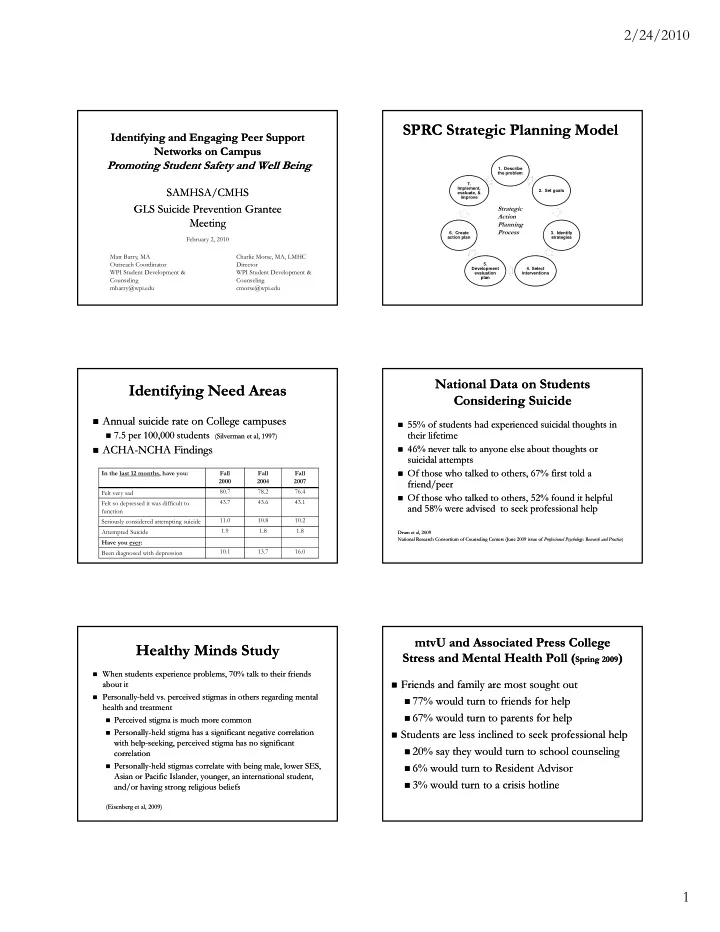

2/24/2010 1
Identifying and Engaging Peer Support Identifying and Engaging Peer Support Networks on Campus Networks on Campus Promoting Student Safety and Well Being Promoting Student Safety and Well Being SAMHSA/CMHS SAMHSA/CMHS GLS S i id Pr ti Gr t GLS S i id Pr ti Gr t GLS Suicide Prevention Grantee GLS Suicide Prevention Grantee Meeting Meeting
February 2, 2010 Charlie Morse, MA, LMHC Director WPI Student Development & Counseling cmorse@wpi.edu Matt Barry, MA Outreach Coordinator WPI Student Development & Counseling mbarry@wpi.edu
SPRC Strategic Planning Model SPRC Strategic Planning Model
- 1. Describe
the problem
- 2. Set goals
7. Implement, evaluate, & improve
St t i
- 3. Identify
strategies
- 4. Select
interventions 5. Development evaluation plan
- 6. Create
action plan
Strategic Action Planning Process
Identifying Need Areas Identifying Need Areas
Annual suicide rate on College campuses
Annual suicide rate on College campuses
7.5 per 100,000 students
7.5 per 100,000 students (Silverman et al, 1997)
(Silverman et al, 1997)
- ACHA
ACHA-
- NCHA Findings
NCHA Findings
In the last 12 months, have you: Fall 2000 Fall 2004 Fall 2007 Felt very sad 80.7 78.2 76.4 Felt so depressed it was difficult to function 43.7 43.6 43.1 Seriously considered attempting suicide 11.0 10.8 10.2 Attempted Suicide 1.9 1.8 1.8 Have you ever: Been diagnosed with depression 10.1 13.7 16.0
National Data on Students National Data on Students Considering Suicide Considering Suicide
55% of students had experienced suicidal thoughts in
55% of students had experienced suicidal thoughts in their lifetime their lifetime
46% never talk to anyone else about thoughts or
46% never talk to anyone else about thoughts or suicidal attempts suicidal attempts
Of those who talked to others, 67% first told a
Of those who talked to others, 67% first told a friend/peer friend/peer
Of those who talked to others, 52% found it helpful
Of those who talked to others, 52% found it helpful and 58% were advised to seek professional help and 58% were advised to seek professional help
Drum et al, 2009 Drum et al, 2009 National Research Consortium of Counseling Centers (June 2009 issue of National Research Consortium of Counseling Centers (June 2009 issue of Professional Psychology: Research and Practice Professional Psychology: Research and Practice)
Healthy Minds Study Healthy Minds Study
When students experience problems, 70% talk to their friends
When students experience problems, 70% talk to their friends about it about it
Personally
Personally-
- held vs. perceived stigmas in others regarding mental
held vs. perceived stigmas in others regarding mental health and treatment health and treatment
Perceived stigma is much more common
Perceived stigma is much more common g
Personally
Personally-
- held stigma has a significant negative correlation
held stigma has a significant negative correlation with help with help-
- seeking, perceived stigma has no significant
seeking, perceived stigma has no significant correlation correlation
Personally
Personally-
- held stigmas correlate with being male, lower SES,
held stigmas correlate with being male, lower SES, Asian or Pacific Islander, younger, an international student, Asian or Pacific Islander, younger, an international student, and/or having strong religious beliefs and/or having strong religious beliefs
(Eisenberg et al, 2009) (Eisenberg et al, 2009)