Spin and Orbital Evolution of the Accreting Millisecond Pulsar SAX - - PowerPoint PPT Presentation

spin and orbital evolution of the accreting millisecond
SMART_READER_LITE
LIVE PREVIEW

Spin and Orbital Evolution of the Accreting Millisecond Pulsar SAX - - PowerPoint PPT Presentation

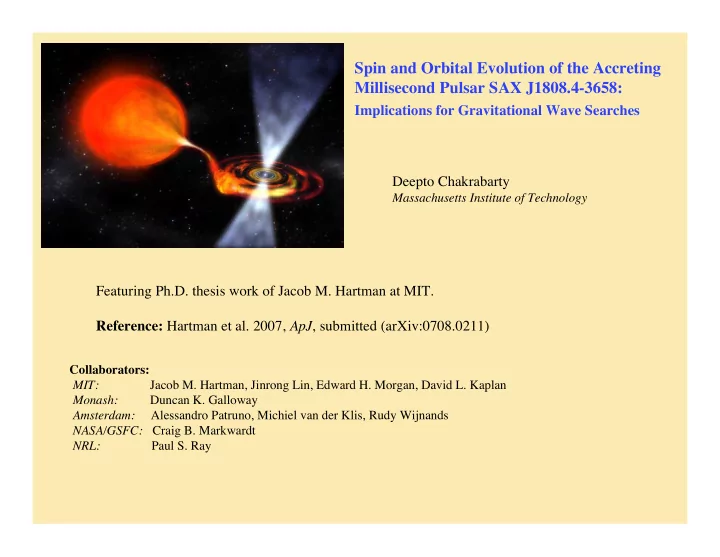
Spin and Orbital Evolution of the Accreting Millisecond Pulsar SAX J1808.4-3658: Implications for Gravitational Wave Searches Deepto Chakrabarty Massachusetts Institute of Technology Featuring Ph.D. thesis work of Jacob M. Hartman at MIT.


slide-1
SLIDE 1

Spin and Orbital Evolution of the Accreting Millisecond Pulsar SAX J1808.4-3658:

Implications for Gravitational Wave Searches Deepto Chakrabarty

Massachusetts Institute of Technology

Featuring Ph.D. thesis work of Jacob M. Hartman at MIT. Reference: Hartman et al. 2007, ApJ, submitted (arXiv:0708.0211)

Collaborators: MIT: Jacob M. Hartman, Jinrong Lin, Edward H. Morgan, David L. Kaplan Monash: Duncan K. Galloway Amsterdam: Alessandro Patruno, Michiel van der Klis, Rudy Wijnands NASA/GSFC: Craig B. Markwardt NRL: Paul S. Ray

slide-2
SLIDE 2

Life History of Pulsars: Spin and Magnetic Evolution

1. Pulsars born with B~1012 G, P~20 ms. Spin-down due to radiative loss of rotational K.E. 2. If in binary, then companion may eventually fill Roche lobe. Accretion spins up pulsar to equilibrium spin period 3. Sustained accretion (~109 yr) attenuates pulsar magnetic field to B~108 G, leading to equilibrium spin P~few ms 4. At end of accretion phase (companion exhausted or binary disrupted), millisecond radio pulsar remains

1 2 3 4

Peq 1 s B 1012 G

  • 6/7

˙ M 109 MSun /yr

  • 3/7

For accreting pulsars, X-ray observations can measure spin by tracing rotating “hot spots”. If these X-ray pulsations persist for long enough, can also measure binary orbital parameters.

slide-3
SLIDE 3

accretion disk

Accretion-Powered X-Ray Pulsars

spin axis magnetic axis dipole magnetic field ~ rm

  • Magnetically-channeled flow onto polar caps,

hits at ~ 0.1 c. (Requires B > 108 G)

  • Gravitational potential energy released as X-

rays,

  • Misaligned magnetic dipole axis: pulsations

at spin period from X-ray hot spots at poles.

  • Accretion adds mass and angular momentum

to NS (measure torque)

L = ˙ M GM R

slide-4
SLIDE 4

“Bona Fide” Accretion-Powered Millisecond X-Ray Pulsars

RXTE Power spectrum of SAX J1808.4-3658 (April 1998) Wijnands & van der Klis 1998 Chakrabarty & Morgan 1998

  • Can measure spin and orbital parameters.
  • 10 known examples, generally all X-ray transients with low mass accretion rates.

Two-hour orbit of SAX J1808.4-3658

401 Hz

slide-5
SLIDE 5
  • Low-mass X-ray binaries with low accretion rates are subject to an ionization instability in their

accretion disk. This leads to episodic accretion: X-ray transients

  • Duty cycle is low: X-ray transients lie dormant for months or years, then become active for a few

days or weeks when accretion disk instability is triggered.

  • All known accretion-powered millisecond pulsars are X-ray transients (but see Galloway talk for

complication....). Cannot continuously monitor spin and orbital evolution in these systems. X-Ray Sources: Persistent versus Transient

slide-6
SLIDE 6
  • Thermonuclear X-ray bursts due to unstable nuclear burning on

NS surface, lasting tens of seconds, recurring every few hours to days.

  • Millisecond oscillations discovered during some X-ray bursts by

RXTE (Strohmayer et al. 1996). Spreading hot spot on rotating NS surface yields “nuclear-powered pulsations”.

  • Oscillations in burst tail not yet understood. Along with

frequency drift, may be due to surface modes on NS. (Heyl; Piro &

Bildsten; Cooper & Narayan)

  • Burst oscillations reveal spin, but not

possible to measure orbital parameters or spin evolution, since bursts only last a few tens of seconds.

Nuclear-Powered Millisecond X-Ray Pulsars (X-Ray Burst Oscillations)

thermonuclear burst quiescent emission due to accretion contours of oscillation power as function of time and frequency X-ray burst count rate

SAX J1808.4-3658 (Chakrabarty et al. 2003) 4U 1702-43 (Strohmayer & Markwardt 1999)

slide-7
SLIDE 7

Distribution of Neutron Star Spins in Low-Mass X-Ray Binaries

Chakrabarty 2005

  • We find that νhigh < 730 Hz (95% confidence) (Chakrabarty et al. 2003)
  • Recycled pulsars evidently have a maximum spin frequency that is well below the breakup

frequency for most NS equations of state. Fastest known radio pulsar is PSR J1748-2446ad (Ter 5) at 716 Hz.

  • Detailed shape of distribution still unclear. (Sharp cutoff? Pileup? Falloff?) Need more systems!
  • Submillisecond pulsars evidently relatively rare, if they exist.
  • Recent report of 1122 Hz burst oscillation in XTE J1739-285 (Kaaret et al. 2007), but statistical

significance questionable (actual significance is only ~3σ). Remains an interesting candidate.

slide-8
SLIDE 8

How to explain cutoff in spin distribution?

1. Equilibrium spin not yet reached?

  • Unlikely, since spin-up time scale is short compared to X-ray lifetime

(but EXO 0748-676 ?)

2. Low breakup frequency for NSs?

  • Requires stiff, exotic EOS with M<1.5 M and R~16 km

3. Magnetic spin equilibrium? (e.g. Ghosh & Lamb 1979; Lamb & Yu 2005)

  • Depends on accretion rate and B. Take observed accretion rate range and apply

disk-magnetosphere interaction relevant for weakly magnetic NSs (see Psaltis &

Chakrabarty 1999).

  • Can reproduce spin distribution if ALL the objects have similar magnetic field B

~108 G. However, this is inconsistent with our inference of a higher field in SAX J1808.4-3658 than in the other burst sources. (Pulsations in other sources?)

4. Accretion torque balanced by gravitational radiation?

  • Gravitational wave torque ∝Ω5, from any of several models:
  • r-mode instability (Wagoner 1984; Andersson et al. 1999)
  • Accretion-induced crustal quadrupole (Bildsten 1998; Ushomirsky et al. 2000)
  • Large (internal) toroidal magnetic fields (Cutler 2002)
  • Magnetically confined “mountains” (Melatos & Payne 2005)
  • Strain of for brightest LMXBs (Bildsten 2002): Advanced LIGO?
  • Use long integrations to search for persistent GW emission from pulsars

(Wagoner 1984; Bildsten 1998)

h ~ 10

26

slide-9
SLIDE 9

Sensitivity of Current and Future Gravitational Wave Observatories

Adapted from D. Ian Jones (2002, Class. Quant. Grav., 19, 1255) University of Southampton, UK seismic noise thermal noise s h

  • t

n

  • i

s e

slide-10
SLIDE 10

What do we know about the spin frequency evolution? This will affect the ability to do long integrations for pulsar GW searches. For a pure accretion torque (no other torque contribution) near magnetic spin equilibrium,

˙ = 4 1014 ˙ M 0.01 ˙ M

Edd

  • 600 Hz
  • 1/3

Hz s-1

where we have scaled to an accretion rate typical for X-ray transient outbursts. Assuming steady accretion, this corresponds to a decoherence time of

= 1 ˙

  • 60

˙ M 0.01 ˙ M

Edd

  • 1/2
  • 600 Hz
  • 1/6

days

Note that in the X-ray transients, there is only a significant accretion torque during the (short)

  • utbursts. It would be interesting to know how the spin evolves during X-ray quiescence, when

accretion is shut off.

slide-11
SLIDE 11

Can we study the spin evolution of individual millisecond X-ray pulsars?

  • In principle, accretion-powered millisecond pulsars ideal targets. Pulse timing during

weeks-long active outburst allows precise measurement of spin and orbital parameters.

  • Spin frequency derivatives have been measured during outbursts of several systems.
  • Complication: Some millisecond X-ray pulsars subject to substantial pulse shape

variability, both systematic and stochastic. This can potentially mimic spin evolution!

(Hartman et al. 2007)

  • Consolation: Not all millisecond X-ray pulsars have strong pulse shape noise, so accretion

torque study during outburst is possible for some sources -- but only during active accretion. Spin derivatives of order ~10-14 Hz/s have been measured (Galloway et al. 2002; Burderi et al.

2006, 2007; Papitto et al. 2007; Riggio et al. 2007)

  • For sources with multiple outbursts, can also study long-term spin and orbital evolution by

using outbursts spaced over several years. Best case is SAX J1808.4-3658, which has been

  • bserved in 1998, 2000, 2002, and 2005.
slide-12
SLIDE 12

Long-Term Spin-down of the Accretion-Powered Millisecond Pulsar SAX J1808.4-3658

This spin-down cannot be due to accretion torques during outbursts, based on spin derivative limits during outbursts. The torque is occurring between outbursts, when there is no accretion. Magnetic dipole spin-down?

  • In the absence of accretion, this should

always be present at some level.

  • Requires B < 1.5×10⁸ G for consistency with

measured spindown. For comparison, presence

  • f accretion-powered pulsations over observed
  • utburst flux range implies B in range (0.4 –

12)×108 G Gravitational wave spin-down?

  • Requires mass quadrupole moment

Q < 4.4×1036 g cm2 (= 10-8 I) for consistency with measured spin-down Note that magnetic dipole spin-down with expected field strength easily explains data -- gravitational wave torque not required for this 401 Hz system. However, given Ω5 torque dependence, GWs could easily still play an important role at ~700 Hz. It would be nice to repeat measurement for a faster rotator.

1998 2000 2002 2005 Hartman et al. (2007)

Magnetic propeller spin-down?

  • Consistent with long-term mass transfer
slide-13
SLIDE 13

Orbital Evolution of the Accretion-Powered Millisecond Pulsar SAX J1808.4-3658

˙ P

  • rb = (3.5 ± 0.2) 1012 s s1

1998 2000 2002 2005 Hartman et al. 2007. (also Di Salvo et al. 2007)

  • We expect orbital period to evolve on a 3 Gyr

timescale due to mass transfer and angular momentum losses. Measured value is an order

  • f magnitude faster! Explanation not clear.
  • Interesting comparison: “black widow” radio

pulsars which are ablating their low-mass companions through intense particle irradiation. At least 2 of these systems have large, varying

  • rbital period derivatives that are quasi-cyclic on

decade timescale (Arzoumanian et al. 1994; Doroshenko et

  • al. 2001).
  • There is some optical evidence that SAX

J1808.4-3658 may be an active radio pulsar during X-ray quiescence (Burderi et al. 2003; Campana

et al. 2004). If so, then it may be a black widow

system as well. It will be interesting to monitor

  • rbital evolution further, look for quasi-cyclic

sign changes in derivative.

  • Unexpectedly large orbital period derivatives have been measured in other low-mass X-ray

binaries as well (4U 1820-30, EXO 0748-676, 4U 1822-371). This may complicate long GW integrations.

slide-14
SLIDE 14

Summary

  • Issues of importance for gravitational wave community:
  • Short-term spin evolution of millisecond X-ray pulsars during transient outbursts appears modest
  • Long-term spin evolution of SAX J1808.4-3658 is very modest, consistent with magnetic dipole
  • spindown. Gravitational wave torque evidently unimportant for 400 Hz rotator.
  • Orbital evolution of LMXBs may be significant and variable.
  • The most luminous LMXBs do not have precisely known spins or orbits
  • Continuous X-ray timing of most LMXBs not possible
  • Long-term programmatic prospects for X-ray timing are uncertain

References:

  • Hartman et al. 2007, ApJ, submitted

(arXiv:0708.0211)