Millisecond Pulsar Populations Millisecond Pulsar Populations in - - PowerPoint PPT Presentation

millisecond pulsar populations millisecond pulsar
SMART_READER_LITE
LIVE PREVIEW

Millisecond Pulsar Populations Millisecond Pulsar Populations in - - PowerPoint PPT Presentation

Millisecond Pulsar Populations Millisecond Pulsar Populations in Globular Clusters in Globular Clusters David C. Y. Hui Department of Astronomy & Space Science Chungnam National University 1. Introduction 2. Dynamical formation of

slide-1
SLIDE 1

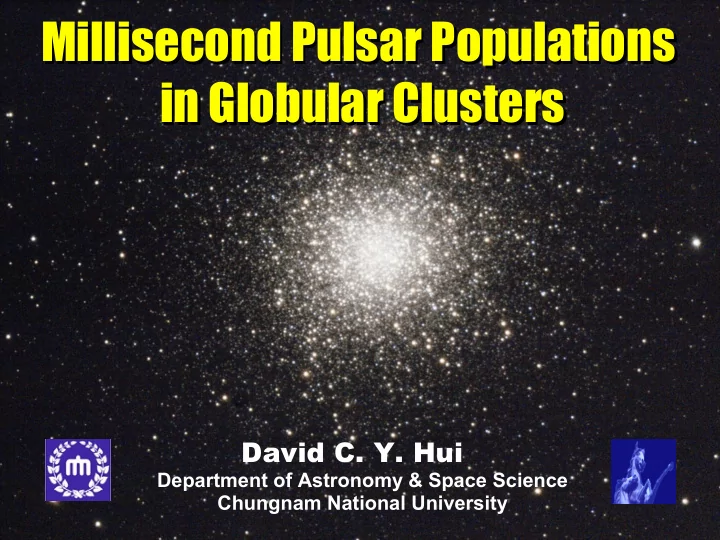
Millisecond Pulsar Populations Millisecond Pulsar Populations in Globular Clusters in Globular Clusters

David C. Y. Hui

Department of Astronomy & Space Science Chungnam National University

slide-2
SLIDE 2
  • 1. Introduction
  • 2. Dynamical formation of millisecond

pulsars (MSPs) in GCs

  • 3. Multi-wavelength emission properties of

GC MSPs

slide-3
SLIDE 3

Globular Clusters

  • Stellar systems tightly

bounded by gravity

  • Densities of the stars

increases toward center

  • Composed of late-type

metal-poor stars

  • Stellar encounters are

frequent in the cores

slide-4
SLIDE 4

Globular Clusters

  • Stellar systems tightly

bounded by gravity

  • Densities of the stars

increases toward center

  • Composed of late-type

metal-poor stars

  • Stellar encounters are

frequent in the cores

GCs are efficient factories of compact binaries!

slide-5
SLIDE 5

Binaries in Globular Clusters

Due to the frequent stellar encounters, the evolutionary history of the binary systems in GCs are expected to be different from that in the Galactic field.

slide-6
SLIDE 6

Binaries in Globular Clusters

Due to the frequent stellar encounters, the evolutionary history of the binary systems in GCs are expected to be different from that in the Galactic field. To investigate the binary populations in GCs:

  • 1. Investigate the relations between the binary

populations in GCs with various cluster properties.

  • 2. Compare the emission properties of the

binaries in GCs with those in the Galactic field.

slide-7
SLIDE 7

Millisecond Pulsars (MSPs)

MSP

slide-8
SLIDE 8

Reincarnation of Dead Pulsars

Low Mass X-ray Binaries (LMXBs)

Millisecond Pulsars (MSPs)

slide-9
SLIDE 9

X-Ray Binaries in GCs

Pooley et al. (2003)

slide-10
SLIDE 10

X-Ray Binaries in GCs

MSPs are also expected to correlate with G!

Pooley et al. (2003)

slide-11
SLIDE 11

MSPs in Globular Clusters

  • Many GCs that host

a single MSPs have not been searched deep enough

  • Observed number of

MSPs do not provide an unbiased sample for correlation study

Hui, Cheng & Taam (2010)

slide-12
SLIDE 12

MSPs in Globular Clusters

Hui, Cheng & Taam (2010)

To alleviate the problem due to selection effects: Use the cumulative radio luminosity functions (CLFs)

N(>L)=N0Lq

We are able to estimate the no. of MSPs in these GCs above the same luminosity threshold. Unbiased sample for correlation analysis can be obtained

slide-13
SLIDE 13

MSPs in Globular Clusters

Spearman Rank=0.78 C.L. > 98%

Hui, Cheng & Taam (2010)

Correlation with Stellar Encounter Rate

slide-14
SLIDE 14

MSPs in Globular Clusters

Spearman Rank=0.78 C.L. > 98%

Hui, Cheng & Taam (2010)

Correlation with Stellar Encounter Rate

Evidence for Dynamical formation of MSPs in GCs

slide-15
SLIDE 15

MSPs in Globular Clusters

Hui, Cheng & Taam (2010)

Correlation with Metallicity

Spearman Rank=0.72 C.L. > 97%

slide-16
SLIDE 16

MSPs in Globular Clusters

Absence of outer convective layer in metal-poor MS donors precludes the orbital shrinkage through magnetic braking Significantly reduce the parameter space for successful mass-transfer in NS-MS binaries (Ivanova 2006).

Metal-rich GCs Metal-poor GCs

slide-17
SLIDE 17

MSPs in Globular Clusters

  • MSPs in GCs have likely been recycled for multiple times
  • In each LMXB phase, accretion might not be in the same plane
slide-18
SLIDE 18

MSPs in Globular Clusters

  • MSPs in GCs have likely been recycled for multiple times
  • In each LMXB phase, accretion might not be in the same plane
  • RESULT: 1. A complicated B-field on the NS surface (Cheng & Taam 2003)
slide-19
SLIDE 19

MSPs in Globular Clusters

  • MSPs in GCs have likely been recycled for multiple times
  • In each LMXB phase, accretion might not be in the same plane
  • RESULT: 1. A complicated B-field on the NS surface (Cheng & Taam 2003)
  • 2. Different emission properties in comparison the MSPs

in the Galactic field

slide-20
SLIDE 20

Radio Luminosity Function

Hui, Cheng & Taam (2010)

Radio Properties of GC MSPs

slide-21
SLIDE 21

X-ray Properties of MSPs

Galactic Field Population Globular Cluster Population

  • Thermal spectral component

(Heated polar cap)

+ Non-thermal PL component (Magnetospheric emission)

  • Energy dependent pulse

profile (multiple components)

  • Pulsar wind nebulae
  • Majority of the GC MSPs

are thermal X-ray emitters

  • Pulse profile (unknown)
  • No conclusive evidence for

pulsar wind nebulae in X-ray

slide-22
SLIDE 22

X-ray Properties of MSPs

Examples of MSPs in Galactic Field

Zavlin (2006)

Spectrum & energy resolved light curves of PSR J0437-4715

slide-23
SLIDE 23

X-ray Properties of MSPs

Examples of MSPs in Galactic Field Pulsar wind nebulae associated with isolated PSR J2124-3358

Chandra ACIS-S3

Hui & Becker (2006)

slide-24
SLIDE 24

X-ray Properties of MSPs

MSPs in Globular Clusters – 47 Tuc Optical X-ray

slide-25
SLIDE 25

X-ray Properties of MSPs

MSPs in Globular Clusters – 47 Tuc

Bogdanov et al. (2006)

slide-26
SLIDE 26

X-ray Properties of MSPs

MSPs in Globular Clusters – 47 Tuc

Cameron et al. (2007)

slide-27
SLIDE 27

X-ray Properties of MSPs

Evidence for Pulsar Wind in GCs?

Intracluster gas density Difference of dispersion measures of MSPs in 47 Tuc suggests tenuous plasma in the center:

(Freire et al. 2001)

Assuming one proton for every free electron: M

gas

expected to accumulate when GC past through the Galactic disk in ~10

7-8 yrs

Spergel (1991) proposed that the relativistic wind of MSPs expel most of the gas

slide-28
SLIDE 28

X-ray Properties of MSPs

Evidence for Pulsar Wind in GCs?

Diffuse X-rays in GC cores

Detailed investigations show that the diffuse X-rays in the clusters are the blend of unresolved point sources. No evidence for PWNe can be found in X-ray

  • bservations.

Hui, Cheng & Taam (2009)

slide-29
SLIDE 29

X-ray Properties of MSPs

Evidence for Pulsar Wind in GCs?

Diffuse X-rays in GC cores

Detailed investigations show that the diffuse X-rays in the clusters are the blend of unresolved point sources. No evidence for PWNe can be found in X-ray

  • bservations.

Hui, Cheng & Taam (2009)

Where does the energy of pulsar wind go?

slide-30
SLIDE 30

Cooling of the Relativistic Particles

Psyn PICS = UB Urad

Synchrotron Cooling vs Inverse Compton Scattering For intracluster B-field of few mG and the typical starlight energy density in the core:

UB Urad ICS predominates in GC cores! t 100

slide-31
SLIDE 31

Cooling of the Relativistic Particles

Psyn PICS = UB Urad

Synchrotron Cooling vs Inverse Compton Scattering For intracluster B-field of few mG and the typical starlight energy density in the core:

UB Urad ICS predominates in GC cores! t

Mean energy gain in a single collision:

Z DEγ _ ~ g2b2 Eγ Pulsar wind can easily boost a soft photon to g-ray regime

100

slide-32
SLIDE 32

Gamma-ray Emission from GCs

Significant Detections of 8 GCs

Abdo et al. (2010)

slide-33
SLIDE 33

Gamma-ray Emission from GCs

Hui et al. (2010b)

slide-34
SLIDE 34

Gamma-ray Emission from GCs

Hui et al. (2010b)

Lg is proportional to:

  • 1. Population size of MSPs in a GC
  • 2. Energy densities of soft photon field
slide-35
SLIDE 35

Gamma-ray Emission from GCs

Fundamental Plane of γ-ray Globular Clusters

Hui et al. (2010b)

slide-36
SLIDE 36

Collaborators

K.S. Cheng (HKU) D.O Chernyshov (Moscow Inst. Of Science & Technology) V.A. Dogiel (P.N. Lebedev Institute) Albert K.H. Kong (NTHU) Ronald Taam (TIARA; Northwestern U.) Thomas P.H. Tam (NTHU)

  • Y. Wang (HKU)