Accretion - driven Millisecond X - ray Pulsars and the Discovery of - - PowerPoint PPT Presentation

accretion driven millisecond x ray pulsars and the
SMART_READER_LITE
LIVE PREVIEW

Accretion - driven Millisecond X - ray Pulsars and the Discovery of - - PowerPoint PPT Presentation

Accretion - driven Millisecond X - ray Pulsars and the Discovery of the First Eclipsing Event Fermi Workshop (06/21/2010 ~ 06/25/2010) Yi-Jung Yang Tuesday, June 22, 2010 Outline Classification of Pulsars Accretion-driven Millisecond

slide-1
SLIDE 1

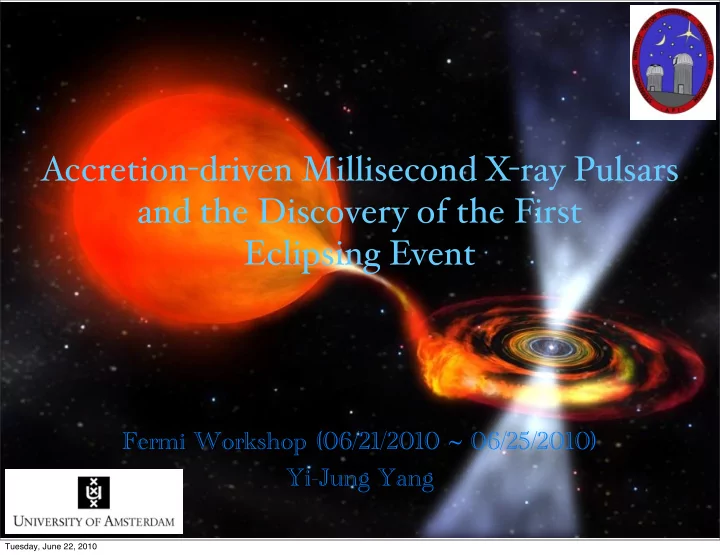
Accretion-driven Millisecond X-ray Pulsars and the Discovery of the First Eclipsing Event

Fermi Workshop (06/21/2010 ~ 06/25/2010) Yi-Jung Yang

Tuesday, June 22, 2010

slide-2
SLIDE 2

Outline

  • Classification of Pulsars
  • Accretion-driven Millisecond X-ray

Pulsars (AMXPs)

  • Discovery of the first eclipsing Event
  • Summary

Tuesday, June 22, 2010

slide-3
SLIDE 3

Pulsar Basic

Pulsars Isolated Binary Radio Optical Pulsars X-ray (i.e. Magnificent 7) Gamma ray (i.e. Geminga, Lupin Lin’s talk) Magnetar Accretion-powered (Radio Quiet) Radio Loud

LMXB(i.e. AMXPs)

HMXB Millisecond Pulsars Double Pulsars/Pulsar + NS Pulsar + Main sequence star

Rotation-powered Pulsars Millisecond Pulsars Rotational Radio T ransients

Anomalous X-ray Pulsars(AXPs) Soft Gamma-ray Repeaters(SGRs)

Tuesday, June 22, 2010

slide-4
SLIDE 4

P-P(dot) Diagram

Tuesday, June 22, 2010

slide-5
SLIDE 5

Accretion-driven Millisecond X-ray Pulsars

According to the recycling scenario, millisecond radio pulsars are produced by spin up via the transfer of angular momentum through

  • accretion. During the phase (~10 Gyrs), they

would be expected to emit X-ray pulsations. Therefore one would expect some accreting neutron stars to be observed as accretion powered X-ray pulsars in the process of spinning up in the millisecond range.

Tuesday, June 22, 2010

slide-6
SLIDE 6

Periodic variability of AMXPs

The blackbody emission from the hot spot where the magnetic funnel flow impacts the neutron star surface, transforming the kinetic energy into radiation. Since the funnel flow is relativistic, a shock is expected to appear. The thermal radiation emitted by the hot spot can the be Comptonized by the shock and upscattered to higher energies (Poutanen & Gierlinski 2003)

Tuesday, June 22, 2010

slide-7
SLIDE 7

Other properties of AMXPs

Quasi-periodic Oscillations (QPOs): Apart from the coherent millisecond variability, AMXPs show quasi-periodic variability on timescales of milliseconds up to hundred seconds (Linares et al. 2005, 2007, 2008) However, the

  • rigin of this phenomenon is not yet clear.

Thermonuclear (runaways) X-ray Bursts: usually called Type I X-ray Bursts Burst Oscillations: which are observed with a frequency close to neutron star spin. Only three AMXPs found with burst oscillations so far. (SAX J1808.4-3658, XTE J1814-338 and Aql X-1)

Tuesday, June 22, 2010

slide-8
SLIDE 8

List of AMXPs found up to date

The first accreting millisecond X-ray Pulsar was discovered in 1998 (SAX J1808.4-3658, Wijnands & van der Klis 1998) Note: All AMXPs are LMXBs. Frequencies are ranging from ~ 180~600 Hz.

Tuesday, June 22, 2010

slide-9
SLIDE 9

Discovery of the First Eclipsing AMXP Swift J1749.4-2807

  • First discovered by Swift/BAT as GRB060602B
  • Later was realized it is an accreting neutron star

binary system instead of GRB (Wijnands et al. 2009)

  • Outburst in April 2010 detected by Integral with

RXTE, Swift/XRT and Chandra follow-ups

  • Eclipses found in RXTE and Swift observations

Tuesday, June 22, 2010

slide-10
SLIDE 10

The Swift/BAT lightcurve of GRB060602B in different energy range. (Wijnands et al. 2009)

Tuesday, June 22, 2010

slide-11
SLIDE 11

Tuesday, June 22, 2010

slide-12
SLIDE 12

Type I Burst by Integral (Ferrigno et al. 2010, ATel#2648)

Tuesday, June 22, 2010

slide-13
SLIDE 13

Eclipses found by RXTE (Altamirano et al. 2010)

Tuesday, June 22, 2010

slide-14
SLIDE 14

Pulse Profiles of Swift J1749.4-2807 (Ferrigno et al.)

Tuesday, June 22, 2010

slide-15
SLIDE 15

Folded Lightcurves

RXTE Swift/XRT

Tuesday, June 22, 2010

slide-16
SLIDE 16

(Altamirano et al. 2010)

Tuesday, June 22, 2010

slide-17
SLIDE 17

At inclinations close to 90 degree the central source is not visible,

  • nly scattered X-rays from a wind or accretion disc corona can be

seen (partially eclipsed by the companion star). Between inclinations of about 60~80 degree the central source is visible, but with dips. Below 60 degree the central source is always visible.

Tuesday, June 22, 2010

slide-18
SLIDE 18

Tuesday, June 22, 2010

slide-19
SLIDE 19

Tuesday, June 22, 2010

slide-20
SLIDE 20

Summary

  • There are so far 13 AMXPs found. They might

be the link between radio pulsars and radio MSPs.

  • The first eclipsing event was found by RXTE

and Swift, which helped to constraint the inclination angle, as well as other parameters.

  • Further observations and studies are needed to

confirm the role of AMXPs in recycling scenario.

Tuesday, June 22, 2010