
SLIDE 1
Les Houches
Accretion discs
Geoffroy Lesur (IPAG, Grenoble, France)
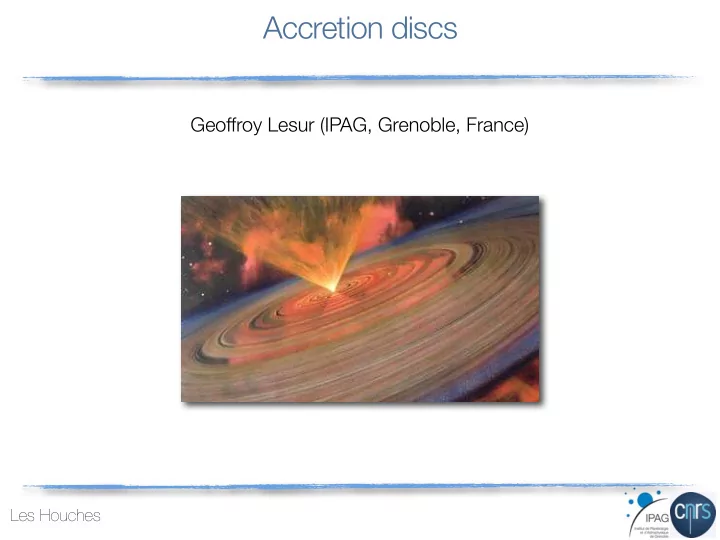
Accretion discs Geoffroy Lesur (IPAG, Grenoble, France) Les Houches - - PowerPoint PPT Presentation
Accretion discs Geoffroy Lesur (IPAG, Grenoble, France) Les Houches Outline Accretion discs and jets: what are they Accretion discs in nature Jets in nature Accretion disc models Hydrostatic equilibrium Angular momentum transport
Les Houches
Geoffroy Lesur (IPAG, Grenoble, France)
Accretion discs and jets: what are they Accretion discs in nature Jets in nature Accretion disc models Hydrostatic equilibrium Angular momentum transport Linear stability A Specific application of the MRI to protoplanetary discs Nonideal MRI Direct detection of turbulence in protoplanetary discs
2
3
Credit: C. Burrows and J. Krist (STScl),
Artist view
4
[van-der Marel+ (2013)]
5
ALMA (ESO/NAOJ/NRAO) Press release 6 Nov. 2014
[Brogan+2015]
6
Artist view
7
M87
8
M87
HH"212"(Class"I"YSO)"
100 AU
HH212 HH30
2000 AU 100 AU
9
Centaurus A Quasar 3C175
Accretion discs and jets: what are they Accretion discs in nature Jets in nature Accretion disc models Hydrostatic equilibrium Angular momentum transport Linear stability A Specific application of the MRI to protoplanetary discs Nonideal MRI Direct detection of turbulence in protoplanetary discs
10
11
12
Courtesy T. Heinemann
13
Use shear-periodic boundary conditions= «shearing-sheet» Allows one to use a sheared Fourier Basis periodic in y and z (non stratified box)
14
Simulation parameters: Re=1000, Pm=1, β=1000 3D map of vy (azimuthal velocity)
15
2 4 6 8 10 12 14 0.02 0.04 0.06 0.08 0.1
t (orbits) α
16
17
e
NO NO
1600 3125 6250 12500 800 800 1600 3125 6250 12500 25000
NO NO YES YES NO YES NO YES NO YES NO
Re Rem
25000
YES
Zero net flux MRI
[Fromang+ 2007]
Small scale dynamo
[Schekochihin+ 2006]
[Flock+ 2011]
Global simulations are consistent with box simulations in the same conditions
[Hawley+ (1995) ; Fromang & Nelson (2006) ; Sorathia+ (2012)]
18
α ∼ 10−3—10−2
Accretion discs and jets: what are they Accretion discs in nature Jets in nature Accretion disc models Hydrostatic equilibrium Angular momentum transport Linear stability A Specific application of the MRI to protoplanetary discs Nonideal MRI Direct detection of turbulence in protoplanetary discs
19
20
21
Thermal ionisation X-rays Far-UV
R (AU) z/R
Ionisation Fraction 10
−1
10 10
1
10
2
0.05 0.1 0.15 0.2 −12 −10 −8 −6 −4
22
Thermal ionisation X-rays Far-UV
1) Ambipolar 2) Hall 3) Ohmic 1) Hall 2) Ambipolar 3) Ohmic 1) Hall 2) Ohmic 3) Ambipolar 1) Ohmic 2) Hall 3) Ambipolar 0.1 AU 1 AU 10 AU 102 AU Midplane temperature, density Density at z = 4 h, efgective disk temperature 10 –17 10 –15 10 –13 10 –11
ρ (g cm–3) T (K)
10 –9 10 –7 10 –5 10 3 10 2 10 1 10 0
23
[Armitage 2011]
NB: strongly depends on grain size and metallically
[Kunz & Balbus 2003]
24
[Béthune+2017]
: elec-
w- that not
25
26
Emission lines from the gas are broaden by: Keplerian rotation Thermal velocity Turbulence
27
Figure 6. CO(3-2) high resolution spectra (black line) compared to the median model when turbulence is allowed to move toward very low values (red dotted– dashed lines) or when it is fixed at 0.1 km s−1 (blue dashed lines). All spectra have been normalized to their peak flux to better highlight the change in shape. The models with weak turbulence provide a significantly better fit to the data despite the fact that the turbulence is smaller than the spectral resolution of the data.
[Flaherty+2015]
28
29
30
HL tau, as seen by ALMA observatory [ALMA partnership 2015]
31