
SLIDE 1
Space Utilization & Metrics Team Number: 25 Determine baseline - - PowerPoint PPT Presentation
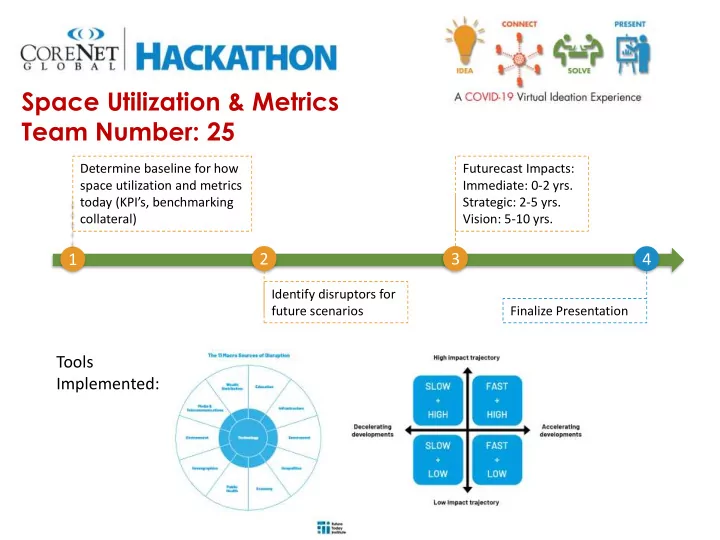
Space Utilization & Metrics Team Number: 25 Determine baseline for how Futurecast Impacts: space utilization and metrics Immediate: 0-2 yrs. today (KPIs, benchmarking Strategic: 2-5 yrs. collateral) Vision: 5-10 yrs. 1 2 3 4
Remote learning lowers the barrier of entry for college (more prolific + educated workforce) G5 revolutionizes speed and access and changes data consumption Chief Safety Officer / Industrial Hygienist for
3) Increased regulations creates a nationalist approach to growth Recession caused by C19 and oil crisis reduce severely operating budgets Distributed workforce now located in suburban offices, closer to universities. This could drive innovation, job opportunities for college interns/grad, reduced employment costs, etc. 1) Increase WFH demand more infrastructure (internet speeds, etc.) in suburban locations. Technology has to reconsider new security protocols and sol’ns. Social distancing measures incorporated into Code requirements? Temporary or long term? 3) Global labor pool 1) Distributed workforce
markets for labor arbitrage and financial savings – with global HR implications. 2) 5G allows for teleportation and enhance communications Data Privacy legislation develops new issues in the world 2+3) Best for all is best for one, or best for one is best for all – cultural differences IP privacy concerns – how to protect in a virtual world? SEC compliance? Infectious Disease inspectors as part of the building process – construction environment
4) Pandemic mitigation considerations influence code regulation for space,
Longer life spans change retirement models Reduced travel and manufacturing stabilizes global warming Peer pressure forces behaviors (masks, social distancing) 5) Economic drivers (technology access) create 2 classes of citizens (have and have nots) 5) WFH requires employers to re- evaluate HSE / ergonomic set-ups and funding solutions. Gender specific solutions – restrooms? (India, Middle East) Health cost plummet due to sustainable environmental solutions + employee effectiveness Naming and shaming companies who are not doing the right thing Hygiene chain of custody – use blockchain for connecters – Chinese QR code 4) Social rating for companies practices
(Glassdoor)
Organizations gain access to but fail to get the most
No backbone to support deep connection between employees or to ensure companies get what they need to effectively use workforce Workforce is ready to work yet they do not have the right tools to engage consequentially delivering limited results and leaving untapped potential on the table. Employees will have low engagement, resulting in limited results and productivity Employees need access to reliable technology and tools; the only space to attain it is in the office, thereby continuing the reliance on the workspace. Offices reliant on basic utilities (power, broadband, etc.) which the landlord is contractually not obligated to guarantee
Organizations benefit from larger labor pool and rapid technology advancement
Risk is distributed more evenly and org’s maintain a sustained level of business continuity Less sqft/person but investment in tertiary markets that are more competitive and less expensive help to offset Real estate portfolio compresses as WFH + tertiary labor pool increases Reimaging of the workplace occurs. Workplace could now be areas of collaboration, communication, and true expression of the company’s culture Companies find a way to express culture through technology for distributed workforces Emerging economies (even at a local scale) will jump technology generations during development IoT is critical as everything is interconnected. Teleportation, driverless technologies, new ways of communicating create demand for 5g+
Organizations lack workplace innovation and continue to firefight
Orgs will be very reactionary if a similar situation arises (will be like Feb
No innovation to the workplace Not using the expanses of technology to innovate the workplace Less diversification of risk due to local labor pools and central HQ’s. Continued reliance on size and scope of the workplace (RE Portfolio) Sqft per person has increased (social distancing) therefore higher real estate costs for organizations Less efficient use of real estate compared to pre-C19 metrics Health and Safety may continue to be a concern for employees/orgs Working protocols will change to accommodate Health & Safety
Organizations suffer from poor ROI and high localized risks
Org are not getting the full benefit of technology development Underutilized technology results in poor ROI High investment and low/no adoption to tech because there is no need yet Less diversification of risk due to localized labor pools (i.e. pockets of
Some breakout organizations using technology to its fullest results in economic winners and losers Sqft/person goes up. Cost of real estate gets higher and cost of technology goes up as well.
Rapid development
infrastructure Current infrastructure remains Local labor force is standard
C19 put most organizations into unchartered water and resulted in a high degree of reactive decision structures. Post C19, successful
compressing real estate and tapping into global, tertiary labor markets. They will put increased emphasis on the technologies that improve distributed work thereby fast-tracking innovations in
culture expression will evolve into the physical and digital workspace.
Globally distributed workforces are standard
Current State
Technology fights culture Current technology stays. Regionalization of technology advancements all driven by local forces – culture, identity. Less progress in feeling the world is “one place” to live and work. Local codes and unique issues suppress massive digitalization and global competence. Strong cultural identity but processes not supported by advanced technologies. Trade wars. Technology affects the removal of cultural differences 5G and other digital technologies drive the society into the future and connect us beyond mobile phones, driving AI to replace “ mobile” devices in the next 5
Sex, gender, religion, national original or geo place on globe would not matter. Physical presence not required for most jobs. AI brings backroom automation and sophistication. More gadgets. Universal competence and knowledge. Virtual prayer rooms or any other unique personal requirements. Technology adaptation is delayed due to cultural difference locally or globally Societies where remote work is not allowed or supported make small changes towards acceptance. Policies dictating Who What When and Where are a
new positions managing this process. Some companies could be scrambling to solve urgent security, data, and collaboration issues related to remote work without much preparation leaving them vulnerable to security risks as well as unnecessary inefficiencies in the companies workflow Technology leaves room for cultural differentiators Organizations and businesses will demonstrate greater flexibility to support a broader range of work situations and scenarios for their employees; i.e. companies that formerly had a strict 'in-person' workplace culture might ease up on their requirements and allow employees the flexibility to work from home, when the need arises. Likely see shifts in attitudes and workplace culture that will ultimately result in organizations being more flexible and accommodating of different work styles.
Sweeping digitalization across globe Current state of Technology Culture rules the way world responds to changes Cultural issues stay as is
5G/ Teleportation and cultural influences The COVID-19 pandemic has forced people and businesses to adapt to remote working and related technology regardless of the level of their preparedness. While we might have expected
processes, and routines to evolve
directly in the deep end. Companies will be forced to make enhancements in their technology platforms including 5G, virtual calls, and Teleportation. Cultural differences might be gradually removed with the technology acceleration and adaptation; or, because of cultural uniqueness, technology won’t be implemented at the same level throughout the world.
Current State
Technology supportive of ad-hoc mobility Robust technology infrastructure to provide widespread mobility
number of ppl invited/joining per meeting, tools used in meeting (digital whiteboard, PowerPoint, etc.) Digital tools developed Digital collaboration tools enhanced – DocuSign and other digital authority and approval tools Office provides a place to create culture, work relationships and trust – HR Tools to develop culture and trust need to be re-evaluated for a predominantly virtual work environment (KPI: Work survey?) KPI: Utilization based on community. Challenge is how we get together without being together. Productivity metrics a mixture of performance and presenteeism Productivity metrics based on digital connectivity (Wi-Fi, home office set up) and performance, and impact on team and culture Global Workforce with poor technology infrastructure Poor infrastructure will leave some markets less developed with lower economic
workforce Technology that supports the physical space – utilization, dashboards Enhanced Technology that supports the virtual space – teleporting, virtual reality, AI for capacity analysis and exposure tracking; AI for back office operations (KPI: % meetings in person vs digital (# of meeting room seats occupied) Employee Handbook “Cultural Ambassadors” positions and virtual playbooks Communications “Siri” translators in all languages
Directed Uniformity
Offices uniformly adjust to OSHA and legal requirements on healthy workplaces, leading to across-the board, “sticky” changes to office design Regulatory reporting and spacing requirements drive up office costs and space Smaller companies may struggle with meeting standards Activists push for more extensive regulation coupled with social policy, leading to higher taxes
Extensive Adjustment
State sets minimal, “sticky” standards w/ higher costs and reporting, but less onerous than Quadrant 1 Activist pressure pushes high-profile companies above-and-beyond as a brand differentiator Growth of wellness certification schemes Companies meet minimal guidelines, with uneven efforts to maintain social distancing or other redesigns over time; large-scale reversion to business-as-usual Governments may pass on cost of social regulation through higher taxes but will leave office regulation as-is, esp. in conservative states
Ad hoc
Larger, consumer-facing companies targeted by activists, experiment with solutions Growth of wellness certification schemes Smaller businesses face uneven pressure for change and exemption from most guidelines, but may act based on social pressure Generic or less visible businesses may make minimal changes based on guidelines New NGOs or expanded NGO mandates to focus on health as part of CSR
Tiered Response with Experimentation
Society looks to Govt
“Pandemic-Proofing” Requirements Recommendations, not Regulations
Pandemic Considerations vs Social Rating:
Since the pandemic, both governments and civil society have been trying to grapple with who should be responsible for responding to the pandemic. Companies will demand flexibility and recommendations rather than risk legal liability and burdensome requirements. Activists will be trying to determine whether to focus
social and economic policies,
corporations to act. We believe both groups will take a mixed approach but that which group is given responsibility will shape (a) the cost and (b) uniformity of responses.
Society looks to Business
Health and Wellness Certification is starting to catch on in big companies to attract talent, but strictly optional Health and Wellness Certification gains added weight, may add more categories/measures (e.g. optimal humidity and temp. to reduce viral transmission, space between persons), may become more important than other certifications Health and safety regulation does not center space per person Regulatory definitions expand and regulatory authority may extend to new agencies Emergency response systems not primarily concerned with viral transmission Viral training and response systems implemented, new capabilities for contact tracing rolled
Employee satisfaction surveys ask general questions about wellness programs More pointed questions about health in surveys; possible expansion to annual reporting Employees felt safe coming to the office – no metric needed Public sentiment will need thresholds to define psychological comfort with coming back to the office (Transit solutions, policies to contain transmission, PPE, Vaccine, etc.) KPI: Environmental Metrics: Temp, Co2, IAQ, Humidity, etc Space Syntax (“Urban planning” metrics). Metrics that score safety like “Walkability”, average distance between sanitation zones, “number of hand sanitations by location” (like water bottles saved from fountains), Facility Managers focused on standard office provisions New parameters inclusive of building policy, social distancing enforcement, business continuity Architectural planning models with high density New metrics and planning focus on communal space vs. individual space
Political instability Increased health risk + poor work / life integration WFH – eliminated from a significant portion of the labor pool Increase wealth distribution extremes Targeted Growth + Development Better public health and work / life integration Targeted company infrastructure Supply Chain Regionalizes Higher exposure / risks for 2nd wave Less progress in growth / innovation Increased health risk + poor work / life integration Slower Growth and Development More competitive global landscape Diverse supply chain Better public health and work / life integration Targeted Country infrastructure Widespread Growth + Development
High WFH Support Low Wealth Disparity: Blended Citizens High Wealth Disparity: Have vs. Have Nots Public Health Impacts vs. Wealth Disparity:
The wealth disparity is currently very great. The country’s wealth divide also impacts how it can provide infrastructure and tools to work remotely, which in turn impacts companies ability to harness technology and new work solutions. As we move forward, we believe the focus will be on more WFH / Remote solutions, but how far down the rabbit hole will this go? Will we start looking at a remote worker with global considerations like India or Bali? Or a more Regional approach like Austin?
Low WFH Support
Current State
Traditional office infrastructure % of organization / employees who have remote tools and satisfaction rates for:
Productivity measurement based on presenteeism Productivity measurement based on digital footprint (MS Analytics), performance based Cultural Metrics (Best Places to Work or other HR surveys) Cultural Metrics do not change, but which areas of focus in the questionnaire will be revised / evaluated (Best Places to Work or other HR surveys) CRE Economic Indicators (Sq. Ft., Rent costs per person or per seat) CRE Economic Indicators (Sq. Ft., Rent costs per person or per seat), however less focus than previously because it will be much smaller No tracking of ESG metrics ESG rating by Bloomberg or Dow Jones Index Personal information protected by HIPPA Regulations Personal data potentially shared for exposure tracking, liability for exposure to virus?