Solving a problem: scandir and Unix ls Access all the entries in a - - PowerPoint PPT Presentation

solving a problem scandir and unix ls
SMART_READER_LITE
LIVE PREVIEW

Solving a problem: scandir and Unix ls Access all the entries in a - - PowerPoint PPT Presentation

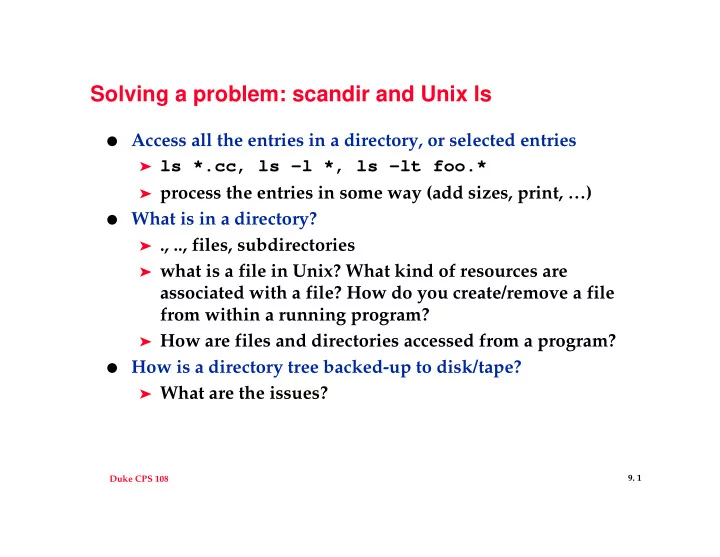
Solving a problem: scandir and Unix ls Access all the entries in a directory, or selected entries ls *.cc, ls -l *, ls -lt foo.* process the entries in some way (add sizes, print, ) What is in a directory? ., .., files,


slide-1
SLIDE 1

Duke CPS 108

  • 9. 1

Solving a problem: scandir and Unix ls

  • Access all the entries in a directory, or selected entries

➤ ls *.cc, ls -l *, ls -lt foo.* ➤ process the entries in some way (add sizes, print, …)

  • What is in a directory?

➤ ., .., files, subdirectories ➤ what is a file in Unix? What kind of resources are

associated with a file? How do you create/remove a file from within a running program?

➤ How are files and directories accessed from a program?

  • How is a directory tree backed-up to disk/tape?

➤ What are the issues?

slide-2
SLIDE 2

Duke CPS 108

  • 9. 2

Solving another problem: search for words

  • Web-based search engines

➤ Search for “Titanic” + “Linux” in Alta vista

  • File-based search engines

➤ What’s the file that has the reference to “elephants”?

  • What are the issues in the searches?

➤ User’s perspective ➤ Programmer’s perspective

  • What about approximate matches

➤ search for “pincake” or “pancake” or “pancakes” or … ➤ are approximate/fuzzy matches a good idea?

slide-3
SLIDE 3

Duke CPS 108

  • 9. 3

Coping with transferable ownership

  • Factory creates a class, who deletes it?

Foo * f = FooFactory::makeFoo(); f->doFooStuff(); delete f;

➤ Why might this be a problem? What are alternatives?

  • Instead of using a Foo pointer, use a proxy, a class that stands

in for a Foo pointer

➤ looks like a Foo pointer, acts like a Foo pointer, but cleans

up after itself (SmartStrings in sortall/cps 100): heap vs. stack allocation

FooProxy f(FooFactory::makeFoo()); f->doFooStuff();

slide-4
SLIDE 4

Duke CPS 108

  • 9. 4

Program parameters and errors

  • What are alternatives to large if/else chains to process argc and

argv?

➤ What are argc/argv used for? ➤ What helper functions cope with arg parsing? ➤ What’s wrong with if (argv[k] == “-f”) ➤ Other options to getting info into program

  • How do you signal an error condition?

➤ Files don’t open, times (wag) out of order, … ➤ cerr << ➤ other alternatives?