Soils Soils How much soil is there? Pretend that this apple is the - - PowerPoint PPT Presentation

soils soils
SMART_READER_LITE
LIVE PREVIEW

Soils Soils How much soil is there? Pretend that this apple is the - - PowerPoint PPT Presentation

Soils Soils How much soil is there? Pretend that this apple is the planet Earth, round, beautiful, and full of good things. Notice its skin, hugging and protecting the surface.Water covers approximately 75% of the surface. Right away, cut the


slide-1
SLIDE 1

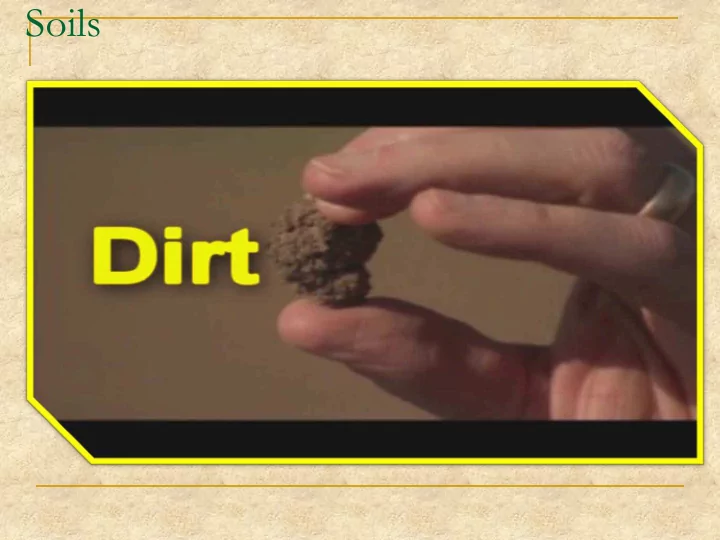
Soils

slide-2
SLIDE 2

How much soil is there?

Pretend that this apple is the planet Earth, round, beautiful, and full of good things. Notice its skin, hugging and protecting the surface.Water covers approximately 75% of the surface.

Right away, cut the apple in quarters. Toss three quarters (75%) away.

Soils

slide-3
SLIDE 3

How much soil is there?

The three quarters (75%) you just removed represents how much of the earth is covered with water - oceans, lakes, rivers, streams. What is left (25%) represents the dry land. 50% of that dry land is desert, polar, or mountainous regions where it is too hot, too cold or too high to be productive.

So cut that dry land quarter in half and toss one piece away.

Soils

slide-4
SLIDE 4

How much soil is there?

When 50% is removed, this is what is left. (12.5% of the original) Of that 12.5%, 40% is severely limited by terrain, fertility or excessive rainfall. It is too rocky, steep, shallow, poor or too wet to support food production.

Cut that 40% portion away.

Soils

slide-5
SLIDE 5

How much soil is there?

You are left with approximately 10% of the apple.

Peel the skin from the tiny remaining sliver.

Soils

slide-6
SLIDE 6

How much soil is there?

The remaining 10% (approximately)- this small fragment of the land area - represents the soil we depend on for the world's food supply. This fragment competes with all other needs - housing, cities, schools, hospitals, shopping centers, land fills, etc., etc. And, sometimes, it doesn't win.

Soils

slide-7
SLIDE 7

Soils

  • A. Define soil: product of nature having both depth and surface area,

resulting from both DESTRUCTIVE and SYNTHETIC forces. Weathering & microbial decay of organic matter are examples of DESTRUCTIVE forces, while the formation of NEW minerals & the development of different layers are synthetic forces at work.

slide-8
SLIDE 8

Soils

5 tons of topsoil spread over an acre is only as thick as a dime.

5 – 10 tons of animal life can live in an acre of soil.

Natural processes can take 500 years to form 1 inch of topsoil.

slide-9
SLIDE 9

Soils

slide-10
SLIDE 10
  • 1. Physical Weathering

Soils: B. Types of Weathering

slide-11
SLIDE 11
  • 2. Chemical Weathering

 CO2 + H2O = Carbonic Acid  This mild acid etches the surface

  • f rock gradually weathering it

away.

Soils: B. Types of Weathering

slide-12
SLIDE 12
  • 3. Biological Weathering

Roots

Soils: B. Types of Weathering

slide-13
SLIDE 13
  • 3. Biological Weathering

Lichens

Soils: B. Types of Weathering

slide-14
SLIDE 14

"The threat of nuclear weapons and man's ability to destroy the environment are really alarming. And yet there are other almost imperceptible changes - I am thinking of the exhaustion of our natural resources, and especially of soil erosion - and these are perhaps more dangerous still, because once we begin to feel their repercussions it will be too late." (p144 of The Dalai Lama's Little Book of Inner Peace: 2002, Element Books, London)

Soils: C. Erosion

slide-15
SLIDE 15
  • 1. Water

The rain drop on impact with the soil throws small particles into the air. Flowing water then picks these soil particles up and carries them away.

Soils: C. Erosion

slide-16
SLIDE 16
  • 1. Water

An unprotected crop field severely eroded after a rain storm. Much of the good top soil has washed to the bottom of the field. Other amounts have washed down into an adjacent stream.

Soils: C. Erosion

slide-17
SLIDE 17
  • 2. Wind

With wind erosion, dry soil particles are dislodged by other blowing soil particles. The 1930's photo depicts a town soon to be enveloped by a giant dust storm.

Soils: C. Erosion

slide-18
SLIDE 18
  • 2. Wind

With wind erosion, dry soil particles are dislodged by other blowing soil particles. The 1930's photo depicts a town soon to be enveloped by a giant dust storm.

Soils: C. Erosion

slide-19
SLIDE 19
  • 3. Ice

Large rock being moved by an Alpine glacier. The figure on the right is almost 6 feet tall

Soils: C. Erosion

slide-20
SLIDE 20
  • 3. Ice

Soils: C. Erosion

slide-21
SLIDE 21
  • 3. Ice

Soils: C. Erosion

slide-22
SLIDE 22
  • 1. Mineral: 44% - 49%
  • 2. Organic: 1% - 6%
  • 3. Soil Water: 25%
  • 4. Soil Air: 25%

Soils: D. Soil Components by Volume

___% pore ___ % solid

50 50

slide-23
SLIDE 23

Relative Size Comparison of Soil Particles

Soils: E. Classification by Particle Size

slide-24
SLIDE 24

Relative Size Comparison of Soil Particles

Barrel Sand (feels gritty) (2.00 - 0.05 mm, USDA) (2.00 - 0.02 mm, ISSS) Plate Silt (feels floury) (0.05 - 0.002 mm, USDA) (0.02 - 0.002 mm, ISSS) Coin Clay (feels sticky) (< 0.002 mm, USDA) (< 0.002 mm, ISSS)

Soils: E. Classification by Particle Size

slide-25
SLIDE 25

Soil Components

How Soil Particle Size and Surface Area Affect water holding capacity.

Soils: E. Classification by Particle Size

slide-26
SLIDE 26

Soils: E. Classification by Particle Size

slide-27
SLIDE 27

Component H2O Holding Capacity Aeration Fertility

Sand Silt Clay

Physical Nature of soil separates.

Low None Poor High Low Good None High Excellent

Soils: F. Physical Nature of Soil Separates

slide-28
SLIDE 28

Soils: G. Soil Texture

Define: The percentage of sand, silt and clay that a soil consists of.

  • H. Define Loam Soil:

Approximately equal amounts of sand, silt and clay.

slide-29
SLIDE 29

Soils

slide-30
SLIDE 30

Soils: I. Soil Solution

Define: The liquid phase of soil & the dissolved solutes that are in it.

  • J. Soil Air:

The gaseous phase of soil. The relative mixtures of O2, N2, and CO2

slide-31
SLIDE 31

Soils: K. Soil pH

  • 1. Define pH:

degree of acidity or alkalinity.

Increased acidity (High H+ concentrations) Increased alkalinity (Low H+ concentrations) 7.0

Range of pH for soils common in Arid regions (S.W. Deserts) Range of pH for soils common in Humid regions (typical Midwest & East Coast) Extreme pH for acid peat soils (as in Peat Bog) Attained only by alkali mineral soils (Utah Salt Flats, Nevada)

0 1 2 3 4 5 6 7 8 9 10 11 12 13 14

slide-32
SLIDE 32

Soils: K. Soil pH

  • 2. pH Scale
slide-33
SLIDE 33

Soils: K. Soil pH

  • 3. Humus

The dark residue remaining after the complete decomposition of organic matter.

slide-34
SLIDE 34

Soils: K. Soil pH

  • 4. Why is soil pH so important?
  • a. Soil pH & nutrient uptake

Clay or Humus Particle (-)

Na+ Mg+ Ca+ Fe+ K+ NH3

+

Cations from particles exchange with cations in soil solution.

Ion exchange Ion exchange

Roots pickup cations from soil solution.

  • Nutrient uptake and microbial activity depends on soil pH.
slide-35
SLIDE 35

Soils: K. Soil pH

  • 4. pH Scale

b. What is the ideal pH for microbial activity and nutrient availability and uptake?

slide-36
SLIDE 36

Soils: K. Soil pH

Plant adaptation to acid soil

slide-37
SLIDE 37

Soils: II. Soil Problems

  • A. Acid Soils
  • 1. Define: excessive amts. Of hydrogen ions [H+] that interfere

with normal plant growth & development.

  • 2. Amendments used to cure acid condition.

Limestone

CaCO3 + H+ CO2 + H2O + Ca++ CaCO3●MgCO3+ H+ CO2 + H2O + Ca+++ Mg++

(Dolomite)

To Raise Soil One Unit of pH

Hydrated Lime Dolomite Ground Limestone

Light Soil 100 sq. ft 11/2 pounds 2 pounds 2 1/2 pounds Heavy Soil 100 sq. ft. 3 1/2 pounds 5 1/2 pounds 6 pounds

slide-38
SLIDE 38

Soils: II. Soil Problems

  • B. Saline soil
  • 2. Sources of salt:

a. Evaporation of water. b. Geological deposits of salt.

  • 3. Remedies for saline soils:

a. Use higher quality water. b. Deep water (flush). c. Deep plow. d. Grow salt tolerant crops; like alfalfa & cotton.

  • 1. Define: contains excessive amts. of water soluble

salts that interfere with normal plant growth & development.

slide-39
SLIDE 39

Soils: II. Soil Problems

  • C. Alkali soils
  • 1. Define: Excessive amounts of Na (sodium) that interfere with plant

growth and development.

  • 2. Remedies for alkali soil:
  • a. Soil sulfur
  • r
  • b. Gypsum (CaSO4)

Soil sulfur. To Lower Soil One Unit of pH

Soil Sulfur Ammonium Sulphate Iron Sulphate

Light Soil 100 sq. ft 1/2 pounds 2 1/2 pounds 3 pounds Heavy Soil 100 sq. ft. 2 pounds 6 1/2 pounds 7 1/2 pounds

slide-40
SLIDE 40

Soils: II Soil Problems

  • D. Caliche or hardpan
  • 1. Limestone fused with gravel and rock by evaporation of water.
  • 2. Characteristic of soils south of the Mogollon Rim.
  • 3. Impenetrable to roots.
slide-41
SLIDE 41

Soils: III. Cryptobiotic Soil

  • A. What is cryptobiotic soil?
  • 1. Means “hidden life”.
  • 2. Crust on the surface of the soil that consists of numerous

microbe species. Scabby crust common in the Sonoran Desert.

slide-42
SLIDE 42

Soils: III. Cryptobiotic Soil

  • B. Importance of cryptobiotic soil.
  • 1. Increases fertility.
  • 2. Slows runoff of rain (increases soil moisture and stabilizes the soil.
  • 3. Protects against erosion.
  • 4. Affects abundance, diversity, and health of plant species.
slide-43
SLIDE 43

Soils: III. Cryptobiotic Soil

  • C. How are human’s activities negatively affecting

cryptobiotic crusts?

  • 1. People, cattle, and vehicles crush the crust.
  • 2. Squashed crust produces less nitrogen and

carbon.

slide-44
SLIDE 44

Soils: III. Cryptobiotic Soil

  • D. How can we manage cryptobiotic soil?
  • 1. Drive only on developed roads & jeep trails.
  • 2. Hike on established trails.
  • 3. Camp in a minimized zone of impact.
slide-45
SLIDE 45

Soils: III. Cryptobiotic Soil

slide-46
SLIDE 46

Soils: IV. Compost Making

  • A. Compost Pile
slide-47
SLIDE 47

Soils: IV. Compost Making

  • B. Worm Composting