
SLIDE 1
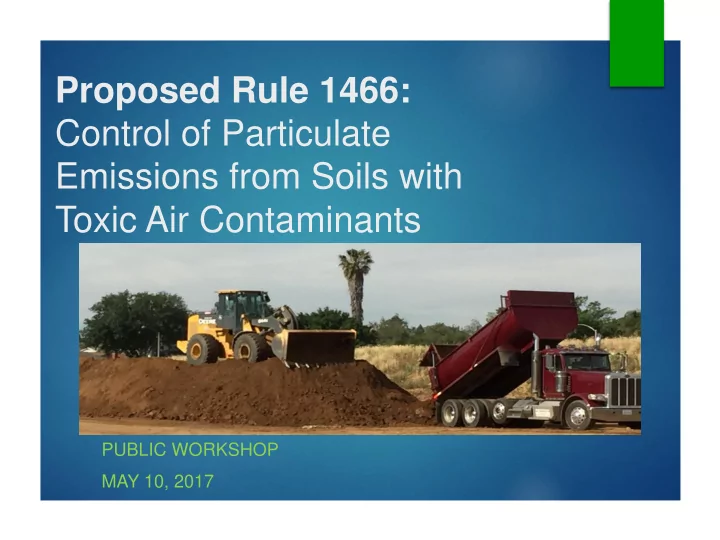
Proposed Rule 1466: Control of Particulate Emissions from Soils with Toxic Air Contaminants
PUBLIC WORKSHOP MAY 10, 2017
Control of Particulate Emissions from Soils with Toxic Air - - PowerPoint PPT Presentation
Proposed Rule 1466: Control of Particulate Emissions from Soils with Toxic Air Contaminants PUBLIC WORKSHOP MAY 10, 2017 2 Background Soils with toxic air contaminants can become airborne during excavation, grading, stockpiling, removal,
PUBLIC WORKSHOP MAY 10, 2017
Soils with toxic air contaminants can become airborne during
SCAQMD’s existing regulatory structure addresses:
Volatile organic compound contaminated soil (Rule 1166) Toxic emissions from equipment used for on-site remediation
Fugitive dust (Rule 403) Public nuisance (Rule 402)
Currently, existing regulatory structure does not address
Establish basic requirements to minimize offsite fugitive dust
Provides additional health protection from toxic particulate
Requirements intended to be incorporated in other agencies’
Approach does not preclude a cleanup agency from imposing
PR 1466 fills gap in existing regulatory structure
Applies to an owner or operator conducting earth-moving activities
Only sites that have been identified to contain arsenic, asbestos,
U.S. Environmental Protection Agency as a Superfund National Priorities List
site;
Department of Toxic Substances Control as Brownfield or Cleanup Program
site;
State Water Resources Control Board or Regional Water Quality Board as a
Site Cleanup Program site; or
SCAQMD Executive Officer
Owner or operator must conduct continuous near real-time
If the ambient PM10 contribution exceeds 25 µg/m3 averaged
Cease earth-moving activities Apply dust suppressant to fugitive dust sources or implement other
Can resume earth-moving activities when PM10 concentration
Method must be a federally equivalent PM10
Monitor Requirements
A minimum of one upwind and one downwind monitor
Upwind monitor(s) must be indicative of background PM10
levels and not generally influenced by fugitive dust sources from the site
Downwind monitor(s) must be placed in the predominant wind
direction downwind of any earth-moving activity and as close to the property line as feasible
Requires data acquisition system capable of logging near
predominant wind direction earth-moving activities X upwind monitor X downwind monitor
The PM10 concentration is the difference between the hourly
Hourly average PM10 concentration starts at the top of each hour If there is more than one upwind monitor, the upwind hourly average
If there is more than one downwind monitor, the downwind hourly
The owner or operator may use a different calculation
Upwind Monitor 1 = 68 µg/m3 Upwind Monitor 2 = 72 µg/m3 Downwind Monitor 1 = 83 µg/m3 Max Downwind Downwind Monitor 2 = 77 µg/m3 Downwind Monitor 3 = 81 µg/m3
83 µg/m3 – 70 µg/m3 = 13 µg/m3
Surround perimeter with fencing and windscreens
Fencing must be a minimum of 6 feet tall and at least as tall as the
Windscreen must have a porosity of 50%
While conducting earth-moving activities:
Adequately wet to the depth of earth-moving activity and allow time
Adequately wet at frequencies to prevent the generation of visible
Stop all operations if average wind speed exceeds 15 mph or
Must have completed AQMD Fugitive Dust Control Class Must be asbestos trained, if asbestos is contaminant of concern
Speed Limit = 15 mph Stabilize all surfaces used for vehicular traffic and parking Clean trucks, trailers, and tires prior to leaving site Track-out shall not extend beyond 25 feet of the property line
Remove track-out daily using a vacuum equipped with a filter
Employ at least one vehicle egress measure:
Install a pad consisting of washed gravel Pave the surface Utilize a wheel shaker/wheel spreading device Install and utilize a wheel washing system
Segregate contaminated stockpiles from non-contaminated stockpiles
Label contaminated stockpiles “SCAQMD Rule 1466 Contaminated Soil”
Stockpiles must not have steep sides or faces beyond the angle of repose Stockpiles must not exceed 400 cubic yards or height of perimeter fencing
Apply dust suppressant to stockpiles Completely cover stockpile with 10 mL thick plastic sheeting which overlap
Inspect covered/stabilized stockpiles daily and repair cover or re-stabilize
Loading and unloading TAC-contaminated materials
Water or stabilize material prior to moving Empty loader bucket slowly so that no dust plumes are generated Minimize drop height from loader bucket
Maintain at least six inches of
Truck and trailer shall be
Immediately placed in sealed containers; Directly loaded into trucks and hauled off site; Stockpiled in a fenced and locked area
At least 72 hours and no more than 30 days prior to conducting any
Notification must include
Owner or operator and onsite dust control supervisor information Project name and identification number from designating agency Project location Identify if site is a school or early education center Map of site which indicates locations of earth-moving activities and
concentrations of applicable toxic air contaminants
Anticipated project start and end date Current and/or previous site operations and uses
Within 72 hours of exceedance of daily average limit, the owner or
Notification must include
Owner or operator and onsite dust control supervisor information Project name and identification number from designating agency Project location PM10 monitoring results, including date and time of
Exceedance(s) 12 hours before first exceedance 12 hours after last exceedance
Earth-moving activities occurring at the date and time of exceedance(s) Dust control measure(s) taken to mitigate fugitive dust
The owner or operator must install and maintain a sign in
Installed at all entrances and at intervals of 1,000 feet or less along the
property line or perimeter of the site, with a minimum of one along each side
Located between 6 and 8 feet above grade from the bottom of the sign Measures at least 48 inches wide by 48 inches tall Displays lettering at least 4 inches tall with text contrasting with the sign
background that states:
“THIS SITE CONTAINS SOILS THAT CONTAIN THE FOLLOWING CHEMICALS: [LIST APPLICABLE TOXIC AIR CONTAMINANTS] TO REPORT ANY DUST LEAVING THE SITE PLEASE CALL [FACILITY CONTACT] OR THE SOUTH COAST AIR QUALITY MANAGEMENT DISTRICT AT 1-800-CUT-SMOG”
Records must be maintained for at least three years and made
Maintain records of:
Covered stockpile inspections PM10 and wind monitoring results, including calibration records Earth-moving activities conducted and corresponding volume of
contaminated soil
Names and addresses of transporter and receiving facility of soils with
applicable toxic air contaminants and a copy of the shipping manifests
Complaints called in, including the name of complainant and contact
information, date and time, earth-moving activities occurring at the date and time, complaint, and action taken to mitigate the source of the complaint
PR 1466 includes the following exemptions:
Earth-moving activities of soils with applicable toxic air contaminants
Removal of soil for sampling purposes Notifications for operations conducted during emergency life-
The Executive Officer shall be notified no later than 48 hours following
such earth-moving activities.
Active operations conducted by essential service utilities to provide
The Executive Officer shall be notified no later than 48 hours following
such earth-moving activities.
Stakeholder Comment: Requesting additional provision that
Staff Response: Staff working with stakeholder to develop additional
Stakeholder Comment: Alternative provision needed to ensure
Staff Response: Staff is continuing to work with stakeholder to
California State Law adopted 1970 Purpose [CEQA Guidelines § 15002(a)]
Inform governmental decision-makers and public about potential significant effects of
projects
Identify ways to avoid or reduce adverse impacts Require feasible alternatives and mitigation measures to prevent significant
environmental damage
Disclose to the public why a project was approved
Applies to projects undertaken by a Public Agency such as SCAQMD adoption of
rules [CEQA Guidelines § 15002(b)]
Required to comply with CEQA when approving a project [CEQA Guidelines § 15002(d)] Required for discretionary approvals [CEQA Guidelines § 15002(i)]
Lead Agency = SCAQMD
Oversight and legal responsibility for appropriate CEQA document preparation,
circulation, response to comments, and approval/certification
PR 1466 is a project subject to CEQA Decision to prepare 30-day Draft Environmental Assessment (EA)
Equivalent to a Negative Declaration when no significant impacts identified No CEQA scoping meeting is required to be held Analysis of alternatives and mitigation measures not required Will contain project description (Chapter 1) and environmental checklist (Chapter 2) to
evaluate project’s impacts on 17 topic areas
Will be released for 30-day public review period from May 16, 2017 to June 15, 2017
Final EA
Will include responses to Draft EA comment letters and any necessary modifications to
Draft EA
Governing Board must certify Final EA