SLIDE 1
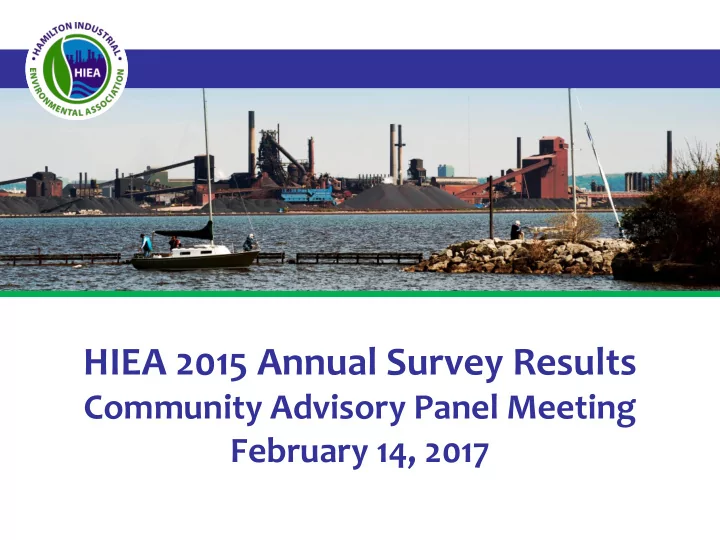
HIEA 2015 Annual Survey Results
Community Advisory Panel Meeting February 14, 2017
SLIDE 2
2016 Members
SLIDE 3 to improve the local environment – air, land and water – through joint and individual activities, and by partnering with the community to enhance future understanding
and help establish priorities for action
Mandate
SLIDE 4
- Employed 6,953 people
- Occupied almost 740 hectares of land
- Paid over $21.6 million in municipal taxes
In 2016 HIEA’s 12 member companies:
Overview
SLIDE 5
- Survey data has been reported since 1997
- Compares data to the base year – 1997 as well
as the trend over the most recent 5 years
- Survey results were reported separately prior
to 2011
- Streamlined reporting in 2013 and focused on
key parameters
Survey Overview
SLIDE 6 Air emission highlights relative to 1997 include:
- 44% reduction in Greenhouse Gases
- 75% reduction in Total Particulate Matter
- 41% reduction in Nitrogen Oxides
- 84% reduction in Polycyclic Aromatic
Hydrocarbons (PAH’s)
Air Emission Highlights
SLIDE 7 Water Discharge highlights relative to 1997 include:
- 46% reduction in Bay Water use
- 52% reduction in City Water use
- 96% reduction in Suspended Solids discharged
to the Harbour and over 77% reduction in Suspended Solids discharged to sanitary sewer for an overall 93% reduction.
Water Discharge Highlights
SLIDE 8 HIEA member companies have invested
- ver $243 million
- n environmental capital expenses
in the last 5 years an average of $49 million per year in environmental capital projects
Environmental Capital
SLIDE 9
Environmental Capital
Millions of dollars
5 year Cumulative Environmental Capital Spending
SLIDE 10
- Greenhouse gas emissions include carbon dioxide,
methane, nitrous oxide, hydrofluorocarbons, perfluorocarbons, and sulphur hexafluoride.
- Carbon dioxide is the most significant greenhouse
gas reported by HIEA member companies.
- Although there has been an increase in production in
the last few years, the total Greenhouse Gas emissions in 2015 are almost 44% below the 1997 levels with over an 11% decrease since 2011.
Greenhouse Gases
SLIDE 11
Greenhouse Gases (GHG)
Millions of tonnes/yr
SLIDE 12
- Total Particulate Matter (TPM) emissions are 75%
below those reported in 1997, and are almost 20% lower than those in 2011.
- Improved testing methods and better information
for PM10 and PM2.5 results in higher reported numbers of those parameters in 2009 versus 1997
- TPM emissions continue to show a reducing trend.
- Much of this drop can be attributed to a number of
initiatives implemented in the last few years.
Total Particulate Matter (TPM)
SLIDE 13
Total Particulate Matter (TPM)
Tonnes/yr
SLIDE 14
- Nitrogen oxides are precursors to ground level ozone.
- The main source of NOx is the combustion of fuels.
- HIEA member companies have reduced their NOx
emissions by 41% since 1997.
- Although production levels have generally increased
- ver the last 4 years and these emissions have
fluctuated, they continue to show a reducing trend.
Nitrogen Oxides (Nox)
SLIDE 15
Nitrogen Oxides (Nox)
Thousands of tonnes/yr
SLIDE 16
- Sulphur dioxides are a precursor to acid rain.
- SO2 emissions are almost 11% lower that those reported in 2011.
Total emissions remain 26% lower than 1997 levels.
- Changes or slowdowns in production that required different
fuel sources do result in higher sulphur dioxide emissions.
- Several options are being implemented to reduce these
emissions including switching to lower sulphur fuels and feedstocks and shutting down obsolete equipment.
- Future: Coke Oven Gas desulphurizing will remove the sulphur
before the gas is burned.
Sulphur Dioxides (SO2)
SLIDE 17
Sulphur Dioxides (SO2)
Thousands of tonnes/yr
SLIDE 18
- PAHs are a group of over 100 chemicals that are formed
during incomplete burning of coal, oil and gas and are usually found as a mixture containing two or more of these compounds.
- PAH emissions have been reduced by over 84% since 1997
and are 28% lower than 2011 levels.
- Reductions have been achieved primarily by improving
coke oven operations.
- The increase shown in 2014 is a result of updated source
testing that was conducted this year. Polycyclic Aromatic Hydrocarbons (PAH’s)
SLIDE 19
Polycyclic Aromatic Hydrocarbons (PAH’s) Tonnes/yr
SLIDE 20
- Hamilton Harbour water use has decreased by 46%
since 1997 and shows a declining trend over the past five years.
- A large portion of this water is used for non-contact
- cooling. This water circulates within equipment
without contacting a process and does not pick up contaminants other than heat.
- Hamilton Harbour water is also used for dust
control.
Hamilton Harbour Water Use
SLIDE 21
Hamilton Harbour Water Use
Millions m3/yr
SLIDE 22
- HIEA companies have reduced their city water
use by 52% since 1997.
- Although city water use has fluctuated over the
past five years it continues to remain at these lower levels.
City Water Use
SLIDE 23
City Water Use
Millions m3/yr
SLIDE 24
- TSS discharges have been reduced by 93% since 1997, with
55% of these reduced discharges going to a city wastewater treatment plant for further treatment.
- Over the past five years discharges continue to show an
- verall reducing trend through the implementation of
improved water recycle systems and shutdown of obsolete facilities.
- New water treatment capabilities added in 2011 and
commissioned in 2012 by HIEA member companies continue to reduce these discharges significantly.
Total Suspended Solids (TSS)
SLIDE 25 TSS in Process Water discharged to Harbour
- 45% of process waters discharged by HIEA member
companies were discharged directly to the harbour or to storm sewers
- There has been a 96% decrease in TSS discharge to the
Harbour since 1997.
- A large portion of this water is used for non-contact
cooling and circulates within equipment without contacting any processes and therefore does not pick up contaminants.
Total Suspended Solids (TSS)
SLIDE 26 TSS in Process Water discharged to Sanitary Sewer
- In 2015, 55% of process water discharged by HIEA member
companies were discharged to the Hamilton sanitary sewer system.
- There has been more than a 77% decrease in TSS discharge
to the Sanitary Sewer since 1997.
- Discharges to the sanitary sewer system are treated at the
Hamilton Sewage Treatment Plant before discharge to Hamilton Harbour and therefore the values below do not represent an actual discharge to the environment.
Total Suspended Solids (TSS)
SLIDE 27
Total Suspended Solids (TSS)
Tonnes/yr
SLIDE 28
- This category is comprised of waste streams sent to
landfill and/or off-site for treatment and/or destruction and includes subject waste, commercial/domestic waste and non-hazardous industrial waste.
- Total off-site disposal levels fluctuate as a result of
changes in year to year production and show an increasing trend overall.
- Total off-site disposal levels in 2015 show a 117%
increase over 1997. This increase is also due in part to the change in membership since 1997.
Off Site Disposal
SLIDE 29
- Hamilton is an important recycling centre and HIEA
companies are major participants.
- Waste is defined as material going to landfill. Recycled
and by-products are materials that are used as a feedstock by other companies.
- HIEA member companies purchase each others’
by-products providing each other with raw materials and feed stock to be recycled or manufactured into
Off Site Disposal
SLIDE 30
Off Site Disposal
SLIDE 31
Off Site Disposal
Thousands of Tonnes/yr
SLIDE 32
QUESTIONS?