Digital Twins Technology IDA Mechanical & IPU 17:00 17:05 - - PowerPoint PPT Presentation

digital twins technology ida mechanical ipu
SMART_READER_LITE
LIVE PREVIEW

Digital Twins Technology IDA Mechanical & IPU 17:00 17:05 - - PowerPoint PPT Presentation

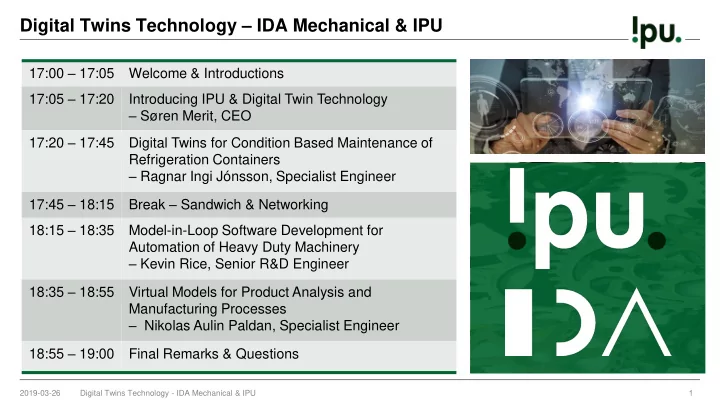
Digital Twins Technology IDA Mechanical & IPU 17:00 17:05 Welcome & Introductions 17:05 17:20 Introducing IPU & Digital Twin Technology Sren Merit, CEO 17:20 17:45 Digital Twins for Condition Based Maintenance of


slide-1
SLIDE 1

Digital Twins Technology – IDA Mechanical & IPU

2019-03-26 Digital Twins Technology - IDA Mechanical & IPU 1

17:00 – 17:05 Welcome & Introductions 17:05 – 17:20 Introducing IPU & Digital Twin Technology – Søren Merit, CEO 17:20 – 17:45 Digital Twins for Condition Based Maintenance of Refrigeration Containers – Ragnar Ingi Jónsson, Specialist Engineer 17:45 – 18:15 Break – Sandwich & Networking 18:15 – 18:35 Model-in-Loop Software Development for Automation of Heavy Duty Machinery – Kevin Rice, Senior R&D Engineer 18:35 – 18:55 Virtual Models for Product Analysis and Manufacturing Processes – Nikolas Aulin Paldan, Specialist Engineer 18:55 – 19:00 Final Remarks & Questions

slide-2
SLIDE 2

Introducing IPU & Digital Twin Technology

Søren Merit

CEO at IPU, Technology Driven Business Innovation, M.Sc., B.Com.

(+45) 40 90 46 30 sme@ipu.dk

slide-3
SLIDE 3

We are a spin-off of the Technical University of Denmark

70%

Technology development for industry

30%

Research projects

50%

  • f projects are we working

with DTU researchers

130

million DKK in donations supporting DTU research Started in

1956

by 4 DTU professors Independent commercial foundation Purpose to facilitate use of new technology in Danish industry

2019-03-26 Introducing IPU & Digital Twin Technology, Søren Merit, sme@ipu.dk

slide-4
SLIDE 4

We Develop Solutions to Complex Technology Challenges

We help our clients speed up development … and reduce technical risks … and manufacturing uncertainties

Discovery Basic Research Applied Research Product and Manufacturing Development Production

  • Technology Search
  • Proof of Concept
  • Feasibility Study
  • Test setup
  • Data analysis
  • Prototyping & development
  • Modelling & Simulations
  • Digital Twin
  • Specialists in multi-disciplinary product- and manufacturing technology development
  • Team of international specialists

2019-03-26 Introducing IPU & Digital Twin Technology, Søren Merit, sme@ipu.dk

slide-5
SLIDE 5

IPU Key Expertises

2019-03-26 Introducing IPU & Digital Twin Technology, Søren Merit, sme@ipu.dk 5

We can help you… developing and optimizing materials and surfaces processes for specific purposes, including analyzing problems and malfunctions. Our core strengths are metallic and polymer materials as well as electroplating and corrosion Materials Types and Choices Surface Treatment Corrosion and Wear Protection Software and simulation Modelling of Cooling Processes Energy Optimisation We can help you… analyzing thermodynamic and heat transfer processes and their components. We optimize system performance and efficiency using tailored simulation models and the latest R&D expertise. Digital twins Fault detection FEM analysis Machine learning We can help you… developing digital models of physical system in order to perform simulations in a fast and safe environment. We develop digital twins, perform big data analyses, decision algorithms (AI), machine learning and visual pattern recognition

Advanced materials and surfaces Thermodynamics and energy Physical systems modelling

Software & Algorithm Development Condition-Based Monitoring System Analysis We can help you… modelling, analyzing and developing complex autonomous systems, robotics and automation

  • f systems and processes.

Combining development of mechanical design and hardware with control systems and software

Autonomous systems and automation
slide-6
SLIDE 6

How We Work with Complex Systems

2019-03-26 Introducing IPU & Digital Twin Technology, Søren Merit, sme@ipu.dk 6

Understand physics Multi physics modelling Prototyping and tests Data analysis Machine Learning Understand business case and process

slide-7
SLIDE 7

We Develop Solutions to Complex Technology Challenges

2019-03-26 Introducing IPU & Digital Twin Technology, Søren Merit, sme@ipu.dk 7

IPU has developed a software solution

  • ffering predictive

maintenance and conditions-based fault detection of refrigerated containers enabling significant savings in costs related to physical inspection. IPU has developed an automation concept for the new ESO telescope, using a safe chemical cleaning process, that strips the mirror coating during planned maintenance, without altering the fragile mirror substrate. IPU has developed an autonomous systems solution for heavy duty construction machinery. IPU developed automation control system, retrofit hardware components, develop control software and operator user interface. Digital twin based hardware and software in the loop development

slide-8
SLIDE 8

Digital Twin Technology

slide-9
SLIDE 9

Welcome to the Most Hyped Technology!

Gartner’s Hype Cycle, August 2018

2019-03-26 Introducing IPU & Digital Twin Technology, Søren Merit, sme@ipu.dk

slide-10
SLIDE 10

What is a Digital Twin?

Digital model of the elements and dynamics of how a product, process or service operates

10

..applied in development ..and in operations

2019-03-26 Introducing IPU & Digital Twin Technology, Søren Merit, sme@ipu.dk

slide-11
SLIDE 11

What is Digital Twin?

Digital model of the elements and dynamics of how a product, process or service operates

11

Development Operations

  • CAD interacting with multi-

physical simulations

  • Developing and testing

software (Model-in-Loop)

  • Developing and testing

components (Hardware-in-loop)

  • Installation: Calibrating and

adjusting

  • Monitoring: Comparing

sensor data with simulation results

  • Optimizing: Adjusting

system for wear and external conditions

2019-03-26 Introducing IPU & Digital Twin Technology, Søren Merit, sme@ipu.dk

slide-12
SLIDE 12

Why use Digital Twins

12

Automotive Aerospace Benefits of digital twins

  • Faster insights – Fail fast succeed faster
  • Cheaper and faster tests
  • Feasible to explore extreme conditions
  • Understand dynamics better
  • Ability to predict and adjust – during operations
  • Faster update with minimal stops in operations

2019-03-26 Introducing IPU & Digital Twin Technology, Søren Merit, sme@ipu.dk

slide-13
SLIDE 13

Digital Twins for Condition-Based Maintenance of Refrigeration Containers

Ragnar Ingi Jónsson

Specialist Engineer at IPU, Physical System Modelling & Conditions-Based Monitoring, M.Sc., Ph.D.

(+45) 45 25 41 86 rij@ipu.dk

slide-14
SLIDE 14

Maersk Motivation & Goals

2019-03-26 Digital Twins for Condition-Based Maintenance of Refrigeration Containers, Ragnar Ingi Jónsson, rij@ipu.dk 14

  • Remote Container Management (RCM)
  • Connectivity and transparency – being in control
  • Improved customer experience – documentation
  • Monetary savings – maintenance and operation

How can we improve the efficiency of the reefer maintenance operations, cargo safety and energy consumption?

  • Vast funds spent on pre-trip inspections (PTI)
  • approx. US$ 750 yearly, per unit.
slide-15
SLIDE 15

Timeline & Overview

2019-03-26 Digital Twins for Condition-Based Maintenance of Refrigeration Containers, Ragnar Ingi Jónsson, rij@ipu.dk 15

  • 2010 IPU/Maersk collaboration on Reefer Alarm

Prediction System (RAPS/ePTI) of the RCM system

  • 2012 Agreement with Ericsson and AT&T for

hardware and data infrastructure.

  • Satellite communication installed on 400 vessels
  • Local GSM communication between container and

vessels

  • 2015 RCM system launch may 1st.
  • 2018 IPU to update RAPS/ePTI with new reefer

models, detections updates and other features.

slide-16
SLIDE 16

RAPS / ePTI – Step-by-Step

2019-03-26 Digital Twins for Condition-Based Maintenance of Refrigeration Containers, Ragnar Ingi Jónsson, rij@ipu.dk 16

1. Sensor readings are collected and saved on each reefer. 2. Reefer data is send to vessel via on-board local GSM or commercial GSM while in land 3. Satellite communication sends reefer data to head quarters 4. Individual reefer data is processed through simulation models and fault detection algorithms. 5. Alarms and warnings are reviewed and appropriate actions taken  service

  • rdered if needed.
slide-17
SLIDE 17

Reefer Models for Fault Detection

2019-03-26 Digital Twins for Condition-Based Maintenance of Refrigeration Containers, Ragnar Ingi Jónsson, rij@ipu.dk 17

  • Model requirements
  • Fast calculation models
  • Include all major properties
  • Basic refrigeration system
  • Heat uptake, heat release, power

consumption

  • High and low pressure parts
  • Internal temperatures
  • Other temperatures included

(ambient, cooling water, reefer, set point)

  • The general refrigeration system model
  • Refrigeration type determines, compressor type, whether there is e.g. internal heat exchange,

economizer etc.

slide-18
SLIDE 18

Fault Detection Algorithm Overview

2019-03-26 Digital Twins for Condition-Based Maintenance of Refrigeration Containers, Ragnar Ingi Jónsson, rij@ipu.dk 18

Normal operation Fault Normal operation Fault Model Residual (difference) Statistical Detection Threshold Comparison

Detection Threshold Normal Behavior Faulty Behavior

Detection Results measured data time stamp

  • perational data
  • ther…

measured data not used in model simulated values component-wise residual data setpoint ambient conditions cargo info etc.

Reefer Data

slide-19
SLIDE 19

Statistical Change Detection Overview

  • Statistical model of normal and faulty behavior, and

signal-to-noise ratio affects the detection time

  • Cumulative log-likelihood is typically used with a

cumulative threshold

2019-03-26 Digital Twins for Condition-Based Maintenance of Refrigeration Containers, Ragnar Ingi Jónsson, rij@ipu.dk 19

Normal operation Fault

15:00 18:00 21:00 00:00 03:00 06:00 09:00 12:00 15:00 18:00 21:00 00:00 20 40 60 80 100 120 140 160 180 200
  • Evap. decis.
Pdisc decis.

Normal operation Fault

slide-20
SLIDE 20

Statistical Change Detection Example

  • Reduced flow of air in evaporator

2019-03-26 Digital Twins for Condition-Based Maintenance of Refrigeration Containers, Ragnar Ingi Jónsson, rij@ipu.dk 20 Normal Fault Normal Fault Normal Fault

slide-21
SLIDE 21

IPU Deliveries & Results for Maersk

  • Backend computational core of the RAPS/ePTU systems, processing approximately 200.000

hourly updates providing alarms and warnings to monitoring systems.

  • Calibrated high performance models of all reefer refrigeration system and their variants
  • The majority of technical issues detected before cargo is affected ($), efficiency of the reefer

maintenance operations could be improved by over 40%

2019-03-26 Digital Twins for Condition-Based Maintenance of Refrigeration Containers, Ragnar Ingi Jónsson, rij@ipu.dk 21

ePTI which was developed in close coordination with IPU, has not only resulted in significant direct cost

  • reductions. ePTI also gives Maersk Line full cold chain transparency, improves and optimizes operational

processes and offers faster turn times benefiting our customers. All this whilst ensuring that the equipment we release for our customer is in fully cargo worthy condition suitable for transport of temperature sensitive cargo. We look forward to further develop the ePTI algorithm together with IPU to get the full benefits from the huge amount of data now made available through RCM. — Lars-Henrik Jensen, Operations Manager, Remote Container Management, Maersk Line

“ “

slide-22
SLIDE 22

Lessons Learned & Recommendations

  • Technical Recomentations
  • Exploit your physical understanding of the problem or data-set – especially when developing the digital

twin of refrigeration system.

  • Balance the amount of time used on cleaning up data and improving the detection algorithm.
  • Time is on your side, a longer timeline will limit false predictions.
  • Ensure constant alignment with the process – physical experiments are needed.
  • Organization and project alignment
  • Secure the easy wins first and build from there based on risk assessment, FMEA, experience.
  • Business case with Digital twin – ensure the efforts brings value to the organization.
  • Align with stakeholders and involve their knowledge, inputs and ideas if applicable.
  • It will most likely never be perfect, set reasonable goals.

2019-03-26 Digital Twins for Condition-Based Maintenance of Refrigeration Containers, Ragnar Ingi Jónsson, rij@ipu.dk 22

slide-23
SLIDE 23

Break – Sandwich & Networking

slide-24
SLIDE 24

Model-in-Loop Software Development for Automation of Heavy Duty Machinery

Kevin Rice

Senior R&D Egineer at IPU, Autonomous System, Mechatronics and Controls, M.Sc.

(+45) 29 93 47 93 ksr@ipu.dk

slide-25
SLIDE 25

Automation Project Overview (On-going & Confidential)

  • Costumer Owns and Operates Heavy-Duty Machinery
  • Task to develop automation solution to ensure high machine efficiency.

2019-03-26 Model-in-Loop Software Development for Automation of Heavy Duty Machinery, Kevin Rice, ksr@ipu.dk 25

Operator & GUI Automation Controller Construction Machine Sensor & Positioning Actuator Input System Data & User Input

Difficult to find skilled operators. Training takes time with high chance of new operators leaving.

  • Automation Controls

System Architecture

  • Retrofit Machine with

new Hardware

  • Automation software

and User Interface

slide-26
SLIDE 26

Software development with Digital Twin

2019-03-26 Model-in-Loop Software Development for Automation of Heavy Duty Machinery, Kevin Rice, ksr@ipu.dk 26

  • Large efforts on automation software
  • Adaptive/learning path planning depending on soil hardness.
  • Sensor algorithms – fusion techniques, global/local location,

redundant sensors for safety.

  • Safe-zone of operation – not damaging itself or surrounding
  • bjects.
  • Software complexity, and low availability of machine,

demands development with Digital Twin

  • Hardware-in-Loop (HiL)

development.

  • Model-in-Loop (MiL)

development.

slide-27
SLIDE 27

Developing the Digital Twin

2019-03-26 Model-in-Loop Software Development for Automation of Heavy Duty Machinery, Kevin Rice, ksr@ipu.dk 27

  • Digital Twin must represent the actual system through Cyber-Physical Modelling
  • Excavator dynamics / kinematics, hydraulic actuation system, sensor noise, …
  • Certain Components modelled in hardware – electronics of sensor, valve dynamics, …

[1] [2]

slide-28
SLIDE 28

Digital Twin and Physical System Mismatch

  • Digital Twin will deviate from physical system
  • Sufficient accuracy is obtained from system

understanding, engineering intuition and experience.

  • Digital Twin accuracy vs. Modelling Efforts vs.

Simulation Time should be considered

  • Digital model mismatch results in higher

software quality

  • Algorithms are implemented to support model and

physical system behavior.

  • Typically through calibration options, resulting in

software supporting variations (Manufacturing, mechanical wear, etc.)

2019-03-26 Model-in-Loop Software Development for Automation of Heavy Duty Machinery, Kevin Rice, ksr@ipu.dk 28

[3]

slide-29
SLIDE 29

Model-in-Loop Development Workflow

  • System and Integration testing is fast with MiL
  • development. Limiting time consuming physical

tests.

  • Continuous Integration testing with simulated
  • perating conditions, and failure modes.
  • High confidence in algorithms in other software

functionality.

2019-03-26 Model-in-Loop Software Development for Automation of Heavy Duty Machinery, Kevin Rice, ksr@ipu.dk 29

Requirements & Specifications System Design Architecture Design Module Design Implementation Functional & Unit Testing Integration Testing System Testing Acceptance Testing

Implementation Unit and functional testing System & integration testing

slide-30
SLIDE 30

Model-in-Loop Recommendation & Final Remarks

  • Fast development flow, and possible to development physical system in parallel with software.
  • Testing all operating modes, including failure modes, is fast with Digital twins and Simulation.

(Expensive and time consuming tests on physical system, safety issues, …)

  • Integration and system test should be performed on physical system in parallel with

development on digital twin. Software and control strategies will require online tuning

2019-03-26 Model-in-Loop Software Development for Automation of Heavy Duty Machinery, Kevin Rice, ksr@ipu.dk 30

Mechanical & Electronics Software Design Time – Traditional Development Mechanical & Electronics Software Design Smarter Products Time – Development with MiL

[1] H. Feng, C. B. Yin, W. Weng, W. Ma, J. Zhou, W. Jia & Z. Zhang, Mechanical Systems and Signal Processing, Volume 105, 15 May 2018, Pages 153-168 [2] T. O Andersen, Department of Energy Technology Lecture Notes, Aalborg University, 2nd Edition, 2003. [2] L. Schmidt, PhD Dissertation, Department of Energy Technology, Aalborg University, 2014
slide-31
SLIDE 31

Virtual Models for Product Analysis and Manufacturing Processes

Nikolas Aulin Paldan

Specialist Engineer at IPU, Integrated Product & Process Technology, M.Sc.

(+45) 45 25 46 16 nap@ipu.dk

slide-32
SLIDE 32

Topics

  • Background & Introduction
  • Virtual models for product analysis &

manufacturing processes

  • Example of Virtual Process Model
  • Summary

2019-03-26 Virtual Models for Product Analysis and Manufacturing Processes, Nikolas Aulin Paldan, nap@ipu.dk 32

slide-33
SLIDE 33

Background & Introduction I

  • At IPU for 15 years, Specialist engineer in Integrated Product & Process Technology
  • Background is in mechanical engineering for equipment and tooling.

2019-03-26 Virtual Models for Product Analysis and Manufacturing Processes, Nikolas Aulin Paldan, nap@ipu.dk 33

slide-34
SLIDE 34

Background & Introduction II

  • Heavy user of numerical tools to create virtual models of processes performed by machines

and tooling.

  • Many types of virtual models. Examples shown here will be focused on models for Finite

Element Analysis.

2019-03-26 Virtual Models for Product Analysis and Manufacturing Processes, Nikolas Aulin Paldan, nap@ipu.dk 34

Calculation of steady state tool temperature in a cyclic polymer welding process

slide-35
SLIDE 35

35

Virtual Models for Product Analysis & Manufacturing Processes

slide-36
SLIDE 36

Optimizing Manufacturing Processes Using Virtual Models

2019-03-26 Virtual Models for Product Analysis and Manufacturing Processes, Nikolas Aulin Paldan, nap@ipu.dk 36

Design of Process Equipment Process Optimization & Test Process Modelling

slide-37
SLIDE 37

Possibility to Speed-Up Development and Reducing Testing Efforts

2019-03-26 Virtual Models for Product Analysis and Manufacturing Processes, Nikolas Aulin Paldan, nap@ipu.dk 37

Design Verification Testing Less than 100% workload Virtual Design Verification testing

slide-38
SLIDE 38

38

Example of Virtual Process Model

slide-39
SLIDE 39
  • For IPU Use numerical models in many projects.
  • Due to confidentiality agreements IPU examples can not be shown…
  • Example from a totally different business area, in which they have fully embraced the use of

virtual models:

  • Reduced testing of spot-welds in Automotive manufacture
  • The optimization of the spot-welding process normally requires a lot of physical testing –

being able to do testing on virtual models has been widely adapted.

2019-03-26 Virtual Models for Product Analysis and Manufacturing Processes, Nikolas Aulin Paldan, nap@ipu.dk 39

slide-40
SLIDE 40

Spot-welding in Cars (Tesla Production Line)

2019-03-26 Virtual Models for Product Analysis and Manufacturing Processes, Nikolas Aulin Paldan, nap@ipu.dk 40

Youtube.com

slide-41
SLIDE 41
  • The following slides borrowed from the Company Swantec
  • Spin-out from DTU in 1999, software SORPAS for the simulation of resistance welding –

costumers

2019-03-26 Virtual Models for Product Analysis and Manufacturing Processes, Nikolas Aulin Paldan, nap@ipu.dk 41

slide-42
SLIDE 42

Material Challenges for Automotive Spotwelding Processes

  • Conventional steels - Relative simple to

spotweld

  • Mild steels
  • Interstitial free (IF) steels
  • Bake hardenable (BH) steels
  • High strength low alloy (HSLA) steels
  • Carbon Manganese (CMn) steels

2019-03-26 Virtual Models for Product Analysis and Manufacturing Processes, Nikolas Aulin Paldan, nap@ipu.dk 42

  • Advanced High strength steels (AHSS) -

Can be very difficult to spotweld

  • DP – Dual Phase
  • CP – Complex Phase
  • TRIP – (TRansformation Induced Plasticity)
  • Mart. – Martensite steel
  • TWIP – (Twinning Induced Plasticity)
  • 3rd Gen AHSS
slide-43
SLIDE 43

Principle of Resistance Welding Regarding Current

2019-03-26 Virtual Models for Product Analysis and Manufacturing Processes, Nikolas Aulin Paldan, nap@ipu.dk 43

dt t I t R t Q

t

   

2

) ( ) ( ) (

Joule heating:

slide-44
SLIDE 44

Principle of Resistance Welding Regarding Force

2019-03-26 Virtual Models for Product Analysis and Manufacturing Processes, Nikolas Aulin Paldan, nap@ipu.dk 44

(3) Weld

F I

(2) Squeeze

F F

(4) Hold (5)

slide-45
SLIDE 45

Weldability Lobe – Welding Process Window

2019-03-26 Virtual Models for Product Analysis and Manufacturing Processes, Nikolas Aulin Paldan, nap@ipu.dk 45

Welding current Force

Minimum weld size Acceptable weld size Expulsion Zone

Typical Nugget failures

slide-46
SLIDE 46

Importance of Welding Process Optimization

2019-03-26 Virtual Models for Product Analysis and Manufacturing Processes, Nikolas Aulin Paldan, nap@ipu.dk 46

Undersized weld Acceptable weld size Expulsion Zone

slide-47
SLIDE 47

Spot Welding - Three Sheets of Steel

2019-03-26 Virtual Models for Product Analysis and Manufacturing Processes, Nikolas Aulin Paldan, nap@ipu.dk 47

slide-48
SLIDE 48

Welding Process Optimization – Welding Ranges

  • Spot welding mild steel sheets

2019-03-26 Virtual Models for Product Analysis and Manufacturing Processes, Nikolas Aulin Paldan, nap@ipu.dk 48

Weld Growth Curve Weldability Lobe

slide-49
SLIDE 49

Weld Strength Testing and Failure Modes

2019-03-26 Virtual Models for Product Analysis and Manufacturing Processes, Nikolas Aulin Paldan, nap@ipu.dk 49

  • Weld strengths
  • Tensile shear strength
  • Cross tension strength
  • Peel strength
  • Failure modes
  • Plug (button) failure
  • Interface failure

Plug failure Interface failure

slide-50
SLIDE 50

Weld Strength Testing and Failure Modes

2019-03-26 Virtual Models for Product Analysis and Manufacturing Processes, Nikolas Aulin Paldan, nap@ipu.dk 50

  • Tensile-shear test – plug failure
slide-51
SLIDE 51

Weld Strength Testing and Failure Modes

2019-03-26 Virtual Models for Product Analysis and Manufacturing Processes, Nikolas Aulin Paldan, nap@ipu.dk 51

  • Weld strengths based on welding process simulation
  • Output weld strengths for structural and crash modeling
slide-52
SLIDE 52

Final Remarks & Questions

Nikolas Aulin Paldan Specialist Engineer (+45) 45 25 46 16 nap@ipu.dk Kevin Rice Senior R&D Engineer (+45) 29 93 47 93 ksr@ipu.dk Ragnar Ingi Jónsson Specialist Engineer (+45) 45 25 41 86 rij@ipu.dk Søren Merit CEO (+45) 40 90 46 30 sme@ipu.dk

… see more cases at ipu.dk