
SLIDE 1
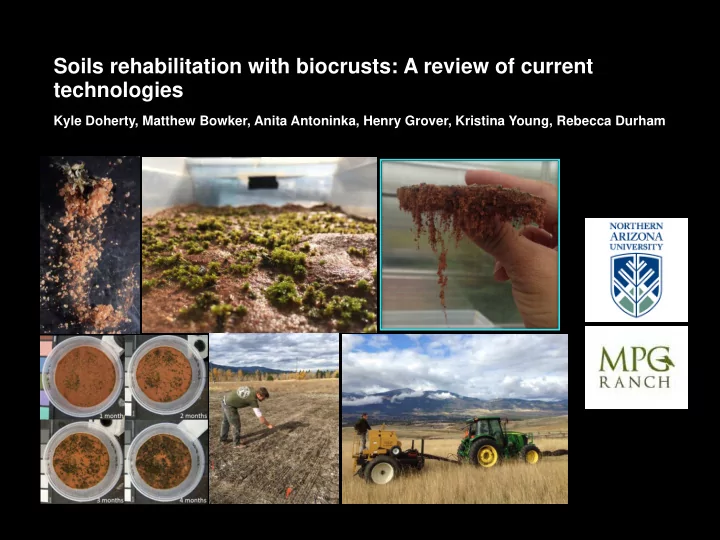
Soils rehabilitation with biocrusts: A review of current technologies
Kyle Doherty, Matthew Bowker, Anita Antoninka, Henry Grover, Kristina Young, Rebecca Durham
Soils rehabilitation with biocrusts: A review of current - - PowerPoint PPT Presentation
Soils rehabilitation with biocrusts: A review of current technologies Kyle Doherty, Matthew Bowker, Anita Antoninka, Henry Grover, Kristina Young, Rebecca Durham Roadmap Intro: What are biocrusts? Advances in propagation Hardening and
Soils rehabilitation with biocrusts: A review of current technologies
Kyle Doherty, Matthew Bowker, Anita Antoninka, Henry Grover, Kristina Young, Rebecca Durham
Biocrust!
Soil Stabilization
Carbon Nitrogen
…but I heard they grow slowly?
Forest and Rangeland Soil Ecology Lab Group School of Forestry
Forest and Rangeland Soil Ecology Lab Group School of Forestry
Doherty et al. 2015
THE BRYOTRON
Days per week hydrated 5 Populations Experiments with Syntrichia ruralis
Effect DF F-value p-value Population 4 7.9242 <0.0001 Hydration 3 29.5009 <0.0001 Interaction 12 2.2048 0.0244
ANOVA result
(5 month exp.)
Physiologically stressful watering Measured how many spritzes until yellowing? Pulse of mist Rapid drying <1hr Green cultivated moss Experiment performed by our technician Jeff Wright
Yes, differential acclimation/adaptation to watering stress Prior watering from first experiment had no effect!
Effect DF F-value p-value Population 4 8.5496 4.946E-06 *** Prior Watering 3 1.4229 0.2401 Interaction 12 1.1358 0.3394
2 years post-fire
Bryum argenteum Funaria hygrometrica Ceratodon purpureus
Potential applications: Burned Area Emergency Response (BAER)
Two Species Sandy or Organic Soils Ash, charcoal,
cul8vate diverse and func8onal biocrusts from most star8ng material
condi8ons vary depending upon the
Antoninka et al. 2015
Early on we established:
As with nursery plants, biocrust might need some help adap7ng from the luxurious greenhouse condi7ons to the harsh field condi7ons
4 watering treatments (2,3,4,5 days con=nuous hydra=on; from Antoninka et al. 2015) Hardening for 21 days:
water)
*Total cover-inoculum addi1on-cover in control plots
*Total cover-inoculum addi4on-cover in control plots
*Treatment slake-control slake
Bandelier National Monument
Photo by NPS
Photo by Craig Allen
October 2002
May 2015 Install plots and collect pre-treatment data July 2015 Added inoculum October 2015 1st post treatment data collec<on May 2016 2nd post-treatment data collec<on
We saw no biocrust growth 11 months a3er we applied inoculum We saw no increase in soil stability related to our treatments of flashing, slashing, and seeding We saw large seasonal changes in soil quality and stability unrelated to our treatments. This is a very dynamic system
Delivery mechanisms
Exploring effects on vascular plants
x y
10 20 30Predicted Richness
10 20 30Actual Richness
Modeling biocrust abundance and richness
Fogponics
materials mentality, mosses are plants too!
western US, please include them in management and funding strategies
Acknowledgements NAU Phillip Patterson Nancy Johnson Pete Chukran Jeff Wright Troy Wood UNLV Lloyd Stark
BLM Wayne Padgett Adrienne Pilmanis ASU Ferran Garcia-Pichel Ana Giraldo Sergio Velasco-Ayuso