Newell Highway Upgrade Project 28 km of Newell Highway Single - - PowerPoint PPT Presentation

newell highway upgrade project
SMART_READER_LITE
LIVE PREVIEW

Newell Highway Upgrade Project 28 km of Newell Highway Single - - PowerPoint PPT Presentation

Newell Highway Upgrade Project 28 km of Newell Highway Single carriageway, single lane in each direction Highest heavy vehicle traffic in NSW Black soil country Annual flood risk Regional Geology Scope of


slide-1
SLIDE 1

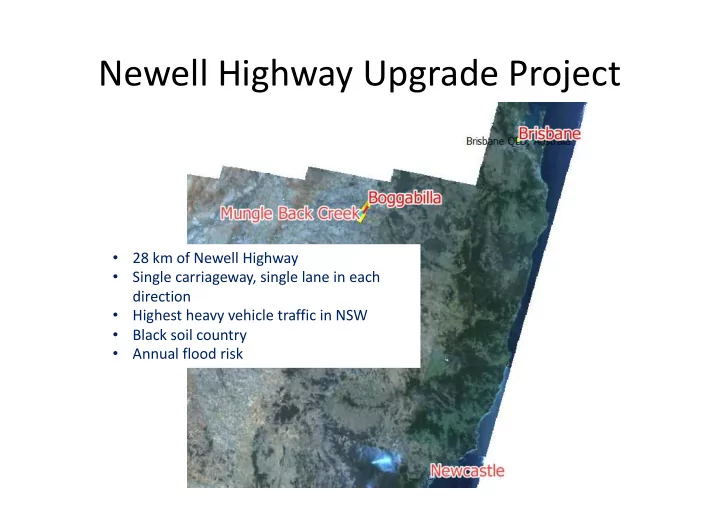
Newell Highway Upgrade Project

  • 28 km of Newell Highway
  • Single carriageway, single lane in each

direction

  • Highest heavy vehicle traffic in NSW
  • Black soil country
  • Annual flood risk
slide-2
SLIDE 2

Regional Geology

slide-3
SLIDE 3

Scope of Investigation

  • DP provided:

– investigation services; – factual reporting for submission to RMS; and – laboratory testing.

slide-4
SLIDE 4

Scope of Investigation

  • 114 Test pits (shoulder, embankment, verge, offline)
  • 32 Pavement bores
  • 12 Piezometers (with monitoring for 16 months)
slide-5
SLIDE 5

Scope of Investigation – Laboratory Testing

  • Subgrade

– CBR testing (4 day, 10 day and 21 day soak) – 105 tests; – Atterberg limits – 71 tests; – Particle size distribution including hydrometer – 24 tests; – Emerson – 21 tests – Acid sulfate testing – 50 tests

  • Pavement Materials

– CBR testing (4 day soak) – 16 tests – Atterberg limits – 16 tests – Particle size distribution including hydrometer – 16 tests;

  • Verge, Cutting and Bridge Sized Structures

– CBR testing (10 day soak) – 10 tests; – Atterberg limits – 10 tests – Particle size distribution including hydrometer – 10 tests; – Emerson - 4 tests – Acid sulfate testing – 45 tests – Soil Aggressivity testing – 8 tests

slide-6
SLIDE 6

Scope of Investigation – Laboratory Testing

  • Subgrade

– CBR testing (4 day, 10 day and 21 day soak) – 105 tests; – Atterberg limits – 71 tests; – Particle size distribution including hydrometer – 24 tests; – Emerson – 21 tests – Acid sulfate testing – 50 tests

  • Pavement Materials

– CBR testing (4 day soak) – 16 tests – Atterberg limits – 16 tests – Particle size distribution including hydrometer – 16 tests;

  • Verge, Cutting and Bridge Sized Structures

– CBR testing (10 day soak) – 10 tests; – Atterberg limits – 10 tests – Particle size distribution including hydrometer – 10 tests; – Emerson - 4 tests – Acid sulfate testing – 45 tests – Soil Aggressivity testing – 8 tests

slide-7
SLIDE 7

Scope of Investigation – Laboratory Testing

20 40 60 80 100 120 140

CBR Atterberg PSD with Hydrometer Emerson Acid Sulfate Soil Aggressivity Pinhole Wet/Dry Strength Resilient Modulus UCS Lime Demand X-Ray Diffraction Organic Content Sulfate Capillary Rise

Number of Tests

Existing Subgrade Existing Pavement Materials Subgrade Blends Pavement Blends Verge, Cuttings

130 – 1 per 200 m Predominantly on subgrade Subgrade lime stabilisation Foamed Bitumen Stabilisation of Pavement

slide-8
SLIDE 8

271 48 87 50 70

Total Number of Tests

Existing Subgrade Existing Pavement Materials Verge, Cuttings Pavement Blends Subgrade Blends

105 16 10

CBR

Existing Subgrade Existing Pavement Materials Verge, Cuttings

slide-9
SLIDE 9

Existing Pavement

40 mm to 50 mm AC 160 mm to 250 mm Base 100 mm to 300 mm Subbase (generally less than 200 mm) Clay and Sandy Clay Subgrade

CBR = 8% to 45% (8 tests) Clay and silt content = 17% – 23% PI = 4% to 13% CBR = 4.5% to 14% (8 tests) Clay and silt content = 35% – 50% PI = 5% to 17% Shallow subgrade (30 tests) CBR = 1.5% to 12% Clay and silt content = 36% – 93% PI = 18% to 59% Deep Subgrade (20 tests) CBR = 1.5% to 5% Clay and silt content = 56% – 90% PI = 31% to 49%

Poor quality base and subase material Weak Subgrade

slide-10
SLIDE 10

What is foamed bitumen?

  • It is a mixture of air, water and bitumen
  • The characteristics include:
  • Once a foaming agent is mixed, it expands about 15 times
  • Large surface area and low viscosity
  • When mixed with gravel material, the droplets coat the finer particles

that binds them together

slide-11
SLIDE 11

What benefits?

  • Increases strength through stabilisation
  • Modulus increases significantly, shear strength gains (similar to

that of cement treated material) but with higher flexibility

  • Higher flexibility reduces risk of fatigue (cemented material)
  • Decreases the permeability of the pavement
  • Less susceptible to heavy rainfall (i.e. copes with weather)

Sourced from Wirtgen Group, “Binder with a proven track record worldwide, foamed bitumen”

Unbound Pavement Bitumen foam stabilised pavement

slide-12
SLIDE 12
  • Not suitable for all pavements
  • Purpose built equipment needed
  • More expensive than other stabilisation

methods

What Disadvantages?

slide-13
SLIDE 13

Costs over $50k

slide-14
SLIDE 14

Where has it been done in Aus?

  • Queensland Main Roads

– 1.6 km of Cunningham Highway at Gladfield (near Warwick) – Gympie – Inglewood

slide-15
SLIDE 15

Advantages for Pavement Design

  • The fatigue relationship for asphalt can be used in

calculations (CIRCLY), as follows

N = RF

!"#$(&.$(!)*+#.&$)

  • ./0 1Ɛ

(

Where: N = allowable repetitions Smix = Modulus of foamed bitumen stabilised material VB = % by volume of bitumen in the stabilised material RF = reliability factor (=1 for rehabilitation)

  • This means greater allowable repetitions for the same

thickness of pavement layers

  • RMS puts a cap on Smix of 2500 Mpa (close to some

asphalts)

slide-16
SLIDE 16

Suitability Assessment

  • Differs for RMS and QMR

– RMS

  • Binder (RMS R76)
  • Foamed bitumen expansion ratio of 10 and minimum half

life of 20 seconds

  • Particle distribution as for Material to be bound (RMS 3051)
  • Plasticity requirements (Austroads PI<10%) – lime can be

added to reduce plasticity

  • Test material with foamed bitumen to obtain average

resilient modulus

  • Plot the average resilient modulus against binder content to

determine bitumen application rate require to satisfy table below

slide-17
SLIDE 17

Suitability Assessment

200 400 600 800 1000 1200 1400 1600 2000 4000 6000 8000 10000 12000 14000 2.0 2.5 3.0 3.5 4.0 Initial Resilient Modulus (MPa) Average Resilient Modulus (MPa) Foamed Bitumen Content (%) Type 2.1 Gravel Type 2.3 Gravel Blend D - 25% pavement and 75% Type 2.1 Gravel Type 2.1 Gravel Initial Resilient Modulus Type 2.3 Gravel Initial Resilient Modulus Blend D - Initial Resilient Modulus

Soaked Resilient Modulus Initial Resilient Modulus

Minimum Initial Resilient Modulus Minimum Soaked Resilient Modulus

Gravel 2.1 and 2.3 do not meet minimum initial resilient modulus

Blend D meets minimum initial resilient modulus and also minimum soaked resilient modulus

slide-18
SLIDE 18

Austroads Design Procedure for Foamed Bitumen

  • Long Term Modulus (based on laboratory

trials)

  • Initial Modulus (needed because it is assumed

that the road will be open within 3 hours of stabilisation)

  • Adjustments for climate, rate of load
slide-19
SLIDE 19
  • Then the following fatigue relationship is used in

calculations (CIRCLY) Ø greater allowable repetitions for the same thickness of pavement layers ØRMS puts a cap on Smix of 2500 Mpa (close to some asphalts)

Austroads Design Procedure for Foamed Bitumen

slide-20
SLIDE 20
  • Minimum Surface Requirements

< 1x10⁷ ESA Spray seal or hot mix AC ≥ 1x10⁷ ESA 30 to 40 mm AC (minimum)

Austroads Design Procedure for Foamed Bitumen

slide-21
SLIDE 21
  • Example

Austroads Design Procedure for Foamed Bitumen

Existing Road (poorly performing)

Check Uncracked and cracked phase for bound base

Proposed Stabilised Road

5 x 10⁶ ESA 300 mm

Reconstruction (Austroads Mechanistic) 480 mm thickness (Base and Subbase)

100 mm

slide-22
SLIDE 22
  • Remove about 300 mm
  • Lime stabilise remaining subbase and

subgrade blend

  • Re-use top 300 mm with foamed bitumen

stabilisation

Newell Highway Proposed Stabilisation

slide-23
SLIDE 23
  • Normal Stabilisation Process

– Run stabilised through the pavement (to stabilisation depth) to mix AC and basecourse

Foamed Bitumen Stabilisation Process

  • Apply quicklime to the surface
  • Slake quicklime
  • Mix the slake lime through the pavement
  • Shape and lightly compact
  • Apply foaming agent to hot asphalt in tank

and stabilise through pavement

slide-24
SLIDE 24

– Excavate to the proposed stabilisation depth – Stockpile material – Stabilise additional 300 mm of existing subbase and subgrade with 8% to 10% lime (LSF + 2%) – Compact the stabilised material – Place stockpiled material on exposed surface – Apply quicklime to the surface – Slake quicklime – Mix the slake lime through the pavement – Shape and lightly compact – Apply foaming agent to hot asphalt in tank and stabilise through pavement

Proposed Newell Highway Stabilisation Process

slide-25
SLIDE 25

Lime Demand Test

2 4 6 8 10 12 14 1 2 3 4 5 6 7 8 9 pH Lime Content (%) pH Hydrated Lime

Measure the amount of lime to return mix to pH of Lime This is the Lime Saturation Factor – (LSF) Need to add more than the LSF before permanent modification of material occurs

slide-26
SLIDE 26
  • Two Methods UCS v CBR

Testing Regime

  • UCS testing of subgrade

blends with lime

  • Trialled different mixes

at LSF LSF+2, LSF+4

  • Lime, quicklime,

hydrated lime

  • Aim to get UCS of 2.5

MPa @ 28 days

  • CBR testing on subgrade

blends

  • Mixes at LSF, LSF+2, LSF+4
  • Aim to get increase in soaked

CBR to allow improvement in thickness design and better support for foamed bitumen basecourse

slide-27
SLIDE 27

CBR Method

Subgrade 3.5% Deep Subgrade 2.5% Pavement Subgrade 3.5% Offline Subgrade 4.0% Overall Subgrade after 110 tests???

3%