
SLIDE 1
Smith-Cotton High School
By: Malacki Ehlers
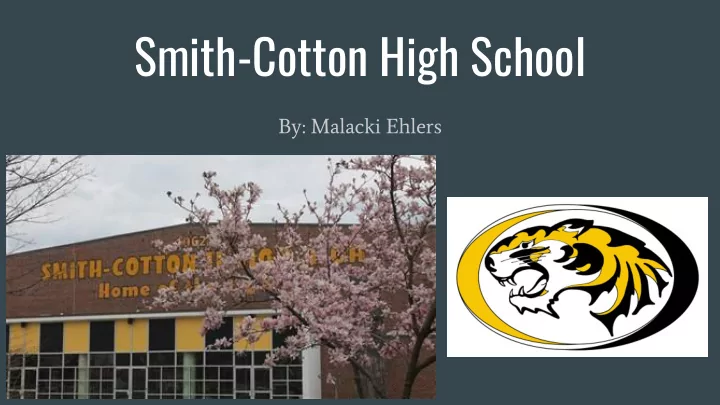
Smith-Cotton High School By: Malacki Ehlers Sedalia High School - - PowerPoint PPT Presentation
Smith-Cotton High School By: Malacki Ehlers Sedalia High School Before the Smith-Cotton High School, the public high school for the school district was the Sedalia High School. It was built in 1895 for $40,000 and stood on the corner of 6th
By: Malacki Ehlers
Before the Smith-Cotton High School, the public high school for the school district was the Sedalia High
$40,000 and stood on the corner of 6th Street and Massachusetts Avenue.
The old high school had several serious problems, from its lack
to fire. The building nearly burned down multiple times, and the school district began to consider establishing a new high school.
In the early 1920’s, Sarah Cotton donated a large portion of her land to the construction of the new Smith-Cotton High School. It was built directly in front of her mansion, which is now the park area
deal with the city of Sedalia, in which she provided the land and the city provided the funds for the construction.
The city raised around $400,000 for the construction of the school building (almost $6 million today). They hired T. W. Bast, a popular architect in Sedalia at the time, to design and build the school.
The new high school was very modern for its time, and its construction was a big deal in the school district. As such, they wanted to honor Sarah Cotton’s donation
However, she wanted to honor her father, George R. Smith, so the district settled on the name Smith-Cotton. The building was completed in 1924.
After the new high school building was completed, the old high school became the junior high. It was named the Martha Lett’s Junior High, after the principal that was serving at the
years before retiring, while the new high school hired Heber U. Hunt as principal.
The Martha Lett’s Junior High was only in operation for a few short years before its transition to a college in
Central Business College until 1968, and remained mostly unused until it burned down in 1974.
In the absence of a junior high building, the high school was required to house grades 6-12. During this time period, it was known as the Junior-Senior High. It was largely split in half, with separate classrooms for junior high and high school students, and even a different library.
In 1951, the school district received funding for the construction of a cafeteria, just outside the main building of the school.
With the high school housing all of grades 6-12, it was in desperate need for more classroom space. The city of Sedalia voted to provide funding for an expansion to the school in 1960. 6 classrooms were added to the main building of the school at this time, located on the second and third floors. Another addition they made was the Little Theater, which is connected to the main school building.
With the same funds used to expand the main building, the school built a large gymnasium and several art classrooms in a separate building. Up until this point, PE classes were held
indoor sports were held on the auditorium stage.
Even with the classrooms that the district added to the high school, it was still not large enough to hold all of grades 6-12. The school district recognized this, so in 1972 they built the Sedalia Middle School. It was designed to hold grades 6-8 and allowed the high school return to its original 9-12.
The high school remained the same for a long time after the construction
school was quickly becoming
the small cafeteria, which had to feed the over a thousand students that attended the school. In 2009 the district addressed this problem by building the FEMA building.
While the FEMA building contains the cafeteria, a gym, and several classrooms, these are not its only
Federal Emergency Management Agency for over $3 million and serves as a storm shelter for nearly 4,000 people from the surrounding area.
The cafeteria was not the only part of the building that was outdated,
designed before technology like the internet existed, and it would need a lot
expansions, the school district elected to build a new high school in 2009.
When the new high school was completed in 2009, the old building became the Smith-Cotton Junior High. It held grades 7-9 for a short period of time, until the freshman wing at the high school was completed. Then it changed to grades 6-8, which it still teaches today.
When the school was first built, they decided to leave access to the foundations and plumbing of the building through maintenance
many years as storage, but have since been cleaned out. Today, they house the boilers, pipes, and wiring for the school.
The auditorium in the high school was one of the nicest parts of the building, and hosted many of the community’s gatherings. Musical performances were done there regularly, indoor sports such as wrestling and basketball were held on the stage, and the theater department put on several performances each year.
Scotten, C. F. History of the Schools of Pettis County, Missouri, 1974. Elyse Gualtieri, Allison. “Shelter Construction to Affect Traffic around High School.” Sedalia Democrat, The (MO), 10 Mar. 2009. EBSCOhost, search.ebscohost.com/login.aspx?direct=true&db=nfh&AN=2W62W63397581563&site=ehost-live. Smith-Cotton High School. SHS Annual. Sedalia, MO: 1924. https://www.sedalia200.org/Page/957 Smith-Cotton High School. Archives. Sedalia, MO: 1925. https://www.sedalia200.org/Page/957 Hammond, Mark. Sarah & Jennie: Sedalia's Legacy. 2016. “Smith-Cotton Junior High School / Welcome.” Smith-Cotton Junior High School / Welcome, www.sedalia200.org/domain/32. Imhauser, Becky Carr. Sedalia. Arcadia Publishing, 2016. Smith, Jeff. Moments in Time: a Pictorial History. Jeffrey W. Smith, 2009. Division of Community Development. Missouri Community Betterment Program. https://www.fema.gov/