
SLIDE 1
Cotton: The Fabric of our Lives
By: Jack Milligan, Jasmine Furin, Jack Schoeb, and Aliza Haskal
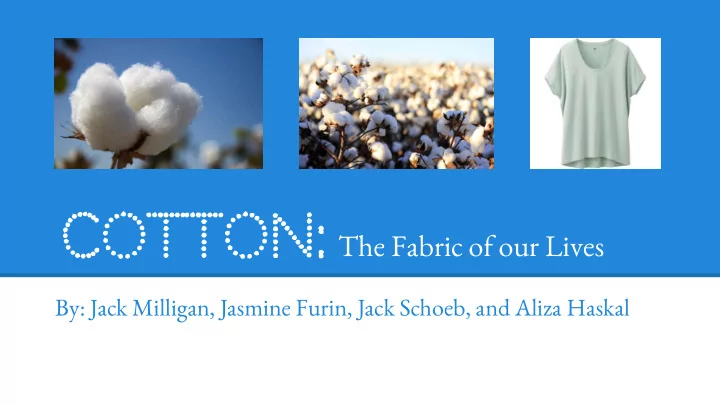
Original Production 5,000 BC- Mexican cave first strands of cotton - - PowerPoint PPT Presentation
Cotton: The Fabric of our Lives By: Jack Milligan, Jasmine Furin, Jack Schoeb, and Aliza Haskal Original Production 5,000 BC- Mexican cave first strands of cotton 1700s Americas Key time for cotton production 1700s- to present.
By: Jack Milligan, Jasmine Furin, Jack Schoeb, and Aliza Haskal
➢ 5,000 BC- Mexican cave first strands of cotton ➢ 1700’s Americas ➢ Key time for cotton production 1700s- to present.
Separates the seeds from the pure cotton
➢ United States, China, Brazil, Pakistan, and Turkey ➢ Most prevalent in textile and food products today
68% of China’s cotton is GMO.
European Union.
➢ Decreases pesticides, chemical fertilizer, and water usage ➢ Better for environment ➢ Greater yield per acre ➢ Seeds are more expensive ➢ Bt toxin can kill good insects ➢ Danger of “super-pests”
➢ GMO or Organic ➢ Competitors ➢ Colored Cotton ➢ Labor
➢ Pedro Camargo ➢ US is giving $1.5-4 billion subsidies a year ➢ Brazil files a case and wins ➢ $147 million “agreement”
➢ Women and children ➢ Child labor laws passed ➢ Uzbekistan and Turkmenistan
➢ Hundreds of thousands of students and teachers ○ Employers forced to provide workers ➢ 2008 Child Labor law ignored
➢ America is fortunate enough to have machines that produce cotton efficiently. ➢ Would Uzbekistan and Turkmenistan use child labor if they were more technologically advanced? ➢ Would American cotton farmers be paid subsidies if they didn’t have to compete with Uzbekistan and Turkmenistan’s low prices?
http://www.forbes.com/sites/realspin/2014/10/16/obama-administration-cuts-expensive-deal-with-brazil-over-cotton-subsidies/
http://static1.squarespace.com/static/54b4b328e4b01e2b101f085e/t/556e35b7e4b01f283c9824f4/1433286082381/Bt+Toxin+Cycle "Adoption of genetically engineered crops in the US." ers.usda.gov. United States Department of Agriculture, n.d. Web. 17 Sept. 2015. <http://www.ers.usda.gov/data-products/adoption-of-genetically- engineered-crops-in-the-us/recent-trends-in-ge-adoption.aspx>. Beckert, Sven. "Empire of Cotton." Theatlantic.com. The Atlantic, n.d. Web. 17 Sept. 2015. https://www.washingtonpost.com/opinions/us-brazil-cotton-deal-perpetuates-an-unhealthy-status-quo-of-subsidies/2014/10/07/d8346bf4-4b2a-11e4-891d-713f052086a0_story.html<http://www.theatlantic. com/business/archive/2014/12/empire-of-cotton/383660/>. "Cotton." GMO Compass. GMO, 4 Dec. 2008. Web. 17 Sept. 2015. <http://www.gmo-compass.org/eng/grocery_shopping/crops/161.genetically_modified_cotton.html>. "History of Cotton." cottons journey. Cotton's Journey, n.d. Web. 17 Sept. 2015. <http://www.cottonsjourney.com/storyofcotton/page2.asp>. Joffe-Walt, Channa. "Why US tax payers are paying Brazilian cotton growers." npr.org. National Public Radio, n.d. Web. 17 Sept. 2015. <http://www.npr.
"Where Cotton Grows." Cotton Counts. National Cotton Council of America, n.d. Web. 17 Sept. 2015. <https://www.cotton.org/pubs/cottoncounts/story/where.cfm>.