
SLIDE 1
kmµv iFIGPiv DÆn_FnFanyuv Cn
YOUTH RESOURCE DEVELOPMENT PROGRAM
(YRDP)
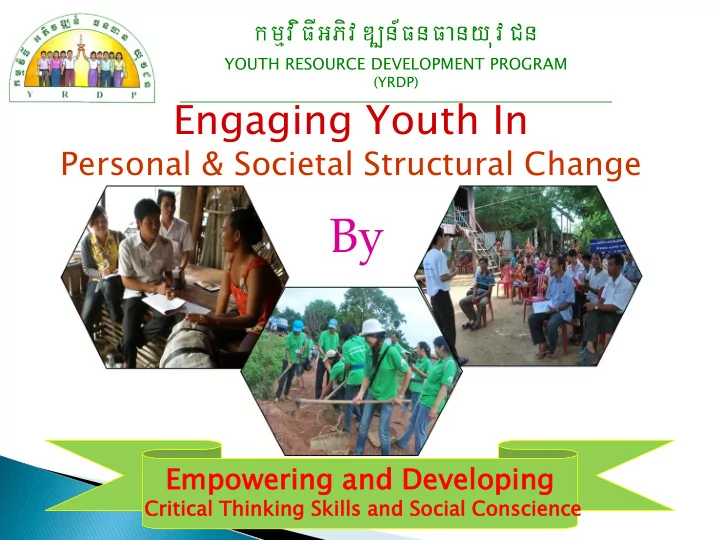
By Empo mpowe wering and and De Deve veloping Critic ical T - - PowerPoint PPT Presentation
kmv iFIGPiv Dn_FnFanyuv Cn YOUTH RESOURCE DEVELOPMENT PROGRAM (YRDP) Engaging Youth In Personal & Societal Structural Change By Empo mpowe wering and and De Deve veloping Critic ical T l Thin inkin ing Skills ills a and
YOUTH RESOURCE DEVELOPMENT PROGRAM
(YRDP)
A leading local youth organization since 1992, registered with MoI
1999, N0 891sCN
Since 1992, more than 50,000 youth (42% female) from around 18 provinces and 32 higher education institutes have participated in YRDP activities
In 2011 YRDP planed to engage around 9,040 young people and between 2012-2014 more than 30,000 in YRDP activities focusing Peace-building, Social Accountability & Good Governance, Extractive Industries, Climate Change,..
To empower youth to be committed and active citizens who take concrete action that influences and changes other people for promoting peaceful, just and democratic community development.
Youth Capacity Development Unit
Change attitude, build self confidence , skills and social conscience, prepare youth to take concrete action for positive change
Youth Empowerment unit
Sharpen skills and citizenship by taking concrete action for community development
Publication & Communication Unit
Promote social values /role model of being active citizen to public
Youth in Action for Extractive Industry Transparency & Climate Change Exercise rights & role as citizens in democratic society to sustainable natural resource management
Donors: CCFD, MISEREOR, ICCO, D&P, OSI, CORD, NPA,OA,
HBF, TROCAIRE, DED, AFSC, TAF, Dvv/BMZ, Students
Committed and Active Citizens for Justice, Peace , and, Sustainable Development
668 participants including university students, representatives of local and international NGO, embassy and representatives of government sector are participating in Annual Youth Forum under the topic of “The ASEAN’s Opportunity for Youth”
Commune, Basedth District, Kampong Speu Province.
Commune, Basedth District, Kampong Speu Province.
Commune, Basedth District, Kampong Speu Province.
Goal: To empower young people to be active agents in bringing the gape between commune council and community members by promoting public consensus and local ownership of issues and their solutions. Beneficiary: YRDP selected 20 youth( university students)
(CG) on this project in the mandate of one year term. The main beneficiary are community members and commune councilors.
Outcomes Framework Project outcomes (medium term)
social accountability students, contribute to a body of knowledge relating to social accountability, and the role of young people.
people and resources when an issue arises, can engage effectively with each other, build relationships and have increased mutual trust within and between villagers, commune and provinces. Are better prepared for decentralization reforms, including increased funding, use more transparent, inclusive and equitable decision making processes, experience improve quality of life. Activities outcomes (short term)
capacity, knowledge and confidence to engage in and facilitate social accountability
knowledge and confidence relating to social accountability, increase the quality and frequency of communication with each other, are better equipped to write and implement a community development plan
1.1 Indoor training: Leadership, Good Governance and Social Accountability 1.2 Exposure to experiences senior speakers from MoI, Civil Society and Independent consultant 1.3 Field study Speaker sharing on SA tools In door training, experiential learning activity on leadership
experts)
Baseline study Monitoring and Evaluation
Small group discussion of key activists in drafting the monthly planning of public meeting Role play of student core group on Rights and
capacity building workshop
Information sharing after exposure trip from Svay Rieng Province at Public meeting
Activists in 11 villages of Pau Angrang Commune
Commune councilor exchange experience during exposure trip in Battambang
Commune Council Experience Exchange
Year Number of activity Number of people reached Youth core group members Total Women Promotion Mid 2009 39 1138 496 1st : 20 (F:09) Mid 2010 16 729 291 2nd: 14 (F:03) 2011 41 5522 2847 3rd: 13 (F:05) 2012 32 1850 910 4th : 18 (F:09) Total 128 9239 4544 65 (F:26)
Main changes
1. Gain the concept and practical experiences of Leadership, good governance and social accountability. 2. Can play roles actively as the coordination body to closely work with community people and commune councilors. 3. Build more network in social accountability work and know how to facilitate the workshop and meeting. 4. Be mature workers and capable to put words into action for change. 5. Be more idenpendent , wiser decision making and social participation. 6. Be role model of sense of volunteering for social accountability and strentheing good govenance. 7. Gain more critical thinking skill and problem solving. 8. Be more effective communicators and coordinator of the event. 9. Can take the lead in any social activities. Key activists 1. Know how to form their sefl-help group and create their networks 2. Participate more active in commune monthly meeting and raise the issue to be discussed 3. Initiate the acitivities to settle in commune for the whole commune benefit 4. Understand the concept and some practice of good governance and social accountability, rights and active citizen. 5. Be more ownership of their commune issue and solutions. Reduce the ignorant and fearness of political engagement. 6. Mobilize their commune members by applying soft advocacy method to solve the problem 7. Be more enthusiastic with accessing to information especially from commune 8. Be more closely work with commune councilors and know how to advocate for better changes 9. Increase sense of conscience and community planning development.
The influence from various project activities lead to burning desire of key activists youth and villagers to initiate and take action for their commune development. This demonstrated their ownership of their commune issue and solutions. Previous time, this lake was destroyed by some villagers who used illegal finishing
commune dare not used those harmful equipment anymore because
Key activists and youth.
karpea ( Initiated by key activists through the impact of project activities) Mr. Neang ( Chroneang Chas village) Youth group members and key activists clear the lake for being restored and make the lake as conservative lake for whole commune benefits
Case study:
the letters put in the accountability box by the people in her village for quite a long time with no response until now. Another issue is about the secondary school teacher take money from students if they do not attend the extra class. (extra class requires student to pay wage to teacher so that they will get proper teaching from teacher).
Case study
Serein Choubchum village said in the focus group discussion that “There is a private company in my village that built chicken farm that pollutes the environment of my village by making the water become dirty and has bad smell. These have negatively impacted many villagers’ health. I and many villagers have come together and written a suggestion letter stamped by all villagers’ thumb to commune councilors for
was sent to commune and district level; the company have accepted the suggestion and readjust their farm activity. I am really glad and feel that commune councilor have changed their behavior from ignorant to active help if comparing to previous year when any issue happened it took so long to solve and sometime the issue was forgotten by commune councilors. ”
Rice Bank in Por Angkrang Rice bank was initiated by key activist Mr. Neang and Mr. Sarith after the exposure trip from Svay Rieng Province. This mechanism help to push the key activists and villagers work more closely.
1st deputy commune chief said that “I have observed that the villagers now know more about accountability box and they dare to put the letter in the box. It is different from previous time. This month accountability box has 21 letters; which is more than other
district meeting in November, the district officer said that this commune got more letters than
and it means people know the accountability box and commune works than other communes.”
Currently, in this March; there are two episodes were requested to YRDP for being a guest speakers sharing on
with their Commune councilors development work, LOY 9 Program conducted by BCC, on CTN TV
Together for Social Accountability is together for Sustainable Development