Small Cell Lung Cancer, or Head and Neck cancer patients receiving - - PowerPoint PPT Presentation

small cell lung cancer or head and neck cancer
SMART_READER_LITE
LIVE PREVIEW

Small Cell Lung Cancer, or Head and Neck cancer patients receiving - - PowerPoint PPT Presentation

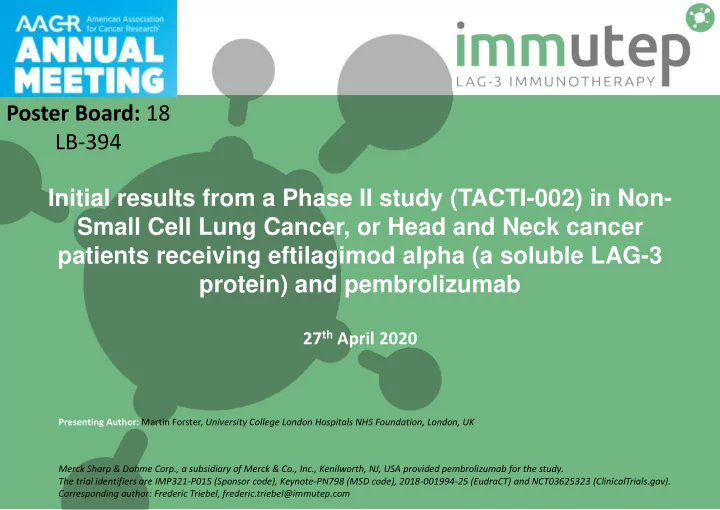
Poster Board: 18 LB-394 Initial results from a Phase II study (TACTI-002) in Non- Small Cell Lung Cancer, or Head and Neck cancer patients receiving eftilagimod alpha (a soluble LAG-3 protein) and pembrolizumab 27 th April 2020 Presenting


slide-1
SLIDE 1

27th April 2020

Initial results from a Phase II study (TACTI-002) in Non- Small Cell Lung Cancer, or Head and Neck cancer patients receiving eftilagimod alpha (a soluble LAG-3 protein) and pembrolizumab Poster Board: 18 LB-394

Presenting Author: Martin Forster, University College London Hospitals NHS Foundation, London, UK Merck Sharp & Dohme Corp., a subsidiary of Merck & Co., Inc., Kenilworth, NJ, USA provided pembrolizumab for the study. The trial identifiers are IMP321-P015 (Sponsor code), Keynote-PN798 (MSD code), 2018-001994-25 (EudraCT) and NCT03625323 (ClinicalTrials.gov). Corresponding author: Frederic Triebel, frederic.triebel@immutep.com

slide-2
SLIDE 2

2

MoA: Efti is a soluble LAG-3 protein targeting a subset of MHC class II on APC to mediate antigen presenting cell (APC) and then CD8 T-cell activation. Rationale: Efti activates APCs and leads to an increase in activated T cells which effect potentially reduces the number of non-responders to pembrolizumab.

Efti is an MHC II agonist APC activator

  • boost and sustain the CD8+ T cell responses
  • activate multiple immune cell subsets

“PUSHING THE ACCELERATOR ON IMMUNE RESPONSES” “RELEASING THE BRAKE ON THE T CELL”

LAG-3 antagonist, or blocking, antibodies: Immune checkpoint inhibitor

  • increase cytotoxicity of the pre-existing CD8

T cell response

Eftilagimod alpha (efti) Innovative LAG-3 I-O Product Candidate

slide-3
SLIDE 3

3

Eligiiblity Primary Objective: Overall Response Rate (iRECIST) Secondary: PFS, OS, PK, biomarker, PD, safety and tolerability 30 mg efti SC + 200 mg pembrolizumab IV for 12 months + pembrolizumab alone for another 12 months

Trial Design + Introduction

Notes: NSCLC – non-small-cell lung cancer, HNSCC – head and neck squamous cell cancer, ORR – overall response rate, PFS – progression free survival, OS – overall survival, PK –pharmacokinetics, PD-X – any PD-1 or PD-L1 treatment

  • Available tumor

tissue

  • ECOG 0-1
  • Adequate organ

functions

  • PD-L1 all

comer Part A: 1st line NSCLC stage IIIB/IV, PD-X naïve, not eligible to EGFR/ALK therapy Part B: 2nd line met. NSCLC, refractory for PD- 1/PD-L1 Part C: Incurable 2nd line

  • met. HNSCC after

platinum therapy

→ Phase II, multi-national, open label, PD-L1 (central assessment) all comer trial → The study has a Simon's optimal two-stage design. During the first stage, N1 patients are recruited. Additional patients (N2) will be recruited for each part if the pre-specified threshold for ORR is met. In total, 109 patients planned → In collaboration with Merck Sharp & Dohme (MSD)

eftilagimod alpha TACTI-002

Reported here: Safety all parts, initial efficacy Part A and part C stage 1

slide-4
SLIDE 4

4

Exposure and Safety

Notes:

(1) Preliminary data, cut-off 20-Mar 2020; TEAE – treatment emergent adverse events regardless of causality; TESAE – treatment emergent serious adverse events regardless of causality

eftilagimod alpha - TACTI-002 Results1 – all parts stage 1

  • In total 63 pts were enrolled until data cut-off1.

Recruitment is ongoing.

  • Pts received median 6 (range 1-22) efti

injections and median of 5 (range 1-19) pembrolizumab infusions

  • 20 pts (31.7%) had ≥ 1 TESAE
  • 24 pts (38.1 %) had 1 TEAE ≥ grade 3 (thereof

5 pts (7.9 %) drug related)

  • 5 fatal TEAEs (hemoptysis G5; bronchospasm

G5, respiratory failure G4, respiratory failure G5, malignant neoplasm progress G5) were reported – all unrelated to both study drugs

  • 3 TEAEs (hepatitis drug induced G4; ALT and

AST elevation G3; syncopal event G3) lead to discontinuation both study drugs - first 2 were assessed as related to both study drugs

Summary TEAEs occured in ≥10 % of pts (N=63 in total)

  • Injection site reactions all were reported related to efti
  • No new safety signals observed thus far

Adverse event (PT) Any Grade N (%) Grade 3 N (%) Grade 4 N (%)

Cough 20 (31.7)

  • Asthenia

13 (20.6)

  • Decreased appetite

11 (17.5)

  • Dyspnoe

11 (17.5) 3 (4.8) 1 (1.6) Fatigue 10 (15.9) 1 (1.6)

  • Diarrhoea

9 (14.3) 1 (1.6)

  • Upper respiratory tract

infection 8 (12.7)

  • Constipation

7 (11.1) 1 (1.6)

  • Nausea

7 (11.1)

slide-5
SLIDE 5

5

Baseline Characteristics + efficacy

Notes: (1) Preliminary data, cut-off March 20 2020 (2) % in reference to evaluable samples; 4 specimens not evaluable by central lab using standard IHC kit (3) Garon et al N Engl J Med 2015;372:2018-28

  • PD-L1 distribution as historically expected with 31 % of evaluable

pts ≥ 50 % → PD-L1 all comer trial

  • 65 % male, 71 % ECOG 0, median age 65 yrs, 94 % smokers, 59

% Squamous + 41 non-squamous → typical NSCLC 1st line pts

eftilagimod alpha - TACTI-002 Results1 - 1st line NSCLC (part A, stage 1)

Tumor response - iBOR as per iRECIST N (%) Total (N=17) Complete Response (iCR) 0 (0.0) Partial Response (iPR) 9 (52.9) Stable Disease (iSD) 5 (29.4) Progressive Disease (iPD) 3 (17.7) Objective Response Rate (iORR) 9 (52.9) Disease Control Rate (iDCR) 14 (82.4)

  • 12/17 (71 %) patients with target lesion decrease
  • Responses in all PD-L1 subgroups (3/9 iPRs in ≥ 50 % subgroup)
  • 6/9 iPRs confirmed and treatment ongoing in 7/9
  • At data cut-off 9 pts (53 %) were still under treatment (8+ months)

→ median not yet reached

  • Two late responders after 8 and 10 months
  • 100
  • 75
  • 50
  • 25

25 50 75 100 best % change from baseline

iUPD/iCPD iSD iP R Best response:

n = 17 Part A* - 1st line NSCLC

* cut-off 20-Mar 2020

25% NE 0 % NE 50 % 15 % 3 % 0 % NE 1 % 10 % 10 % 0 % NE 75 % 90% 100%

9 18 27 36 45 54

  • 100
  • 80
  • 60
  • 40
  • 20

20 40 60 80 100

weeks % change compared to start of therapy

n =17

< 1 % PD-L1 >=50% 1-49 %

Part A* - 1st line NSCLC

* cut-off 20-Mar 2020

N E

* - unconfirmed PD

*

PD-L1 %

slide-6
SLIDE 6

6

  • Initial iORR of 33.3 % in this PD-L1 all comer 2nd line HNSCC pts (1 pt

with outstanding imaging)

  • 5 responses confirmed; all 6 pts with PR still under therapy
  • 1 iPR after pseudoprogression, 1 iPR at 8 months, responses getting

deeper over time

  • At cut-off 9 pts (50 %) still under therapy - HNSCC 2nd line patients

Tumor response - iBOR as per iRECIST N (%) Total (N=18) Complete Response (iCR) 0 (0.0) Partial Response (iPR) 6 (33.3) Stable Disease (iSD) 3 (16.6) Progressive Disease (iPD) 6 (39.9) Not evaluable* 2 (11.1) Not yet evaluated** 1 (5.6) Objective Response Rate (iORR) 6 (33.3) Disease Control Rate (iDCR) 9 (50.0)

Baseline Characteristics + efficacy

eftilagimod alpha - TACTI-002 Results1 – 2nd line HNSCC (part C, stage 1)

* - dropped out prior to first restaging ** - not yet staged still on therapy for > 9 weeks

  • Median age 66, 94 % male, 47 % ECOG 1, different HNSCC

subtypes -> typical 2nd line HNSCC population

  • 100
  • 75
  • 50
  • 25

25 50 75 100 best % change from baseline

iSD Best response:

n = 15 Part C* - 2nd line HNSCC

* cut-off 20-Mar 2020

iP R

1 1 % 0 % not yet 0 % NE NE 2 % NE 0 % 70 % 100 % 50 % not yet 25% 85 %

iUPD/iCPD 9 18 27 36 45 54

  • 100
  • 80
  • 60
  • 40
  • 20

20 40 60 80 100

weeks % change compared to start of therapy

n =15

Best response: iP R

Part C* - 2nd line HNSCC

* cut-off 20-Mar 2020

iUPD/iCPD iSD

PD-L1 %

slide-7
SLIDE 7

Poster Board: 18 LB-394

Authors: Forster M1, Felip E2, Doger B3, Majem M4, Carcereny E5, Bajaj P6, Clay T7, Krebs M8, Peguero J9, Roxburgh P10, Triebel F11 Affiliates: 1 - University College London Hospitals NHS Foundation, London, UK;2 - Vall d’ Hebron University Hospital, Barcelona, Spain; 3 - START Madrid - Fundación Jiménez Díaz, Madrid, Spain; 4 - Hospital de la Santa Creu i Sant Pau, Barcelona, Spain; 5 - Catalan Institue of Oncology Badalona-Hospital Germans Trias i Pujol, B- ARGOgroup, Barcelona, Spain; 6 – Griffith University, Gold Coast, Australia; 7 - St John of God Subiaco Hospital, Perth, Australia; 8 - The University of Manchester and The Christie NHS Foundation Trust, Manchester, UK; 9 - Oncology Consultants, P.A., Houston, Texas, USA; 10 – University of Glasgow / Beatson West of Scotland Cancer Centre, Glasgow, UK; 11- Research & Development, Immutep S.A.S., Orsay, France

Merck Sharp & Dohme Corp., a subsidiary of Merck & Co., Inc., Kenilworth, NJ, USA provided pembrolizumab for the study. The trial identifiers are IMP321-P015 (Sponsor code), Keynote-PN798 (MSD code), 2018-001994-25 (EudraCT) and NCT03625323 (ClinicalTrials.gov). Corresponding author: Frederic Triebel, frederic.triebel@immutep.com