Slides for lecture on an introduction to government in Australia for - - PDF document

slides for lecture on an introduction to government in
SMART_READER_LITE
LIVE PREVIEW

Slides for lecture on an introduction to government in Australia for - - PDF document

Slides for lecture on an introduction to government in Australia for international students - 9/3/2016 An introduction to government and environmental regulation in Australia for international students Dr Chris McGrath, The University of


slide-1
SLIDE 1

1

Photo: Rock Island Bend by Peter Dombrovskis

An introduction to government and environmental regulation in Australia for international students

Dr Chris McGrath, The University of Queensland, 2015

Photographer unknown

Acknowledgement of the Traditional Custodians of this Land, Elders past and present & future generations on which we hold this Land in trust.

GPEM student body (2012) Lecture outline:

  • 1. Our goals for government & our society
  • 2. Four levels of government:
  • International: The United Nations and other

international institutions

  • National: Commonwealth / Federal /

Australian Government

  • State: Queensland Government
  • Local: 73 local governments in Queensland
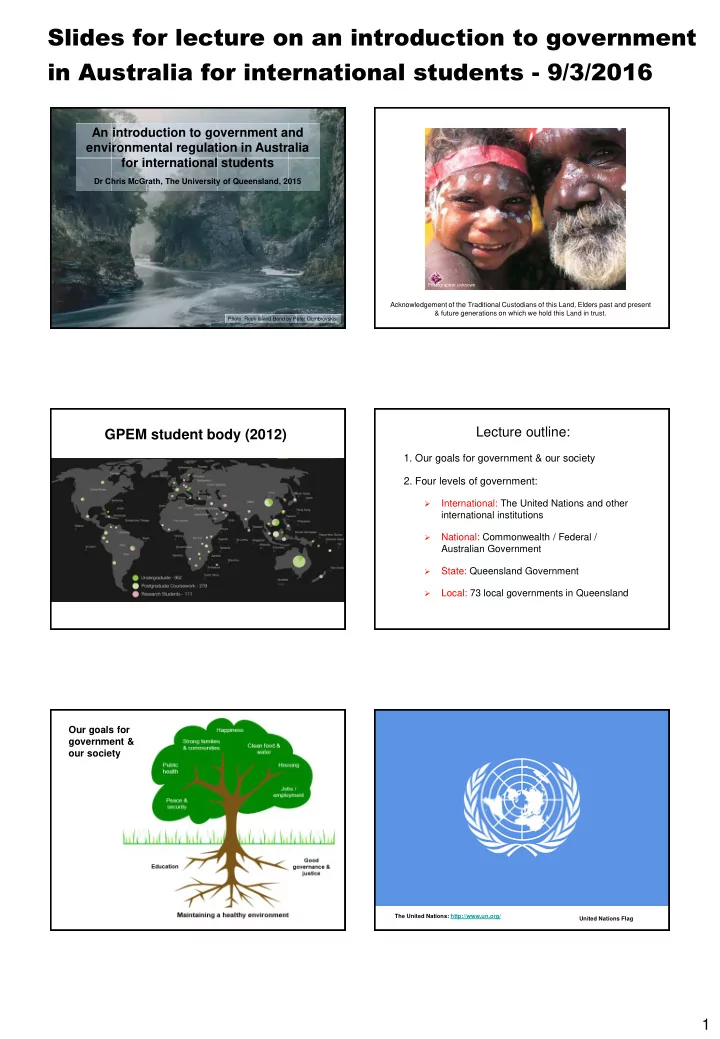
Our goals for government &

  • ur society

United Nations Flag The United Nations: http://www.un.org/

Slides for lecture on an introduction to government in Australia for international students - 9/3/2016

slide-2
SLIDE 2

2

UN Headquarters, New York (Photographer unknown) http://www.un.org/ UN Security Council at UN HQ, New York (Photographer unknown) UN Secretary General Ban Ki-moon (Photographer unknown)

There is no international (unilateral) “government” International law is founded on the sovereignty of individual nations. The United Nations (UN) does not have a general power to impose obligations on countries without their consent (with the limited exception of maintaining international peace). The UN cannot impose international environmental

  • bligations on individual countries such as Australia,

China or the United States of America without their consent.

Australia has become a party to many international agreements (normally called “conventions” or “treaties”) but these generally have limited enforcement and oversight powers, leaving implementation largely at the discretion of the Australian Government. Example of international agreement: The World Heritage Convention

http://whc.unesco.org/

slide-3
SLIDE 3

3

Under the World Heritage Convention the identification, protection, conservation, presentation and transmission to future generations of World Heritage properties within Australia is largely at the discretion of the Australian Government. Only countries that are parties to the Convention are liable to comply with its obligations. Normal people are not a party to the Convention and cannot be held liable for breaching it.

While international bodies have limited roles, they can be important. The World Heritage Committee recently reviewed whether to enter the Great Barrier Reef on the List of World Heritage in Danger because of rapid coastal development.

In mid-2012 the World Heritage Committee requested that Australia:

… not permit any new port development

  • r associated infrastructure outside of the

existing and long-established major port areas within or adjoining the property …”

Location of new proposed coal terminals north of Gladstone

Source: Geoscience Australia

One more important point: under international law, the Commonwealth of Australia has sovereignty (the exclusive right to govern & control) the Australian mainland and

  • ffshore islands and sovereign rights to control an enormous maritime area.

(Nb. Australia’s sovereignty in Antarctica is disputed by many countries)

Government in Australia

slide-4
SLIDE 4

4

Adapted from the Australian Parliamentary Education Office http://www.peo.gov.au/students/cl/multi.html

The Australian Constitution creates a separation of powers in the Commonwealth Government

View of Old and New Parliament House Canberra taken from the Australian War Memorial. Photo: Brenden Ashton (2006)

http://aph.gov.au

slide-5
SLIDE 5

5

Main Australian political parties

  • Nb. Liberal + National Parties form “the Coalition”

Images from http://www.peo.gov.au/multimedia/library/parl.html

House of Representatives composition in 2013-present

Source: Parliamentary Education Office

Source: Parliamentary Education Office

Source: Parliamentary Education Office (2013-present)

Process of making a law (statute) in the Australian Parliament

Source: Parliamentary Education Office

Cover of the EPBC Act & regulations: examples of existing statute & regulations made under it.

slide-6
SLIDE 6

6

Where to find Commonwealth laws

http://www.comlaw.gov.au

Departments principally relevant for environmental matters

(as at 2016)

Source: http://australia.gov.au/directories/australian-government-directories/government-departments

The Federal Judiciary

High Court of Australia Canberra

Photograph: High Court of Australia

What can the Commonwealth Government regulate and what is its relationship with the States and Territories?

slide-7
SLIDE 7

7

Rock Island Bend by Peter Dombrovskis

The Tasmanian Dam dispute in 1983 dramatically expanded the Commonwealth Government’s powers to regulate activities impacting on the environment.

Photographer unknown

The High Court of Australia has held in a series of cases since the Tasmanian Dams Case in 1983 that under s51(xxix)

  • f the Commonwealth Government has

power to enact legislation that is reasonably capable of being considered appropriate and adapted to fulfil Australia’s international legal obligations.

Due to the width of Australia’s international legal obligations, this gives the Commonwealth Government a wide power to make laws to protect the environment.

Example of Australia’s international legal

  • bligations:

the Biodiversity Convention

See http://www.cbd.int/

slide-8
SLIDE 8

8

What happens if a Commonwealth law and a State law conflict?

  • Nb. True conflict is rare. Normally Commonwealth

and State laws operate side by side.

A hierarchy of laws is established under the Commonwealth Constitution Queensland Government

Queensland's Parliament House Source: Rebecca C's Flickr photostream

slide-9
SLIDE 9

9

Where do I find Queensland legislation?

http://www.legislation.qld.gov.au

Local Government

Source: Queensland Government (2011) Cf.http://www.qldcouncils.com.au/web/guest/find-

your-council and http://www.dlgp.qld.gov.au/local-government- directory/

73 local government areas in Queensland

  • Nb. Local governments

may be called “council” “regional council” “city”

  • r “shire”.

Example of local government: Brisbane City Council

See http://www.brisbane.qld.gov.au

slide-10
SLIDE 10

10

Discussion: For many issues, including environmental protection, government in Australia is not a neatly layered cake. It is more like scrambled eggs.

See: The Conversation website: https://theconversation.com/australias-scrambled-egg-of- government-who-has-the-environmental-power-9582

Six key ingredients to understanding why there are no neat roles in government for environmental protection in Australia

  • 1. State governments were historically responsible for environmental management,

and they still often resent the Commonwealth intruding into these matters. State, territory and local governments still handle the vast bulk of day-to-day decisions and administration of land and water management.

  • 2. The Commonwealth Government has wide powers to make laws to protect the

environment.

  • 3. The purpose and practical effect of a Commonwealth law are irrelevant for

determining its validity.

  • 4. No issues that are exclusively reserved for the State and Territory governments.
  • 5. Commonwealth laws override State, Territory and local government laws to the

extent of inconsistency.

  • 6. The Commonwealth has a wide discretion on how it distributes funding and the

conditions that are attached to funding. Because the Commonwealth collects most

  • f the taxation in Australia, its power to fund different programs gives it a huge

influence over programs that are implemented at state and territory level such as health and education.

See: https://theconversation.com/australias-scrambled-egg-of-government-who-has-the-environmental-power-9582

When we combine these six ideas in practice with over 100 years of trying to address often complicated, overlapping problems like environmental protection, the three tiers of government in Australia have become so entwined that it often becomes difficult to distinguish their roles in a logical, neat way.

See: https://theconversation.com/australias-scrambled-egg-of-government-who-has- the-environmental-power-9582

Cooperation and occasional battles

While battles between the Commonwealth and state governments

  • ften flare up and make the headlines, generally they cooperate.

We see this if we look at things like environmental protection and taxation. Battles like the Tasmanian Dam dispute in 1983 and recent fights between the Commonwealth and Queensland governments over the mining tax and state royalties are interspersed by long periods

  • f cooperation.

This reality reflects the idea of “cooperative federalism”. Federal - state relationships do not always need to be smooth and it is unrealistic to expect that they will.

Lecture outline:

  • 1. Our goals for government & our society
  • 2. Four levels of government:
  • International: The United Nations and other

international institutions

  • National: Commonwealth / Federal /

Australian Government

  • State: Queensland Government
  • Local: 73 local governments in Queensland