Slide 1 Welcome to the CACFP Annual Training called Recipe for - - PDF document

slide 1 welcome to the cacfp annual training called
SMART_READER_LITE
LIVE PREVIEW

Slide 1 Welcome to the CACFP Annual Training called Recipe for - - PDF document

Slide 1 Welcome to the CACFP Annual Training called Recipe for Success during CACFP Recipe for Success Reviews, hosted by Oregon during CACFP Reviews Department of Education Child Nutrition Programs. This session will Common Review


slide-1
SLIDE 1

Slide 1

Fueling Oregon’s Future

Recipe for Success during CACFP Reviews

Common Review Findings for

Child Care Centers, including:

  • Outside School Hour Care Centers
  • At-Risk Afterschool Programs
  • Homeless/Emergency Shelter sites

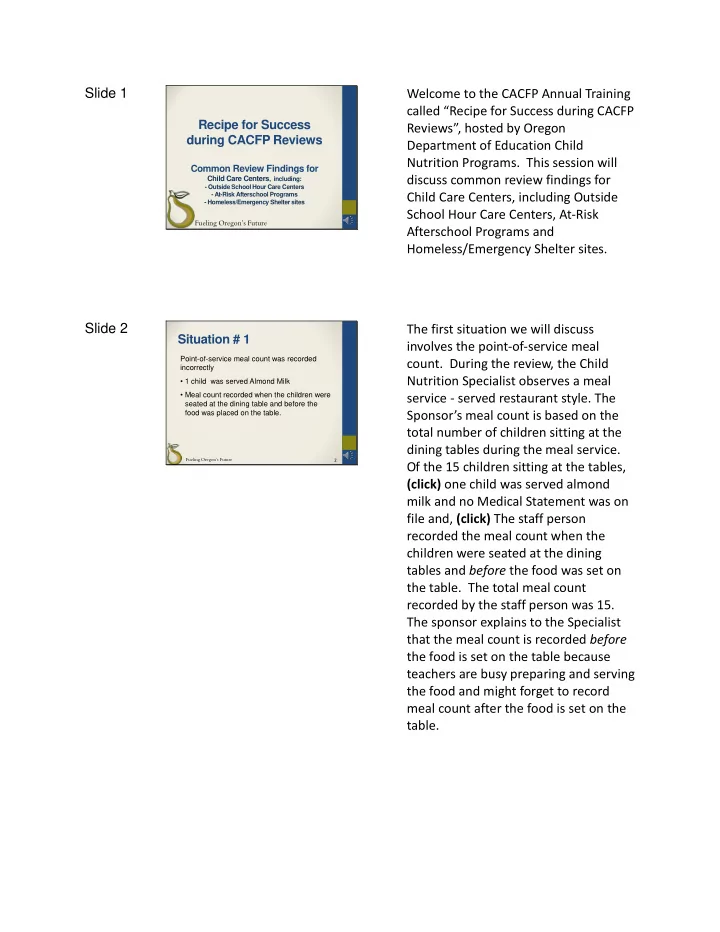
Welcome to the CACFP Annual Training called “Recipe for Success during CACFP Reviews”, hosted by Oregon Department of Education Child Nutrition Programs. This session will discuss common review findings for Child Care Centers, including Outside School Hour Care Centers, At-Risk Afterschool Programs and Homeless/Emergency Shelter sites. Slide 2

Fueling Oregon’s Future

Situation # 1

Point-of-service meal count was recorded incorrectly

  • 1 child was served Almond Milk
  • Meal count recorded when the children were

seated at the dining table and before the food was placed on the table.

2

The first situation we will discuss involves the point-of-service meal

  • count. During the review, the Child

Nutrition Specialist observes a meal service - served restaurant style. The Sponsor’s meal count is based on the total number of children sitting at the dining tables during the meal service. Of the 15 children sitting at the tables, (click) one child was served almond milk and no Medical Statement was on file and, (click) The staff person recorded the meal count when the children were seated at the dining tables and before the food was set on the table. The total meal count recorded by the staff person was 15. The sponsor explains to the Specialist that the meal count is recorded before the food is set on the table because teachers are busy preparing and serving the food and might forget to record meal count after the food is set on the table.

slide-2
SLIDE 2

Slide 3

Fueling Oregon’s Future

Why

Incorrect point-of-service meal count

  • Meals must be counted at the actual

point-of-service

  • Non-reimbursable meals were counted at

the POS

3

CACFP Policy & Procedure Manual Chapters 5 and 8. 7 CFR226.17(b)(4), 7 CFR 226.19(b)(6), 7 CFR 226.10(c)

Situation #1 has two point-of-service meal count findings. (click) The first finding is the point-of-service meal count was executed incorrectly. (click) The second finding is non-reimbursable meals were counted in the point-of- service meal count. Let’s discuss when the point-of-service meal count must be recorded. Meals must be counted at the actual point-of- service, that is meals are counted as they are served. This will ensure that an accurate count of complete and reimbursable meals is documented and reported. When using restaurant style meal service the point-of-service meal count must be taken during the meal service when the children are seated at the dining table with a reimbursable meal in front of them. It cannot be recorded before the meal service begins or after the meal is finished. Point-of-service meal count cannot be solely based on the number of children actually eating at the table. Meal count must not include the meals served to participants who received a non-creditable milk substitution, or who left the table before meal count was recorded. The Sponsor’s meal count for this meal service should have been zero (0) not

  • 15. Meals must not be counted for

entire meal, since the meal count was recorded before the food was placed on the dining table. Additionally, even if meal count was timely recorded when the food was on the dining table, the meal for the child served almond milk should not be included in the meal

slide-3
SLIDE 3

count, due to the missing Medical Statement. (click) Point-of-service meal count requirements can be found in the CACFP Policy & Procedure Manual, Chapter 5. Meal Pattern and Meal Service Style requirements can be found in Chapter 8. (click) The Federal regulations governing these topics are 7 CFR 226.17(b)(4), 7 CFR 226.19(b)(6), and 7 CFR 226.10(c). Slide 4

Fueling Oregon’s Future

Why

Non-reimbursable meals were included in the POS

  • Almond milk is not a creditable

substitution for milk

  • Exceptions to the meal pattern must be

documented

4

Chapter 8 – Section D. 7 CFR 226.20(h)

The second finding of Situation #1 is meals were claimed for a child who was served Almond Milk and did not have a valid Medical Statement on file. (click) Almond milk is not a creditable substitute for fluid milk. (click) All exceptions to the meal pattern must be documented if the meal is to be claimed for

  • reimbursement. Three forms are

available for participants with Special Dietary Needs:

  • Medical Statement for Participants

with Disabilities

  • Medical Statement for Participants

without Disabilities

  • Milk Substitution Request –

Participants without Disabilities When a substitution to the CACFP meal pattern is made which eliminates a required component – and the sponsor wishes to claim the meal for reimbursement – then one of the three previously mentioned forms must be

slide-4
SLIDE 4

completed and on file. The sponsor must also document the actual food served to a child if it is different than the written menu for the day. (click) Special Dietary Needs requirements can be found in Chapter 8 – Section D. (click) The Federal regulation governing this topic is 7 CFR 226.20(h). Slide 5

Fueling Oregon’s Future

How To Correct

Incorrect point-of-service meal count

  • Develop and implement a procedure –

meal counts

  • Provide training to all pertinent staff

5

Now let’s discuss corrections to prevent the first finding: incorrect point-of- service meal count. To correct, the sponsor would need to (click) develop and implement a point-

  • f-service meal count procedure that

ensures the point-of-service is taken as the CACFP - reimbursable meal is served to participants. The procedure would need to include the staff position responsible for point-of-service count at each feeding location (classroom, cafeteria, etc.). (click) In addition, the sponsor needs to train site staff on recording proper point-of-service meal counts and have records of this training available for review. It is critical that all site staff and monitors understand the importance of accurate point-of-service meal counts. Only complete meals meeting CACFP meal pattern may be claimed for reimbursement.

slide-5
SLIDE 5

Slide 6

Fueling Oregon’s Future

How To Correct

Non-reimbursable meals were included in the POS

  • Develop and implement a procedure –

exceptions to the meal pattern

  • Provide training to all pertinent staff

6

Now let’s discuss how to correct the second finding of non-reimbursable meals included in the point-of-service meal count. Meals were claimed for a child who was served Almond Milk and did not have a valid Medical Statement

  • n file.

To correct, the sponsor would need to (click) develop and implement a procedure to make sure that exceptions to the meal pattern have documentation on file. Valid Medical Statements For Participants without Disabilities, Medical Statement for Participants with Disabilities, and Milk Substitution forms must be on file to support all meals claimed for reimbursement when there was an exception to the meal pattern that requires a non-creditable item to be

  • served. Include in the procedure: The

system for collecting and tracking Medical Statements, the system for documenting meals as non- reimbursable on the meal count records when no Medical Statement is

  • n file and the title/position(s) of the

person(s) responsible for each step of the procedure. (click) In addition, the sponsor needs to train site staff on recording proper meal count when an exception to the meal pattern is made and have records of this training available for review.

slide-6
SLIDE 6

Slide 7

Fueling Oregon’s Future

Situation # 2

The meal observed uses Family Style Meal

  • Service. During the meal observation:
  • Teachers served meal components to

children

  • One teacher stands and watches the

children eat

7

The second situation we will discuss involves incorrect execution of family style meal service. The sponsor tells the Child Nutrition Specialist prior to the meal service that they use family style meal service for all meals. During the meal observation, the Child Nutrition Specialist observes a meal served in a classroom to children. There are 2 dining tables in the classroom, with 2 teachers present. (click) Children are seated at the tables, while the teachers stand and serve the casserole-style entrée to the

  • children. One teacher pours a small

amount of milk in children’s glasses at both tables and the single milk pitcher is put on a cart located between the two tables. The bowls with extra entrée are placed on each table. (click) One teacher sits at a table to eat with the children, while the second teacher stands and watches as the children eat at the second table. The children at the second table eat without an adult seated at their table. Slide 8

Fueling Oregon’s Future

Why

Family style meal service is executed incorrectly

  • All required meal components are on

the table

  • Participants serve themselves with

minimal assistance

  • An adult must be seated at each table

CACFP Policy & Procedure Manual Chapter 8 – Section F 7 CFR 226.20 (p)

8

Situation #2 is a finding. (click) The meal observed did not follow the requirements for family style meal service. Requirements for family style meal service include: (click) All required meal components must be placed on the table at the same time in communal serving dishes in adequate quantities for each participant and supervising adult to be served. (click) Participants must serve themselves from serving dishes that are

slide-7
SLIDE 7
  • n the table, with minimal assistance

from supervising adults. Participants are allowed to make choices selecting foods and in the size of the serving. (click) A supervising adult must be seated at each table to actively encourage participants to take the full required portion of each food

  • component. The supervising adult must
  • ffer the food item again later in the

meal if participants initially refuse the food or take a very small portion. (click) All meal style service requirements, including Family Style and Combination Family Style / Restaurant Style meal service can be found in the CACFP Policy & Procedure Manual Chapter 8. (click) The Federal regulation governing this topic is 7 CFR 226.20(p) Slide 9

Fueling Oregon’s Future

How To Correct

Family Style meal service is executed incorrectly

  • Develop and implement a procedure -

family style meal service

  • Provide training to staff

9

Now let’s discuss corrections you can make to prevent the finding in Situation #2. To meet family style meal service requirements, the sponsor should: (click) Develop and implement a procedure to ensure family style service is correctly executed. The procedure should include:

  • How all required meal components

in adequate amounts will be served in communal serving dishes or pitchers

  • How children will serve themselves

with minimal assistance from adults

  • That supervising adults will be

seated at the table during the majority of the meal service. They will encourage children to take all required components and ensure

slide-8
SLIDE 8

that children who do not take the full minimum portion of a food item will be offered it again.

  • how and when meal service will be

monitored for compliance to family style meal service requirements

  • And the procedure should include

the position/title of staff member(s) responsible for each step of the process (click) In addition, sponsors need to provide training to staff on how to correctly use Family Style meal service and have records of this training available for review. Slide 10

Fueling Oregon’s Future

Situation # 3

  • Lunch menu includes a commercially

prepared combination pizza item

  • Snack menu includes “banana pudding” that

credits the second snack component.

10

Situation #3 involves CACFP meal pattern requirements. During the review the Child Nutrition Specialist evaluates a day’s menu during the test month that includes a lunch and a PM

  • snack. (click) The lunch menu includes

a commercially prepared combination pizza food item. The menu does not include any additional meat/meat alternate, but does include a fruit and a

  • milk. The sponsor explains to the

Specialist that the pizza, which includes cheese, green pepper and onions credits toward the meat/meat alternate component, the grain/bread component and the 2nd fruit/vegetable

  • component. The sponsor further

explains there is no crediting documentation for the combination pizza item. (click) Additionally, on the menu is a snack menu which lists “banana pudding” as the second snack

slide-9
SLIDE 9
  • component. The other snack

component listed on the menu is goldfish crackers. The sponsor explains that the banana pudding is made onsite with fresh milk and a boxed pudding mix. Slide 11

Fueling Oregon’s Future

Why

Failure to meet meal pattern requirements

  • CN Label or MPFS not on file for Pizza
  • Pudding is not a creditable component

11

Chapters 8 – Sections B & C, Chapter 10 - Section B 7CFR226.17(b)(4), 7CFR226.19(b)(6), 7CFR226.10(c)

Situation #3 is a finding. The sponsor failed to meet the meal pattern requirements for both the lunch and snack service. (click) Crediting information, such as a Child Nutrition (CN) Label or a Manufacturer Product Formulation Statement (MPFS), was not maintained to document the amount of meat/meat alternate component, the grain/bread component and the fruit/vegetable component to credit the pizza. Combination food items contain foods from more than one food group and credit for more than one meal

  • component. Combination foods may

be homemade or commercially

  • prepared. Homemade combination

foods are those assembled in a kitchen serving the sponsors site(s), whether the kitchen is operated by the Sponsor

  • r operated by the vendor from whom

the Sponsor is purchasing meals. To count a homemade combination food item toward the meal pattern component requirements, the Sponsor must have a written recipe

slide-10
SLIDE 10

documenting the amount of all ingredients in the product. For commercially prepared combination foods the sponsor must have either a Child Nutrition or CN Label or a Manufacturer’s Product Formulation Statement (or MPFS) on file (click) Now let’s talk about the banana pudding as a second snack component. Any flavor or type of Pudding is not creditable as any component on the CACFP meal pattern. (click) Information on CN Labels and Manufacturer’s Product Formulation Statements and the Non-Creditable Food List can be found in the CACFP Policy & Procedures Manual Chapter 8 – Sections B and C. Information on written recipe requirements are found in Chapter 10 – Section B. (click) The Federal regulations governing this topic are 7CFR226.17(b)(4), 7CFR226.19(b)(6), 7CFR226.10(c)

slide-11
SLIDE 11

Slide 12

Fueling Oregon’s Future

How To Correct

Failure to meet meal pattern requirements

  • Develop and implement a procedure - meals

meet meal pattern requirements

  • Obtain and maintain crediting documentation
  • Provide training to all pertinent staff

12

Now let’s discuss corrections you can make to prevent this finding. To meet meal pattern requirements the sponsor should (click) develop and implement a procedure for ensuring that all menu documentation for combination foods is maintained on

  • file. In the procedure you will need to

include what additional components would be offered during a meal service that included a combination food if crediting information is not available, i.e. cheese stick for the meat/meat alternate component and broccoli florets for the fruit/vegetable

  • component. This needs to be included

in the procedure in order to ensure a complete reimbursable meal is offered. (click) In addition, you would need to maintain the crediting documentation

  • n file, for example the CN Label,

written recipe (for the homemade combination foods) or the Manufacturer’s Product Formulation Statement. (click) Finally, the sponsor needs to train site staff on CACFP meal pattern compliance, and acceptable crediting documentation for both commercially prepared and homemade combination food items. The written training record needs to be available upon request.

slide-12
SLIDE 12

Slide 13

Fueling Oregon’s Future

Situation # 4

  • 20 gallons of milk purchased
  • 32 gallons needed

13

Situation #4 involves the Sponsor not purchasing enough milk to justify the number of meals and snacks claimed for reimbursement. During the review, the Child Nutrition Specialist examines the month’s food purchase receipts for the test month. Since the sponsor uses restaurant style meal service, the Specialist is required to complete a milk study for the test

  • month. (click) The sponsor’s food

purchase receipts show they purchased 20 gallons of milk during the month, including receipts from the last 7 days

  • f the previous month. The test month

menu lists breakfasts, lunches and some PM snacks with milk served as the second component. The Specialist calculated the estimated number of gallons of milk required for the all breakfasts, lunches and PM snacks with milk menued for the test month. (click) It was determined that an estimated 32 gallons of milk was required to be purchased to justify the number of meals and snacks with milk claimed for reimbursement during the test month. The sponsor explains the same number

  • f gallons of milk is purchased each

week, and the number hasn’t changed in two years. However, when asked, the sponsor admits that enrollment at the center has increased over this time period and 1 additional classroom was

  • added. After further reflection, the

sponsor admits that the portion size of milk served to children in some of the classrooms does not meet the minimum portion for the age group served.

slide-13
SLIDE 13

Slide 14

Fueling Oregon’s Future

Why

Adequate amount of milk was not purchased

  • Food purchase receipts do not show

adequate gallons of milk purchased

  • Missing food purchase receipts
  • Minimum portions must be served

14

Chapter 7 – Section B, FNS Instruction 796-2, Rev. 4 – Exhibit B, Chapter 8 – Sections B & C, Chapter 20 - Section B 7 CFR 226.15(e)(6), 7 CFR 226.15(e)(13) 7CFR226.10(d)

Situation #4 is a finding. An adequate amount of milk was not purchased to justify the number of meals and snacks claimed for reimbursement during the test month. Fluid milk is a required menu component for breakfast and lunch meals and milk may be menued as one of two components for snacks. Sponsors must ensure minimum portions are served to each participant as required by the CACFP meal pattern. (click) The sponsor failed to provide food purchase receipts to document an adequate number of gallons of milk were purchased during the test month. (click)During administrative reviews, ODE CNP reviewers are required to examine milk receipts and invoices and will calculate the amount of milk purchased during the test month. The amount purchased will be compared to the amount needed for the meals claimed for reimbursement during the test month, based on number of meals served and minimum portion sizes. When there is a shortage of milk gallons purchased compared to the calculated required amount of milk

slide-14
SLIDE 14

needed, snacks and meals will be disallowed based on actual meal count records. (click) Information on requirements on allowable foodservice expenses and how to document them is in CACFP Policy & Procedures Manual, Chapter 7 – Section B. Additional guidance on documenting food costs is in FNS Instruction 796-2, Rev. 4 – Exhibit B. (click) Information on CACFP Meal Pattern Requirements can be found in the CACFP Policy & Procedures Manual, Chapter 8 – Sections B and C. (click) Information on the milk study completed during CACFP administrative reviews can be found in the Manual, Chapter 20 – Section B. (click) The Federal regulations governing this topic are 7 CFR 226.15(e)(6), 7 CFR 226.15(e)(13) and 7CFR226.10(d) Slide 15

Fueling Oregon’s Future

How To Correct Adequate amount of milk was not purchased

  • Develop and implement a procedure to purchase

adequate amounts of foods

  • How receipts will be retained on file
  • How to determine the amounts of foods to

purchase.

  • Title(s) of staff responsible for each step
  • Train pertinent Staff on CACFP meal pattern

15

Now let’s discuss corrections you can take to prevent this finding. (click) The sponsor would need to develop and implement a procedure to purchase adequate amounts of foods, including milk, to support the monthly menus and to meet the minimum portion requirements for all age groups. The procedure would include the following information:

  • (click) How receipts will be retained
  • n file for all purchases made for the

CACFP food service.

  • (click) The methods used to

determine the amounts of foods to purchase.

  • (click) The title/position(s) of the

person(s) responsible for each step

  • f the procedure.
slide-15
SLIDE 15

(click) Finally, the sponsor needs to train site staff on CACFP meal pattern compliance, including minimum portions of milk to be poured during meals and snacks for the age group

  • served. The written training record

needs to be available upon request. Slide 16

Fueling Oregon’s Future

Resources

CACFP Policy & Procedure Manual:

www.ode.state.or.us/wma/nutrition/cacfp/centermanu al.pdf

7 CFR 226: 7 CFR 226 *

* This link can also be found on this page:

http://www.ode.state.or.us/search/page/?id=3285

ODE CNP CACFP training page:

http://www.ode.state.or.us/search/page/?id=3281

16

All resources discussed during this training, including: the CACFP Policy and Procedure Manual and the 7 CFR 226 are all available on ODE CNP public website at the links included on the screen. In addition, sponsors may access online trainings that address Meal Counts, Meal Service Styles, Special Dietary Needs, and Menu Records & Meal Pattern compliance at the link located

  • n the slide.

Slide 17

In accordance with Federal civil rights law and U.S. Department of Agriculture (USDA) civil rights regulations and policies, the USDA, its Agencies, offices, and employees, and institutions participating in or administering USDA programs are prohibited from discriminating based on race, color, national origin, sex, disability, age, or reprisal or retaliation for prior civil rights activity in any program or activity conducted or funded by USDA. Persons with disabilities who require alternative means of communication for program information (e.g. Braille, large print, audiotape, American Sign Language, etc.), should contact the Agency (State or local) where they applied for

  • benefits. Individuals who are deaf, hard of hearing or have speech disabilities may contact USDA through the

Federal Relay Service at (800) 877-8339. Additionally, program information may be made available in languages

  • ther than English.

T

  • file a program complaint of discrimination, complete the USDA Program Discrimination Complaint Form, (AD-

3027) found online at: http://www.ascr.usda.gov/complaint_filing_cust.html, and at any USDA office, or write a letter addressed to USDA and provide in the letter all of the information requested in the form. T

  • request a copy of the

complaint form, call (866) 632-9992. Submit your completed form or letter to USDA by: (1) mail: U.S. Department of Agriculture Office of the Assistant Secretary for Civil Rights 1400 Independence Avenue, SW Washington, D.C. 20250-9410; (2) fax: (202) 690-7442; or (3) email: program.intake@usda.gov This institution is an equal opportunity provider.

Thank you for participating in Child Care Centers Training for the Child and Adult Care Food Program. If you have any questions please contact your assigned Child Nutrition Specialist. We greatly appreciate the work that you do to fuel Oregon’s future.