Welcome to the CACFP Annual Training called Recipe for Success - - PDF document

welcome to the cacfp annual training called recipe for
SMART_READER_LITE
LIVE PREVIEW

Welcome to the CACFP Annual Training called Recipe for Success - - PDF document

Slide 1 Welcome to the CACFP Annual Training called Recipe for Success during CACFP Reviews, hosted by Oregon Recipe for Success Department of Education Child during CACFP Reviews Nutrition Programs. This session will Common Review


slide-1
SLIDE 1

Slide 1

Fueling Oregon’s Future

Recipe for Success during CACFP Reviews

Common Review Findings for

Child Care Centers with Infants in Care

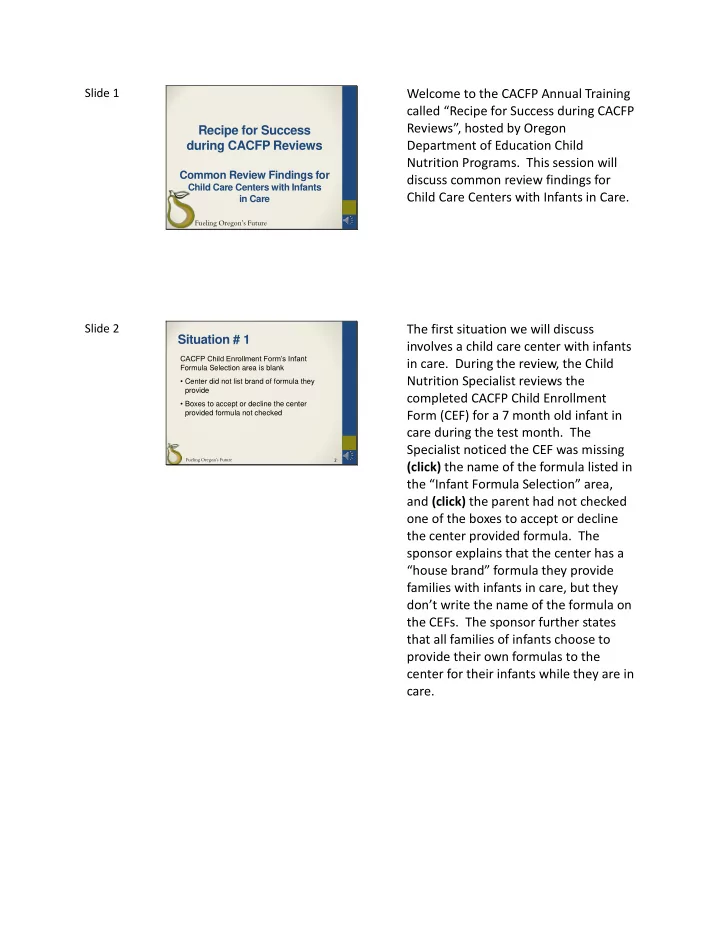
Welcome to the CACFP Annual Training called “Recipe for Success during CACFP Reviews”, hosted by Oregon Department of Education Child Nutrition Programs. This session will discuss common review findings for Child Care Centers with Infants in Care.

Slide 2

Fueling Oregon’s Future

Situation # 1

CACFP Child Enrollment Form’s Infant Formula Selection area is blank

  • Center did not list brand of formula they

provide

  • Boxes to accept or decline the center

provided formula not checked

2

The first situation we will discuss involves a child care center with infants in care. During the review, the Child Nutrition Specialist reviews the completed CACFP Child Enrollment Form (CEF) for a 7 month old infant in care during the test month. The Specialist noticed the CEF was missing (click) the name of the formula listed in the “Infant Formula Selection” area, and (click) the parent had not checked

  • ne of the boxes to accept or decline

the center provided formula. The sponsor explains that the center has a “house brand” formula they provide families with infants in care, but they don’t write the name of the formula on the CEFs. The sponsor further states that all families of infants choose to provide their own formulas to the center for their infants while they are in care.

slide-2
SLIDE 2

Slide 3

Fueling Oregon’s Future

Why

Infant Formula Selection Section of the CEF is not completed for each infant

  • Program meals offered to all eligible

children in care

  • Claim meals for infants with a signed &

complete CEF

3

Chapter 5 - Section A; Chapter 9 –Sections A & E 7 CFR 226.20(b)

Situation #1 is a finding. (click) The Infant Formula Selection Section of the CACFP Child Enrollment form is not completed for each infant in care before claiming infant meals for reimbursement. (click) Sponsors participating in CACFP must offer Program meals to all eligible children enrolled in their center. Program regulations define an enrolled child as a child whose parent or guardian has submitted to an institution a signed document which indicated that the child is enrolled in child care. A center may not avoid this

  • bligation by stating that the infant is

not enrolled in the CACFP, or by citing logistical or cost barriers to offering infant meals. Decisions on offering Program meals must be based on whether the child is enrolled for care, not if the child is enrolled in the CACFP. As long as an infant is in care during the meal service period, the center must

  • ffer the infant a meal that complies

with Program requirements. Also, parents or guardians cannot be required or coerced to supply formula

  • r solid foods for their infant who is

participating in the CACFP. (click) Sponsors may not claim reimbursement for meals served to an infant without a signed and complete CACFP Child Enrollment Form on file. A complete CEF form includes when the brand name of sponsor offered formula is listed and the parent/guardian has checked either they accept or decline the offered formula.

slide-3
SLIDE 3

(click) CACFP Child Enrollment Forms requirements for infants in care can be found in the CACFP Policy & Procedure Manual, Chapter 5 – Section A. Requirements for the obligation to offer meals to infants in care is in Chapter 9 – Section A and information regarding claiming infant meals is in Chapter 9 - Section E. (Click) The Federal regulation governing this topic is 7 CFR 226.20(b).

Slide 4

Fueling Oregon’s Future

How To Correct

Infant Formula Selection Section of the CEF is not completed for each infant

  • Develop and implement a procedure
  • Provide training to all pertinent staff

4

Now let’s discuss corrections to prevent this finding. To correct, the sponsor would need to (click) develop and implement a procedure that ensures the Infant Formula Selection Section of the CACFP Child Enrollment form is completed for each infant in care. The procedure would need to include the staff position responsible for each step of the

  • procedure. The center may choose to

make a master copy of the CEF and put the name of the brand of infant formula the center provides on the

  • form. This way all copies of the CEF will

have the “house brand” of formula written on the form. Only parents with infants in care are required to complete the Infant Formula Selection area. (click) In addition, the sponsor needs to train site staff on ensuring the Infant Formula Selection area of the CACFP Child Enrollment Form is completed. Records of this training need to be available for review.

slide-4
SLIDE 4

Slide 5

Fueling Oregon’s Future

Situation # 2

Infant menu records do not document formula

  • n the Infant Menu record.
  • Formula is documented on the CEF only

5

For the second situation, we will discuss infant meals claimed for reimbursement that did not meet meal pattern requirements. The sponsor provides the Child Nutrition Specialist all infant menu records for the test month of February. During the review of the records, the Child Nutrition Specialist observes that “formula” was not documented on the daily Infant Menu record for meals claimed for reimbursement. (click) The Sponsor explains to the Specialist the brand name of the formula is documented on the CEF. Since the parent indicated they accept the sponsor-provided formula offered, the sponsor did not think they had to document formula on the Infant Menu record.

Slide 6

Fueling Oregon’s Future

Why

Infant Meals claimed do not meet meal pattern requirements

  • Formula must be listed on the Infant

Menu record

  • Sponsor did not adequately train staff

Chapter 9 – Sections A and D 7 CFR 226.20(b)

6

Situation #2 is a finding. (click) Infant meals claimed during the test month of February do not meet meal pattern requirements. (click) The meals served to the infant did not meet the infant meal pattern requirements because “formula” was not recorded on the daily Infant Menu record for meals claimed for

  • reimbursement. The daily Infant Menu

record must document all required components were offered to the infant. Since “formula” was missing from the Infant Menu record, the documented meal did not show compliance to the Infant meal pattern. (click) Additionally, the sponsor has not

slide-5
SLIDE 5

adequately trained the infant room teachers and staff to fully complete the daily Infant Menu record, to include the infant formula for each meal or snack served. (click) Infant Feeding requirements can be found in the CACFP Policy & Procedure Manual Chapter 9 – Section A, which talks about Infant Meal Pattern requirements and Section D, which talks about Infant Feeding Recordkeeping requirements. (Click) The Federal regulation governing this topic is 7 CFR 226.20(b).

Slide 7

Fueling Oregon’s Future

How To Correct

Infant Meals claimed do not meet meal pattern requirements

  • Develop and implement a procedure
  • Provide training to staff

7

Now let’s discuss corrections you can make to prevent the finding in Situation #2. To meet infant meal pattern requirements, the sponsor should: (click) Develop, implement and submit to ODE CNP a procedure to ensure that

  • nly infant meals meeting meal pattern

requirements are claimed for

  • reimbursement. Include in the

procedure:

  • The position/title of the person(s)

involved in documenting infant meals on infant menu production records.

  • A description of the double check

method used to ensure that infant meals are accurately documented

  • n the infant menu production

record.

  • The timeline for recording infant

meals on the infant menu production records.

  • The position/title of the person(s)

responsible for determining that

slide-6
SLIDE 6

the infant meal is reimbursable. (click) In addition, sponsors need to provide training to infant teaching staff

  • n infant feeding record keeping
  • requirements. At minimum training

must include the CACFP infant meal pattern including non-creditable foods, point of service meal counts, distribution, collection, and completion

  • f the Infant Formula Selection Section
  • f the CACFP Child Enrollment Form,

and completing Daily Infant Feeding Menu Records. Staff should also be trained on how to transition infants to the next meal pattern at the required

  • time. Training documentation records

must be maintain on file and available for review.

Slide 8

Fueling Oregon’s Future

Resources

CACFP Policy & Procedure Manual:

www.ode.state.or.us/wma/nutrition/cacfp/centermanu al.pdf

7 CFR 226: 7 CFR 226 *

* This link can also be found on this page:

http://www.ode.state.or.us/search/page/?id=3285

ODE CNP CACFP training page:

http://www.ode.state.or.us/search/page/?id=3281

8

All resources discussed during this training, including: the CACFP Policy and Procedure Manual and the 7 CFR 226 are all available on ODE CNP public website at the links included on the screen. In addition, sponsors may access online trainings that address Meal Counts, Menu Records and Meal Pattern compliance at the link located on the slide.

slide-7
SLIDE 7

Slide 9

In accordance with Federal civil rights law and U.S. Department of Agriculture (USDA) civil rights regulations and policies, the USDA, its Agencies, offices, and employees, and institutions participating in or administering USDA programs are prohibited from discriminating based on race, color, national origin, sex, disability, age, or reprisal or retaliation for prior civil rights activity in any program or activity conducted or funded by USDA. Persons with disabilities who require alternative means of communication for program information (e.g. Braille, large print, audiotape, American Sign Language, etc.), should contact the Agency (State or local) where they applied for

  • benefits. Individuals who are deaf, hard of hearing or have speech disabilities may contact USDA through the

Federal Relay Service at (800) 877-8339. Additionally, program information may be made available in languages

  • ther than English.

T

  • file a program complaint of discrimination, complete the USDA Program Discrimination Complaint Form, (AD-

3027) found online at: http://www.ascr.usda.gov/complaint_filing_cust.html, and at any USDA office, or write a letter addressed to USDA and provide in the letter all of the information requested in the form. T

  • request a copy of the

complaint form, call (866) 632-9992. Submit your completed form or letter to USDA by: (1) mail: U.S. Department of Agriculture Office of the Assistant Secretary for Civil Rights 1400 Independence Avenue, SW Washington, D.C. 20250-9410; (2) fax: (202) 690-7442; or (3) email: program.intake@usda.gov This institution is an equal opportunity provider.

Thank you for participating in Child Care Centers with Infants in Care Training for Child and Adult Care Food

  • Program. If you have any questions

please contact your assigned Child Nutrition Specialist. We greatly appreciate the work that you do to fuel Oregon’s future.