Welcome to the CACFP Annual Training called Recipe for Success - - PDF document

welcome to the cacfp annual training called recipe for
SMART_READER_LITE
LIVE PREVIEW

Welcome to the CACFP Annual Training called Recipe for Success - - PDF document

Slide 1 Welcome to the CACFP Annual Training called Recipe for Success during CACFP Recipe for Success Reviews, hosted by the Oregon during CACFP Reviews Department of Education Child Nutrition Programs. This session will Common


slide-1
SLIDE 1

Slide 1

Fueling Oregon’s Future

Recipe for Success during CACFP Reviews

Common Review Findings for Family Day Care Home Sponsors

Welcome to the CACFP Annual Training called “Recipe for Success during CACFP Reviews”, hosted by the Oregon Department of Education Child Nutrition Programs. This session will discuss common review findings for Family Day Care Home Sponsors.

Slide 2

Fueling Oregon’s Future

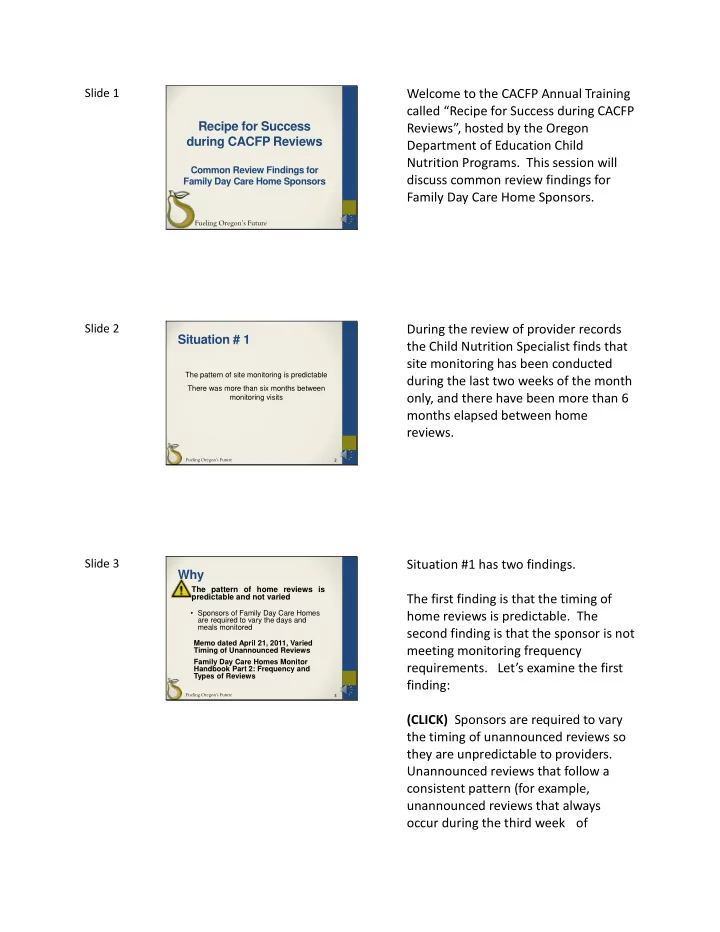
Situation # 1

The pattern of site monitoring is predictable There was more than six months between monitoring visits

2

During the review of provider records the Child Nutrition Specialist finds that site monitoring has been conducted during the last two weeks of the month

  • nly, and there have been more than 6

months elapsed between home reviews.

Slide 3

Fueling Oregon’s Future

Why

The pattern of home reviews is predictable and not varied

  • Sponsors of Family Day Care Homes

are required to vary the days and meals monitored Memo dated April 21, 2011, Varied Timing of Unannounced Reviews Family Day Care Homes Monitor Handbook Part 2: Frequency and Types of Reviews

3

Situation #1 has two findings. The first finding is that the timing of home reviews is predictable. The second finding is that the sponsor is not meeting monitoring frequency

  • requirements. Let’s examine the first

finding: (CLICK) Sponsors are required to vary the timing of unannounced reviews so they are unpredictable to providers. Unannounced reviews that follow a consistent pattern (for example, unannounced reviews that always

  • ccur during the third week of
slide-2
SLIDE 2

January, the third week of May, and the third week of September, or reviews that never occur during the first week

  • f the month when claims are being

processed) undermine the intent of the Program’s unannounced review requirements. (CLICK) Information on the varied timing of review requirements can be found in the April 21, 2011 memo - Varied Timing of Unannounced Review. As well as, the Family Day Care Homes Monitor Handbook , Part 2 – Frequency and Types of Reviews. A link to the resources will be available at the end of this presentation.

Slide 4

Fueling Oregon’s Future

Why

Out of Compliance with Monitoring Frequency Requirements

  • No more than 6 months may pass between reviews
  • Sponsors must ensure that all monitoring

requirements are met:

  • 3 Reviews per federal fiscal year
  • 2 out of the 3 unannounced
  • 1 unannounced review must include a meal

service

  • Pre-Approval and 4 week follow up visits must be

completed for new providers

Family Day Care Homes Monitor Handbook Part 2: Frequency and Types of Reviews 7 CFR 226.16(d)(4)(iii) 4

The second finding is not meeting the monitoring frequency requirements, due to 6 months having had elapsed between home reviews. The sponsor is outside the monitoring frequency requirements. (CLICK) In order for Family Day Care Home sponsors to meet federal regulations for monitoring requirements, no more than 6 months may pass between reviews. (CLICK) Sponsors must ensure that all monitoring requirements are met, including:

  • 3 reviews per fiscal year, which

is October 1 – September 30

  • 2 out of the 3 reviews must be

unannounced, and conducted during the home’s regular hours of day care

  • peration
slide-3
SLIDE 3
  • At least one unannounced

review must include observation of a meal service;

  • and Pre-Approval and 4 week

follow up visits must be completed for new providers. (CLICK) Information on monitoring frequency requirements can be found in the USDA Family Day Care Home Monitor Handbook Part 2: Frequency and Types of Reviews. (CLICK) Information on Monitoring requirements can be found in the regulation listed on this slide. A link to the manual will be listed on the resources slide at the end of this presentation.

Slide 5

Fueling Oregon’s Future

How To Correct

The pattern of home reviews is predictable and not varied Out of Compliance with Monitoring Frequency

  • Develop and implement and a

procedure to conduct and track reviews

5

Now lets discuss corrections you can make to prevent these findings from

  • ccurring.
  • To correct finding 1, the pattern of

home reviews is predictable and not varied, and finding 2, the sponsor is out of compliance with monitoring frequency, the Sponsor would need to develop and implement a procedure that addresses:

  • Tracking to ensure no more

than 6 months has elapsed between the reviews,

  • How reviews are varied,

including documenting the days of the week that reviews are completed, as well as the meal type that was reviewed.

  • How reviews are tracked for
slide-4
SLIDE 4

each provider and,

  • Tracking when providers

close, or take temporary leaves of absence including maternity/paternity leave, family illness. Both findings are related to conducting and tracking home reviews, the corrections may be placed together in

  • ne procedure, or the sponsor may

choose to create two procedures.

Slide 6

Fueling Oregon’s Future

Situation # 2

5 day reconciliation was not completed during home review

6

Now let’s review situation number 2. During the review the Child Nutrition Specialist conducts provider home visits with the Sponsor’s Monitor. During the visits, the monitor did not complete a 5 day reconciliation. The Child Nutrition Specialist requests that the monitor complete a 5 day reconciliation.

Slide 7

Fueling Oregon’s Future

Why

Failure to complete required review elements FDCH reviews must include:

  • Comparison of meal counts with

enrollment and attendance

  • Consecutive 5 day operating period
  • Review the current or previous

claiming month USDA FDCH Monitor Handbook Part 3: Review Elements Regulation 7 CFR 226.16(d)(4)(ii)

7

Situation # 2 has one finding. The Monitor failed to complete required review elements. (CLICK) Sponsors must ensure that all required review requirements are met, which includes completing and documenting a five day reconciliation. The monitor’s review must include a comparison of meal counts with enrollment and attendance records. The 5 days of the reconciliation must be consecutive and they must be days the provider actually operated. The 5 day reconciliation must be completed for

slide-5
SLIDE 5

either the current claiming month or the previous claiming month. (CLICK) Information on Review Elements can be found in the USDA Family Day Care Home Monitor Handbook Section 3: Review Elements. A link to the manual is listed on the resources slide at the end of this

  • presentation. Information on review

elements can also be found in, federal regulations listed on this slide.

Slide 8

Fueling Oregon’s Future

How To Correct

Failure to complete required review elements

  • Complete Training
  • Training documentation

8

Now let’s discuss corrections you can make to prevent this finding from

  • ccurring.

To correct the finding, failure to complete required review elements, the sponsor would need to re-train staff

  • n how to complete a 5-day

reconciliation, and document the completed training. The training documentation shall include, the position/title of the person(s) conducting the training, and the agenda, the training date, and the printed names and signatures of the persons attending the training.

slide-6
SLIDE 6

Slide 9

Fueling Oregon’s Future

Situation # 3

Review form is missing:

  • Dates for 5 day reconciliation
  • Meals disallowed
  • Have past issues been corrected

9

Now let’s review situation #three. During the administrative review, the Child Nutrition Specialist receives a copy of the sponsor’s review form that is used during home reviews by the

  • monitor. The review form does not

document the dates of the 5 day reconciliation, if meals were disallowed as a result of the 5 day reconciliation and whether or not past issues had been corrected.

Slide 10

Fueling Oregon’s Future

Why

10

Review Form is missing required review elements

The Sponsor’s developed review form must include a field to:

  • Prompt follow up on findings from previous

review(s)

  • Dates chosen for the 5 day reconciliation
  • The meals disallowed as a result of the 5 day

reconciliation and the reason for each USDA FDCH Monitor Handbook Part 1: Monitor Responsibilities and Training Part 3: Review Elements Regulation 7 CFR 226.16(d)(4)(i) 7 CFR 226.16(d)(4)(ii)

Situation #3 is a finding. The Sponsor’s review form is missing required review elements. (CLICK) The sponsor’s developed review form must include: (CLICK) a field to prompt the reviewer to follow up on findings from previous review(s), (CLICK) document the dates chosen for the 5 day reconciliation, and (CLICK) to document the meals disallowed as a result of the 5 day reconciliation and the reason for each. (CLICK) For more information on the required review elements read the USDA FDCH Monitor Handbook Part 1and Part 3: Review Elements: a link to the manual will be listed on the resources slide at the end of this

  • presentation. In addition, the federal

regulations listed on this slide addresses review elements.

slide-7
SLIDE 7

Slide 11

Fueling Oregon’s Future

How To Correct

Review form is missing required review elements

  • Update review form
  • Train staff

11

Now let’s discuss corrections you can make to prevent this finding from

  • ccurring.

(CLICK) To correct the finding, the review form is missing required review elements, the sponsor will need to update the review form to include: a field to document the dates of the 5- day reconciliation, a place to document the meals disallowed and the reason why and, a field to prompt the reviewer to follow up on findings from the previous review. (CLICK) The sponsor will also need to re-train the appropriate staff on how to accurately complete the updated review form and the new fields. The training documentation shall include the position/title of the person or persons conducting the training, the agenda, the training date, and the printed names and signatures of the persons attending the training.

slide-8
SLIDE 8

Slide 12

Fueling Oregon’s Future

Situation # 4

  • Staff training is not documented
  • Documents available for review is dated

two years prior to the review

12

During the CACFP Administrative Review, the Sponsor was not able to (click) produce documentation of staff training conducted within the last 12

  • months. (CLICK) The training

documentation available was dated two years prior to the review.

Slide 13

Fueling Oregon’s Future

Why

13

Staff Training is Not Documented

  • Required to annually train all staff with

CACFP responsibilities

  • Document training
  • Collect and maintain program records

Regulation 7CFR226.15(e)(12) and (e)(14) 7CFR226.16(d)(2) and (d)(3)

Situation #4 is a finding. (click) The Sponsor was not able to produce documentation for staff training in the last 12 months. The Sponsor is required to annually train and (click)document training for all staff with CACFP responsibilities. (click) The Sponsor must also establish procedures to collect and maintain all program records. Training documentation must include:

  • The date of the training session,
  • Location of the training session,
  • The topics/agenda presented
  • The name and position of the

presenter

  • The names and signatures of the

persons trained The ODE CNP reviewer will review training documentation for the previous 12 months. (click) The federal regulations listed on this slide describes the regulations regarding staff training. A link to the CFR and manual is listed on the resources slide at the end of this presentation.

slide-9
SLIDE 9

Slide 14

Fueling Oregon’s Future

How To Correct

Staff Training Not Documented

Develop and implement a written plan to annually train staff on CACFP requirements. Include in the plan:

  • A timeline for training new staff
  • The schedule for annual training of all staff
  • The form used for documenting the

training

  • The position/title of staff responsible for

conducting training

  • Train all staff with CACFP responsibilities

14

Now let’s discuss how to prevent findings in this area. When annual staff training is not documented, a written plan to annually train staff in all CACFP requirements is

  • needed. The written plan should

include

  • (click) A timeline for training new

staff on CACFP requirements and recordkeeping

  • (click) The schedule for the annual

training for all staff on CACFP requirements, recordkeeping and Civil Rights

  • (click) The form used for

documenting all training provided to staff.

  • (click) The position(s)/title(s) of the

person(s) responsible for conducting new staff training and the annual staff training. (click) Additionally the sponsor is required to train all staff with CACFP responsibilities on CACFP requirements.

Slide 15

Fueling Oregon’s Future

Situation # 5

Provider Files Are Missing the Following:

  • Original Application
  • Original Agreement
  • Completed Review Reports
  • Tiering Documentation

15

During the CACFP Administrative Review, the ODE CNP reviewer identifies that the provider files are missing required documentation in a large number of the providers files, including (click) original applications, (click) original signed agreements, (click) completed review reports, and (click) tiering documentation.

slide-10
SLIDE 10

Slide 16

Fueling Oregon’s Future

Why

16

Failure to Maintain Required Records Must maintain all application and supporting documents for each provider. Provider Files must include:

  • Original Application and Signed Agreement
  • Completed Review Reports
  • Tiering Documentation

Regulation 7 CFR 226.16(e)

Situation #5 is a finding. (CLICK) The sponsor is required to maintain all applications and supporting documents for each provider. The provider files must include, but is not limited to: (CLICK) Original Application and signed agreement (CLICK) Completed Review Reports (CLICK) Tiering Documentation (CLICK) The federal regulation is listed

  • n this slide, describes the regulation

regarding recordkeeping. A link to the CFR is listed at the end of this presentation.

Slide 17

Fueling Oregon’s Future

How To Correct

  • Failure to Maintain Required

Records

  • Develop and implement procedures to

collect, update and maintain all program records

  • Train staff of recordkeeping requirements

17

Now let’s discuss how to prevent findings in this area.

  • (CLICK) Develop and implement

procedures to implement, collect, update, maintain, and store CACFP records according to CACFP

  • requirements. Include in the

procedures the positions or titles of staff responsible for each step.

  • (CLICK) Also you will want to train

staff on recordkeeping requirements

slide-11
SLIDE 11

Slide 18

Fueling Oregon’s Future

Resources

USDA Family Day Care Homes Monitor Handbook

http://www.ode.state.or.us/wma/nutrition/cacfp/fdch- monitor-handbook.pdf

Child and Adult Food Program Regulations

http://www.ecfr.gov/cgi-bin/text- idx?c=ecfr&SID=86570c8e304645e5da8d64b9d778e428&rgn=div5&vi ew=text&node=7:4.1.1.1.5&idno=7 18

All resources discussed during this training, including : the USDA Family Day Care Homes Monitor Handbook and the CACFP Regulations are available on the ODE CNP public website at the links included on this slide.

Slide 19

In accordance with Federal civil rights law and U.S. Department of Agriculture (USDA) civil rights regulations and policies, the USDA, its Agencies, offices, and employees, and institutions participating in or administering USDA programs are prohibited from discriminating based on race, color, national origin, sex, disability, age, or reprisal or retaliation for prior civil rights activity in any program or activity conducted or funded by USDA. Persons with disabilities who require alternative means of communication for program information (e.g. Braille, large print, audiotape, American Sign Language, etc.), should contact the Agency (State or local) where they applied for

  • benefits. Individuals who are deaf, hard of hearing or have speech disabilities may contact USDA through the

Federal Relay Service at (800) 877-8339. Additionally, program information may be made available in languages

  • ther than English.

T

  • file a program complaint of discrimination, complete the USDA Program Discrimination Complaint Form, (AD-

3027) found online at: http://www.ascr.usda.gov/complaint_filing_cust.html, and at any USDA office, or write a letter addressed to USDA and provide in the letter all of the information requested in the form. T

  • request a copy of the

complaint form, call (866) 632-9992. Submit your completed form or letter to USDA by: (1) mail: U.S. Department of Agriculture Office of the Assistant Secretary for Civil Rights 1400 Independence Avenue, SW Washington, D.C. 20250-9410; (2) fax: (202) 690-7442; or (3) email: program.intake@usda.gov This institution is an equal opportunity provider.

Thank you for participating in Recipe for Success during CACFP reviews training on common reviewing findings for Family Daycare Home Sponsors Training for Child and Adult Care Food

  • Program. If you have any questions

please contact your assigned Child Nutrition Specialist. We greatly appreciate the work that you do to fuel Oregon’s future.