Slide 1 ___________________________________ - - PDF document

slide 1
SMART_READER_LITE
LIVE PREVIEW

Slide 1 ___________________________________ - - PDF document

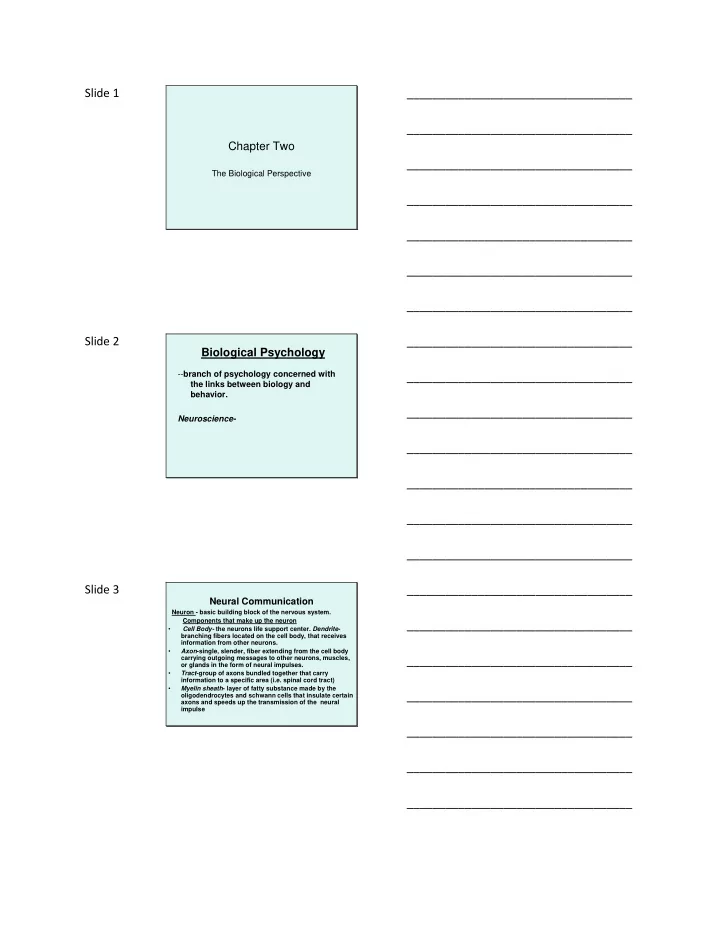
Slide 1 ___________________________________ ___________________________________ Chapter Two ___________________________________ The Biological Perspective ___________________________________ ___________________________________


slide-1
SLIDE 1

Slide 1

Chapter Two

The Biological Perspective

___________________________________ ___________________________________ ___________________________________ ___________________________________ ___________________________________ ___________________________________ ___________________________________ Slide 2

Biological Psychology

  • -branch of psychology concerned with

the links between biology and behavior. Neuroscience-

___________________________________ ___________________________________ ___________________________________ ___________________________________ ___________________________________ ___________________________________ ___________________________________ Slide 3

Neural Communication

Neuron - basic building block of the nervous system. Components that make up the neuron

  • Cell Body- the neurons life support center. Dendrite-

branching fibers located on the cell body, that receives information from other neurons.

  • Axon-single, slender, fiber extending from the cell body

carrying outgoing messages to other neurons, muscles,

  • r glands in the form of neural impulses.
  • Tract-group of axons bundled together that carry

information to a specific area (i.e. spinal cord tract)

  • Myelin sheath- layer of fatty substance made by the
  • ligodendrocytes and schwann cells that insulate certain

axons and speeds up the transmission of the neural impulse

___________________________________ ___________________________________ ___________________________________ ___________________________________ ___________________________________ ___________________________________ ___________________________________

slide-2
SLIDE 2

Slide 4

Types of Neurons

  • Sensory (afferent) Neurons- neurons that

collect messages from sense organs and carry those messages to the spinal cord or brain.

  • Motor (efferent) Neurons-neurons that carry

messages from the spinal cord or the brain to the muscles and glands

  • Interneurons (association) Neurons- neurons

that carry messages from one neuron to another.

___________________________________ ___________________________________ ___________________________________ ___________________________________ ___________________________________ ___________________________________ ___________________________________ Slide 5

Neural Impulse-method of communication between neurons

  • A neural impulse is an electrical

charge that travels down the axon causing the neuron to fire.

  • This electrically charged impulse

allows the neuron to communicate with

  • ther neurons and is called an Action

Potential

___________________________________ ___________________________________ ___________________________________ ___________________________________ ___________________________________ ___________________________________ ___________________________________ Slide 6

Composition of Intra and Extra- cellular Fluid

  • Electrically charged ions on either side of the
  • membrane. Intra-cellular fluid is predominately

negative and extra-cellular fluid is predominately positive in relation to each other.

  • Intra-cellular fluid-Higher concentration of:

– Negative Ion-(Cation)-A- – K+

  • Extra-cellular fluid-

– Na+ – Cl-

___________________________________ ___________________________________ ___________________________________ ___________________________________ ___________________________________ ___________________________________ ___________________________________

slide-3
SLIDE 3

Slide 7

Action Potential

  • Resting Potential- small negative electrical charge across the neuron

due to the concentration of positive ions on the outside and negative ions on the inside.

  • Due to negative electrical charge, the neuron at rest is said to be in a

state of polarization.

  • Incoming signals from other neurons stimulate receiving neurons at

the dendrites through binding of Neurotransmitter.

  • When the NT binds, local channels open and briefly change the

polarity which results in a graded potential.

  • When there are enough graded potentials in succession, channels
  • pen allowing positive ions from the outside to enter the interior of

the neuron.

  • Entrance of the positive ions into the cell body depolarizes the

neuron, changing the interior from negative to more positive, setting

  • ff a chain reaction that eventually sends an electrical charge (action

potential), down the axon.

___________________________________ ___________________________________ ___________________________________ ___________________________________ ___________________________________ ___________________________________ ___________________________________ Slide 8

Selective Permeability

  • Neuron is semi-permeable, meaning some ions

can flow freely in and out while other ions cannot due to different types of channels which are

  • pen or closed.
  • Channels-( open when neuron is at rest)

– Both K+ and Cl- channels are open while neuron is at rest and freely cross the semi-permeable membrane. – Although the K+ and Cl- ions are free to move in and

  • ut of the neuron when it is at rest, whether ions

move in or out is influenced by the electrical and concentration of ions.

  • Pumps-Na+/K+ pump
  • 3 Na+ ions are pumped out
  • 2 + ions are pumped in
  • helps to maintain the concentration and electrical

gradient.

___________________________________ ___________________________________ ___________________________________ ___________________________________ ___________________________________ ___________________________________ ___________________________________ Slide 9

Voltage gated Channels

  • Voltage gated channels are closed when

membrane is at rest

  • Voltage gated channels begin to open when

there is a change in the voltage of the neuron.

  • Different voltage gated channels open and close

and different times.

– Sodium (Na+) channels-open FIRST and more quickly than K+ initiate depolarization – Potassium ions (K+)- open later than Na+ gates, but close more slowly-contribute to hyperpolarization through the efflux ( leaving the cell ) of K+ = neuron becomes more negative..

___________________________________ ___________________________________ ___________________________________ ___________________________________ ___________________________________ ___________________________________ ___________________________________

slide-4
SLIDE 4

Slide 10

Propagation of Action Potential

  • aka. When the Neuron fires.
  • Neurotransmitters stimulate the neuron via dendrites,

which influence the opening and closing of voltage channels.

– Action potential is a sequence of events – Na+ channels open first, allowing positive ions to rush in and allowing the inside of the neuron to be more positive.

  • Graded potential -stimulation via NT is not always

enough to open enough gates to cause a change in polarity that is enough to reach threshold. Therefore a brief sudden change in polarity is a graded potential and the neuron remains at rest.

___________________________________ ___________________________________ ___________________________________ ___________________________________ ___________________________________ ___________________________________ ___________________________________ Slide 11

Action Potential

  • Threshold Potential- As more NT

stimulates the dendrites, we see a summation of graded potentials, which isis enough to begin the sequence of events that changes the polarity of the neuron when the neuron reaches threshold.

  • All or None Response- once the axon

reaches threshold it fires, it does not fire at any greater speed or stronger response. It either fires, or it does not.

___________________________________ ___________________________________ ___________________________________ ___________________________________ ___________________________________ ___________________________________ ___________________________________ Slide 12

Sending the Message to other cells.

  • Propagation- the action potential begins at the

axon hillock of the soma and continues down the axon.

  • As Na+ gates open the electrical impulse

continues to travel down the axon.

  • As Na+ gates close, no more positive ions can

enter from the Na+ gates.

  • K+ gates open later, and stay open longer

which allows K+ to leave the neuron while it has a positive charge.

  • ___________________________________

___________________________________ ___________________________________ ___________________________________ ___________________________________ ___________________________________ ___________________________________

slide-5
SLIDE 5

Slide 13 ___________________________________ ___________________________________ ___________________________________ ___________________________________ ___________________________________ ___________________________________ ___________________________________ Slide 14

C

___________________________________ ___________________________________ ___________________________________ ___________________________________ ___________________________________ ___________________________________ ___________________________________ Slide 15

Hyperpolarization

  • The action potential sequence takes less

than one-thousandth of a second.

  • After the action potential fires, the neuron

re-polarizes to its former resting state.

  • After the Na+ voltage gated channels

close, the K+ voltage gated channels remain open, allowing the neuron to be more negative than resting potential which is called Hyperpolarization.

___________________________________ ___________________________________ ___________________________________ ___________________________________ ___________________________________ ___________________________________ ___________________________________

slide-6
SLIDE 6

Slide 16

Repolarization

  • Absolute Refractory Period- period

after the neuron fires when it will not fire again no matter how strong the

  • signal. (Neuron is hyper-polarized)
  • Relative Refractory Period-period

after firing when the cell is returning to its normal polarized state (negative) and will fire again only if the incoming signal is much stronger than usual.

___________________________________ ___________________________________ ___________________________________ ___________________________________ ___________________________________ ___________________________________ ___________________________________ Slide 17

Synapse & Synaptic Transmission

  • As the action potential travels down the axon it reaches the

terminal buttons at the end of the axon.

  • Terminal button –tip of the axon from which the neural

impulse is released out into the synapse in the form of chemicals called neurotransmitters.

  • Synapse- tiny gap between the axon tip of one neuron and

the dendrite or cell body of the next neuron.

  • Neurotransmitter Release – release of chemicals from axon

terminals into the synapse when the neural impulse reaches the end of the axon.

  • Vesicles –tiny sacs filled with NT that release the NT into the

synapse, where it binds to receptor sites on the receiving neuron.

  • Binding of the NT sends a chemical signal which activates

the next neuron by binding at the receptor sites.

___________________________________ ___________________________________ ___________________________________ ___________________________________ ___________________________________ ___________________________________ ___________________________________ Slide 18 ___________________________________ ___________________________________ ___________________________________ ___________________________________ ___________________________________ ___________________________________ ___________________________________

slide-7
SLIDE 7

Slide 19

Types of Synapses

  • Excitatory Synapse-synapse at which a

neurotransmitter causes the receiving cell to fire.

  • Inhibitory Synapse-synapse at which a

neurotransmitter causes the receiving cell to stop firing  cessation of pain signal.

  • It is not the NT that is excitatory or

inhibitory, but rather the synapse to which the NT binds.

___________________________________ ___________________________________ ___________________________________ ___________________________________ ___________________________________ ___________________________________ ___________________________________ Slide 20

Drugs and Neurotransmitters

  • Drugs are synthesized molecules that are

similar enough in shape to a specific neurotransmitter, so that the drug can fit into the receptor site.

  • Agonists-chemical substances that can mimic
  • r enhance the effects of the

neurotransmitters on the receptor site of the next cell.

  • Antagonist-chemical substance that blocks or

reduces the cells response to the action of

  • ther chemicals or neurotransmitters.

___________________________________ ___________________________________ ___________________________________ ___________________________________ ___________________________________ ___________________________________ ___________________________________ Slide 21

Drug Effects

  • AgonistExcitatory synapse
  • AgonistInhibitory synapse
  • AntagonistExcitatory synapse
  • AntagonistInhibitory synapse
  • Re-uptake
  • Re-uptake inhibitor

___________________________________ ___________________________________ ___________________________________ ___________________________________ ___________________________________ ___________________________________ ___________________________________

slide-8
SLIDE 8

Slide 22

How Neurotransmitters influence Us

  • Acetylcholine (Ach)-triggers muscle

contraction.

  • Dopamine-NT involved with voluntary

movement, learning, memory and emotions.

  • Serotonin_primarily involved in mood

and depression. Also important in regulation of sleep and appetite.

  • Endorphins (endogenous morphine)-

natural opiate released in response to pain and vigorous exercise

___________________________________ ___________________________________ ___________________________________ ___________________________________ ___________________________________ ___________________________________ ___________________________________ Slide 23 ___________________________________ ___________________________________ ___________________________________ ___________________________________ ___________________________________ ___________________________________ ___________________________________ Slide 24

Central Nervous system

  • Includes all of the neurons in the brain and

spinal cord. Two main areas of the CNS:

– Brain – Spinal Cord

___________________________________ ___________________________________ ___________________________________ ___________________________________ ___________________________________ ___________________________________ ___________________________________

slide-9
SLIDE 9

Slide 25

Subdivisions of the brain

  • Central Core- earliest part of the brain to

develop.

– Hindbrain: point where the spinal cord enters the skull. Contains the medulla, pons and cerebellum

  • Medulla-controls basic body functions such as

breathing, heart rate, and blood pressure.

  • Pons- maintains the bodies sleep wake cycle
  • Cerebellum-sense of balance and coordinating the

bodies actions

– Thalmus-major sensory relay center, integrates and shapes incoming signals – Hypothalamus-governs hunger thirst, sex drive and body temperature.

___________________________________ ___________________________________ ___________________________________ ___________________________________ ___________________________________ ___________________________________ ___________________________________ Slide 26 ___________________________________ ___________________________________ ___________________________________ ___________________________________ ___________________________________ ___________________________________ ___________________________________ Slide 27 ___________________________________ ___________________________________ ___________________________________ ___________________________________ ___________________________________ ___________________________________ ___________________________________

slide-10
SLIDE 10

Slide 28

Limbic System

  • Located on top of and around the central

core.

  • Composed of a set of structures that impose

additional controls over instinctive behaviors regulated by the central core.

  • Associated with emotions such as fear and

aggression, and drives such as food and sex

– Hippocampus-formation of new memories – Amygdala-governs emotions related to self preservation

___________________________________ ___________________________________ ___________________________________ ___________________________________ ___________________________________ ___________________________________ ___________________________________ Slide 29

Cerebral Cortex

  • More highly developed in humans than in any other

animal.

  • Literally covers the central core and limbic system
  • Divided into two cerebral hemispheres, right and left.

Each hemisphere is further divided into four lobes.

  • The central fissure runs sideways form ear to ear

and separates the primary somatosensory cortex from the primary motor cortex.

  • Primary somatosensory cortex-receives sensory

messages from the entire body.

  • Primary motor cortex-sends messages from the

brain to muscles and glands

___________________________________ ___________________________________ ___________________________________ ___________________________________ ___________________________________ ___________________________________ ___________________________________ Slide 30 ___________________________________ ___________________________________ ___________________________________ ___________________________________ ___________________________________ ___________________________________ ___________________________________

slide-11
SLIDE 11

Slide 31

Functional Lobes of the Cerebral Cortex

  • Four lobes, two in each hemisphere, for example, right and

left frontal lobe, etc.

  • Occipital - Receives and processes visual information.

Damage: “blind sight”

  • Temporal -Regulates hearing, smell, balance and

equilibrium, emotion and motivation, some language comprehension and complex visual processing such as recognizing faces. Damage: prosopagnosia

  • Parietal – Receives sensory information from all over the

body and registers these messages in the primary somatosensory cortex. Regulates spatial and mathematical

  • abilities. Damage: neglect.,
  • Frontal lobe- executive function--receives and coordinates

messages from the other three lobes. Also appears to play a key role in personality, motivation, persistence, affect (mood) and character traits such as moral character: Damage: Phineas Gage

___________________________________ ___________________________________ ___________________________________ ___________________________________ ___________________________________ ___________________________________ ___________________________________ Slide 32

Spinal Cord

  • Consists of soft jelly-like bundles of axons,

protected by the vertebrae

  • Two pathways-descending motor, ascending

sensory

  • Motor-carries information from the brain controls

internal organs, muscles, and autonomic nervous system

  • Sensory-carries information from the organs and

extremities to the brain.

  • Reflex-circuit that does not require input from the

brain…sensory fibers send info to the spinal cord where interneurons pass info to motor fibers causing withdrawl reflex, before brain has registered what has happened.

___________________________________ ___________________________________ ___________________________________ ___________________________________ ___________________________________ ___________________________________ ___________________________________ Slide 33 ___________________________________ ___________________________________ ___________________________________ ___________________________________ ___________________________________ ___________________________________ ___________________________________

slide-12
SLIDE 12

Slide 34

Peripheral Nervous system-

  • (def). the sensory and motor neurons that

connect the CNS to the rest of the body. Autonomic

  • Sympathetic
  • Parasympathetic

Somatic-

  • ___________________________________

___________________________________ ___________________________________ ___________________________________ ___________________________________ ___________________________________ ___________________________________ Slide 35

ENDOCRINE SYSTEM

  • (def)-chemical communication system,

slower than electrical, consists of glands that secrete hormones into the blood- stream.

  • Hormones-
  • Endocrine glands-

– Thyroid gland - – Parathyroid- – Pineal gland- – Pancreas- – Pituitary gland- – Adrenal gland-

___________________________________ ___________________________________ ___________________________________ ___________________________________ ___________________________________ ___________________________________ ___________________________________ Slide 36 ___________________________________ ___________________________________ ___________________________________ ___________________________________ ___________________________________ ___________________________________ ___________________________________