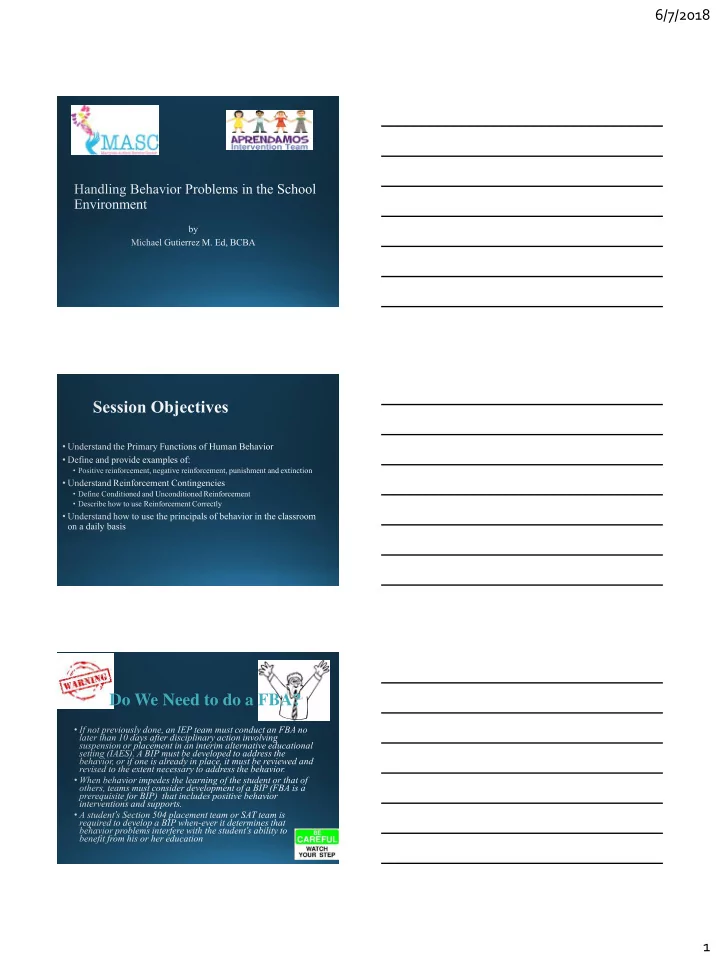
Do We Need to do a FBA? . 1 6/7/2018 There is a LOT we can do to - - PDF document

do we need to do a fba
SMART_READER_LITE
LIVE PREVIEW

Do We Need to do a FBA? . 1 6/7/2018 There is a LOT we can do to - - PDF document

6/7/2018 Do We Need to do a FBA? . 1 6/7/2018 There is a LOT we can do to change students problem behavior(s) This starts with student learning 2 6/7/2018 1. 2. 3 6/7/2018 Manage De- Set up Understand your own escalate


slide-1
SLIDE 1

6/7/2018 1

Do We Need to do a FBA?

.

slide-2
SLIDE 2

6/7/2018 2

There is a LOT we can do to change student’s problem behavior(s) This starts with student learning……

slide-3
SLIDE 3

6/7/2018 3

1. 2.

slide-4
SLIDE 4

6/7/2018 4

Understand why students misbehave Manage your own emotions as a provider De- escalate crises with your students Set up prevention plans for any repeat problems

slide-5
SLIDE 5

6/7/2018 5

Explanatory Fiction

Why does Johnny leave his seat frequently? He has ADHD (condition) How do you know he has ADHD?

Because he leaves his seat frequently (symptom)

DON’T Attribute cause of a behavior to a process or a thing (i.e., behavior is a symptom of some underlying condition)

Why does Matt hit his head

  • n the

wall? He has Autism (condition ) How do you know he has Autism? Because he hits his head on the wall (symptom)

slide-6
SLIDE 6

6/7/2018 6

Respondent Operant

  • Behavior is elicited by antecedent

stimuli

  • Antecedent stimulus
  • Causes the response
  • Behavior is evoked by antecedent stimuli
  • Antecedent stimulus changes

probability of whether response will

  • ccur again
  • Behavior is involuntary (i.e., reflexive)
  • Eye blink
  • Salivating
  • Heart beating fast
  • Typically involves action from

autonomic nervous system

  • Association between involuntary

response and stimulus

  • Behavior is voluntary
  • Throwing a ball
  • Singing
  • Eating
  • Association between voluntary

response and consequence

  • A & B (2 term contingency)
  • S-->R
  • A, B, & C (3 term contingency)
  • R-->S
  • Behavior is maintained by its

consequence

Review of Classic and Operant Conditioning

slide-7
SLIDE 7

6/7/2018 7 The Bottom Line

Reinforcement Punishment Positive Present something to increase behavior Present something to decrease behavior Negative Remove something to increase behavior Remove something to decrease behavior

slide-8
SLIDE 8

6/7/2018 8

  • What's’ the function?
  • Correct:
  • Incorrect:
  • Positive =
  • Negative =

idiosyncratic

slide-9
SLIDE 9

6/7/2018 9

  • Remember that all behaviors, good and bad, are performed because they are reinforced

in some way. Undesired behaviors can be eliminated by determining how the behavior is being reinforced and removing the reinforcer.

  • When feasible, use differential reinforcement rather than punishment to eliminate

undesired behaviors.

  • When you use punishment, make sure students know exactly why they are being

punished.

  • Make sure the chosen negative consequence is indeed a punishment for the individual

in question.

slide-10
SLIDE 10

6/7/2018 10

Principles governing reinforcement

anything

slide-11
SLIDE 11

6/7/2018 11

GIVE something desirable TAKE AWAY something undesirable

Student completes a task sheet Take away three task sheets (reduce workload) Increases the likelihood that the student will complete a task in the future

Positive Reinforcement Negative Reinforcement

Reinforcement vs. bribery

Reinforcement Bribery

slide-12
SLIDE 12

6/7/2018 12

Reinforcement vs. bribery

Reinforcement Bribery

Main difference: When delivering a reinforcer:

  • You communicate ahead of time (i.e.,

BEFORE the bad behavior occurs) what behaviors will and will not access a reinforcer

slide-13
SLIDE 13

6/7/2018 13

The way that learned reinforcers are learned is through pairing.

slide-14
SLIDE 14

6/7/2018 14

slide-15
SLIDE 15

6/7/2018 15

slide-16
SLIDE 16

6/7/2018 16

Altering the Consequences

Earned with tokens Earned with a response

slide-17
SLIDE 17

6/7/2018 17

Common Challenging Behaviors that Teachers Deal with on a Daily Basis

slide-18
SLIDE 18

6/7/2018 18

slide-19
SLIDE 19

6/7/2018 19

Questions, Comments, Etc.

slide-20
SLIDE 20

6/7/2018 20