SLIDE 1
1 What is the name of the following statement: "When two systems are in thermal equilibrium with a third system, then they are in thermal equilibrium with each other"?
A First Law of Thermodynamics B
Second Law of Thermodynamics
C
Mechanical Equivalent of Heat
D
Zeroth Law of Thermodynamics
E
Thermal Expansion of Solids
Slide 1 / 66
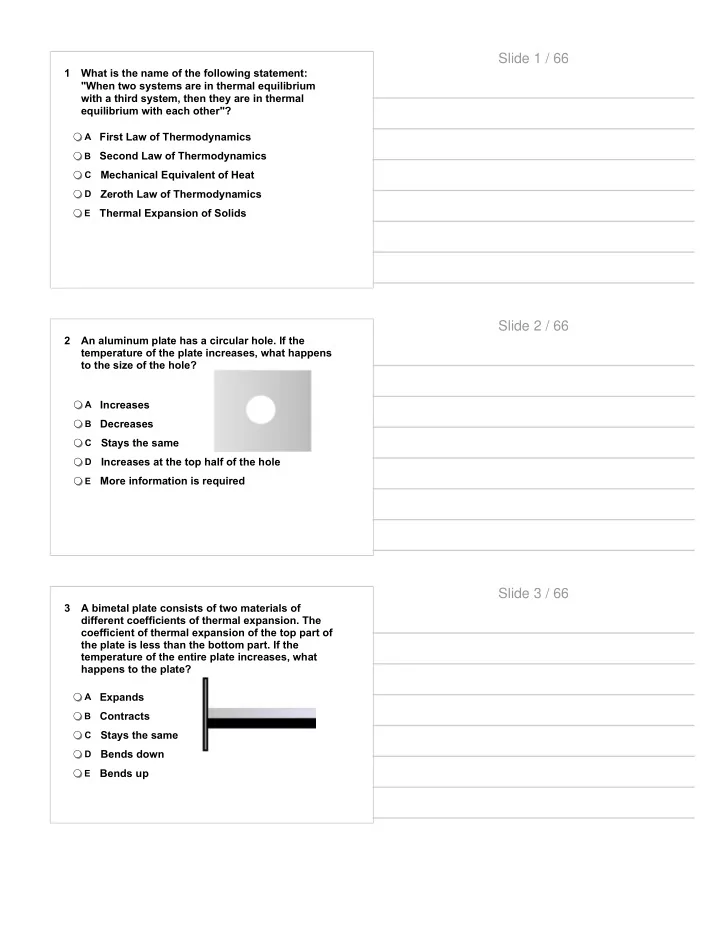
2 An aluminum plate has a circular hole. If the temperature of the plate increases, what happens to the size of the hole?
A Increases B
Decreases
C
Stays the same
D
Increases at the top half of the hole
E
More information is required
Slide 2 / 66
3 A bimetal plate consists of two materials of different coefficients of thermal expansion. The coefficient of thermal expansion of the top part of the plate is less than the bottom part. If the temperature of the entire plate increases, what happens to the plate?
A
Expands
B
Contracts
C
Stays the same
D
Bends down
E
Bends up
Slide 3 / 66
SLIDE 2
4 Which of the following temperature scales doesn't have negative numbers?
A Celsius B
Kelvin
C
Reaumur
D
Fahrenheit
E
Galileo
Slide 4 / 66
5 Which of the two temperature changes are equivalent?
A 1 K = 1 F B
1 F = 1 C
C
1 Re = 1 F
D
1 K = 1 C
E
1 Re = 1 K
Slide 5 / 66
6 The state of an ideal gas was changed three times at three different temperatures. The diagram represents three different isothermal curves. Which of the following is true about the temperature of the gas?
A
T1 > T2 > T3
B
T1 > T2 < T3
C
T1 < T2 < T3
D
T1 > T2 = T3
E
T1 = T2 > T3
Slide 6 / 66
SLIDE 3
7 A container is filled with a sample of an ideal gas at a pressure of 1.5 atm. The gas is compressed isothermally to one-fourth of its original volume. What is the new pressure of the gas?
A 2 atm B
3 atm
C
4 atm
D
5 atm
E
6 atm
Slide 7 / 66
8 The state of an ideal gas was changed three times in a way that the pressure stays the same. The graph represents three isobaric lines. Which of the following is true about the pressure of the gas?
A
P1 > P2 < P3
B
P1 > P2 > P3
C
P1 < P2 < P3
D
P1 = P2 > P3
E
P1 > P2 = P3
Slide 8 / 66
9 The temperature of an ideal gas increases from 20O C to 40O C while the pressure stays the same. What happens to the volume of the gas?
A It doubles B
It quadruples
C
It is cut to one-half
D
It is cut to one-fourth
E
It slightly increases
Slide 9 / 66
SLIDE 4 10 The state of an ideal gas was changed three times in a way that the volume stays the same. The graph represents three isobaric lines. Which of the following is true about the volume of the gas?
A
V1 > V2 > V3
B
V1 > V2 < V3
C
V1 < V2 < V3
D
V1 = V2 > V3
E
V1 > V2 = V3
Slide 10 / 66
11 A container with rigid walls filled with a sample of ideal gas. The absolute temperature of the gas is
- doubled. What happens to the pressure of the
gas?
A Doubles B
Quadruples
C
Triples
D
Decreased to one-half
E
Decreased to one-fourth
Slide 11 / 66
12 The absolute temperature of an ideal diatomic gas is quadrupled. What happens to the average speed of the molecules?
A
Quadruples
B
Doubles
C
Triples
D
Increases by a factor of 1.41
E
Stays the same
Slide 12 / 66
SLIDE 5 13 Two containers are filled with diatomic hydrogen gas and diatomic oxygen gas. The gases have the same temperature. Compare the average speed of the hydrogen molecules to the average speed of the oxygen molecules.
A 1/16 B
1/4
C
16/1
D
1/2
E
4/1
Slide 13 / 66
14 The average molecular kinetic energy of a gas depends on:
A
Pressure
B
Volume
C
Temperature
D
Number of holes
E
None of the above
Slide 14 / 66
15 Kinetic Theory is based on an ideal gas model. The following statements about the ideal gas are true EXCEPT:
A The average molecular kinetic energy is directly proportional
to the absolute temperature
B
All molecules move with the same speed
C
All molecules make elastic collisions with each other and the walls of the container
D
The attractive force between the molecules can be ignored
E
All molecules obey laws of classical mechanics
Slide 15 / 66
SLIDE 6 16 Internal energy of an ideal gas depends on:
- I. the volume of the ideal gas.
- III. the pressure of the ideal gas
- III. the absolute temperature of the ideal gas.
A I B
II
C
III
D
I and II
E
I, II, and III
Slide 16 / 66
17 A sample of ideal gas has an internal energy U and is then compressed to one-half of its original volume while the temperature stays the same. What is the new internal energy of the ideal gas in terms of U?
A U B
U/2
C
U/4
D
2U
E
4U
Slide 17 / 66
18 An ideal gas with an internal energy U initially at 0O C is heated to 273 C. What is the new internal energy in terms of U?
A U B
U/2
C
U/4
D
2U
E
4U
Slide 18 / 66
SLIDE 7 19 Mechanical equivalent is associated with:
A Newton B
Kelvin
C
Joule
D
Boltzmann
E
Avogadro
Slide 19 / 66
20 Three containers filled with 1 kg each of: water, ice, and water vapor are at the same temperature T = 0 C. Which of the following is true about the internal energy of the substances?
A
U water > U ice > U vapor
B
U water < U ice > U vapor
C
U water = U ice = U vapor
D
U water < U ice < U vapor
E
U ice < U water < U vapor
Slide 20 / 66
21 A silver tea spoon is placed in a cup filled with hot
- tea. After some time, the exposed end of the
spoon becomes hot even without direct contact with the liquid. This phenomenon can be explained by:
A
Thermal Expansion
B
Conduction
C
Convection
D
Radiation
E
Emission
Slide 21 / 66
SLIDE 8 22 The process of heat transfer from object to another object because of molecular motion and interaction is called:
A Convection B
Conduction
C
Radiation
D
Induction
E
None of the above
Slide 22 / 66
23 A hot object with a temperature of T1 is connected to a cool object with a temperature of T2. The
- bject used to conduct the heat has a length L
and a cross-sectional area A. The rate of heat flow is:
A A(T1 – T2)/kL B
k(T1 – T2)/AL
C
kAL/(T1 – T2)
D
kL(T1 – T2)/A
E
kA(T1 – T2)/L
Slide 23 / 66
24 When we touch a piece of metal and a piece of wood that are placed in the same room, the piece
- f metal feels much colder than the piece of wood.
This happens because of the difference in:
A
Specific Heat
B
Temperature
C
Density
D
Thermal Conductivity
E
Latent Heat
Slide 24 / 66
SLIDE 9
25 The process of heat transfer by the movement of mass from one place to another is called:
A Convection B
Conduction
C
Radiation
D
Induction
E
None of the above
Slide 25 / 66
26 Which mechanism of heat transfer is involved in heating a pot with water on a stove?
A Convection B
Conduction
C
Radiation
D
Induction
E
None of the above
Slide 26 / 66
27 Which mechanism of heat transfer is involved in heat flow from the Sun to the Earth?
A Convection B
Conduction
C
Radiation
D
Induction
E
None of the above
Slide 27 / 66
SLIDE 10
28 If the absolute temperature of a radiating object is doubled, by what factor does the rate of energy emission change?
A 2 B
4
C
8
D
16
E
32
Slide 28 / 66
29 The state of an ideal gas changed isothermally from position 1 to position 2 is shown below. What is the change in the internal energy of the gas during the process?
A ΔU = W B
ΔU = Q
C
ΔU > 0
D
ΔU = 0
E
ΔU < 0
Slide 29 / 66
30 An ideal gas is taken from state 1 to state 2 and then to state 3. If the process 1-2 is adiabatic and 2-3 is isothermal, what is a true statement about the change in temperature and heat transferred during 1-2?
A ΔT > 0, Q > 0 B
ΔT < 0, Q = 0
C
ΔT = 0, Q = 0
D
ΔT > 0, Q < 0
E
ΔT = 0, Q < 0
Slide 30 / 66
SLIDE 11 31 The state of an ideal gas is changed in a closed path 1→2→3→4→1. Which of the following is true about work done on the gas?
A W > 0
W = 0 W < 0 W = 0
B
W < 0 W = 0 W = 0 W > 0
C
W < 0 W = 0 W > 0 W = 0
D
W = 0 W > 0 W = 0 W < 0
E
W = 0 W < 0 W = 0 W > 0
Work 1→2 Work 2→3 Work 3→4 Work 4→1
Slide 31 / 66
32 The change of the state of an ideal gas is presented by the diagram. What is the ratio between work done on the gas during the process 2→3 and the work done on the gas during the process 4→1?
A 2/1 B
1/2
C
4/1
D
1/4
E
3/1
Slide 32 / 66
33 An ideal gas is taken through a closed path 1→2→ 3→4→1. What is the net work done by the gas?
A 6PV B
9PV
C
4PV
D
E
Slide 33 / 66
SLIDE 12 34 Which of the following is a characteristic of an adiabatic process?
A ΔU = 0 B
W = 0
C
Q = 0
D
ΔV = 0
E
ΔP = 0
Slide 34 / 66
35 A sample of an ideal gas taken through a closed cycle is presented by the P-V
1-2 is perfectly
the following is true about the change in internal energy and work done by the gas during the process 1-2?
A
Δ U = 0 W by the gas > 0
B
Δ U > 0 W by the gas = 0
C
Δ U < 0 W by the gas < 0
D
Δ U = 0 W by the gas = 0
E
Δ U = 0 W by the gas < 0
Slide 35 / 66
36 A sample of an ideal gas taken through a closed cycle is presented by the P-V
1-2 is perfectly
the following is true about the change in internal energy and work done by the gas during the process 3-1?
A Δ U = 0 Q > 0 B
Δ U > 0 Q > 0
C
Δ U < 0 Q < 0
D
Δ U = 0 Q = 0
E
Δ U = 0 Q < 0
Slide 36 / 66
SLIDE 13 37 The state of an ideal gas is changed in four different steps: A→B, B→C, C→D, D→A. The gas is moved from the state C to the state D
which process is no work done by the gas?
A A→B B
B→C
C
C→D
D
D→A
E
More information is required
Slide 37 / 66
38 An ideal gas undergoes a cyclic process presented by the P-V diagram. which of the following points has the highest temperature?
A B C D E
Slide 38 / 66
39 An ideal gas can be taken from point K to point N in three different paths: K→L→N, K→N, K→M→N. Which of the following is a true statement?
A The same work is done
during each process
B
The same amount of heat is added to the gas during each process
C
The same change in internal energy occurs during each process
D
There is no work done in the process K→N
E
There is no change in internal energy during the process K→L→N
Slide 39 / 66
SLIDE 14 40 An ideal heat engine operates between two temperatures: 600 K and 900 K. What is the efficiency of the engine?
A 50% B
80%
C
100%
D
10%
E
33%
Slide 40 / 66
- 1. 2 moles of a monatomic ideal gas is placed
under a piston in a cylindrical container. The piston can move freely up and down without friction and its diameter is 20 cm. A 50 kg weight is placed on the top of the piston. The initial temperature of the gas is 0O C.
- a. Calculate the absolute pressure in the container.
- b. Calculate the volume of the gas.
The gas is heated to a temperature of 100O C at constant pressure.
- c. Calculate the new volume of the gas.
- d. Calculate the amount of work done by the gas during
its expansion.
- e. Calculate the change in internal energy of the gas.
- f. Calculate the amount of heat added to the gas.
Slide 41 / 66
- 1. 2 moles of a monatomic ideal gas is placed
under a piston in a cylindrical container. The piston can move freely up and down without friction and its diameter is 20 cm. A 50 kg weight is placed on the top of the piston. The initial temperature of the gas is 0O C.
- a. Calculate the absolute pressure in the container.
Slide 42 / 66
SLIDE 15
- 1. 2 moles of a monatomic ideal gas is placed
under a piston in a cylindrical container. The piston can move freely up and down without friction and its diameter is 20 cm. A 50 kg weight is placed on the top of the piston. The initial temperature of the gas is 0O C.
- b. Calculate the volume of the gas.
Slide 43 / 66
- 1. 2 moles of a monatomic ideal gas is placed
under a piston in a cylindrical container. The piston can move freely up and down without friction and its diameter is 20 cm. A 50 kg weight is placed on the top of the piston. The initial temperature of the gas is 0O C. The gas is heated to a temperature of 100O C at constant pressure.
- c. Calculate the new volume of the gas.
Slide 44 / 66
- 1. 2 moles of a monatomic ideal gas is placed
under a piston in a cylindrical container. The piston can move freely up and down without friction and its diameter is 20 cm. A 50 kg weight is placed on the top of the piston. The initial temperature of the gas is 0O C. The gas is heated to a temperature of 100O C at constant pressure.
- d. Calculate the amount of work done by the gas during
its expansion.
Slide 45 / 66
SLIDE 16
- 1. 2 moles of a monatomic ideal gas is placed
under a piston in a cylindrical container. The piston can move freely up and down without friction and its diameter is 20 cm. A 50 kg weight is placed on the top of the piston. The initial temperature of the gas is 0O C. The gas is heated to a temperature of 100O C at constant pressure.
- e. Calculate the change in internal energy of the gas.
Slide 46 / 66
- 1. 2 moles of a monatomic ideal gas is placed
under a piston in a cylindrical container. The piston can move freely up and down without friction and its diameter is 20 cm. A 50 kg weight is placed on the top of the piston. The initial temperature of the gas is 0O C. The gas is heated to a temperature of 100O C at constant pressure.
- f. Calculate the amount of heat added to the gas.
Slide 47 / 66
monatomic ideal gas is taken from state A to state B isobarically.
done on the gas during the process A→B?
in internal energy UA – UB?
- c. Is heat added or removed from the gas during the
process A→B?
- d. How much heat is added or removed from the gas?
The state of the gas is changed from B→C where the pressure drops to 300 Pa without any change in volume and after the gas is compressed to point A isothermally.
- e. On the diagram below show the complete cycle
A→B→C→A.
Slide 48 / 66
SLIDE 17
monatomic ideal gas is taken from state A to state B isobarically.
done on the gas during the process A→B?
Slide 49 / 66
monatomic ideal gas is taken from state A to state B isobarically.
in internal energy UA – UB?
Slide 50 / 66
monatomic ideal gas is taken from state A to state B isobarically.
removed from the gas during the process A→B?
Slide 51 / 66
SLIDE 18
monatomic ideal gas is taken from state A to state B isobarically.
added or removed from the gas?
Slide 52 / 66
- 2. One mole of a monatomic ideal gas is taken from
state A to state B isobarically. The state of the gas is changed from B→C where the pressure drops to 300 Pa without any change in volume and after the gas is compressed to point A isothermally.
- e. On the diagram below show the complete cycle
A→B→C→A.
Slide 53 / 66
taken from state a to state c in three different paths: a→b→c, a→d→c, and curved path a→c. The pressure of the ideal gas at point a is three times the pressure at point d. Use the following information to answer all questions: Qa→c = -120 J (curved path) Wa→c = 75 J (curved path) Wa→d→c = 95 J Ua – Ud = 20 J In the given information above we assume that work is done
- n the gas.
- a. Find the change in internal energy Ua –Uc.
- b. Find the heat added to the gas in the process
a→d→c.
- c. Find the work done on the gas in the process a→b→c.
- d. Find the heat added to the gas in the process
a→b→c.
Slide 54 / 66
SLIDE 19
- 3. An ideal gas can be taken from state a to state c in
three different paths: a→b→c, a→d→c, and curved path a→c. The pressure of the ideal gas at point a is three times the pressure at point d. Use the following information to answer all questions: Qa→c = -120 J (curved path) Wa→c = 75 J (curved path) Wa→d→c = 95 J Ua – Ud = 20 J In the given information above we assume that work is done on the gas.
- a. Find the change in internal energy Ua –Uc.
Slide 55 / 66
- 3. An ideal gas can be taken from state a to state c in
three different paths: a→b→c, a→d→c, and curved path a→c. The pressure of the ideal gas at point a is three times the pressure at point d. Use the following information to answer all questions: Qa→c = -120 J (curved path) Wa→c = 75 J (curved path) Wa→d→c = 95 J Ua – Ud = 20 J In the given information above we assume that work is done on the gas.
- b. Find the heat added to the gas in the process
a→d→c.
Slide 56 / 66
- 3. An ideal gas can be taken from state a to state c in
three different paths: a→b→c, a→d→c, and curved path a→c. The pressure of the ideal gas at point a is three times the pressure at point d. Use the following information to answer all questions: Qa→c = -120 J (curved path) Wa→c = 75 J (curved path) Wa→d→c = 95 J Ua – Ud = 20 J In the given information above we assume that work is done on the gas.
- c. Find the work done on the gas in the process
a→b→c.
Slide 57 / 66
SLIDE 20
- 3. An ideal gas can be taken from state a to state c in
three different paths: a→b→c, a→d→c, and curved path a→c. The pressure of the ideal gas at point a is three times the pressure at point d. Use the following information to answer all questions: Qa→c = -120 J (curved path) Wa→c = 75 J (curved path) Wa→d→c = 95 J Ua – Ud = 20 J In the given information above we assume that work is done on the gas.
- d. Find the heat added to the gas in the process
a→b→c.
Slide 58 / 66
- 4. One mole of an ideal gas is
taken through a closed cycle A→B→C→A. Use the information from the graph to answer the following questions:
- a. Find the temperature at point A.
- b. Is the net work done by the gas positive or
negative? Explain.
- c. How much work is done by the gas?
- d. Is heat added to the gas or removed from the gas
for the entire cycle? Explain.
- e. How much heat is added to the gas?
f. What is the change in internal energy for the entire cycle?
Slide 59 / 66
- 4. One mole of an ideal gas is
taken through a closed cycle A→B→C→A. Use the information from the graph to answer the following questions:
- a. Find the temperature at point A.
Slide 60 / 66
SLIDE 21
- 4. One mole of an ideal gas is
taken through a closed cycle A→B→C→A. Use the information from the graph to answer the following questions:
- b. Is the net work done by the gas positive or
negative? Explain.
Slide 61 / 66
- 4. One mole of an ideal gas is
taken through a closed cycle A→B→C→A. Use the information from the graph to answer the following questions:
- c. How much work is done by the gas?
Slide 62 / 66
- 4. One mole of an ideal gas is
taken through a closed cycle A→B→C→A. Use the information from the graph to answer the following questions:
- d. Is heat added to the gas or removed from the gas
for the entire cycle? Explain.
Slide 63 / 66
SLIDE 22
- 4. One mole of an ideal gas is
taken through a closed cycle A→B→C→A. Use the information from the graph to answer the following questions:
- e. How much heat is added to the gas?
Slide 64 / 66
- 4. One mole of an ideal gas is
taken through a closed cycle A→B→C→A. Use the information from the graph to answer the following questions: f. What is the change in internal energy for the entire cycle?
Slide 65 / 66 Slide 66 / 66