SLIDE 1 Slide 1 / 48
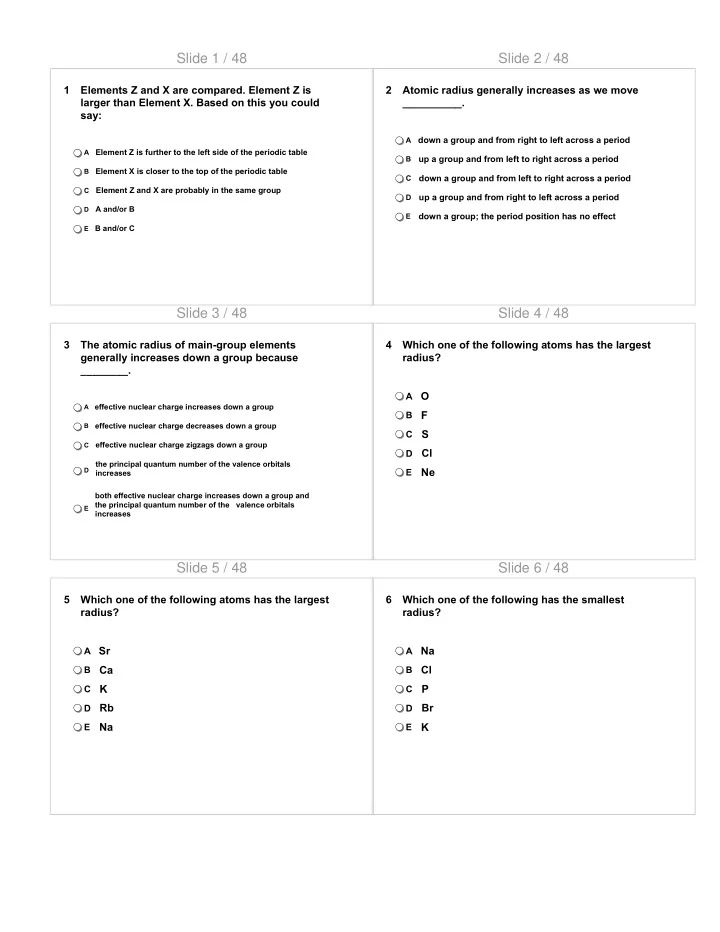
1 Elements Z and X are compared. Element Z is larger than Element X. Based on this you could say:
A Element Z is further to the left side of the periodic table B
Element X is closer to the top of the periodic table
C
Element Z and X are probably in the same group
D
A and/or B
E
B and/or C
Slide 2 / 48
2 Atomic radius generally increases as we move __________.
A down a group and from right to left across a period B
up a group and from left to right across a period
C
down a group and from left to right across a period
D
up a group and from right to left across a period
E
down a group; the period position has no effect
Slide 3 / 48
3 The atomic radius of main-group elements generally increases down a group because ________.
A effective nuclear charge increases down a group B
effective nuclear charge decreases down a group
C
effective nuclear charge zigzags down a group
D
the principal quantum number of the valence orbitals increases
E
both effective nuclear charge increases down a group and the principal quantum number of the valence orbitals increases
Slide 4 / 48
4 Which one of the following atoms has the largest radius?
A O B F C
S
D
Cl
E
Ne
Slide 5 / 48
5 Which one of the following atoms has the largest radius?
A Sr B Ca C
K
D
Rb
E
Na
Slide 6 / 48
6 Which one of the following has the smallest radius?
A Na B
Cl
C
P
D
Br
E
K
SLIDE 2 Slide 7 / 48
7 Which one of the following atoms has the largest radius?
A I B Co C
Ba
D
Sr
E
Ca
Slide 8 / 48
8 Which one of the following elements has the largest atomic radius?
A Se B As C
S
D
Sb
E
Te
Slide 9 / 48
9 Which one of the following elements has the largest atomic radius?
A O B F C
Al
D
P
E
B
Slide 10 / 48
10 In which of the following atoms is the 2s orbital closest to the nucleus?
A S B Cl C
P
D
Si
E
They are the same distance in all of these atoms.
Slide 11 / 48
11 Which of the following correctly lists the five atoms in order of increasing size (smallest to largest)?
A F < K < Ge < Br < Rb B
F < Ge < Br < K < Rb
C
F < K < Br < Ge < Rb
D
F < Br < Ge < K < Rb
E
F < Br < Ge < Rb < K
Slide 12 / 48
12 In which of the following atoms is the 3s orbital closest to the nucleus?
A Br B Cl C
At
D
I E
They are the same distance in all of these atoms.
SLIDE 3 Slide 13 / 48
13 Which of the following correctly lists the five atoms in order of increasing size (smallest to largest)?
A O < F < S < Mg < Ba B
F < O < S < Mg < Ba
C
F < O < S < Ba < Mg
D
O < F < S < Ba < Mg
E
F < S < O < Mg < Ba
Slide 14 / 48
14 Which ion below has the largest radius?
A Cl- B
K+
C
Br-
D
F-
E
Na+
Slide 15 / 48
15 The ion with the smallest diameter is __________.
A Br- B Cl- C
I-
D
F-
E
O2-
Slide 16 / 48
16 The most common sulfur ion has a charge of __________.
A 2- B 1- C
4+
D
6+
E
Sulfur does not form ions.
Slide 17 / 48
17 Chlorine is much more apt to exist as an negative ion than is sodium. This is because __________.
A chlorine is bigger than sodium B chlorine has a greater ionization energy than sodium does C
chlorine has a greater electronegativity than sodium does
D
chlorine is a gas and sodium is a solid
E
chlorine is more metallic than sodium
Slide 18 / 48
18 Sodium is much more apt to exist as a positive ion than is chlorine. This is because __________.
A chlorine is a gas and sodium is a solid B chlorine has a greater electron affinity than sodium does C
chlorine is bigger than sodium
D
chlorine has a greater ionization energy than sodium does
E
chlorine is more metallic than sodium
SLIDE 4 Slide 19 / 48
19 Of the following species, __________ has the largest radius.
A Rb+ B
Sr2+
C
Br-
D
Kr
E
Ar
Slide 20 / 48
20 Which of the following is an isoelectronic series? [*]
A B5-, Sr4-, As3-, Te2- B
F-, Cl-, Br-, I-
C
S, Cl, Ar, K
D
Si2-, P2-, S2-, Cl2-
E
O2-, F-, Ne, Na+
Slide 21 / 48
21 Which isoelectronic series is correctly arranged in order of increasing radius?
A K+ < Ca2+ < Ar < Cl- B
Cl- < Ar < K+ < Ca2+
C
Ca2+ < Ar < K + < Cl
Ca2+ < K+ < Ar < Cl-
E
Ca2+ < K+ < Cl- < Ar
Slide 22 / 48
22 __________ is isoelectronic with argon and __________ is isoelectronic with neon.
A Cl-, F- B
Cl-, Cl+
C
F+, F-
D
Ne-, Kr+
E
Ne-, Ar+
Slide 23 / 48
23 The ability of an atom in a molecule to attract electrons is best quantified by the __________.
A paramagnetism B
diamagnetism
C
electronegativity
D
first ionization potential
E
electron change-to-mass ratio
Slide 24 / 48
24 Electronegativity __________ from left to right within a period and __________ from top to bottom within a group.
A decreases, increases B
increases, increases
C
increases, decreases
D
stays the same, increases
E
increases, stays the same
SLIDE 5
Slide 25 / 48
25 Of the atoms below, __________ is the most electronegative.
A Br B
O
C
Cl
D
N
E
F
Slide 26 / 48
26 Of the atoms below, __________ is the most electronegative.
A Si B
Cl
C
Rb
D
Ca
E
S
Slide 27 / 48
27 Of the atoms below, __________ is the least electronegative.
A Rb B F C
Si
D
Cl
E
Ca
Slide 28 / 48
28 Which of the elements below has the largest electronegativity?
A Si B Mg C
P
D
S
E
Na
Slide 29 / 48
29 In general, as you go across a period in the periodic table from left to right: (1) the atomic radius __________; (2) the electronegativity __________; and (3) the first ionization energy __________. A decreases, decreases, increases B increases, increases, decreases C increases, increases, increases D decreases, increases, increases E decreases, increases, decreases
Slide 30 / 48
30 The first ionization energies of the elements __________ as you go from left to right across a period of the periodic table, and __________ as you go from the bottom to the top of a group in the table. A increase, increase B increase, decrease C decrease, increase D decrease, decrease E are completely unpredictable
SLIDE 6
Slide 31 / 48
31 Of the choices below, which gives the order for first ionization energies?
A Cl > S > Al > Ar > Si B
Ar > Cl > S > Si > Al
C
Al > Si > S > Cl > Ar
D
Cl > S > Al > Si > Ar
E
S > Si > Cl > Al > Ar
Slide 32 / 48
32 Of the following atoms, which has the largest first ionization energy?
A Br B
O
C
C
D
P
E
I
Slide 33 / 48
33 Of the following elements, which has the largest first ionization energy?
A Na B Al C
Se
D
Cl
E
Br
Slide 34 / 48
34 Of the following elements, which has the largest first ionization energy?
A K B
Rb
C
Sr
D
Ca
E
Ba
Slide 35 / 48
35 Of the following elements, which has the largest first ionization energy?
A Se B As C
S
D
Sb
E
Ge
Slide 36 / 48
36 Of the following elements, which has the largest first ionization energy?
A B B
N
C
P
D
Si
E
C
SLIDE 7 Slide 37 / 48
37 Of the elements below, __________ has the largest first ionization energy.
A Li B K C
Na
D
H
E
Rb
Slide 38 / 48
38 __________ have the lowest first ionization energies of the groups listed.
A Alkali metals B
Transition metals
C
Halogens
D
Alkaline Earth metals
E
Noble gases
Slide 39 / 48
39 Which equation correctly represents the first ionization of aluminum? [*]
A Al- (g) Al (g) + e- B
Al (g) Al
C
Al (g) + e- Al
D
Al (g) Al
+ (g) + e-
E
Al+ (g) + e- Al (g)
Slide 40 / 48
40 Which of the following correctly represents the second ionization of aluminum? [*]
A Al+ (g) + e- Al(g) B
Al (g) Al
+ (g) + e-
C
Al+ (g) Al2+ (g) + e-
D
Al+ (g) + e- Al
2+ (g)
E
Al+ (g) Al
2+ (g) + e-
Slide 41 / 48
41 Which equation correctly represents the first ionization of phosphorus?
A P(g) + e- P
B
P(g) P- (g) + e-
C
P(g) P+ (g) + e-
D
P- (g) P (g) + e-
E
P+ (g) + e- P(g)
Slide 42 / 48
42 Which of the following correctly represents the second ionization of phosphorus?
A P+ (g) + e- P2+ (g) B
P(g) P+ (g) + e-
C
P- (g) + e- P2- (g)
D
P+ (g) P2+ (g) + e-
E
P+ (g) + e- P (g)
SLIDE 8
Slide 43 / 48
43 Which equation correctly represents the first ionization of Barium? [*]
A Ba (g) Ba+ (g) + e- B
Ba (g) Ba- (g) + e-
C
Ba (g) + e- Ba- (g)
D
Ba- (g) Ba (g) + e-
E
Ba+ (g) + e- Ba (g)
Slide 44 / 48
44 Which of the following correctly represents the second ionization of calcium? [*]
A Ca (g) Ca+ (g) + e- B
Ca+ (g) Ca2+ (g) + e-
C
Ca- (g) + e- Ca2- (g)
D
Ca+ (g) + e- Ca2+ (g)
E
Ca+ (g) + e- Ca (g)
Slide 45 / 48
45 Of the elements below, __________ is the most metallic.
A Na B Mg C
Al
D
K
E
Ar
Slide 46 / 48
46 The list that correctly indicates the order of metallic character is __________.
A B > N > C B
F > Cl > S
C
Si > P > S
D
P > S > Se
E
Na > K > Rb
Slide 47 / 48
47 Between which two elements is the difference in metallic character the greatest?
A Rb and O B
O and I
C
Rb and I
D
Li and O
E
Li and Rb
Slide 48 / 48