Slide 1 / 42 Momentum Free Response Problems Slide 2 / 42 1. - - PDF document

slide 1 42
SMART_READER_LITE
LIVE PREVIEW

Slide 1 / 42 Momentum Free Response Problems Slide 2 / 42 1. - - PDF document

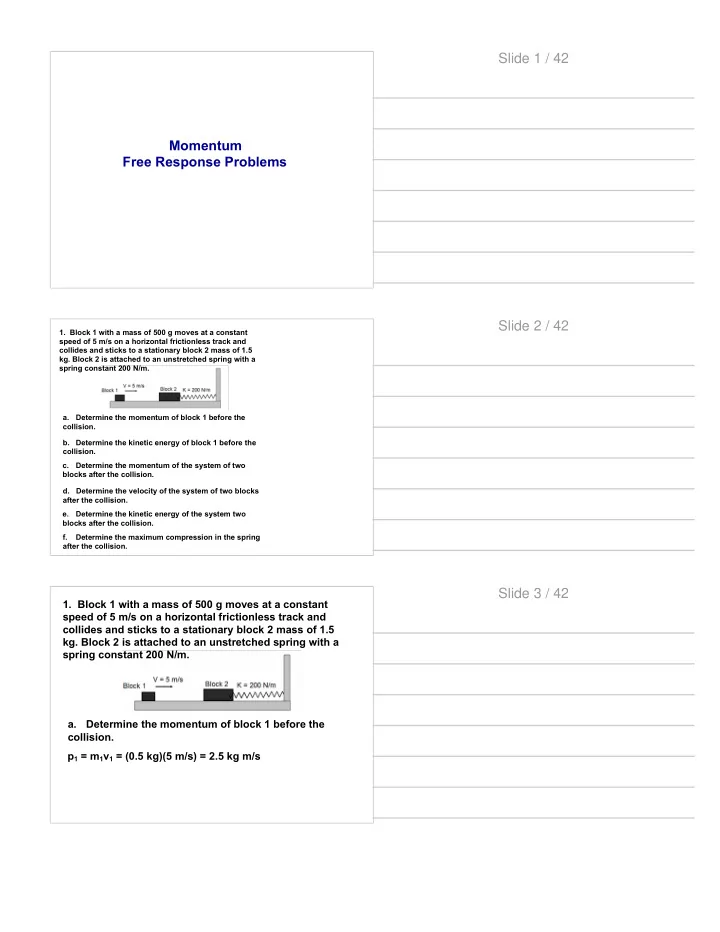
Slide 1 / 42 Momentum Free Response Problems Slide 2 / 42 1. Block 1 with a mass of 500 g moves at a constant speed of 5 m/s on a horizontal frictionless track and collides and sticks to a stationary block 2 mass of 1.5 kg. Block 2 is


slide-1
SLIDE 1

Momentum Free Response Problems Slide 1 / 42

  • 1. Block 1 with a mass of 500 g moves at a constant

speed of 5 m/s on a horizontal frictionless track and collides and sticks to a stationary block 2 mass of 1.5

  • kg. Block 2 is attached to an unstretched spring with a

spring constant 200 N/m.

  • a. Determine the momentum of block 1 before the

collision.

  • b. Determine the kinetic energy of block 1 before the

collision.

  • c. Determine the momentum of the system of two

blocks after the collision.

  • d. Determine the velocity of the system of two blocks

after the collision.

  • e. Determine the kinetic energy of the system two

blocks after the collision. f. Determine the maximum compression in the spring after the collision.

Slide 2 / 42

  • 1. Block 1 with a mass of 500 g moves at a constant

speed of 5 m/s on a horizontal frictionless track and collides and sticks to a stationary block 2 mass of 1.5

  • kg. Block 2 is attached to an unstretched spring with a

spring constant 200 N/m.

  • a. Determine the momentum of block 1 before the

collision. p1 = m1v1 = (0.5 kg)(5 m/s) = 2.5 kg m/s

Slide 3 / 42

slide-2
SLIDE 2
  • 1. Block 1 with a mass of 500 g moves at a constant

speed of 5 m/s on a horizontal frictionless track and collides and sticks to a stationary block 2 mass of 1.5

  • kg. Block 2 is attached to an unstretched spring with a

spring constant 200 N/m.

  • b. Determine the kinetic energy of block 1 before the

collision. KEo = ½m1v1

2 = ½(0.5 kg)(5 m/s)2 = 6.25 J

Slide 4 / 42

  • 1. Block 1 with a mass of 500 g moves at a constant

speed of 5 m/s on a horizontal frictionless track and collides and sticks to a stationary block 2 mass of 1.5

  • kg. Block 2 is attached to an unstretched spring with a

spring constant 200 N/m.

  • c. Determine the momentum of the system of two

blocks after the collision.

p1 + p2 = p' p' = m1v1 + m2v2 p' = (0.5 kg)(5 m/s) = 2.5 kg m/s

Slide 5 / 42

  • 1. Block 1 with a mass of 500 g moves at a constant

speed of 5 m/s on a horizontal frictionless track and collides and sticks to a stationary block 2 mass of 1.5

  • kg. Block 2 is attached to an unstretched spring with a

spring constant 200 N/m.

  • d. Determine the velocity of the system of two blocks

after the collision.

p1 = (m1 + m2)v' v' = p'/(m1 + m2) v' = (2.5 kg m/s)/(0.5 kg + 1.5kg) = 1.25 m/s

Slide 6 / 42

slide-3
SLIDE 3
  • 1. Block 1 with a mass of 500 g moves at a constant

speed of 5 m/s on a horizontal frictionless track and collides and sticks to a stationary block 2 mass of 1.5

  • kg. Block 2 is attached to an unstretched spring with a

spring constant 200 N/m.

  • e. Determine the kinetic energy of the system two

blocks after the collision.

KEF = ½Mv'2 KEF = ½(m1 + m2)(v')2 KEF = ½(0.5 kg + 1.5 kg)(1.25 m/s)2 = 1.56 J

Slide 7 / 42

  • 1. Block 1 with a mass of 500 g moves at a constant

speed of 5 m/s on a horizontal frictionless track and collides and sticks to a stationary block 2 mass of 1.5

  • kg. Block 2 is attached to an unstretched spring with a

spring constant 200 N/m. f. Determine the maximum compression in the spring after the collision.

Eo + W = Ef KEo = EPEF KEo = ½kx2 x = (2KEo/k)

1/2

x = [(2)(1.56 J)/(200 N/m)]1/2 = 0.12 m

Slide 8 / 42

  • 2. A 20 g piece of clay moves with a constant speed of 15 m/s. The piece of

clay collides and sticks to a massive ball of mass 900 g suspended at the end

  • f a string.

a. Calculate the momentum of the piece of clay before the collision. b. Calculate the kinetic energy of the piece of clay before the collision. c. What is the momentum of two objects after the collision? d. Calculate the velocity of the combination of two objects after the collision. e. Calculate the kinetic energy of the combination of two objects after the collision. f. Calculate the change in kinetic energy during the collision. g. Calculate the maximum vertical height of the combination of two objects after the collision.

Slide 9 / 42

slide-4
SLIDE 4
  • 2. A 20 g piece of clay moves with a constant speed of 15 m/s. The piece of

clay collides and sticks to a massive ball of mass 900 g suspended at the end

  • f a string.

a. Calculate the momentum of the piece of clay before the collision. p1 = m1v1 = (0.02 kg)(15 m/s) = 0.3 kg m/s

Slide 10 / 42

  • 2. A 20 g piece of clay moves with a constant speed of 15 m/s. The piece of

clay collides and sticks to a massive ball of mass 900 g suspended at the end

  • f a string.

b. Calculate the kinetic energy of the piece of clay before the collision. KEo = ½(0.02 kg)(15 m/s)2 = 2.25 J

Slide 11 / 42

  • 2. A 20 g piece of clay moves with a constant speed of 15 m/s. The piece of

clay collides and sticks to a massive ball of mass 900 g suspended at the end

  • f a string.

c. What is the momentum of two objects after the collision? p1 + p2 = p' p' = p1 + p2 p' = m1v1 + m2v2 p' = (0.02 kg)(15 m/s)2 = 0.3 kg m/s

Slide 12 / 42

slide-5
SLIDE 5
  • 2. A 20 g piece of clay moves with a constant speed of 15 m/s. The piece of

clay collides and sticks to a massive ball of mass 900 g suspended at the end

  • f a string.

d. Calculate the velocity of the combination of two

  • bjects after the collision.

p' = Mv' p' = (m1 + m2)v' v' = p'/(m1 + m2) v' = (0.3 kg m/s)/(0.02 kg + 0.9 kg) = 0.33 m/s

Slide 13 / 42

  • 2. A 20 g piece of clay moves with a constant speed of 15 m/s. The piece of

clay collides and sticks to a massive ball of mass 900 g suspended at the end

  • f a string.

e. Calculate the kinetic energy of the combination

  • f two objects after the collision.

KEF = ½(m1 + m2)v' KEF = ½(0.02 kg + 0.9 kg)(0.33 m/s)2 = 0.05 J

Slide 14 / 42

  • 2. A 20 g piece of clay moves with a constant speed of 15 m/s. The piece of

clay collides and sticks to a massive ball of mass 900 g suspended at the end

  • f a string.

f. Calculate the change in kinetic energy during the collision. ΔKE = KEF - KEo ΔKE = (0.05 J) - (2.25 J) = -2.2 J

Slide 15 / 42

slide-6
SLIDE 6
  • 2. A 20 g piece of clay moves with a constant speed of 15 m/s. The piece of

clay collides and sticks to a massive ball of mass 900 g suspended at the end

  • f a string.

g. Calculate the maximum vertical height of the combination of two objects after the collision. Eo + W = Ef Eo = EF KE = Mgh h = KE/Mg h = KE/(m1 + m2)g h = (0.05 J)/(0.02 kg + 0.90 kg)(9.8 m/s2) = 0.006 m

Slide 16 / 42

  • 3. A 10 g bullet moves at a constant speed
  • f 500 m/s and collides with a 1.5 kg

wooden block initially at rest. The surface of the table is frictionless and 70 cm above the floor level. After the collision the bullet becomes embedded into the block. The bullet-block system slides off the top of the table and strikes the floor. a. Find the momentum of the bullet before the collision. b. Find the kinetic energy of the bullet before the collision. c. Find the velocity of the bullet-block system after the collision. d. Find the kinetic energy of the bullet-block after the collision. e. Find the change in kinetic energy during the collision. f. How much time it takes the bullet-block system to reach the floor? g. Find the maximum horizontal distance between the table and the striking point on the floor.

Slide 17 / 42

  • 3. A 10 g bullet moves at a constant speed
  • f 500 m/s and collides with a 1.5 kg

wooden block initially at rest. The surface of the table is frictionless and 70 cm above the floor level. After the collision the bullet becomes embedded into the block. The bullet-block system slides off the top of the table and strikes the floor. a. Find the momentum of the bullet before the collision. p1 = m1v1 = (0.01 kg)(500 m/s) = 5 kg m/s

Slide 18 / 42

slide-7
SLIDE 7
  • 3. A 10 g bullet moves at a constant speed
  • f 500 m/s and collides with a 1.5 kg

wooden block initially at rest. The surface of the table is frictionless and 70 cm above the floor level. After the collision the bullet becomes embedded into the block. The bullet-block system slides off the top of the table and strikes the floor. b. Find the kinetic energy of the bullet before the collision. KEo = KE1 + KE2 KEo = ½m1v1

2

KEo = ½(0.01 kg)(500 m/s)2 KEo = 1,250 J

Slide 19 / 42

  • 3. A 10 g bullet moves at a constant speed
  • f 500 m/s and collides with a 1.5 kg

wooden block initially at rest. The surface of the table is frictionless and 70 cm above the floor level. After the collision the bullet becomes embedded into the block. The bullet-block system slides off the top of the table and strikes the floor. c. Find the velocity of the bullet-block system after the collision. p' = p1 + p2 (m1 + m2)v' = m1v1 v' = (m1v1)/(m1 + m2) v' = (0.01 kg)(500 m/s)/(0.01 kg + 1.6 kg) v' = 3.3 m/s

Slide 20 / 42

  • 3. A 10 g bullet moves at a constant speed
  • f 500 m/s and collides with a 1.5 kg

wooden block initially at rest. The surface of the table is frictionless and 70 cm above the floor level. After the collision the bullet becomes embedded into the block. The bullet-block system slides off the top of the table and strikes the floor. d. Find the kinetic energy of the bullet-block after the collision. KEF = ½(m1 + m2)v'2 KEF = ½(0.01 kg + 1.5 kg)(3.3 m/s)2 KEF = 8.2 J

Slide 21 / 42

slide-8
SLIDE 8
  • 3. A 10 g bullet moves at a constant speed
  • f 500 m/s and collides with a 1.5 kg

wooden block initially at rest. The surface of the table is frictionless and 70 cm above the floor level. After the collision the bullet becomes embedded into the block. The bullet-block system slides off the top of the table and strikes the floor. e. Find the change in kinetic energy during the collision. ΔKE = KEF - KEo ΔKE = 8.2 J - 1250 J ΔKE = -1241.8 J

Slide 22 / 42

  • 3. A 10 g bullet moves at a constant speed
  • f 500 m/s and collides with a 1.5 kg

wooden block initially at rest. The surface of the table is frictionless and 70 cm above the floor level. After the collision the bullet becomes embedded into the block. The bullet-block system slides off the top of the table and strikes the floor. f. How much time it takes the bullet-block system to reach the floor? y = yo + vot + ½at2 y = ½at2 t = (2y/g)1/2 t = [(2)(0.7 m)/(9.8 m/s2)]1/2 t = 0.38 s

Slide 23 / 42

  • 3. A 10 g bullet moves at a constant speed
  • f 500 m/s and collides with a 1.5 kg

wooden block initially at rest. The surface of the table is frictionless and 70 cm above the floor level. After the collision the bullet becomes embedded into the block. The bullet-block system slides off the top of the table and strikes the floor. g. Find the maximum horizontal distance between the table and the striking point on the floor. Δx = vxt Δx = (3.3 m/s)(0.38s) Δx = 1.25 m

Slide 24 / 42

slide-9
SLIDE 9
  • 4. Block A with a mass of m is released

from the top of the curved track of radius

  • r. Block A slides down the track without

friction and collides inelastically with an identical block B initially at rest. After the collision the two blocks move distance X to the right on the rough horizontal part

  • f the track with a coefficient of kinetic

friction µ. a. What is the speed of block A just before it hits block B? b. What is the speed of the system of two blocks after the collision? c. What is the kinetic energy of the system of two blocks the collision? d. How much energy is lost due to the collision? e. What is the stopping distance X of the system of two blocks?

Slide 25 / 42

  • 4. Block A with a mass of m is released

from the top of the curved track of radius

  • r. Block A slides down the track without

friction and collides inelastically with an identical block B initially at rest. After the collision the two blocks move distance X to the right on the rough horizontal part

  • f the track with a coefficient of kinetic

friction µ. a. What is the speed of block A just before it hits block B? Eo + W = EF mgh = ½mv2 v = (2gh)1/2 v = (2gr)1/2

Slide 26 / 42

  • 4. Block A with a mass of m is released

from the top of the curved track of radius

  • r. Block A slides down the track without

friction and collides inelastically with an identical block B initially at rest. After the collision the two blocks move distance X to the right on the rough horizontal part

  • f the track with a coefficient of kinetic

friction µ. b. What is the speed of the system of two blocks after the collision? p = p' mv + 0 = v'(m + m) mv = 2mv' v' = v/2 since v = (2gr)1/2, v' = [(2gr)1/2]/2

Slide 27 / 42

slide-10
SLIDE 10
  • 4. Block A with a mass of m is released

from the top of the curved track of radius

  • r. Block A slides down the track without

friction and collides inelastically with an identical block B initially at rest. After the collision the two blocks move distance X to the right on the rough horizontal part

  • f the track with a coefficient of kinetic

friction µ. c. What is the kinetic energy of the system of two blocks after the collision? KE' = ½(m + m)v'2 KE' = ½(2m)[(2gr)1/2/2]2 KE' = 2grm/4 KE' = grm/2

Slide 28 / 42

  • 4. Block A with a mass of m is released

from the top of the curved track of radius

  • r. Block A slides down the track without

friction and collides inelastically with an identical block B initially at rest. After the collision the two blocks move distance X to the right on the rough horizontal part

  • f the track with a coefficient of kinetic

friction µ. d. How much energy is lost due to the collision? ΔE = EF - Eo ΔE = mgr/2 - mgr ΔE = -mgr/2 (energy lost)

Slide 29 / 42

  • 4. Block A with a mass of m is released

from the top of the curved track of radius

  • r. Block A slides down the track without

friction and collides inelastically with an identical block B initially at rest. After the collision the two blocks move distance X to the right on the rough horizontal part

  • f the track with a coefficient of kinetic

friction µ. e. What is the stopping distance X of the system of two blocks? W = FΔX ΔX = W/F ΔX = (mgr/2)/μmg ΔX = r/2μ

Slide 30 / 42

slide-11
SLIDE 11
  • 5. Two discs of masses m1 = 2kg and m2 = 8 kg are placed on a horizontal

frictionless surface. Disc m1 moves at a constant speed of 8 m/s in +x direction and disc m2 is initially at rest. The collision of two discs is perfectly elastic and the directions of two velocities presented by the diagram.

a. What is the x-component of the initial momentum of disc m1? b. What is the y-component of the initial momentum of disc m1? c. What is the x-component of the initial momentum of disc m2? d. What is the y-component of the initial momentum of disc m2? e. What is the x-component of the final momentum of disc m1? j. What is the final vector velocity of disc m1? h. What is the final vector velocity of m2? g. What is the y-component of the final momentum of disc m2? i. What is the y-component of the final momentum of disc m1? f. What is the x-component of the final momentum of disc m2?

Slide 31 / 42

  • 5. Two discs of masses m1 = 2kg and m2 = 8 kg are placed on a horizontal

frictionless surface. Disc m1 moves at a constant speed of 8 m/s in +x direction and disc m2 is initially at rest. The collision of two discs is perfectly elastic and the directions of two velocities presented by the diagram. a. What is the x-component of the initial momentum of disc m1? p = (2 kg)(8 m/s) p = 16 kg m/s

Slide 32 / 42

  • 5. Two discs of masses m1 = 2kg and m2 = 8 kg are placed on a horizontal

frictionless surface. Disc m1 moves at a constant speed of 8 m/s in +x direction and disc m2 is initially at rest. The collision of two discs is perfectly elastic and the directions of two velocities presented by the diagram. b. What is the y-component of the initial momentum of disc m1?

Slide 33 / 42

slide-12
SLIDE 12
  • 5. Two discs of masses m1 = 2kg and m2 = 8 kg are placed on a horizontal

frictionless surface. Disc m1 moves at a constant speed of 8 m/s in +x direction and disc m2 is initially at rest. The collision of two discs is perfectly elastic and the directions of two velocities presented by the diagram. c. What is the x-component of the initial momentum of disc m2?

Slide 34 / 42

  • 5. Two discs of masses m1 = 2kg and m2 = 8 kg are placed on a horizontal

frictionless surface. Disc m1 moves at a constant speed of 8 m/s in +x direction and disc m2 is initially at rest. The collision of two discs is perfectly elastic and the directions of two velocities presented by the diagram. d. What is the y-component of the initial momentum of disc m2?

Slide 35 / 42

  • 5. Two discs of masses m1 = 2kg and m2 = 8 kg are placed on a horizontal

frictionless surface. Disc m1 moves at a constant speed of 8 m/s in +x direction and disc m2 is initially at rest. The collision of two discs is perfectly elastic and the directions of two velocities presented by the diagram. e. What is the x-component of the final momentum of disc m1?

Slide 36 / 42

slide-13
SLIDE 13
  • 5. Two discs of masses m1 = 2kg and m2 = 8 kg are placed on a horizontal

frictionless surface. Disc m1 moves at a constant speed of 8 m/s in +x direction and disc m2 is initially at rest. The collision of two discs is perfectly elastic and the directions of two velocities presented by the diagram. f.

What is the x-component of the final momentum of disc m2?

30o p2' p2y' p2x' px + I = px' p1x + 0 = 0 + p2x' p2x' = p1x = 16 kg m/s

Slide 37 / 42

  • 5. Two discs of masses m1 = 2kg and m2 = 8 kg are placed on a horizontal

frictionless surface. Disc m1 moves at a constant speed of 8 m/s in +x direction and disc m2 is initially at rest. The collision of two discs is perfectly elastic and the directions of two velocities presented by the diagram. g.

What is the y-component of the final momentum of disc m2?

30o p2' p2y' 16 kg m/s tan 30o = p2y'/p2x' p2y' = p2x'(tan30o) p2y' = (16 kg m/s)(tan 30o) p2y' = 9.2 kg m/s

Slide 38 / 42

  • 5. Two discs of masses m1 = 2kg and m2 = 8 kg are placed on a horizontal

frictionless surface. Disc m1 moves at a constant speed of 8 m/s in +x direction and disc m2 is initially at rest. The collision of two discs is perfectly elastic and the directions of two velocities presented by the diagram.

h. What is the final vector velocity of m2?

30o p2' 9.2 kg m/s 16 kg m/s p2' = (p2x'2 + p2y'2)1/2 p2' = [(16 kg m/s)2 + (9.2 kg m/s)2]1/2 p2' = 18.5 kg m/s p2' = m2v2' v2' = p2'/m2 v2' = (18.5 kg m/s)/(8 kg) v2' = 2.3 m/s

Slide 39 / 42

slide-14
SLIDE 14
  • 5. Two discs of masses m1 = 2kg and m2 = 8 kg are placed on a horizontal

frictionless surface. Disc m1 moves at a constant speed of 8 m/s in +x direction and disc m2 is initially at rest. The collision of two discs is perfectly elastic and the directions of two velocities presented by the diagram.

i. What is the y-component of the final momentum of disc m1?

py + I = py' 0 = p1y' + p2y' p1y' = -p2y' p1y' = -9.2 kg m/s

Slide 40 / 42

  • 5. Two discs of masses m1 = 2kg and m2 = 8 kg are placed on a horizontal

frictionless surface. Disc m1 moves at a constant speed of 8 m/s in +x direction and disc m2 is initially at rest. The collision of two discs is perfectly elastic and the directions of two velocities presented by the diagram.

j. What is the final vector velocity of disc m1?

p1' = m1v1' v1' = p1'/m1 v1' = (-9.2 kg m/s)/(2 kg) v1' = -4.6 m/s

Slide 41 / 42 Slide 42 / 42