SLIDE 1
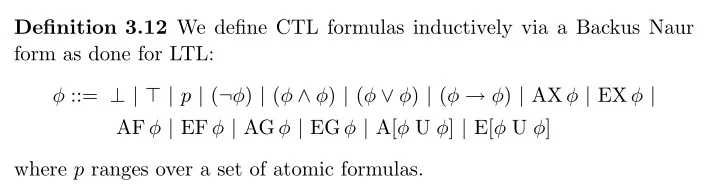
Definition 3.12 We define CTL formulas inductively via a Backus Naur form as done for LTL: φ ::= ⊥ | ⊤ | p | (¬φ) | (φ ∧ φ) | (φ ∨ φ) | (φ → φ) | AX φ | EX φ | AF φ | EF φ | AG φ | EG φ | A[φ U φ] | E[φ U φ] where p ranges over a set of atomic formulas.
SLIDE 2
AU EU AX ¬ ¬ EX p p ∧ q p
Figure 3.18. The parse tree of a CTL formula without infix notation.
SLIDE 3 Definition 3.15 Let M = (S, →, L) be a model for CTL, s in S, φ a CTL
- formula. The relation M, s φ is defined by structural induction on φ:
1. M, s ⊤ and M, s ⊥ 2. M, s p iff p ∈ L(s) 3. M, s ¬φ iff M, s φ 4. M, s φ1 ∧ φ2 iff M, s φ1 and M, s φ2 5. M, s φ1 ∨ φ2 iff M, s φ1 or M, s φ2 6. M, s φ1 → φ2 iff M, s φ1 or M, s φ2. 7. M, s AX φ iff for all s1 such that s → s1 we have M, s1 φ. Thus, AX says: ‘in every next state.’ 8. M, s EX φ iff for some s1 such that s → s1 we have M, s1 φ. Thus, EX says: ‘in some next state.’ E is dual to A – in exactly the same way that ∃ is dual to ∀ in predicate logic. 9. M, s AG φ holds iff for all paths s1 → s2 → s3 → . . ., where s1 equals s, and all si along the path, we have M, si φ. Mnemonically: for All computation paths beginning in s the property φ holds Globally. Note that ‘along the path’ includes the path’s initial state s. 10. M, s EG φ holds iff there is a path s1 → s2 → s3 → . . ., where s1 equals s, and for all si along the path, we have M, si φ. Mnemonically: there Exists a path beginning in s such that φ holds Globally along the path.
SLIDE 4
11. M, s AF φ holds iff for all paths s1 → s2 → . . ., where s1 equals s, there is some si such that M, si φ. Mnemonically: for All computation paths begin- ning in s there will be some Future state where φ holds. 12. M, s EF φ holds iff there is a path s1 → s2 → s3 → . . ., where s1 equals s, and for some si along the path, we have M, si φ. Mnemonically: there Exists a computation path beginning in s such that φ holds in some Future state; 13. M, s A[φ1 U φ2] holds iff for all paths s1 → s2 → s3 → . . ., where s1 equals s, that path satisfies φ1 U φ2, i.e., there is some si along the path, such that M, si φ2, and, for each j < i, we have M, sj φ1. Mnemonically: All com- putation paths beginning in s satisfy that φ1 Until φ2 holds on it. 14. M, s E[φ1 U φ2] holds iff there is a path s1 → s2 → s3 → . . ., where s1 equals s, and that path satisfies φ1 U φ2 as specified in 13. Mnemonically: there Exists a computation path beginning in s such that φ1 Until φ2 holds on it.
SLIDE 5
φ
Figure 3.19. A system whose starting state satisfies EF φ.
SLIDE 6
φ φ φ
Figure 3.20. A system whose starting state satisfies EG φ.
SLIDE 7
φ φ φ φ φ φ φ φ φ φ
Figure 3.21. A system whose starting state satisfies AG φ.
SLIDE 8
φ φ φ φ φ
Figure 3.22. A system whose starting state satisfies AF φ.
SLIDE 9
equivalent. The syntax of CTL* involves two classes of formulas:
r state formulas, which are evaluated in states: φ ::= ⊤ | p | (¬φ) | (φ ∧ φ) | A[α] | E[α] where p is any atomic formula and α any path formula; and r path formulas, which are evaluated along paths: α ::= φ | (¬α) | (α ∧ α) | (α U α) | (G α) | (F α) | (X α)
where φ is any state formula. This is an example of an inductive definition which is mutually recursive: the definition of each class depends upon the definition of the other, with base cases p and ⊤.
SLIDE 10
LTL
ψ1 ψ2 ψ3 ψ4
CTL CTL*
Figure 3.23. The expressive powers of CTL, LTL and CTL*.