Section 3.1: Inductively Defined Sets To define a set S inductively, - - PowerPoint PPT Presentation

section 3 1 inductively defined sets
SMART_READER_LITE
LIVE PREVIEW

Section 3.1: Inductively Defined Sets To define a set S inductively, - - PowerPoint PPT Presentation

Section 3.1: Inductively Defined Sets To define a set S inductively, we need to give 3 things: Basis: Specify one or more elements that are in S. Induction Rule: Give one or more rules telling how to construct a new element from an


slide-1
SLIDE 1

Section 3.1 CS340-Discrete Structures

Section 3.1: Inductively Defined Sets

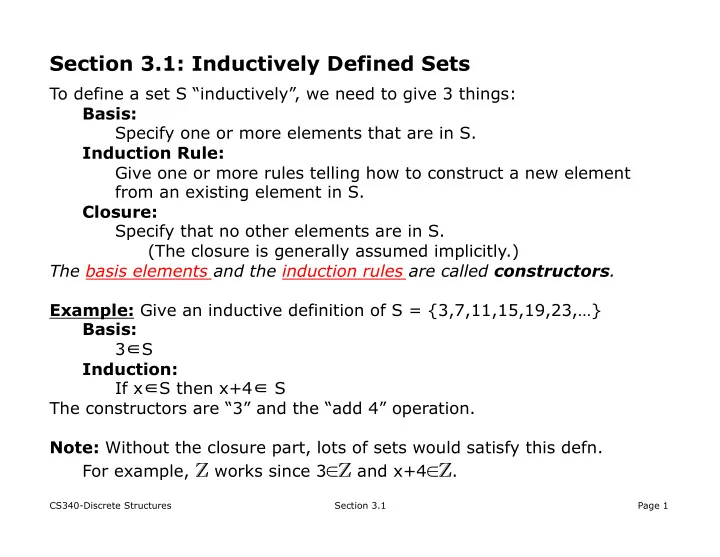
To define a set S “inductively”, we need to give 3 things: Basis: Specify one or more elements that are in S. Induction Rule: Give one or more rules telling how to construct a new element from an existing element in S. Closure: Specify that no other elements are in S. (The closure is generally assumed implicitly.) The basis elements and the induction rules are called constructors. Example: Give an inductive definition of S = {3,7,11,15,19,23,…} Basis: 3∈S Induction: If x∈S then x+4∈ S The constructors are “3” and the “add 4” operation. Note: Without the closure part, lots of sets would satisfy this defn. For example, Z works since 3∈Z and x+4∈Z.

Page 1

slide-2
SLIDE 2

Section 3.1 CS340-Discrete Structures Page 2

Example: Find an inductive definition of S={3,4,5,8,9,12,16,17,20,24,33,…} Solution: Notice that S can be written as a union of simpler sets: S = {3,5,9,17,33,…} ∪ {4,8,12,16,20,…} Basis: Induction: Example: Here is an inductive definition. What does this set look like? Basis: 2 ∈ S Induction: x ∈ S implies x+3 ∈ S and x-3 ∈ S Solution:

slide-3
SLIDE 3

Section 3.1 CS340-Discrete Structures Page 3

Example: Find an inductive definition of S={3,4,5,8,9,12,16,17,20,24,33,…} Solution: Notice that S can be written as a union of simpler sets: S = {3,5,9,17,33,…} ∪ {4,8,12,16,20,…} Basis: 3,4 ∈ S Induction: If x ∈ S then If x is odd then 2x-1 ∈ S else x+4 ∈ S. Example: Here is an inductive definition. What does this set look like? Basis: 2 ∈ S Induction: x ∈ S implies x+3 ∈ S and x-3 ∈ S Solution:

slide-4
SLIDE 4

Section 3.1 CS340-Discrete Structures Page 4

Example: Find an inductive definition of S={3,4,5,8,9,12,16,17,20,24,33,…} Solution: Notice that S can be written as a union of simpler sets: S = {3,5,9,17,33,…} ∪ {4,8,12,16,20,…} Basis: 3,4 ∈ S Induction: If x ∈ S then If x is odd then 2x-1 ∈ S else x+4 ∈ S. Example: Here is an inductive definition. What does this set look like? Basis: 2 ∈ S Induction: x ∈ S implies x+3 ∈ S and x-3 ∈ S Solution: S = {2,5,8,11,…} ∪ {-1,-4,-7,-10,…} = {…,-10,-7,-4,-1,2,5,8,11…}

slide-5
SLIDE 5

Section 3.1 CS340-Discrete Structures Page 5

Example: Find an inductive definition for S = {Λ, ac, aacc, aaaccc, …} = { ancn | n∈N } Basis: Induction: Example: Find an inductive definition for S = { an+1bcn | n∈N } Basis: Induction: Example: What set is defined by this inductive definition? Basis: a,b ∈ S Induction: x ∈ S then f(x) ∈ S. Solution:

slide-6
SLIDE 6

Section 3.1 CS340-Discrete Structures Page 6

Example: Find an inductive definition for S = {Λ, ac, aacc, aaaccc, …} = { ancn | n∈N } Basis: Λ ∈ S Induction: If x ∈ S then axc ∈ S. Example: Find an inductive definition for S = { an+1bcn | n∈N } Basis: Induction: Example: What set is defined by this inductive definition? Basis: a,b ∈ S Induction: x ∈ S then f(x) ∈ S. Solution:

slide-7
SLIDE 7

Section 3.1 CS340-Discrete Structures Page 7

Example: Find an inductive definition for S = {Λ, ac, aacc, aaaccc, …} = { ancn | n∈N } Basis: Λ ∈ S Induction: If x ∈ S then axc ∈ S. Example: Find an inductive definition for S = { an+1bcn | n∈N } Basis: ab ∈ S Induction: If x ∈ S then axc ∈ S. Example: What set is defined by this inductive definition? Basis: a,b ∈ S Induction: x ∈ S then f(x) ∈ S. Solution:

slide-8
SLIDE 8

Section 3.1 CS340-Discrete Structures Page 8

Example: Find an inductive definition for S = {Λ, ac, aacc, aaaccc, …} = { ancn | n∈N } Basis: Λ ∈ S Induction: If x ∈ S then axc ∈ S. Example: Find an inductive definition for S = { an+1bcn | n∈N } Basis: ab ∈ S Induction: If x ∈ S then axc ∈ S. Example: What set is defined by this inductive definition? Basis: a,b ∈ S Induction: x ∈ S then f(x) ∈ S. Solution: S = {a,f(a),f(f(a)),…} ∪ {b,f(b),f(f(b)),…} = { fn(a) | n∈N } ∪ { fn(b) | n∈N } = { fn(x) | x ∈ {a,b} and n∈N }

slide-9
SLIDE 9

Section 3.1 CS340-Discrete Structures Page 9

Example: Describe the set S defined inductively by: Basis: <0> ∈ S Induction: x ∈ S implies cons(1,x) ∈ S. Solution: S = { <0>, <1,0>, <1,1,0>, <1,1,1,0>, … } Giuseppe Piano’s Definition of

The Set of Natural Numbers, N:

Define the “successor” function, succ. Basis: 0∈N Induction: If x∈N then succ(x) ∈N. Closure: There are no other elements in N. N = { 0, succ(0), succ(succ(0)), succ(succ(succ(0))), … }

slide-10
SLIDE 10

Section 3.1 CS340-Discrete Structures Page 10

List Functions: head (<a,b,c,d>) = a tail (<a,b,c,d>) = <b,c,d> cons (a,<b,c,d>) = <a,b,c,d> Notation: cons(x,y) can be written with the infix operator :: x :: y Examples: a::<b,c,d> = <a,b,c,d> a :: (b :: (c :: <>)) = <a,b,c> <a,b> :: <c,d> = <<a,b>,c,d> Most operators are left-associative: x ÷ y ÷ z = (x ÷ y) ÷ z Assume that :: is right-associative: x :: y :: z = x :: (y :: z) So: a :: b :: c :: <> = <a,b,c>

slide-11
SLIDE 11

Section 3.1 CS340-Discrete Structures Page 11

Example: Find an inductive definition for S = { <>, <a,b>, <a,b,a,b>, … } Solution: Basis: Inductive Step: Example: Find an inductive defition for S = { <>, <<>>, <<<>>>, … } Solution: Basis: Inductive Step:

slide-12
SLIDE 12

Section 3.1 CS340-Discrete Structures Page 12

Example: Find an inductive definition for S = { <>, <a,b>, <a,b,a,b>, … } Solution: Basis: <> ∈ S. Inductive Step: x ∈ S implies a::b::x ∈ S. Example: Find an inductive defition for S = { <>, <<>>, <<<>>>, … } Solution: Basis: Inductive Step:

slide-13
SLIDE 13

Section 3.1 CS340-Discrete Structures Page 13

Example: Find an inductive definition for S = { <>, <a,b>, <a,b,a,b>, … } Solution: Basis: <> ∈ S. Inductive Step: x ∈ S implies a::b::x ∈ S. Example: Find an inductive defition for S = { <>, <<>>, <<<>>>, … } Solution: Basis: <> ∈ S. Inductive Step: x ∈ S implies x::<> ∈ S.

slide-14
SLIDE 14

Section 3.1 CS340-Discrete Structures Page 14

Binary Trees

The set of binary trees B is defined as follows: (Assume A is an alphabet: the labels for the nodes.) Basis: <> ∈ B Induction: If L, R ∈ B and x ∈ A then <L,x,R> ∈ B. Example: Here is a set S, which is a subset of B. What is in S? Basis: <<>,a,<>> ∈ S Induction: T ∈ S implies <T,a,<<>,a,<>>> ∈ S.

slide-15
SLIDE 15

Section 3.1 CS340-Discrete Structures Page 15

Binary Trees

The set of binary trees B is defined as follows: (Assume A is an alphabet: the labels for the nodes.) Basis: <> ∈ B Induction: If L, R ∈ B and x ∈ A then <L,x,R> ∈ B. Example: Here is a set S, which is a subset of B. What is in S? Basis: <<>,a,<>> ∈ S Induction: T ∈ S implies <T,a,<<>,a,<>>> ∈ S. a a

T

slide-16
SLIDE 16

Section 3.1 CS340-Discrete Structures Page 16

Binary Trees

The set of binary trees B is defined as follows: (Assume A is an alphabet: the labels for the nodes.) Basis: <> ∈ B Induction: If L, R ∈ B and x ∈ A then <L,x,R> ∈ B. Example: Here is a set S, which is a subset of B. What is in S? Basis: <<>,a,<>> ∈ S Induction: T ∈ S implies <T,a,<<>,a,<>>> ∈ S. a a a a a a a a a a a a a a a a a a

T

slide-17
SLIDE 17

Section 3.1 CS340-Discrete Structures Page 17

Problem: Find an inductive definition of the set S of trees like this: a a a a a a a a a a a a a a a a

slide-18
SLIDE 18

Section 3.1 CS340-Discrete Structures Page 18

Problem: Find an inductive definition of the set S of trees like this: Basis: <<>,a,<>> ∈ S Induction: <L,a,R> ∈ S implies <<L,a,<>>,a,<<>,a,R>> ∈ S a a a a a a a a a a a a a a a a

slide-19
SLIDE 19

Section 3.1 CS340-Discrete Structures Page 19

Problem: Find an inductive definition of the set S of trees like this: Basis: <<>,a,<>> ∈ S Induction: <L,a,R> ∈ S implies <<L,a,<>>,a,<<>,a,R>> ∈ S Define function left,right: TreesTrees as left (<L,a,R>) = L and right (<L,a,R>) = R Revised Inductive Step: T ∈ S implies <<left(T),a,<>>,a,<<>,a,right(T)>> ∈ S a a a a a a a a a a a a a a a a

slide-20
SLIDE 20

Section 3.1 CS340-Discrete Structures Page 20

Example: Find an inductive definition for the set S={a}* × N. Solution: Basis: Induction:

slide-21
SLIDE 21

Section 3.1 CS340-Discrete Structures Page 21

Example: Find an inductive definition for the set S={a}* × N. Solution: Basis: (Λ,0) ∈ S Induction: (s,n) ∈ S implies (as,n) ∈ S and (s,n+1) ∈ S.

slide-22
SLIDE 22

Section 3.1 CS340-Discrete Structures Page 22

Example: Find an inductive definition for the set S = {(x,-y) | x,y∈N and x≥y} Let’s try to understand S by writing out some tuples: Here is a graphical representation of S: Basis: Induction:

slide-23
SLIDE 23

Section 3.1 CS340-Discrete Structures Page 23

Example: Find an inductive definition for the set S = {(x,-y) | x,y∈N and x≥y} Let’s try to understand S by writing out some tuples: (0,0), (1,0), (1,-1), (2,0), (2,-1), (2,-2), and so on Here is a graphical representation of S: Basis: Induction: y x

  • • • •
  • • •
slide-24
SLIDE 24

Section 3.1 CS340-Discrete Structures Page 24

Example: Find an inductive definition for the set S = {(x,-y) | x,y∈N and x≥y} Let’s try to understand S by writing out some tuples: (0,0), (1,0), (1,-1), (2,0), (2,-1), (2,-2), and so on Here is a graphical representation of S: Basis: (0,0) ∈ S Induction: (x,y) ∈ S implies (x+1,y) ∈ S and (x+1,y-1) ∈ S Notice that the inductive step will construct some points two ways. (1,-1)  (2,-1) (1,0)  (2,-1) y x

  • • • •
  • • •
slide-25
SLIDE 25

Section 3.1 CS340-Discrete Structures Page 25

Example: Find an inductive definition for the set S = {(x,-y) | x,y∈N and x≥y} Let’s try to understand S by writing out some tuples: (0,0), (1,0), (1,-1), (2,0), (2,-1), (2,-2), and so on Here is a graphical representation of S: Basis: (0,0) ∈ S Induction: (x,y) ∈ S implies (x+1,y) ∈ S and (x+1,y-1) ∈ S Notice that the inductive step will construct some points two ways. (1,-1)  (2,-1) (1,0)  (2,-1)

In-Class Quiz: Try to find a solution that does not

construct repeated points. y x

  • • • •
  • • •
slide-26
SLIDE 26

Section 3.1 CS340-Discrete Structures Page 26

Example: Find an inductive definition for the set S = {(x,-y) | x,y∈N and x≥y} Let’s try to understand S by writing out some tuples: (0,0), (1,0), (1,-1), (2,0), (2,-1), (2,-2), and so on Here is a graphical representation of S: Basis: (0,0) ∈ S Induction: (x,y) ∈ S implies (x+1,y) ∈ S and (x+1,y-1) ∈ S Notice that the inductive step will construct some points two ways. (1,-1)  (2,-1) (1,0)  (2,-1)

In-Class Quiz: Try to find a solution that does not

construct repeated points. Approach: Construct the diagonal. Then construct horizontal lines. Basis: (0,0) ∈ S Induction: (x,-x)∈S implies (x+1,-(x+1))∈S (x,y)∈S implies (x+1,y)∈S y x

  • • • •
  • • •