Simple Internetworking Network 1 (Ethernet) Internetworking - - PowerPoint PPT Presentation

simple internetworking
SMART_READER_LITE
LIVE PREVIEW

Simple Internetworking Network 1 (Ethernet) Internetworking - - PowerPoint PPT Presentation

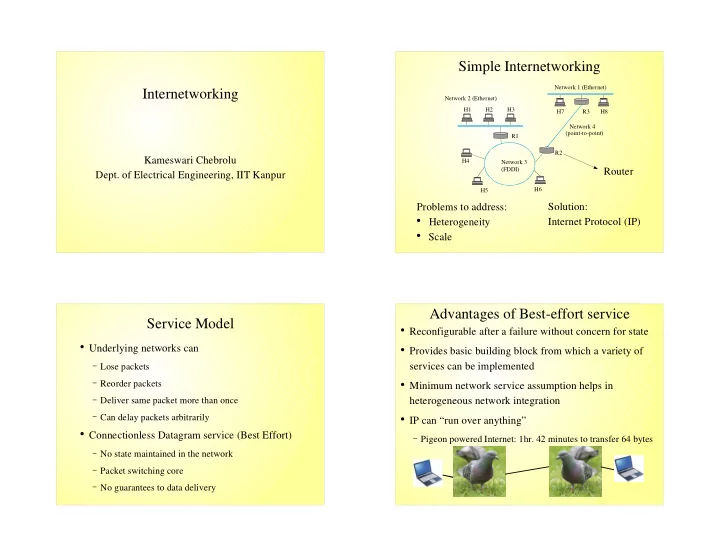
Simple Internetworking Network 1 (Ethernet) Internetworking Network 2 (Ethernet) H1 H2 H3 H7 R3 H8 Network 4 (point-to-point) R1 R2 Kameswari Chebrolu H4 Network 3 (FDDI) Router Dept. of Electrical Engineering, IIT Kanpur H6 H5


slide-1
SLIDE 1

Internetworking

Kameswari Chebrolu

  • Dept. of Electrical Engineering, IIT Kanpur

Simple Internetworking

R2 R1 H4 H5 H3 H2 H1 Network 2 (Ethernet) Network 1 (Ethernet) H6 Network 4 (point-to-point) H7 R3 H8 Network 3 (FDDI)

Problems to address:

  • Heterogeneity

Scale

Solution: Internet Protocol (IP) Router

Service Model

Underlying networks can

Lose packets Reorder packets Deliver same packet more than once Can delay packets arbitrarily

Connectionless Datagram service (Best Effort)

No state maintained in the network Packet switching core No guarantees to data delivery

Advantages of Best-effort service

Reconfigurable after a failure without concern for state Provides basic building block from which a variety of

services can be implemented

Minimum network service assumption helps in

heterogeneous network integration

IP can “run over anything”

Pigeon powered Internet: 1hr. 42 minutes to transfer 64 bytes

slide-2
SLIDE 2

Addressing

Globally unique Hierarchical (32 bit binary number):

Consists of two parts: network and host Network part: Identifies the network of the host Host part: Identifies the host within the network

IP address space divided into 5 classes (A,B,C,D,E)

Network Host 7 24

Class A

Network Host 14 16

1

Class B

Network Host 21 8

1 1

Class C 10.0.0.1 128.32.12.89 192.43.54.06

Datagram Forwarding

Host

Computers that execute application programs on behalf of

users

Examples: Personal computers, workstations, batch systems

etc

Routers

Building blocks that interconnect networks Receive datagrams from hosts and routers on one network Forward datagrams to hosts or routers on other networks

Datagram Forwarding Cont..

Forwarding algorithms employed by hosts

different from those of gateways

Number of hosts far exceed gateways Algorithms change with time Resource constraints

Host Forwarding

On receipt of a packet

If (NetworkNum of destination = NetworkNum of my

interface) then deliver packet to destination on that interface

else deliver packet to default router

A host maintains a cache of recently used routes If cache lookup fails, use default router

slide-3
SLIDE 3

Router Forwarding

When a packet arrives at a router A,

If (NetworkNum of destination = NetworkNum of

  • ne of my interfaces) then deliver packet to

destination on that interface

else chooses another router B, such that

B is closer to the destination address B is directly reachable from G B is next hop for the packet Process of selecting next hop host or router is called

ROUTING

Example

R2 R1 H4 H5 H3 H2 H1 Network 2 (Ethernet) Network 1 (Ethernet) H6 Network 4 (point-to-point) H7 R3 H8 Network 3 (FDDI)

Forwarding Table of R2

NetworkNum NextHop 1 R3 2 R1

Scalability: Router tables list only set of network numbers

Protocol Stack

R1 R2 R3 H1 H8 ETH FDDI IP ETH TCP FDDI PPP PPP ETH IP ETH TCP IP IP IP

IP Packet Format

Version HLen TOS Length Ident Flags Offset TTL Protocol Checksum SourceAddr DestinationAddr Options (variable) Pad (variable) 4 8 16 19 31 Data

slide-4
SLIDE 4

Address Resolution Protocol (ARP)

Translates IP addresses to link-level addresses Each host maintains a table of address pairs

Manual configuration is tedious Dynamical learning of tables achieved by ARP

ARP relies on broadcast

Broadcast request if mapping missing Destination machines responds with the mapping Table entries are discarded is not refreshed

Summary

Problem: How to build huge networks by

interconnecting smaller networks

Challenges: Heterogeneity and Scale Solution: Internet Protocol (IP)

Connectionless datagram service Hierarchical addressing

ARP mechanism to translate IP to link-level

addresses