Set Operations B . It is denoted A B . A B = { x | x A x B } A B = { - - PowerPoint PPT Presentation

set operations
SMART_READER_LITE
LIVE PREVIEW

Set Operations B . It is denoted A B . A B = { x | x A x B } A B = { - - PowerPoint PPT Presentation

Set Operations http://localhost/~senning/courses/ma229/slides/setops/slide01.html Set Operations http://localhost/~senning/courses/ma229/slides/setops/slide02.html Set Operations prev | slides | next prev | slides | next Let A and B be sets.


slide-1
SLIDE 1

Set Operations http://localhost/~senning/courses/ma229/slides/setops/slide01.html 1 of 1 09/07/2003 04:30 PM prev | slides | next

Set Operations

1 2 3 4 5 6 7 8 9 10 11 12 13

Set Operations http://localhost/~senning/courses/ma229/slides/setops/slide02.html 1 of 1 09/07/2003 04:30 PM

Set Operations

prev | slides | next

Let A and B be sets. The union of A and B is the set of all elements in either A or B or in both sets. It is denoted A B. The intersection of A and B is the set of all elements in both A and

  • B. It is denoted A B.

A B = {x | x A x B} A B = {x | x A x B}

1 2 3 4 5 6 7 8 9 10 11 12 13

Set Operations http://localhost/~senning/courses/ma229/slides/setops/slide03.html 1 of 1 09/07/2003 04:30 PM

Set Operations

prev | slides | next

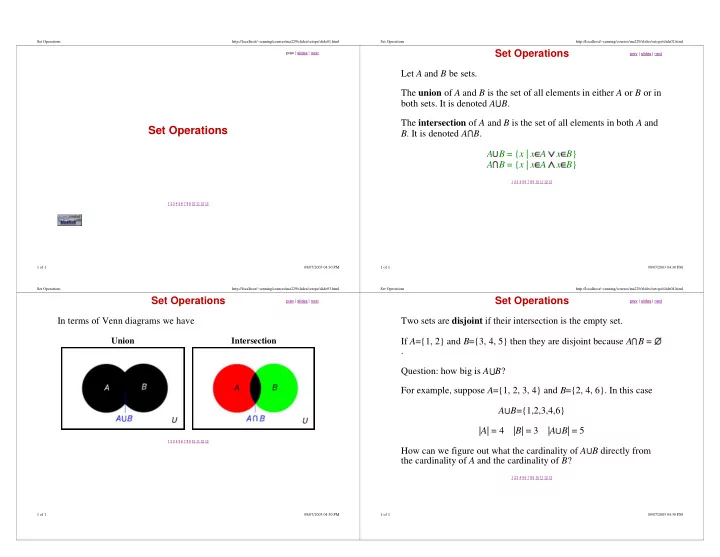
In terms of Venn diagrams we have

Union Intersection

1 2 3 4 5 6 7 8 9 10 11 12 13

Set Operations http://localhost/~senning/courses/ma229/slides/setops/slide04.html 1 of 1 09/07/2003 04:30 PM

Set Operations

prev | slides | next

Two sets are disjoint if their intersection is the empty set. If A={1, 2} and B={3, 4, 5} then they are disjoint because A B = . Question: how big is A B? For example, suppose A={1, 2, 3, 4} and B={2, 4, 6}. In this case A B={1,2,3,4,6} |A| = 4 |B| = 3 |A B| = 5 How can we figure out what the cardinality of A B directly from the cardinality of A and the cardinality of B?

1 2 3 4 5 6 7 8 9 10 11 12 13

slide-2
SLIDE 2

Set Operations http://localhost/~senning/courses/ma229/slides/setops/slide05.html 1 of 1 09/07/2003 04:30 PM

Set Operations

prev | slides | next

In fact, we cannot calculate |A B| knowing only |A| and |B|. We need one additional piece of information. The difficulty lies in that if we find |A|+|B| we’ve counted the elements that are common to both sets twice. We need some way to reduce this by the number of elements common to both sets...

1 2 3 4 5 6 7 8 9 10 11 12 13

Set Operations http://localhost/~senning/courses/ma229/slides/setops/slide06.html 1 of 1 09/07/2003 04:30 PM

Set Operations

prev | slides | next

The inclusion-exclusion principle comes to our rescue. In its most basic form it is |A B| = |A| + |B| - |A B| The last term subtracts the sum by the number of elements common to both sets, which is exactly what we needed to do. Suppose |A B| = 7, |A| = 5 and |A B| = 3. What is |B|? (answer)

1 2 3 4 5 6 7 8 9 10 11 12 13

Set Operations http://localhost/~senning/courses/ma229/slides/setops/slide07.html 1 of 1 09/07/2003 04:30 PM

Set Operations

prev | slides | next

Let A and B be sets. The difference of A and B, denoted A-B, is the set containing all elements that are in A but not also in B. This set is also called the complement of B with respect to A. A-B = {x | x A x B} If U is the universal set then the complement of A is denoted A’ and is the set U-A.

1 2 3 4 5 6 7 8 9 10 11 12 13

Set Operations http://localhost/~senning/courses/ma229/slides/setops/slide08.html 1 of 1 09/07/2003 04:30 PM

Set Operations

prev | slides | next

Here are Venn diagrams for these two types of complements:

A-B A’

1 2 3 4 5 6 7 8 9 10 11 12 13

slide-3
SLIDE 3

Set Operations http://localhost/~senning/courses/ma229/slides/setops/slide09.html 1 of 1 09/07/2003 04:30 PM

Set Operations

prev | slides | next

Set Identities

Identity Name A = A Identity laws A U = A A U = U Domination laws A = A A = A Idempotent laws A A = A (A’)’ = A Complementation law

1 2 3 4 5 6 7 8 9 10 11 12 13

Set Operations http://localhost/~senning/courses/ma229/slides/setops/slide10.html 1 of 1 09/07/2003 04:30 PM

Set Operations

prev | slides | next

Set Identities

Identity Name A B = B A Commutative laws A B = B A A (B C) = (A B) C Associative laws A (B C) = (A B) C A (B C) = (A B) (A C) Distributive laws A (B C) = (A B) (A C) (A B)’ = A’ B’ De Morgan’s laws (A B)’ = A’ B’

1 2 3 4 5 6 7 8 9 10 11 12 13

Set Operations http://localhost/~senning/courses/ma229/slides/setops/slide11.html 1 of 1 09/07/2003 04:30 PM

Set Operations

prev | slides | next

Prove that A (B C) = (A B) (A C) using a common element proof.

x A (B C) x A x (B C) x A (x B x C) (x A x B) (x A x C) x (A B) x (A C) x (A B) (A C)

We have assumed that x is in A (B C) and shown that in this case x must be in (A B) (A C). Thus we have that A (B C) (A B) (A C)

1 2 3 4 5 6 7 8 9 10 11 12 13

Set Operations http://localhost/~senning/courses/ma229/slides/setops/slide12.html 1 of 1 09/07/2003 04:30 PM

Set Operations

prev | slides | next

The bad news is that we’ve only completed half of the proof: to show equality we need still to show that (A B) (A C) A (B C) The good news is that this is easy. Because each of the steps in the first part of the proof is logically equivalent to the step before it, it follows that if we start at the bottom and assume that x is in (A B) (A C) then we can conclude that x is in A (B C) and we are done.

1 2 3 4 5 6 7 8 9 10 11 12 13

slide-4
SLIDE 4

Set Operations http://localhost/~senning/courses/ma229/slides/setops/slide13.html 1 of 1 09/07/2003 04:31 PM

Set Operations

prev | slides | next

The main idea behind a common element proof to show that two sets A and B are equal is to first assume that x is a typical element

  • f A and show that it must be in B. This shows that

A B. Next, assume that x is in B and show that it must also be in A. This shows that B A Finally, because A B and B A it must be that A=B.

1 2 3 4 5 6 7 8 9 10 11 12 13