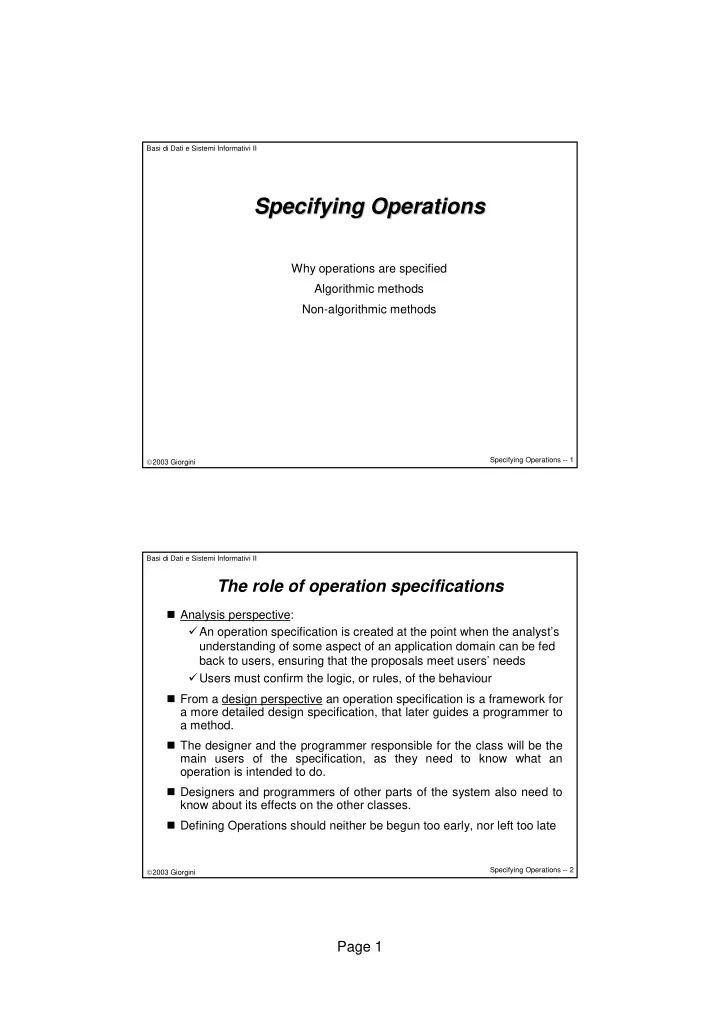
Specifying Operations Specifying Operations Why operations are - - PDF document

specifying operations specifying operations
SMART_READER_LITE
LIVE PREVIEW

Specifying Operations Specifying Operations Why operations are - - PDF document

Basi di Dati e Sistemi Informativi II Specifying Operations Specifying Operations Why operations are specified Algorithmic methods Non-algorithmic methods 2003 Giorgini Specifying Operations -- 1 Basi di Dati e Sistemi Informativi II The


slide-1
SLIDE 1

Page 1

Basi di Dati e Sistemi Informativi II Specifying Operations -- 1 2003 Giorgini

Specifying Operations Specifying Operations

Why operations are specified Algorithmic methods Non-algorithmic methods

Basi di Dati e Sistemi Informativi II Specifying Operations -- 2 2003 Giorgini

The role of operation specifications

Analysis perspective: An operation specification is created at the point when the analyst’s understanding of some aspect of an application domain can be fed back to users, ensuring that the proposals meet users’ needs Users must confirm the logic, or rules, of the behaviour From a design perspective an operation specification is a framework for a more detailed design specification, that later guides a programmer to a method. The designer and the programmer responsible for the class will be the main users of the specification, as they need to know what an

  • peration is intended to do.

Designers and programmers of other parts of the system also need to know about its effects on the other classes. Defining Operations should neither be begun too early, nor left too late

slide-2
SLIDE 2

Page 2

Basi di Dati e Sistemi Informativi II Specifying Operations -- 3 2003 Giorgini

Specification by Contract

Operations are defined primarily in terms of the services they deliver, and the ‘payment’ they receive We identify the nature of the service provided by the server object, and what must be provided by the client object in order to obtain the service The intent or purpose of the operation The return type An appropriate description of the logic Other operations called, whether in the same object or in other

  • bjects

Events transmitted to other objects Attributes set during the operation’s execution The response to exceptions Any non-functional requirements that apply

Basi di Dati e Sistemi Informativi II Specifying Operations -- 4 2003 Giorgini

Non-algorithmic approaches: describing the logic of an operation as a black box Decision table Pre- and post conditions Algorithmic approaches: braking the internal logic of a process into small steps Structured English Pseudo-code Activity Diagrams

Describing Operation Logic

slide-3
SLIDE 3

Page 3

Basi di Dati e Sistemi Informativi II Specifying Operations -- 5 2003 Giorgini

Decision table

Basi di Dati e Sistemi Informativi II Specifying Operations -- 6 2003 Giorgini

What conditions must be satisfied before an operation can take place? What are the conditions that can apply after an operation is completed? Ex: Campaign.assignStaff(creativeStaffObject.id) Pre-condition: creativeStaffObject.id is valid Post-condition: a link is created between campaignObject and creativeStaffObject

Pre- and post conditions

slide-4
SLIDE 4

Page 4

Basi di Dati e Sistemi Informativi II Specifying Operations -- 7 2003 Giorgini

do while there are more staff in the list calculate staff bonus store bonus amount begin case case bonus > £250 add name to ‘star of the month’ list case bonus < £25 print warning letter end case end do

Structured English

Basi di Dati e Sistemi Informativi II Specifying Operations -- 8 2003 Giorgini

Pseudo-code

It differs from Structured english in that it is closer to the vocabulary and syntax of a specific programming language. Pseudo-code remains only a skeleton of a program, intended only to illustrate its logical structure without including full design and implementation details

Activity diagrams

They are a part of UML notation set that can be used to specify the logic of procedurally complex operations We will discuss them later.

slide-5
SLIDE 5

Page 5

Basi di Dati e Sistemi Informativi II Specifying Operations -- 9 2003 Giorgini

Some constraints can be adequately expressed in the graphical language (e.g., Multiplicity of an association). Some can not. For example, constraints within operation specifications (pre- and post-conditions) Where great precision is required, OCL provides a formal language OCL expressions are constructed from a collection of pre-defined elements and types The language has a precise grammar that enables the construction

  • f unambiguous statements

Object Constraint Language

Basi di Dati e Sistemi Informativi II Specifying Operations -- 10 2003 Giorgini

A context that defines a domain within which the expression is valid (underlined for clarity). A property of that instance which is the context for the expression. Properties may include attributes, association-ends and query

  • perations.

An OCL operation that is applied to the property. Operations include the arithmetical operators (*,+,-,/) and logical operators (AND, OR, IMPLIES)

OCL features

slide-6
SLIDE 6

Page 6

Basi di Dati e Sistemi Informativi II Specifying Operations -- 11 2003 Giorgini

OCL features

Basi di Dati e Sistemi Informativi II Specifying Operations -- 12 2003 Giorgini

Type::operation(parameter1:type, parameter2:type)return type pre: parameter1> … parameter2 = … post:result= …

EX:

CreativeStaff::changeGrade(id:String, grade.id:String, gradeChangeDate:Date) pre: self.id->notEmpty self.grade.id->notEmpty self.gradeChangeDate >= today (assumes no retrospective changes) post: staffGrade[grade.id]->exists self.staffGrade->notEmpty self.staffGrade[grade.id].previousGrade->notEmpty self.staffGrade.gradeFinishDate = gradeChangeDate :Boolean

Pre- and Post-conditions in OCL

slide-7
SLIDE 7

Page 7

Basi di Dati e Sistemi Informativi II Specifying Operations -- 13 2003 Giorgini

[Warmer99] Warmer, J. Kleppe, A. The Object Constraint Language: Precise Modeling with UML Addison-Wesley 1999 [Yourdon89] Yourdon, E. Modern Structured Analysis. Prentice Hall. [Meyer97] Meyer, B. Object Oriented Construction. Prentice Hall. [Senn89] Senn, J. A. Analysis & Design of Information Systems. McGraw-Hill.

Additional Readings