Gemplus electronic purse JavaCard applet that runs on JavaCard - - PDF document

gemplus electronic purse
SMART_READER_LITE
LIVE PREVIEW

Gemplus electronic purse JavaCard applet that runs on JavaCard - - PDF document

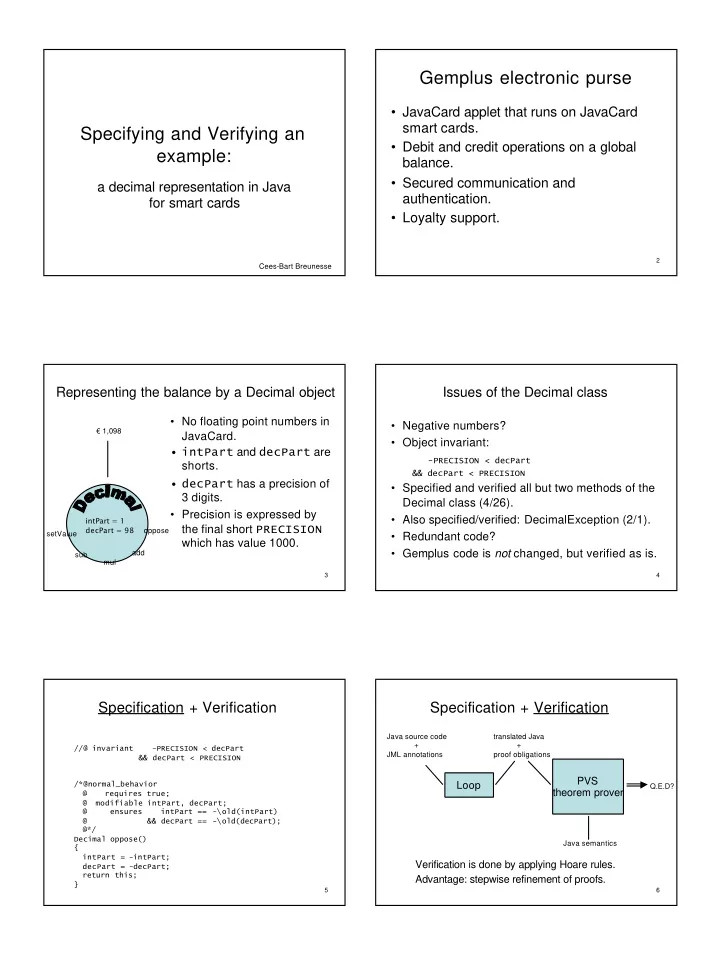
Gemplus electronic purse JavaCard applet that runs on JavaCard smart cards. Specifying and Verifying an Debit and credit operations on a global example: balance. Secured communication and a decimal representation in Java


slide-1
SLIDE 1

Specifying and Verifying an example:

a decimal representation in Java for smart cards

Cees-Bart Breunesse

2

Gemplus electronic purse

  • JavaCard applet that runs on JavaCard

smart cards.

  • Debit and credit operations on a global

balance.

  • Secured communication and

authentication.

  • Loyalty support.

3

Representing the balance by a Decimal object

  • No floating point numbers in

JavaCard.

  • intPart and decPart are

shorts.

  • decPart has a precision of

3 digits.

  • Precision is expressed by

the final short PRECISION which has value 1000.

€ 1,098 intPart = 1 decPart = 98 add mul sub setValue

  • ppose

4

Issues of the Decimal class

  • Negative numbers?
  • Object invariant:
  • PRECISION < decPart

&& decPart < PRECISION

  • Specified and verified all but two methods of the

Decimal class (4/26).

  • Also specified/verified: DecimalException (2/1).
  • Redundant code?
  • Gemplus code is not changed, but verified as is.

5

Specification + Verification

//@ invariant –PRECISION < decPart && decPart < PRECISION /*@normal_behavior @ requires true; @ modifiable intPart, decPart; @ ensures intPart == -\old(intPart) @ && decPart == -\old(decPart); @*/ Decimal oppose() { intPart = -intPart; decPart = -decPart; return this; }

6

Specification + Verification

Loop PVS theorem prover

Q.E.D? Java semantics Java source code + JML annotations

Verification is done by applying Hoare rules. Advantage: stepwise refinement of proofs.

translated Java + proof obligations

slide-2
SLIDE 2

7

A member of Decimal: public add

public void add(Decimal d) { .. add(d.intPart, d.decPart); .. }

  • Public method add is defined by a private helper

function on the integer and decimal parts of argument d.

8

A member of Decimal: private add

private void add(short e, short f) { intPart += e; decPart += f; .. make decPart obey its boundaries .. }

  • Private add method is simplified.
  • Extra checks make execution of the code faster/more

efficient.

  • Consequence: less readable code.
  • Reason for choosing method add in this talk: its code is

complex, its specification is clear.

9

Private method add

private void add(short e, short f) { intPart += e; decPart += f; short retenue = 0; short signe = 1; if ( decPart < 0 ) { signe = -1; decPart = -decPart; } retenue = decPart / PRECISION; decPart = decPart % PRECISION; retenue *= signe; decPart *= signe; intPart += retenue; }

10

How to specify add?

€ 1,098 intPart = 1 decPart = 98 add mul sub setValue

  • ppose

intPart = 2 decPart = -902 add mul sub setValue

  • ppose

intPart * PRECISION + decPart = 1098

11

Specification of add

/*@ normal_behavior @ requires f < PRECISION && f > -PRECISION; @ modifiable intPart, decPart; @ ensures ( \old(intPart) + e)*PRECISION + \old(decPart) + f @ == intPart*PRECISION + decPart; @*/ private add(short e, short f) { .. }

Complex and obscure method source code Short and clear method specification

12

Verification of add

Code Assertions void add(short e, short f) { intPart += e; decPart += f; .. make decPart obey its boundaries .. } decPart == (\old(intPart) + e) * PRECISION + \old(decPart) + f

  • intPart * PRECISION
slide-3
SLIDE 3

13

Verification of add

Code Assertions void add(short e, short f) { intPart += e; decPart += f; .. make decPart obey its boundaries .. } decPart == (\old(intPart) + e) * PRECISION + \old(decPart) + f

  • intPart * PRECISION

–PRECISION < decPart && decPart < PRECISION

14

Verification of add

Code Assertions short retenue = 0; short signe = 1; if ( decPart < 0 ) { signe = -1; decPart = -decPart; } retenue = decPart / PRECISION; decPart = decPart % PRECISION; retenue *= signe; decPart *= signe; intPart += retenue; } decPart == signe * ((\old(intPart) + e) * PRECISION + \old(decPart) + f

  • intPart * PRECISION)

15

Verification of add

Code Assertions short retenue = 0; short signe = 1; if ( decPart < 0 ) { signe = -1; decPart = -decPart; } retenue = decPart / PRECISION; decPart = decPart % PRECISION; retenue *= signe; decPart *= signe; intPart += retenue; } retenue * PRECISION + decPart % PRECISION == signe * ((\old(intPart) + e) * PRECISION + \old(decPart) + f

  • intPart * PRECISION)

16

Verification of add

Code Assertions short retenue = 0; short signe = 1; if ( decPart < 0 ) { signe = -1; decPart = -decPart; } retenue = decPart / PRECISION; decPart = decPart % PRECISION; retenue *= signe; decPart *= signe; intPart += retenue; } retenue * PRECISION + decPart == signe * ((\old(intPart) + e) * PRECISION + \old(decPart) + f

  • intPart * PRECISION)

17

Verification of add

Code Assertions short retenue = 0; short signe = 1; if ( decPart < 0 ) { signe = -1; decPart = -decPart; } retenue = decPart / PRECISION; decPart = decPart % PRECISION; retenue *= signe; decPart *= signe; intPart += retenue; } retenue * PRECISION + decPart == signe * ((\old(intPart) + e) * PRECISION + \old(decPart) + f

  • intPart * PRECISION)

–PRECISION < decPart && decPart < PRECISION

18

Verification of add

Code Assertions short retenue = 0; short signe = 1; if ( decPart < 0 ) { signe = -1; decPart = -decPart; } retenue = decPart / PRECISION; decPart = decPart % PRECISION; retenue *= signe; decPart *= signe; intPart += retenue; } retenue * PRECISION + decPart * signe == (\old(intPart) + e) * PRECISION + \old(decPart) + f

  • intPart * PRECISION
slide-4
SLIDE 4

19

Verification of add

Code Assertions short retenue = 0; short signe = 1; if ( decPart < 0 ) { signe = -1; decPart = -decPart; } retenue = decPart / PRECISION; decPart = decPart % PRECISION; retenue *= signe; decPart *= signe; intPart += retenue; } retenue * PRECISION + decPart == (\old(intPart) + e) * PRECISION + \old(decPart) + f

  • intPart * PRECISION

20

Verification of add

Code Assertions short retenue = 0; short signe = 1; if ( decPart < 0 ) { signe = -1; decPart = -decPart; } retenue = decPart / PRECISION; decPart = decPart % PRECISION; retenue *= signe; decPart *= signe; intPart += retenue; } decPart == (\old(intPart) + e) * PRECISION + \old(decPart) + f

  • intPart * PRECISION

21

Verification of add

Code Assertions short retenue = 0; short signe = 1; if ( decPart < 0 ) { signe = -1; decPart = -decPart; } retenue = decPart / PRECISION; decPart = decPart % PRECISION; retenue *= signe; decPart *= signe; intPart += retenue; } decPart - intPart * PRECISION == (\old(intPart) + e) * PRECISION + \old(decPart) + f

22

Verification of add

private void add(short e, short f){ intPart += e; if ( intPart > 0 && decPart < 0 ) { intPart--; decPart = (short) (decPart + PRECISION); } else if ( intPart < 0 && decPart > 0 ){ intPart++; decPart =(short) ( decPart - PRECISION); } decPart += f; if ( intPart > 0 && decPart < 0 ) { intPart--; decPart = (short) (decPart + PRECISION); } else if ( intPart < 0 && decPart > 0 ){ intPart++; decPart = (short) (decPart - PRECISION); } else { short retenue = (short) 0; short signe = 1; if ( decPart < 0 ) { signe = (short) -1; decPart = (short) -decPart ; } retenue = (short) (decPart / PRECISION); decPart = (short) (decPart % PRECISION); retenue *= signe ; decPart *= signe ; intPart += retenue ; } }

23

Verification of an erroneous method

  • Consider the round method in Decimal.
  • The semantics for round is clear: return the

nearest integer.

6,009 6,0 6,060 6,0 6,501 7,0

24

Verification of an erroneous method

Unfortunately, Gemplus’ implementation is incorrect for inputs w here the absolute value of decPart is within 6-10, 60-100, 501-599.

public Decimal round(){ short aux = decPart; if ( aux < 0 ) aux = -aux; while ( aux > 10 ) aux /= 10; if ( aux > 5 ) { if ( decPart > 0 ) intPart++; else intPart--; } decPart = 0; return this; } 6,009 7,0 6,060 7,0 6,501 6,0

slide-5
SLIDE 5

25

Conclusions

  • Specified and verified all but two members of the

Decimal class.

  • Formal verification is justified in critical

applications.

  • The LOOP verification technology is ready for

such non-trivial examples.

  • Software developers like Gemplus should

annotate their code with assertions.

  • Related work: ESC/Java.

26

ESC/Java vs. LOOP

ensures intPart == \old(decPart) >= PRECISION/2 ? (\old(intPart) + 1) : \old(intPart) && decPart == 0;

ESC/Java: LOOP:

  • Errors caused by null references, out-of-bounds array access, type casts.
  • Automatic checking.
  • More aimed at functional program verification.
  • It needs user interaction.