Electronic Signature Electronic Signature El Electronic Signature - - PowerPoint PPT Presentation

electronic signature electronic signature
SMART_READER_LITE
LIVE PREVIEW

Electronic Signature Electronic Signature El Electronic Signature - - PowerPoint PPT Presentation

Electronic Signature Electronic Signature El Electronic Signature t i Si t Digital Signature Digital Signature And Hash Function Biometric Signature Electronic Signature Act ROC, 2002/04/01,


slide-1
SLIDE 1

Digital Signature And Hash Function 密碼學與應用

海洋大學資訊工程系 丁培毅 丁培毅

1

Electronic Signature Electronic Signature

El

t i Si t

Electronic Signature

Digital Signature Biometric Signature

Electronic Signature Act

 ROC, 2002/04/01,

http://www.moea.gov.tw/~meco/doc/ndoc/s5_p05.htm http://www esign org tw/statutes asp http://www.esign.org.tw/statutes.asp

 US Federal, 2000/06  Japan 2000/05

2

 Japan, 2000/05

RSA RSA

RSA

two large prime numbers p q

RSA

two large prime numbers p, q modulus n = p ꞏ q public key e, gcd(e, (n)) = 1 p y , g ( , ( )) private key d, e ꞏ d  1 (mod (n))

RSA cryptosystem

S yp y

message mZn encryption: ciphertext c  m e (mod n)

d

decryption: plaintext m  c d (mod n)

RSA signature scheme

message digest (document) mZn signing: signature s  m d (mod n) ifi ti d t

e (

d )

3

verification: document m  s e (mod n)

RSA Signature Scheme RSA Signature Scheme

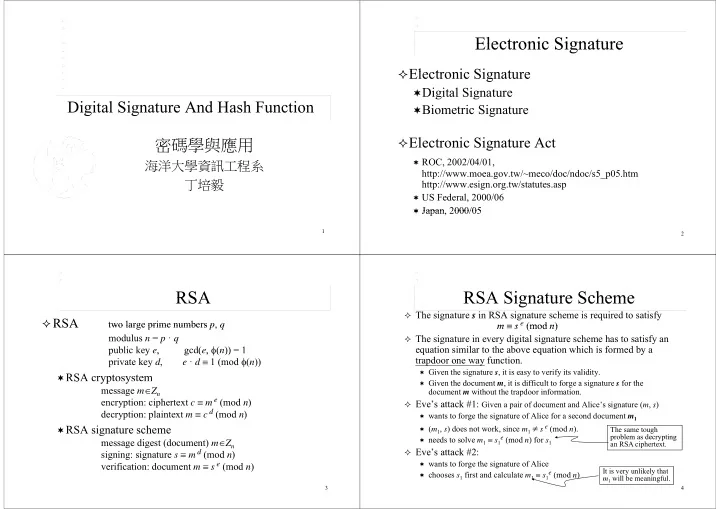
 The signature s in RSA signature scheme is required to satisfy

m  s e (mod n) m  s (mod n)

 The signature in every digital signature scheme has to satisfy an

equation similar to the above equation which is formed by a q q y trapdoor one way function.

 Given the signature s, it is easy to verify its validity.  Gi

th d t it i diffi lt t f i t f th

 Given the document m, it is difficult to forge a signature s for the

document m without the trapdoor information.  Eve’s attack #1: Given a pair of document and Alice’s signature (m, s)

 wants to forge the signature of Alice for a second document m1  (m1, s) does not work, since m1  s e (mod n).

d l

e (

d ) f

The same tough problem as decrypting

 needs to solve m1  s1e (mod n) for s1

 Eve’s attack #2:

 wants to forge the signature of Alice

problem as decrypting an RSA ciphertext.

4

 wants to forge the signature of Alice  chooses s1 first and calculate m1  s1e (mod n)

It is very unlikely that m1 will be meaningful.

slide-2
SLIDE 2

Attack RSA Signature Attack RSA Signature

 RSA signature scheme: s  md (mod n)  suppose Alice is not willing to sign the message m

almost always is meaningless

 Eve’s attacking scheme:

 decompose the message: m  m1ꞏ m2 (mod n) almost always is meaningless  ask Alice to sign m1 and m2 independently and get

s1  m1

d (mod n) and s2  m2 d (mod n)

l i l h i h

 multiply the two signatures together to get

s  s1ꞏ s2  m1

d ꞏ m2 d  (m1m2)d  md (mod n)

 Morale: never sign a message that does not make any

sense to you (never sign a message that contains

5

sense to you (never sign a message that contains unrecognized binary data)

Rabin Signature Scheme Rabin Signature Scheme

 Key generation: public key n=pꞏq, private key p,

y g p y p q, p y p, q

 Si

i

i.e. QRn

 Signing:

 for a plaintext m, 0<m<n, mQRp QRq

i i h h

2 (

d )

 signature is s, such that m  s2 (mod n)

 Verification

This is not easy if m is required to be plaintext

 Verification

 m  s2 (mod n)

required to be plaintext.

 Chosen Message Attack

 Eve chooses x and computes m  x2 (mod n)

Making Rabin signature

  • nly on hashed message

6

 Ask Alice for a signature s on m  Pr{ s  x } = 0.5

  • nly on hashed message

can avoid this attack. Never take square root directly!!

ElGamal Signature Scheme ElGamal Signature Scheme

 Probabilistic: There are many signatures that are valid for a

given message.

 Key generation: Alice chooses a large prime number p, a

*

primitive  in Zp

*, a secret integer a, and calculates a

(mod p) (p, , ) are the public key, a is the secret key

 Signing: Alice signs a message m

 select a secret random k such that gcd(k, p-1) = 1 k  r   k (mod p)  s  k -1 (m - a r) (mod p-1)

V ifi ti

(r, s) is the signature

 Verification: anyone can verify the signature (r, s)

 compute v1   r r s (mod p) and v2   m (mod p)

i t i lid iff ( d )

7

 signature is valid iff v1  v2 (mod p)

ElGamal Signature Scheme ElGamal Signature Scheme

 Proof:

k+ r k s

r

v2   m   sk+ar  ( a)r ( k)s  r r s  v1 (mod p)

 Example

 Alice wants to sign a message ‘one’ i.e. m1 = 151405  She chooses p=225119, =11, a secret a=141421, a18191 (mod p)  To sign the message, she chooses a random number k=239, r k164130,

  • s g

e essage, s e c ooses a a do u be 39,  6 30, s1  k-1 (m1- a r)  130777 (mod p-1) …. (m1, r, s1) is the signature

 Bob wants to verify if Alice signs the message m1  He calculates  r r s1  128841*193273  173527 m1 173527  He calculates  r 1  128841*193273  173527 ,

1 173527

 Signature with Appendix

 message can not be recovered from the signature  message can not be recovered from the signature  ElGamal, DSA

 Message Recovery Scheme

i dil bt i d f th i t

8

 message is readily obtained from the signature  RSA, Rabin

slide-3
SLIDE 3

ElGamal Signature Scheme ElGamal Signature Scheme

 Security:

Discrete Log Decisional Diffie-Hellman

 given public , solving for a is a discrete log problem

r

?

 fixed r, solving v2   r r s (mod p) for s is a discrete log problem  fixed s, solving v2   r r s (mod p) for r is not proven to be as

h d di t l bl b li d t b l i l hard as a discrete log problem (believed to be non-polynomial time)

 it is not known whether there is a way to choose r and s  it is not known whether there is a way to choose r and s

simultaneously which satisfy v2   r r s (mod p)

 Bleichenbacher “Generating ElGamal signatures without  Bleichenbacher, Generating ElGamal signatures without

knowing the secret key,” Eurocrypt96

forging ElGamal signature is sometimes easier than the

9

forging ElGamal signature is sometimes easier than the

underlying discrete logarithm problem

Existential Forgeries Existential Forgeries

RSA

Choose s R Zn*

RSA

Let m  se (mod n) (m, s) is a valid message signature pair

ElGamal

1-parameter 1 parameter

Choose e R Zq Let r  ge ꞏ y (mod p), s  -r (mod q), m  e ꞏ s (mod p)

2-parameter

(m, (r,s)) is a valid message signature pair

p

Choose e, v R Zq Let r  ge ꞏ yv (mod p), s  -r ꞏ v-1 (mod q),

10

m  e ꞏ s (mod p) (m, (r,s)) is a valid message signature pair

ElGamal Signature Scheme ElGamal Signature Scheme

 Security:

 Should not use the same random number k twice for two distinct

  • messages. Eve can easily know this by comparing r in both

i t E th b k thi t l t l d

  • signatures. Eve can then break this system completely and

forge signatures at will. s k m a r s k m (mod p 1) s1 k - m1  -a r  s2 k - m2 (mod p-1) (s1 - s2) k  m1 - m2 (mod p-1) Th d( 1) l ti f k There are gcd(s1 - s2, p-1) solutions for k. Eve can enumerate all  k until she finds r. Aft k i k E l th f ll i ti f After knowing k, Eve can solve the following equation for a a r  m1 - s1 k (mod p-1) Th d( 1) l i f

11

There are gcd(r, p-1) solutions for a. Eve can enumerate all a until she finds .

Example Example

 Example continued

 Alice wants to sign a second message ‘two’ i.e. m2 = 202315  She uses the same ElGamal parameters as before p=225119,

=11, a secret a=141421, a 18191 (mod p)

 She signs this message with the same random number k=239, r 

k 164130

k 1 ( ) 164899 ( d 1) ( ) k 164130, s2  k-1 (m2- a r)  164899 (mod p-1) …. (m2, r, s2) is the signature

 E

t ( ) k 34122 k 50910 ( d

 Eve can compute (s1 - s2) k  -34122 k  m1 - m2  -50910 (mod

p-1).

 Since gcd( 34122 p 1) = 2 k has two solutions 239 or 112798  Since gcd(-34122, p-1) = 2, k has two solutions 239 or 112798  Because r  k (mod p), Eve can verify easily that k = 239  k s  m

a r (mod p 1)  a = 28862 or 141421

12

 k s1  m1 - a r (mod p-1)  a = 28862 or 141421    a (mod p)  a = 141421

slide-4
SLIDE 4

ElGamal Signature Scheme ElGamal Signature Scheme

General ElGamal Signature Schemes

 Horster, Michels, and Petersen, “Meta-ElGamal Signature Schemes,” Tech.

Report TR-94-5, Univ. of Technology Chemnitz-Zwichau, 1994

 6 t

6500+ i ti

 6 types, 6500+ variations  ex. Rearrange m, r, s of m  a r + k s (mod p-1) as

A  a B + k C (mod p-1) A  a B + k C (mod p 1) verification equation A   B r C (mod p) A B C m r s m  a r + k s  m   r r s m s r m  a s + k r  m   s r r k

s

 r

m

s r m s  a r + k m  s   r r m s m r s  a m + k r  s   m r r r s m m  a s + k m  r   s r m

13

r s m m  a s + k m    r r m s r  a m + k s  r   m r s

ElGamal Signature Scheme ElGamal Signature Scheme

Signing two messages at the same time Signing two messages at the same time

r  k (mod p) 

+ k ( d 1)

m1  a m2 r + k s (mod p-1) (r, s) is the signature for m1 and m2 together

Signing three messages at the same time

r  k (mod p) r   (mod p) m1  a m2 r + k m3 s (mod q) (r, s) is the signature for m1, m2 and m3 together

14

Attacks on ElGamal Signature Attacks on ElGamal Signature

 D. Bleichenbacher, “Generating ElGamal Signatures Without

K i th S t K ” E t’96 Knowing the Secret Key,” Eurocrypt’96

  • 1. Prime p should be large enough to prevent GNFS on DL

2  l i | 1 P hli H ll h d f il

  • 2.  large prime q | p-1 s.t. Pohlig-Hellman method fails
  • 3. Using collision resistant hash function on message to prevent

e istential forgeries existential forgeries

  • 4. Should verify 1 r < p: otherwise leads to forgery from a known

signature will be shown later signature, will be shown later

  • 5. Avoid a smooth g which divides p-1, has trapdoor for forging

signatures signatures

  • 6. ElGamal over Zn

* is not as secure as it appears: known signatures

leak the factorization of n and the computation of either Zp

* or Zq *

15

p

p q

is sufficient to forge signatures

Implementation Existential Forgery Implementation Existential Forgery

 Verifier should verify that 1  r < p  Otherwise anybody can forge a signature (r', s') for

arbitrary hash value h' from a known signature (r, s) on y g ( ) hash value h

 For an arbitrary message m' with hash value h'  For an arbitrary message m with hash value h

u  h' ꞏ h-1 (mod p-1)

h' hꞏu rꞏu sꞏu (

d ) gh  gh u  yr u rs u (mod p) Calculate r' from CRT s.t. r'  r ꞏ u (mod p-1) r (mod p) s'  s ꞏ u (mod p-1)

16

s s u (mod p 1) (r', s') is the ElGamal signature for h' = hash(m')

slide-5
SLIDE 5

Cryptographic Hash Function Cryptographic Hash Function

 Input: arbitrary length of message, m  Output: h(m), fixed length (ex. 160 bit) message digest

h(ꞏ) message digest document

 Requirements:

 efficient calculation of h(m)

h(ꞏ) message digest document

 given y = h(m), it is computationally infeasible to find a distinct

message m' such that h(m') = y (weak collision resistance, for i h )

way

signature scheme)

 it is computationally infeasible to find two distinct messages m1

and m with h(m ) h(m ) (strong collision resistance for

  • ne-w

and m2 with h(m1) = h(m2) (strong collision resistance, for resisting birthday attack)

 Examples: Snefru N Hash MD2 MD4 MD5 RIPE

17

 Examples: Snefru, N-Hash, MD2, MD4, MD5, RIPE-

MD160, SHA, SHA-1, SHA-(256, 384, 512) (2002/08)

One way Function One-way Function

 Definition based on Complexity theory not Mathematics  OWF: a function that is easy to evaluate yet its inverse is

hard to compute

easy

p

For e er probabilistic pol time TM A' easy h d x f(x) For every probabilistic poly-time TM A', every positive polynomial p(ꞏ) and all sufficient large n

1

hard

Pr{A'(f(Un), 1n)  f -1f(Un)} < 1 / p(n)

 A weak collision free hash function is a one-way function

negligible

 A weak collision free hash function is a one-way function

x x x x

h(ꞏ) given y, it is computationally infeasible to fi d h th t h( )

18

x

find any message m such that h(m) = y

Popular Hash Functions Popular Hash Functions

MD2 MD4 Extended MD4 MD5 SHA RIPEMD HAVAL SHA 1 SHA-1 RIPEMD-128 RIPEMD-160 SHA-256 SHA-384 SHA-512

19

Cryptographic Hash Function Cryptographic Hash Function

 Discrete Log Hash Function

 D Ch

E H ij t B Pfit

“C

t hi ll St U d i bl

 D. Chaum, E. van Heijst, B. Pfitzmann, “Cryptographically Strong Undeniable

Signatures Unconditionally Secure for the Signer”, Crypto’91

 satisfies the second and the third requirements  too slow to be used

 select a prime number p, such that q=(p-1)/2 is also a prime

number

 choose two random primitive roots ,  in Zp  there exists unique a such that a   (mod p), assume a is

unknown (a discrete log problem, since ,  are chosen independently)

 hash function h : Zq2  Zp

h(m) = x0 x1 (mod p)

here + ith 0

q 1

20

where m = x0 + x1 q with 0 x0, x1 q-1

note: h(m) is about half the bit length of m

slide-6
SLIDE 6

Cryptographic Hash Function Cryptographic Hash Function

Proposition: If we have an algorithm A that can

find m'm with h(m)=h(m'), then using A we can determine the discrete log a = L () determine the discrete log a L()

proof: if we are given the output of A e g m and m' a reduction argument proof: if we are given the output of A, e.g., m and m we can write m = x0 + x1 q and m' = x'0 + x'1 q

h(m)  h(m')  x0 x1  x'0 x'1 (mod p) h(m)  h(m )  x0 x1  x 0 x 1 (mod p) a    a (x1- x'1) + (x0- x'0)  1 (mod p) i i iti

( ' ) ( ' ) 0 (

d 1)  is primitive  a (x1- x'1) + (x0- x'0)  0 (mod p-1) this congruence equation has d = gcd(x1- x'1, p-1) l i d b f d il

21

solutions, and can be found easily

Cryptographic Hash Function Cryptographic Hash Function

since 1. x1 x'1 (otherwise run A again with different )

  • 2. only 1, 2, q, p-1 divides p-1 and
  • 3. -(q-1)  x1- x'1  (q-1)

d t

  • 3. (q 1)  x1 x 1  (q 1)

 d can only be 1 or 2 il t t b th l ti d

random tape

 we can easily test both solutions and determine a = L()

 Given , , p (p=2q+1, ,  are primitives, there are (p-

1)=(2q)=q-1 primitives), find L():

  • 1. using algorithm A to find m and m' s.t. h(m) = h(m')
  • 2. write m = x0 + x1 q and m' = x'0 + x'1 q

22

  • 2. write m

x0 x1 q and m x 0 x 1 q

  • 3. solve a (x1- x'1) + (x0- x'0)  0 (mod p-1) for a

Cryptographic Hash Function Cryptographic Hash Function

Properties of h(m) = x0 x1 (mod p)

h(ꞏ) is strongly collision resistant

from the above proposition, the efficient algorithm A that

  • t e above p opos t o , t e e

c e t a go t t at finds m and m' such that h(m) = h(m') is unlikely to exist

h(ꞏ) is weakly collision resistant h( ) is weakly collision resistant

  • 1. Assume h() is not w.c.r.   an inverse function of h(ꞏ)

2 g(ꞏ): given m  Z 2 and y=h(m)  Z it is efficient

  • 2. g( ): given m  Zq2 and y h(m)  Zp, it is efficient

to compute m' = g(y)  Zq2 such that h(m') = y 3 |Z 2 | >> |Z |  it is very likely that g(y)  m

  • 3. |Zq2 | >> |Zp|  it is very likely that g(y)  m

(otherwise try another m), therefore, we have an algorithm A that can find m  m' but h(m)=h(m')

23

algorithm A that can find m  m but h(m) h(m ) contradict to the ‘strong collision resistant’ property

Cryptographic Hash Function Cryptographic Hash Function

Discussion: ‘strong collision freeness of h(ꞏ)’

given h(ꞏ) it is hard to find m1, m2 such that h(m1)=h(m2) h(m1) h(m2)

computationally infeasible

because the length of h(m) is far less than the length of

m, the mapping h(ꞏ) is definitely many to one

to make it computationally infeasible to find two

distinct m1 and m2 such that h(m1)=h(m2)

1 2

(

1)

(

2)

intuitively, the set of m’s that map to the same h(m)

24

have to be randomly distributed among many many

  • ther m’s that have different h(m)
slide-7
SLIDE 7

Cryptographic Hash Function Cryptographic Hash Function

 Hash function based on symmetric block cipher

 if the block algorithm is secure then the one-way hash function

is secure?? (never proved, Damgård, Crypto’89)

Compression function

mi h hi

function

hi-1 A Key A C Encrypt Key  B

25

A, B, C can be either mi, hi-1, mi  hi-1

Cryptographic Hash Function Cryptographic Hash Function

 Not all 81 assignments of A, B, C are secure, the following 12

assignments are OK (especially the first 4) assignments are OK (especially the first 4)

A B C mi hi-1 mi mi  hi-1 hi-1 hi-1 mi  hi-1 mi mi  hi-1 hi-1 mi  hi-1 mi mi hi-1 hi-1 m m  h m  h hi-1 hi-1 mi mi mi mi  hi-1 mi  hi-1 mi  hi-1 mi  hi-1

i 1

hi-1 hi-1

i

mi mi mi  hi-1 mi  hi-1

i i-1 26

hi-1 hi-1 mi mi mi  hi-1 mi  hi-1

Application of cryptographic hash function Application of cryptographic hash function

Digital Signature: Digital Signature:

document m Hash message digest h(m) Digital Signature signature (m sig(h(m))) m digest h(m) Signature (m, sig(h(m)))

efficient computation and storage

p g

27

Application of cryptographic hash function Application of cryptographic hash function

security: weak collision resistant property of h(m)

thwarts forgers ‘Given (m, sig(h(m))) and another m'( m), ( , g( ( ))) ( ), Is Eve capable of finding sig(h(m'))?’

the underlying signature algorithm guarantees that it is the underlying signature algorithm guarantees that it is

computationally difficult to find sig(h(m')) given h(m') without the trapdoor information without the trapdoor information

if h(m') = h(m) then sig(h(m')) will be sig(h(m))

However given m we know h(m) ‘weakly collision However, given m, we know h(m), weakly collision resistant property of h(ꞏ)’ guarantees that it is computationally infeasible to find m' such that

28

p y h(m') = h(m)

slide-8
SLIDE 8

Application of cryptographic hash function Application of cryptographic hash function

Data Integrity:

data transmitted in noisy channel data transmitted in insecure channel data transmitted in insecure channel

errors: insertion, deletion, modification, rearrangement

non-cryptographic: parity, CRC32

  • nly increase the detection probability of errors

cryptographic: collision resistant, detect almost all

yp g p , errors (slow)

29

The Birthday Paradox The Birthday Paradox

 r = 23 Pr{any two of them have the same birthday}  0.5  r = 30 Pr{any two of them have the same birthday}  0.7  r = 40 Pr{any two of them have the same birthday}  0.9

30

{ y y}

The Birthday Paradox (cont’d) The Birthday Paradox (cont d)

Pr { r people have different birthdays }

r = 2, (1-1/365) = .997 r = 3, (1-1/365)(1-2/365) = .992 r = 4, (1-1/365)(1-2/365)(1-3/365) = .984 , ( )( )( ) … r 23 (1 1/365)(1 2/365) (1 22/365) 493 r = 23, (1-1/365)(1-2/365)… (1-22/365) = .493

Pr { at least two having the same birthday }

= 1 - Pr { all r people have different birthday } = 507

31

1 Pr { all r people have different birthday } .507

The Birthday Paradox (cont’d) The Birthday Paradox (cont d)

 e-x = 1 – x + x2 / 2! - x3 / 3! +…

if x is a small real number, ex. 1/365, then 1 – x  e-x

 (1 1/365)(1 2/365)

(1 ( 1)/365)  (1 i/365)

r-1

 (1-1/365)(1-2/365)… (1-(r-1)/365) =  (1 – i/365)

 -i/365

  •  i/365
  • r(r-1)/(2*365)

i=1

 e i/365 = e  i/365 = e r(r 1)/(2 365)

  = Pr{at least one collision}  1 - e- r(r-1)/(2n)

{ }

  • r(r-1)/(2n)  ln (1-)

define  = ln (1 ) define  = - ln (1-) r2 – r  2 n  

32

neglecting r, we obtain r   2 n 

slide-9
SLIDE 9

The Birthday Paradox (cont’d) The Birthday Paradox (cont d)

In general,

n kinds of objects (n is large, each kinds of objects

have infinite supplies) ave te supp es)

r people each chooses one object independently

Let  = Pr { at least two choose the same kind of object }

define  = - ln (1-) i.e.  = 1 - e-  define  ln (1 ) i.e.  1 e

From the previous derivation r  2  n p

eg: if  = 0.693 Pr {..}  1 - e- .693 = 0.5

33

g { } n = 365 2 .693 365 = 22.49

Birthday Attack Birthday Attack

A slightly different scenario

n kinds of objects (n is large, each kinds of objects

have infinite supplies) ave te supp es)

two groups, each has r people, every one chooses one

  • bject independently
  • bject independently

r   n r   n

Pr { at least one in the first group chooses the same kind of

  • bject as someone in the second group chooses }  1 - e- 
  • bject as someone in the second group chooses }  1 - e

note: Pr{ i matches }  i e- / i!

2! e

2   3 3!

34

  • ie. Pr { at least two matches}  1 - e- - e-

Birthday Attack Birthday Attack

Ex. Pr{ꞏ}  1 - e-  = 0.5

   0.693  r  0.693 n  0.83 n

n=365, r  15.9

35

Birthday Attack on Digital Signature Birthday Attack on Digital Signature

Actually attack on the one-way hash function

Alice Fred

document m Hash message digest h(m) Digital Signature

Alice

signature (m, sig(h(m)))

Receipt serial #12345678

If h( ) i 50 bi i Ali ld g

... I, Fred, hereby owe you, Alice, 10000 dollars

If h(m) is a 50-bit string, Alice would think that she is safe because if the hash is a random mapping the computation time

dollars. … Fred 01/01/04

is a random mapping, the computation time to find another document with the same hash as the given one, h(m), would be

36

g ( ) O(250)  (1015)

slide-10
SLIDE 10

Birthday Attack on Digital Signature Birthday Attack on Digital Signature

Receipt serial #12345678 Receipt serial #12345678

F's U's

... I, Fred, hereby owe you, Alice,10000 dollars. ... I, Fred, hereby

  • we

you,Alice, 100 dollars. …  Fred  01/01/04 …  Fred  01/01/04

 Fred finds 30 places where he can make slight changes in

both favorable (F) and unfavorable (U) versions of

  • documents. i.e.

 r = 230, n = 250,  = r2 / n = 210 = 1024  Fred have r variations of {F }’s and r variations of {U }’s  Fred have r variations of {Fi} s and r variations of {Ui} s  Pr{ there is at least one match in h(Fi) and h(Ui) }  1 - e-   1

 let h(Fi*) = h(Uj*), Fred gave Uj* to Alice when he got

37

e (

i*)

(Uj*), ed gave Uj* o ce w e e go $10000 from her, but later claimed that the document is Fi*

Avoid the Birthday Attack Avoid the Birthday Attack

 Alice changes slightly the document m to m' (wording,

spaces, formats, …) before Fred signs the document

 so that h(m')  h(m)

( ) ( )

 In order to obtain another document that has the same hash

h(m'), Fred needs to search on average 250/2 documents.

 Alice should choose a hash function with output twice as

long as what she feel safe. For example, in this case she should ask Fred to use a hash function with 100-bit output. (The birthday attack effectively halves that number of bits.)

38

Birthday Attack to solve Discrete Log Birthday Attack to solve Discrete Log

 given , and p, find x such that x   (mod p)  procedure step 1: calculate and save k (mod p) for p random k step 2: calculate and save  -i (mod p) for p random i step 3: compare these two sets to find a match step 3: compare these two sets to find a match  analysis

  = 1 Pr{k i k  -i (mod p)}  1

e- = 0 632

  = 1, Pr{k, i, k    i (mod p)}  1 - e = 0.632

 let k*, i* be the index such that k*   -i* (mod p)  k*+i*   (mod p)     (mod p)  L()  k* + i* (mod p-1) Note: repeat step 1 and step 2 if k* and i* can not be found

39

p p p Pr{success}: 0.632  0.864  0.95

1 repetition 2nd repetition 3rd repetition

Meet in the Middle Attack Meet-in-the-Middle Attack

Similar structure to birthday attack Deterministic, always find the solution Double DES Encryption: Double DES Encryption:

let Ek (ꞏ) Ek (ꞏ) be two 56-bit DES let Ek1( ), Ek2( ) be two 56-bit DES, Can Ek2(Ek1(ꞏ)) achieve the level of security as a 112 bit symmetric cryptosystem? 112-bit symmetric cryptosystem?

Note: for RSA (me1)e2 is equivalent to me3 (for the Note: for RSA (me1)e2 is equivalent to me3 (for the same n) for DES E (E (ꞏ)) is not equivalent to some

40

for DES Ek2(Ek1(ꞏ)) is not equivalent to some Ek3(ꞏ)

slide-11
SLIDE 11

Meet in the Middle Attack Meet-in-the-Middle Attack

 brute-force attack on DES: given m and c, try all 256

possible keys to see which key satisfies c = Ek(m)

 direct extension of brute-force attack on Double DES:

given m and c, try all 2112 possible keys to see which two keys k1 and k2 satisfy c = Ek2(Ek1(m)) y

1 2

y

2( 1( ))

 MITM attack (smarter brute-force attack):

given m and c, Eve is going to find k1 and k2 such that c = given m and c, Eve is going to find k1 and k2 such that c Ek2(Ek1(m)) with only 257 DES calculations

 step 1: calculate Ek(m) for all possible k  step 1: calculate Ek(m) for all possible k  step 2: calculate Dk(c) for all possible k  step 3: compare the two lists there is at least one match

41

 step 3: compare the two lists, there is at least one match

note: if there are multiple matches, try another (m, c) pair to resolve

Meet in the Middle Attack Meet-in-the-Middle Attack

Analysis:

storage: 257 blocks (= 260 bytes ~ 230 GB ~8ꞏ106 120G HD) computation: 257 DES + (256)2 comparisons computation: 2

DES + (2 ) comparisons far less than directly try out (256)2 DES key combinations If Eve have plenty of power

  • combinations. If Eve have plenty of power

to break Ek(m) in a brute-force way, she will be capable of breaking Ek (Ek (m)) easily be capable of breaking Ek2(Ek1(m)) easily.

 Triple Encryption: Ek3(Ek2(Ek1(m)))

storage  time tradeoff

given m and c, to break this system in a brute-force

way, it is necessary to compute (2112 + 256) DES and

42

2168 comparisons

Meet in the Middle Attack Meet-in-the-Middle Attack

Ek1(ꞏ) Dk2(ꞏ) = m c Note: * DES is a permutation, means that for a given key, different message m will be encrypted to different ciphertext c1, also different ciphertext c will be decrypted to different m different ciphertext c will be decrypted to different m1 * There could be multiple collisions for the above two lists if E(ꞏ) and D(ꞏ) are DES and its inverse respectively A if E( ) and D( ) are DES and its inverse, respectively. A single message m could be encrypted to the same ciphertext c1 with different keys. In single DES encryption, this might not be very severe, but in two concatenated DES operations, this phenomenon would be frequent since number of key combinations (2112) is far larger than number of ciphertexts

43

combinations (2112) is far larger than number of ciphertexts (264). [ in terms of BA: r=256, n=264, =(256)2/264]

Another thought on Double DES Another thought on Double DES

 Why don’t we try to apply birthday attack on Double DES?  In order to apply birthday attack, we prepare two lists:

calculate Ek1(m) for 232 random k1 for 232 random k2 calculate Dk2(c)

Because DES encryption and decryption can be considered random mappings 232Ek (m)’s and 232Dk (c)’s are close to random mappings, 2 Ek1(m) s and 2 Dk2(c) s are close to random samples from 264 possible ciphertexts. According to the birthday attack the probability that there is a match in the the birthday attack, the probability that there is a match in the two lists is about 0.632, it looks like that we can find a pair

  • f keys (k

k ) that can encrypt m to c

44

  • f keys (k1, k2) that can encrypt m to c.

Will “Double DES” be broken in 233 DES computations?

slide-12
SLIDE 12

Another thought on Double DES Another thought on Double DES

Ek1(ꞏ) m c Ek2(ꞏ)

 Since c is a 64-bit block, c has 264 possibilities. There

are 2112 possible (k1, k2) key combinations. Therefore, p ( 1,

2)

y , for a particular m, there are on average 248 key combinations that can generate a given c by the pigeon g g y p g hole principle. To find out the actual key used , we need to analyze many more (plaintext, ciphertext) pairs. y y (p , p ) p

 The previous birthday attack scheme can only find one

key combination, it would be very difficult to find out

45

key combination, it would be very difficult to find out all key pairs with that kind of probabilistic scheme.

Digital Signature Algorithm Digital Signature Algorithm

NIST 1994 (FIPS 186), 2000 (FIPS 186-2)

( ), ( )

digital signature scheme with appendix,

SHA 1 (FIPS 180 1) th h h l ith use SHA-1 (FIPS 180-1) as the hash algorithm

Generation of keys

y

q is a 160-bit prime number, p is a 512-bit (768-bit,

1024-bit) prime number such that q | p-1 1024 bit) prime number such that q | p 1

g is a primitive root modulo p

  g(p-1)/q (mod p) q  (g(p-1)/q)q  gp-1  1 (mod p)   g (mod p)   (g )  g  1 (mod p)

 choose secret value a, 1 a  q-1 and calculate   a (mod p)  public key (p q  ) secret key a

46

 public key (p, q, , ), secret key a

Digital Signature Algorithm Digital Signature Algorithm

Signature: given message m and p, q, 

Alice selects a random secret k

0<k<q-1

compute r  (k (mod p)) (mod q) compute r  ( (mod p)) (mod q) compute s  k-1 (m + a r) (mod q) ( 0, kꞏk-1  1 (mod q)) signature is (r, s) note: r, s are both 160 bit

Verification: given message m and signature (r, s)

g g g ( , )

Bob downloads (p, q, , ) compute u  s-1 m (mod q) and u  s-1 r (mod q)

sꞏs-1  1 (mod q)

compute u1  s

m (mod q) and u2  s r (mod q)

compute v  (u1u2 (mod p)) (mod q)

47

Bob accepts if v = r

Digital Signature Algorithm Digital Signature Algorithm

Proof:

s  k-1 (m + a r) (mod q)

m = (- a r + k s) (mod q) m ( a r k s) (mod q) gcd(s, q) = 1 s-1 exists s-1 m  a r s-1 + k (mod q) s m  - a r s + k (mod q) k  s-1 m + a r s-1  u1 + a u2 (mod q)

k (

d ) ( d ) r  k (mod p) (mod q)  u1 + a u2 + i q (mod p) (mod q)

u u

i

 u1 u2 i q (mod p) (mod q)  u1 u2 (mod p) (mod q) q  1 (mod p)

48

 v (mod p) (mod q)

slide-13
SLIDE 13

Security of DSA Security of DSA

a must be kept secret k

t b d t i ( ElG l)

k can not be used twice (same as ElGamal) partial information leaked from 

let p-1 = t ꞏ q and g is a primitive root modulo p,

if t has only small prime factors, given g a (mod p), a (mod t) can be calculated by Pohlig-Hellman algorithm

  gt (mod p) (i.e.   gp-1/q (mod p), q  1 (mod p))

g ( p) ( g ( p), ( p))   a  gta(mod p) i.e. Lg()  0 (mod t) no information leaked by  about Lg() is useful even if y 

g()

all prime factors of t are relatively small

a  L ()  L () / t (mod p-1), therefore, no information

49

a  L()  Lg() / t (mod p 1), therefore, no information

  • f L() leaked by  is useful

Computation of DSA Computation of DSA

mod exp is O(n3) mod exp is O(n ) bit length: q: 160 bits p: n bits

ElGamal v1 = r s (mod p) v2 = m (mod p)

where , , r, s, m, v1 , v2 , p are all n bits

DSA v  (u1u2 (mod p)) (mod q)

where , , p are n bits, u1 , u2 , v, q are 160 bits

1 2

overall verification computations

ElGamal: O(3

n3)

ElGamal: O(3 ꞏ n3) DSA: O(2 ꞏ n2 ꞏ 160)

50

Other Signature Related Algorithms Other Signature Related Algorithms

G Si

 Group Signature  Undeniable Signature (Nontransferable Signature)  Undeniable Signature (Nontransferable Signature)  Designated Confirmer Signature  Ring Signature  Multi-Party Digital Signature

51

Other topics Other topics

Security notions of signature schemes Schnorr signature scheme DSS

d ElG l t bl

DSS and ElGamal are not provably secure First encryption or first signature?

yp g

52