STRIPS Planning Set of operators , where each operator has Set of - - PDF document

strips planning
SMART_READER_LITE
LIVE PREVIEW

STRIPS Planning Set of operators , where each operator has Set of - - PDF document

STRIPS Planning Set of operators , where each operator has Set of parameters Set of preconditions Set of effects , consisting of add effects and delete effects. Set of objects to instantiate operators parameters fully


slide-1
SLIDE 1

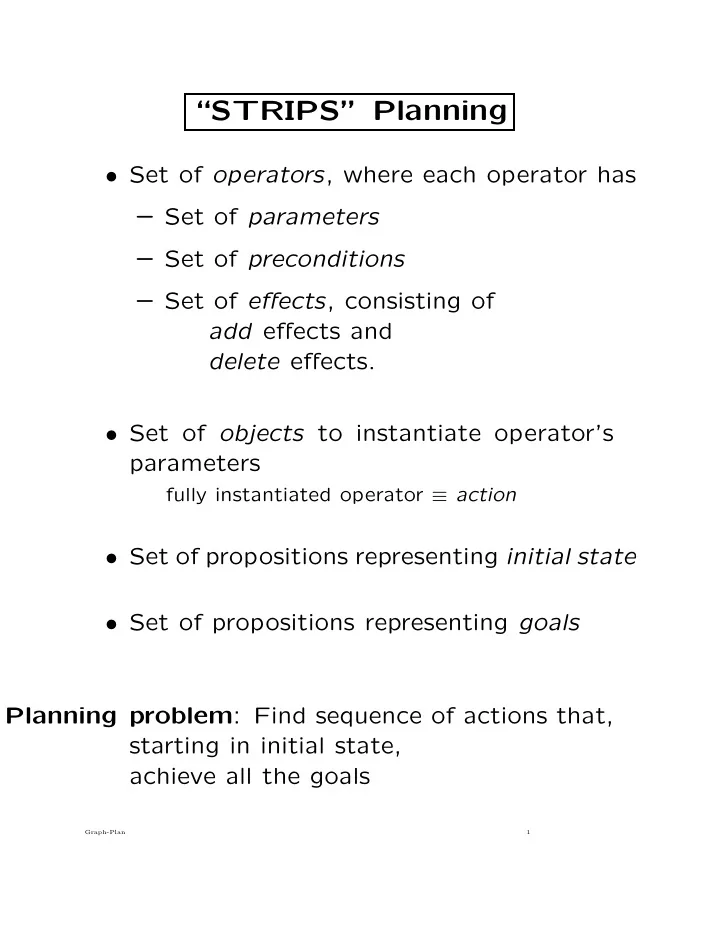
“STRIPS” Planning

  • Set of operators, where each operator has

– Set of parameters – Set of preconditions – Set of effects, consisting of add effects and delete effects.

  • Set of objects to instantiate operator’s

parameters

fully instantiated operator ≡ action

  • Set of propositions representing initial state
  • Set of propositions representing goals

Planning problem: Find sequence of actions that, starting in initial state, achieve all the goals

Graph-Plan 1

slide-2
SLIDE 2

Approaches to STRIPS planning

  • Search through space of world states

– forward search, – regression search – bi-directional search – means-ends analysis – . . .

  • Search through space of plans

– total order planning – partial order planning

  • Search through planning graph

Graph-Plan 2

slide-3
SLIDE 3

GraphPlan Approach

  • 1. Construct a “PlanGraph” that contains

all valid plans + other stuff (invalid plans)

up to a maximum depth

  • 2. Search PlanGraph for valid plan

. . . then return that plan

Graph-Plan 3

slide-4
SLIDE 4

Simple Cake-Eating Domain

  • Initial: HaveCake ∧ ¬EatenCake
  • Goal: HaveCake ∧ EatenCake
  • Actions:

Op

 

Eat PreC: HaveCake Eff: ¬HaveCake ∧ EatenCake

 

Op

 

Bake PreC: ¬HaveCake Eff: HaveCake

 

  • PlanGraph

Bake(Cake) Eat(Cake) Have(Cake)

S0 A S1 A1 S 2

Have(Cake) Have(Cake) Have(Cake) Have(Cake) Eaten(Cake) Eaten(Cake) Eaten(Cake) Eaten(Cake) Eaten(Cake) Eat(Cake)

Graph-Plan 4

slide-5
SLIDE 5

Parts of a PlanGraph

Bake(Cake) Eat(Cake) Have(Cake)

S0 A S1 A1 S 2

Have(Cake) Have(Cake) Have(Cake) Have(Cake) Eaten(Cake) Eaten(Cake) Eaten(Cake) Eaten(Cake) Eaten(Cake) Eat(Cake)

“2-leveled” Graph S0, A0, S1, A1, . . .

  • S0: propositions in initial state
  • Ai: each action whose preconditions

all occur in level Si−1

  • Si: each prop’n that is ADDed/DELETEd by

⋆ an action in level Ai ⋆ a “No-Op” (persistance)

  • Mutex links

⋆ between actions in level Ai ⋆ between propositions in level Si “mutually exclusive” “cannot occur in same plan”

Graph-Plan 5

slide-6
SLIDE 6

Mutex Conditions#1: Actions

Bake(Cake) Eat(Cake) Have(Cake)

S0 A S1 A1 S 2

Have(Cake) Have(Cake) Have(Cake) Have(Cake) Eaten(Cake) Eaten(Cake) Eaten(Cake) Eaten(Cake) Eaten(Cake) Eat(Cake)

Between 2 actions O1 and O2, same level Ai:

  • Inconsistent effects

O1:Eff negates O2:Eff

EatenCake, NoOp(HaveCake) disagree wrt “HaveCake” EatenCake:Eff = ¬HaveCake NoOp(HaveCake):Eff = HaveCake

  • Interference

O1:Eff negates O2:PreC

EatenCake interfers with NoOp(HaveCake): EatenCake:Eff = ¬HaveCake NoOp(HaveCake):PreC = HaveCake

  • Competing Needs

O1:PreC negates O2:PreC

Bake:PreC = ¬HaveCake Eat:PreC = HaveCake

Graph-Plan 6

slide-7
SLIDE 7

Mutex Conditions#2: Propositions

Bake(Cake) Eat(Cake) Have(Cake)

S0 A S1 A1 S 2

Have(Cake) Have(Cake) Have(Cake) Have(Cake) Eaten(Cake) Eaten(Cake) Eaten(Cake) Eaten(Cake) Eaten(Cake) Eat(Cake)

Between 2 propositions ρ1 and ρ2, same level Si:

  • Negation

ρ1 = ¬ρ2

  • Inconsistent Support

Every action achieving ρ1 (from Si−1) is mutex with every action achieving ρ2

In S1: HaveCake mutex EatenCake as

  • nly way to achieve HaveCake:

NoOp(HaveCake) is mutex with only way to achieve EatenCake: Eat N.b.: Not mutex at S2 !

Graph-Plan 7

slide-8
SLIDE 8

Planning Graphs

  • A valid plan is “2-leveled” graph

– two kinds of nodes (propositions, actions) alternates: proposition level, action level – 5 kinds of edges ⋆ precondition (Si → Ai) ⋆ add effect (Ai → Si+1) ⋆ delete effect (Ai → Si+1) ⋆ mutex-action (Ai ↔ Ai) ⋆ mutex-prop (Si ↔ Si) – Include action O at action-level Ai if all preconditions at proposition-level Si – Include proposition ρ at proposition-level Si if it is add/delete effect of action O ∈ Ai−1 (including no-op actions)

Restriction: Allow actions O1, O2 at same time t ONLY if don’t interfere with each other

  • PlanningGraph ≈ valid plan

but without no-interfere restriction

Graph-Plan 8

slide-9
SLIDE 9

GraphPlan Algorithm

function Graphplan( problem ) returns solution or failure graph ← Initial-Planning-Graph(problem) goals ← Goals[problem] loop do if goals all non-mutex in last level of graph then do solution ← Extract-Solution(graph, goals, Length(graph)) if solution = failure then return solution else if No-Solution-Possible(graph) then return failure graph ← Expand-Graph(graph, problem) end

Graph-Plan 9

slide-10
SLIDE 10

Flat-Tire Domain

Fl= Flat; Sp= Spare; Ax= Axel; Tr= Trunk; Gr= Ground

  • Initial: At(Fl, Ax) ∧ At(Sp, Tr)
  • Goal: At(Sp, Ax)
  • Actions:

Op

 

TakeOutSpare PreC: At(Sp, Tr) Eff: ¬At(Sp, Tr) ∧ At(Sp, Gr)

 

Op

 

RemoveFlat PreC: At(Fl, Ax) Eff: ¬At(Fl, Ax) ∧ At(Fl, Gr)

 

Op

 

PutOnSpare PreC: At(Sp, Gr) ∧ ¬At(Fl, Ax) Eff: ¬At(Sp, Gr) ∧ At(Sp, Ax)

 

Op

  

LeaveOverNight PreC:

{}

Eff: ¬At(Sp, Gr) ∧ ¬At(Sp, Ax) ∧ ¬At(Sp, Tr) ∧ ¬At(Fl, Gr) ∧ ¬At(Fl, Ax)

  

Graph-Plan 10

slide-11
SLIDE 11

Flat-Tire in GraphPlan

S0 A S1 A1 S2

At(Spare,Trunk) At(Spare,Trunk) At(Flat,Axle) At(Flat,Axle) At(Spare,Axle) At(Flat,Ground) At(Flat,Ground) At(Spare,Ground) At(Spare,Ground) At(Spare,Trunk) At(Spare,Trunk) At(Flat,Axle) At(Flat,Axle) At(Spare,Axle) At(Flat,Ground) At(Flat,Ground) At(Spare,Ground) At(Spare,Ground) At(Spare,Axle) At(Spare,Trunk) At(Flat,Axle) At(Spare,Axle) At(Flat,Ground) At(Spare,Ground)

PutOnSpare LeaveOvernight RemoveFlat TakeOutSpare TakeOutSpare RemoveFlat LeaveOvernight

Graph-Plan 11

slide-12
SLIDE 12

Trace of GraphPlan Algorithm #1

  • S0: initial facts

(include ¬facts)

  • As

At(Sp,Ax) ∈ S0 do not call Extract-Solution

  • Expand-Graph forms A0 with

⋆ 3 “real” actions ⋆ 5 no-op actions; S1 is effects Expand-Graph then finds ⋆ 4 action-mutex within A0 ⋆ 4 prop-mutex within S1

  • As

At(Sp,Ax) ∈ S1 do not call Extract-Solution

  • Expand-Graph forms A1 with

⋆ 4 “real” actions ⋆ 7 no-op actions S2 is effects

Graph-Plan 12

slide-13
SLIDE 13

Mutex wrt FlatTire

  • Inconsistent Effects

RemoveSpare + LeaveOvernight

RemoveSpare:Eff = At(Sp,Gr) LeaveOvernight:Eff = ¬At(Sp,Gr)

  • Inteference

RemoveFlat + LeaveOvernight

RemoveFlat:PreC = At(Sp,Ax) LeaveOvernight:Eff = ¬At(Sp,Ax)

  • Competing Needs

RemoveFlat + PutOnSpare

RemoveFlat:PreC = At(Fl,Ax) PutOnSpare:Eff = ¬At(Fl,Ax)

  • Inconsistent Support

At(Sp,Ax) + At(Fl,Ax) in S2

At(Sp,Ax) by PutOnSpare At(Fl,Ax) by NoOp[At(Fl,Ax)] and PutOnSpare mutex NoOp[At(Fl,Ax)] (Can’t put 2 objects in same place at same time)

Graph-Plan 13

slide-14
SLIDE 14

Trace of GraphPlan Algorithm #2

  • “All” goal literals, At(Sp, Ax) , in S2

none are mutex . . .

  • So there MAY be solution

. . . call Extract-Solution

Extract-Solution(. . . ) Let Gn be the GOAL at last level, Sn For each i = n..1 ⋆ Let Hi be a conflict-free subset of Ai−1, that covers Gi (in Si) ⋆ Let Gi−1 be preconditions of Hi . . . until reach state in S0 satisfying all goals Action-set H is “conflict-free” ≡ no pair of H are mutex, and no pair of preconditions (in G) are mutex

Graph-Plan 14

slide-15
SLIDE 15

Trace of Extract-Solution

  • G2

= { At(Sp,Ax) } H2 = { PutOnSpare }

  • G1

= { At(Sp,Gr), ¬At(Fl,Ax) } What is H1?

– Achieve At(Sp,Gr) by TakeOutSpare – Achieve ¬At(Fl,Ax) by #1. LeaveOvernight #2. RemoveFlat But not #1, as LeaveOvernight is mutex with TakeOutSpare ⇒ H1

= { TakeOutSpare, RemoveFlat }

  • G0 = { At(Sp,Tr), At(Fl,Ax) }

As in G0 ⊂ S0, DONE!

Graph-Plan 15

slide-16
SLIDE 16

Extending PlanGraph

Add action level Ai: ForEach action(∗) O If O’s preconditions all true in prop-level Si, and NOT mut-ex, Then add O to level Ai include precondition-links create mutex (O:actions-I-am-exclusive-of) Add prop-level Si+1: ForEach effect ρ of each action in action-level Ai Add ρ to prop-level Si+1 Add S ← ρ add- or delete- links Mark ρ1, ρ2 as mutex if each way of generating ρ1 is mutex to each way of generating ρ2

(∗) each instantiation of each operator; including “no-op”s

Graph-Plan 16

slide-17
SLIDE 17

Correctness

Graphplan is sound and complete: ∗ any plan Graphplan finds is a legal plan ∗ if ∃ legal plan then Graphplan will find one.

Theorem:

If ∃ valid plan using ≤ t time steps, then plan is subgraph of (depth-t) Planning Graph. + If Goals not satisfiable by any valid plan, then GraphPlan will halt, w/failure, in finite time.

(extends most partial-order planners)

Graph-Plan 17

slide-18
SLIDE 18

Leveling Off

  • GraphPlan ≈ Iterative deepening

When to stop??

  • Lemma: If no valid plan exists, then

∃ a prop-level Sn s.t. all future proposition levels are identical to Sn

– Identical ≡ same propositions, mutual exclusions – graph has “leveled off after Sn”

  • Corollary: No solution exists if

– a goal does not appear in Sn

  • r

– Sn has mutually exclusive goals

  • Subtlety:

{ on(A,B), on(B,C), on(C,A) }

Graph-Plan 18

slide-19
SLIDE 19

Termination Condition

  • Let St

i denote set of memoized goal sets

at level i after an unsuccessful stage t

  • Theorem: If the graph has leveled off at

level n and stage t has passed in which |St−1

n

| = |St

n|, then no valid plan exists

Graph-Plan 19

slide-20
SLIDE 20

Termination Proof

  • As PlanGraph gets deeper. . .

– Literals increase monotonically – Actions increase monotonically – Mutex decrease monotonically

⋆ If O1 and O2 are mutex in Ak, then mutex in Ai i = 1..k provided O1, O2 ∈ Ai ⋆ If ρ1 and ρ2 are mutex in Sk, then mutex in Si i = 1..k provided ρ1, ρ2 ∈ Si

  • Only finite # of actions/literals,

planning graph must eventually “level off”

Graph-Plan 20

slide-21
SLIDE 21

Experimental Results

0.00 5.00 10.00 15.00 20.00 25.00 30.00 35.00

CPU time (sec)

0.00 1.00 2.00 3.00 4.00 5.00 6.00 7.00 8.00 9.00 10.00

Number of Goals

Graphplan UCPOP Prodigy Prodigy-SABA

“2 Rockets Problem”

0.00 2.00 4.00 6.00 8.00 10.00 12.00

CPU time (sec)

4.00 6.00 8.00 10.00 12.00 14.00 16.00 18.00 20.00

Highest Goal

Graphplan Prodigy (from [VB]) SNLP (from [VB])

“Link-Repeat Problem”

Graph-Plan 21

slide-22
SLIDE 22

Accounting for Graphplan’s Efficiency

  • Mutual exclusions

(Most constraints are pair-wise mut-ex’s; Propagating constraints prunes large part of space.)

  • Consideration of parallel plans

(Valid parallel plans are short, wrt total plan ⇒ reduces cost of constructing pgraph, search)

  • Memoizing

(Many goal-sets appear > 1)

  • Low-level costs

(Graphplan avoid cost of instantiation during search)

Graph-Plan 22

slide-23
SLIDE 23

Efficiency Size of Planning Graph

Theorem: Consider planning problem with

n objects, p propositions in initial state, m operators,

each w/constant number of parameters

Let l be length of longest add list. Then size of a t-level planning graph, and time needed to create the graph, are polynomial in n, m, p, l, and t.

  • Empirically:

exclusion relations most expensive part of graph creation Graph creation only significant in simple problems ⇒ As graph is small, “finding mut-ex” is hard as planning. . . PSpace-hard

Graph-Plan 23

slide-24
SLIDE 24

Comments

  • PlanGraph = StateGraph

plan ≡ path in StateGraph but plan ≡ flow in PlanGraph

  • Like “Traditional TotalOrder Planner”:

considers action at FIXED time Like “Partial Order Planner” generates partially-ordered plans

  • Parallel Plan: can execute many actions

at once if no conflicts

(eg, load all items at once)

  • Guaranteed to find SHORTEST plan
  • ≈ Not sensitive to given order of goals

Graph-Plan 24

slide-25
SLIDE 25

Final Comments

  • Planning ≡ Searching

⇒ GraphPlan

. . . a new approach to Planning

  • Future work

∗ Learning (from one plan to next) ∗ Two-way search (fact→goal, goal→fact) ∗ beyond “Strips”-like domains creating objects, ∀, . . . ∗ incorporating other types of constraints ∗ Why guarantee SHORTEST path?

  • http://www.cs.cmu.edu/∼avrim/graphplan.html

Graph-Plan 25

slide-26
SLIDE 26

SatPlan

  • Convert plan-situation

(Operators, Initial/Final Conditions, . . . )

to SAT

(Up to fixed length)

  • Run WalkSat to find

satisficing assignment ≡ plan. . . . . . iterative deepening

  • Plays to SatPlan’s strength,

as ∃ satisfying assignment. . .

Graph-Plan 26