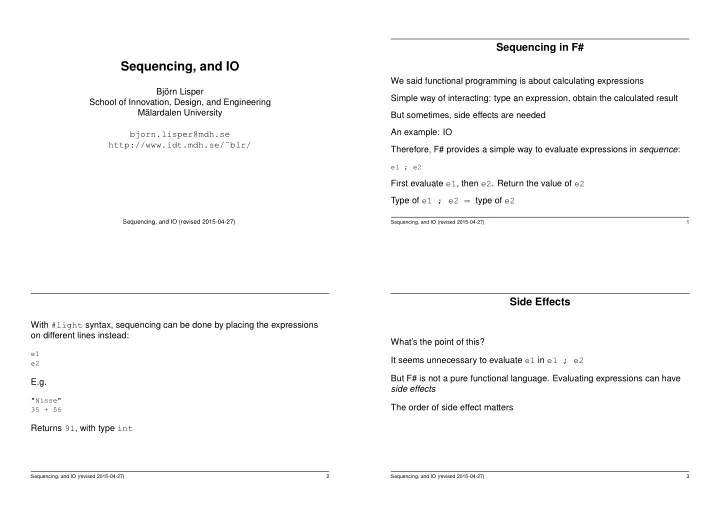
Sequencing, and IO We said functional programming is about - - PowerPoint PPT Presentation

sequencing and io
SMART_READER_LITE
LIVE PREVIEW

Sequencing, and IO We said functional programming is about - - PowerPoint PPT Presentation

Sequencing in F# Sequencing, and IO We said functional programming is about calculating expressions Bjrn Lisper Simple way of interacting: type an expression, obtain the calculated result School of Innovation, Design, and Engineering


slide-1
SLIDE 1

Sequencing, and IO

Björn Lisper School of Innovation, Design, and Engineering Mälardalen University bjorn.lisper@mdh.se http://www.idt.mdh.se/˜blr/

Sequencing, and IO (revised 2015-04-27)

Sequencing in F#

We said functional programming is about calculating expressions Simple way of interacting: type an expression, obtain the calculated result But sometimes, side effects are needed An example: IO Therefore, F# provides a simple way to evaluate expressions in sequence:

e1 ; e2

First evaluate e1, then e2. Return the value of e2 Type of e1 ; e2 = type of e2

Sequencing, and IO (revised 2015-04-27) 1

With #light syntax, sequencing can be done by placing the expressions

  • n different lines instead:

e1 e2

E.g.

"Nisse" 35 + 56

Returns 91, with type int

Sequencing, and IO (revised 2015-04-27) 2

Side Effects

What’s the point of this? It seems unnecessary to evaluate e1 in e1 ; e2 But F# is not a pure functional language. Evaluating expressions can have side effects The order of side effect matters

Sequencing, and IO (revised 2015-04-27) 3

slide-2
SLIDE 2

A Simple Print Function

F# has a function printf Very similar to printf in other languages It takes a format string and a number of additional arguments

printf argument-string arguments

It prints the values of the arguments according to the formatting string

printf "n: %d, x: %f\n" 17 3.0 → n: 17, x: 3.000000

Only this side effect is of interest, returns nothing useful

Sequencing, and IO (revised 2015-04-27) 4

Simple Sequencing Example with printf

printf "n: %d, x: %f" 17 3.0 printf " skonummer %d\n" 43

will yield the printout

n: 17, x: 3.000000 skonummer 43

Sequencing, and IO (revised 2015-04-27) 5

What printf Returns

F# has a data type unit It has a single value “()” Functions like printf, which only are executed for their side effect, return () This indicates that they don’t return anything useful Corresponds to the void data type in other languages

Sequencing, and IO (revised 2015-04-27) 6

Sequencing with Return of Useful Values

The ability to return values from sequenced expression can be useful For instance, flexible ways of doing debug printouts An example: a function traceint that can be used to trace the values of integer expressions in functions:

let traceint n = printf "%d " n; n

A factorial function that prints the argument that its called with for each call:

let rec fac n = if traceint n = 0 then 1 else n * fac (n-1)

Actually, functional programming is very good for testing purposes. Easy to script test suites directly in the language, and instrument the code with debug printouts

Sequencing, and IO (revised 2015-04-27) 7

slide-3
SLIDE 3

A Subtle Thing with Side Effects in F#

Side effects occur when the code is executed Sometimes, this happens already when a value is declared:

let nuff = printf "xxx\n" ; 2 + 2

Here, nuff will be evaluated directly into 4 xxx will be printed when the expression in the declaration is evaluated When nuff is used in the program 4 will be returned, but no printout!

Sequencing, and IO (revised 2015-04-27) 8

This behavior can be avoided by turning the declared entity into a function When a function is called, its body is evaluated over again, with the actual arguments Therefore, the side effect occurs every time the function is called

let nuff n = printf "xxx\n" ; 2 + 2 nuff : ’a -> int

xxx will now be printed every time nuff is called

Sequencing, and IO (revised 2015-04-27) 9

Simple File I/O

F# has a namespace System.IO, which contains means for communicating with the surrounding world In particular to write and read files:

  • pen System.IO // Name spaces can be opened just as modules

File.WriteAllText("test.txt", "Allan tar kakan\n och makan") let s = File.ReadAllText("test.txt")

First writes a string to the file test.txt, then reads back the string and binds s to it So File.WriteAllText has the side effect of creating a file, and writing a string to that file

Sequencing, and IO (revised 2015-04-27) 10

Note the syntax:

File.WriteAllText("test.txt", "Allan tar kakan\n och makan")

File.WriteAllText does not have the usual function syntax of F# It uses syntax from the object-oriented part of F# File can be seen as an object representing the whole file system File.WriteAllText is a method affecting the state of the file system (Methods are called members in F#) Member calls use dot notation, and parentheses around arguments

Sequencing, and IO (revised 2015-04-27) 11

slide-4
SLIDE 4

We can of course define a wrapper function if we prefer functional syntax:

let file_write_alltext file string = File.WriteAllText(file, string)

In general, the object-oriented part of F# comes into play when interfacing with the .NET environment More on F# and object-orientation later

Sequencing, and IO (revised 2015-04-27) 12

Some More File I/O

File.WriteAllText writes a string to a whole file in one go, and File.ReadAllText reads the whole content of a file into a string Not efficient for large files. For such files, better to process them the conventional way:

  • Open the file
  • Read (or write) line by line
  • Close the file

Sequencing, and IO (revised 2015-04-27) 13

Some Simple .NET Stream I/O in F#

F# has support for this. Objects of type StreamReader and StreamWriter represent files open for read and write access, respectively

  • pen System.IO

let myfile = File.CreateText("arne.txt") // create a new file "arne.txt", open it for write access, // create a StreamWriter object representing it, and bind // myfile to that object myfile.WriteLine("Hello World") // write a line to the file myfile.WriteLine("Hello World 2") // write a second line myfile.close() // close the file

Think of myfile as a handle to the file

Sequencing, and IO (revised 2015-04-27) 14

Some Types

File.CreateText("arne.txt") : StreamWriter myfile.Writeline("Hello World") : unit myfile.close() : unit myfile.Writeline(...) and myfile.close() don’t return anything sensible, thus they have type unit But File.CreateText("arne.txt") returns a StreamWriter object (file handle) and thus has type StreamWriter

Sequencing, and IO (revised 2015-04-27) 15

slide-5
SLIDE 5

A StreamReader Example

  • pen System.IO

let myfile = File.OpenText("arne.txt") // open the file "arne.txt" for read access, // create a StreamReader object representing it, and bind // myfile to that object let s1 = myfile.ReadLine() // read first line from the file let s2 = myfile.Readline() // read second line let lines = (s1,s2) // tuple with the two first lines myfile.close() // close the file File.OpenText("arne.txt") : StreamReader

Sequencing, and IO (revised 2015-04-27) 16

An Example: Turning Whitespace into Single Space

Remember string2words? We can use it to “tidy” text files by turning all whitespace between words into a single space Let’s use the version that works on strings:

string2words : int -> string -> string list

Read text from file in.txt, write “tidied” text to out.txt For simplicity, we will use File.WriteAllText and File.ReadAllText Solution on next slides . . .

Sequencing, and IO (revised 2015-04-27) 17

File.WriteAllText writes a string to the file, not a list of strings We need a function that converts a list of strings (words) into a single string, with a single space in-between each word Any idea how to define it? (Solution on next slide)

Sequencing, and IO (revised 2015-04-27) 18

Converting List of Words to String

let rec words2string ws = match ws with | []

  • > ""

| w :: rest -> w + " " + words2string rest words2string : string list -> string

This solution has a deficiency: it puts a space after the last word Exercise: declare an improved version of words2string which avoids this!

Sequencing, and IO (revised 2015-04-27) 19

slide-6
SLIDE 6

A Wrapper for string2words

string2words has an extra position argument (int) This argument is used to keep track of the current position in the string For first call to string2words, it is zero A wrapper function that calls string2words with first argument = 0:

let string_2_words s = string2words 0 s string_2_words : string -> string list

(We could have avoided the declaration with the use of nameless functions. More on them later)

Sequencing, and IO (revised 2015-04-27) 20

Putting it all Together

A way to do it:

  • 1. Read contents of file in.txt into string
  • 2. apply string_2_words to string
  • 3. apply words2string to result
  • 4. Write result of this to out.txt

A solution on next slide . . .

Sequencing, and IO (revised 2015-04-27) 21

let s1 = File.ReadAllText("in.txt") let w = string_2_words s1 let s2 = words2string w File.WriteAllText("out.txt",s2)

Note the separation of purely functional parts (string_2_words, words2string) and parts with side effects (File.WriteAllText). It is usually good practice to write software this way

Sequencing, and IO (revised 2015-04-27) 22

Same Solution, Different Style

We can get rid of the intermediate variables s1, w, s2 by directly applying functions to result of other functions:

File.WriteAllText("out.txt", words2string (string_2_words File.ReadAllText("in.txt")))

No intermediates, but maybe not so easy to read Can we use a different syntax to make this easier?

Sequencing, and IO (revised 2015-04-27) 23

slide-7
SLIDE 7

The “Forward Pipe” Operator

F# has a “forward pipe” binary operator: |> Definition:

let (|>) x f = f x

It’s just another way to write function application! What’s the point with this? We can replace words2string ... with ... |> words2string Similar to unix pipes: “|” Typically used to “pipe” several functions with one argument

Sequencing, and IO (revised 2015-04-27) 24

A Forward Pipe Solution

let s = File.ReadAllText("in.txt") |> string_2_words |> words2string in File.WriteAllText("out.txt",s)

Presumably easier to read and understand Think of |> as “pass data from left to right” This is typical functional programming style!

Sequencing, and IO (revised 2015-04-27) 25

An Example with Recursion

Let’s define a function that writes a number of lines to a file, each differing

  • nly in line numbering, like this:

Line no. 1 Line no. 2 Line no. 3 ...

The number of lines shall be a parameter, as the file name (See next slides for solution)

Sequencing, and IO (revised 2015-04-27) 26

Solution, Overview

We will split the solution into two parts;

  • One part that reads the file name and number of lines, opens the file,

calls a “print function” that writes the lines, and closes the file

  • One part that is the “print function”. This will be the recursive part

We will use a StreamWriter object to write line by line

Sequencing, and IO (revised 2015-04-27) 27

slide-8
SLIDE 8

Solution, Part 1

Assume the print function is printline file n, where file is the StreamWriter object and n is the number of lines to write;

let writelines filename n = let file = File.CreateText(filename) printline file n file.close()

Sequencing, and IO (revised 2015-04-27) 28

Solution, Part 2

To create strings we can use sprintf, a variation of printf that writes to a string instead of the console printline will be a wrapper that calls a local, recursive function:

let printline file n = let rec printlocal k = if k < n then file.Writeline(sprintf "Line no. %d" k) printlocal (k+1) else () in printlocal 1

Functions used only for side effect, returns () (type unit) Compare this to a loop in an “ordinary” language!

Sequencing, and IO (revised 2015-04-27) 29