Sensor based phenotyping for grapevine breeding and genetic - - PowerPoint PPT Presentation

sensor based phenotyping for grapevine breeding and
SMART_READER_LITE
LIVE PREVIEW

Sensor based phenotyping for grapevine breeding and genetic - - PowerPoint PPT Presentation

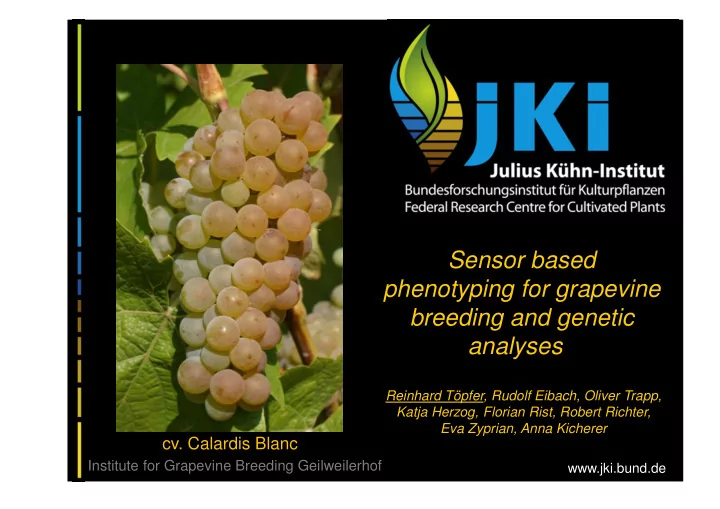
Sensor based phenotyping for grapevine breeding and genetic analyses Reinhard Tpfer, Rudolf Eibach, Oliver Trapp, Katja Herzog, Florian Rist, Robert Richter, Eva Zyprian, Anna Kicherer cv. Calardis Blanc Institute for Grapevine Breeding


slide-1
SLIDE 1

www.jki.bund.de

Sensor based phenotyping for grapevine breeding and genetic analyses

Institute for Grapevine Breeding Geilweilerhof

Reinhard Töpfer, Rudolf Eibach, Oliver Trapp, Katja Herzog, Florian Rist, Robert Richter, Eva Zyprian, Anna Kicherer

  • cv. Calardis Blanc
slide-2
SLIDE 2

downy mildew powdery mildew

slide-3
SLIDE 3

www.jki.bund.de

✁ ✂ ✄ ☎ ✆ ✝ ✞ ✟ ✠ ✡ ☛ ☞ ✌ ✡ ☛ ✂ ✎ ✏ ☛ ✂ ✞ ✌ ☎ ✞ ✟ ✂ ✑ ✒ ✡ ✓ ✔ ✟ ✕ ✕ ✟ ✂ ✑ ✏ ✡ ☛ ✌ ✑ ✞ ✕ ✖ ☛ ✌ ☛ ☛ ☞ ☎ ✂ ✝ ✂ ☛ ✗ ✘ ✙ ✘ ✖ ✂ ✞ ☛ ☞ ✞ ✟ ✕ ✚ ✏ ✠ ✛ ✜ ✢ ✚ ✏ ✠ ✢ ✣ ✚ ✌ ✑ ✛
✡ ✝ ✡ ✑ ✓ ☛ ✂ ✥ ✣ ✣ ✦ ✥ ✣ ✢ ✢ ✗ ✂ ✔ ✟ ✑ ✡ ✧ ✚ ✌ ★ ✌ ✑ ✞ ✁ ✛ ✩ ✪ ✫ ✫ ✍ ✙ ✟ ✑ ✂ ✞ ✟ ✑ ✥ ✣ ✣ ✪ ✥ ✣ ✢ ✩ ✤ ✡ ✖ ✌ ☛ ✑ ✌ ✞ ✬ ✡ ✆ ✠ ✟ ★ ✑ ✂ ✑ ✧ ✚ ✌ ★ ✌ ✑ ✞ ✁ ✥ ✛ ✛ ✫ ✫ ✭ ✙ ☛ ✟ ✂ ☛ ✥ ✣ ✣ ✩ ✥ ✣ ✣ ✮ ✯ ✰ ✂ ✡ ✑ ✑ ✌ ✕ ✬ ✌ ☞ ✠ ✌ ✥ ✛ ✩ ✜ ✢ ✱ ✧ ✙ ✟ ✑ ✂ ✞ ✁ ✂ ✟ ☛ ✲ ✧ ✳ ☛ ✂ ✑ ✑ ✌ ☛ ✁ ✥ ✛ ✛ ✫ ✫ ✴ ✵ ✶ ✷ ✶ ✸ ✹ ✢ ✦ ✦ ✩ ✢ ✦ ✦ ✺ ✗ ✟ ✡ ✑ ✡ ✧ ✤ ✻ ✡ ✔ ✖ ✂ ✆ ☛ ☎ ✟ ✑ ✁ ✛ ✛ ✩ ✫ ✫ ✼ ✽ ✌ ✝ ✟ ✂ ✕ ✥ ✣ ✣ ✩ ✥ ✣ ✣ ✺ ✘ ✌ ☛ ✾ ✝ ✟ ✑ ★ ✧ ✯ ✬ ✌ ☞ ✠ ✌ ✿ ✟ ✝ ✝ ✡ ☛ ✓ ✢ ✥ ✜ ✩ ✮ ✢ ✧ ✘ ❀ ✝ ✝ ✌ ☛ ❁ ✻ ✆ ☛ ★ ✡ ✆ ✲ ✳ ✛ ✛ ✩ ✫ ✫ ❂ ✰ ✂ ✻ ✡ ✑ ✑ ✟ ✞ ✌ ☛ ✢ ✦ ✦ ✪ ✥ ✣ ✣ ✢ ❃ ✌ ✟ ✕ ✕ ✌ ☛ ✚ ✟ ✌ ✕ ✝ ✟ ✑ ★ ✧ ✯ ✬ ✌ ☞ ✠ ✌ ✿ ✟ ✝ ✝ ✡ ☛ ✓ ✢ ✥ ✜ ✩ ✮ ✢ ✧ ✯ ✙ ✟ ✑ ✂ ✞ ★ ✟ ☛ ✕ ✧ ❃ ✌ ✟ ❄ ✌ ☛ ❅ ✆ ✞ ✌ ✓ ✌ ✝ ✲ ✳ ✥ ✛ ✩ ✫ ✫ ❆ ✘ ✆ ✕ ☎ ✡ ☛ ✟ ✕ ✥ ✣ ✢ ✥ ✥ ✣ ✢ ✛ ✬ ✂ ✝ ✡ ☛ ✟ ✕ ✧ ❅ ✌ ✝ ✖ ✌ ☛ ✘ ✆ ✕ ❇ ✡ ✞ ✌ ✝ ✝ ✌ ☛ ✳ ✥ ✛ ✩ ✫ ✫ ❈ ❉ ☛ ✟ ✂ ✑ ✢ ✦ ✦ ✩ ✢ ✦ ✦ ✩ ❉ ✏ ✞ ✟ ✔ ✡ ✧ ✿ ✟ ✝ ✝ ✡ ☛ ✓ ✳ ✝ ✡ ✑ ☎ ✳ ✥ ✺ ✺ ✫ ✫ ❊ ✙ ✻ ✂ ✌ ✑ ✟ ✧ ✢ ✦ ✦ ✥ ✢ ✦ ✦ ✥ ✳ ✡ ☎ ☎ ✻ ✆ ✕ ✧ ✿ ✟ ✝ ✝ ✡ ☛ ✓ ✳ ✝ ✡ ✑ ☎ ✳ ✥ ✩ ✱ ✫ ✫
✬ ✟ ☛ ✟ ✆ ✕ ✢ ✦ ✦ ✺ ✢ ✦ ✦ ✺ ✳ ✡ ☎ ☎ ✻ ✆ ✕ ✧ ✿ ✟ ✝ ✝ ✡ ☛ ✓ ✳ ✝ ✡ ✑ ☎ ✳ ✥ ✺ ✩ ✫ ✫
✞ ✡ ✆ ✎ ✌ ☛ ✢ ✦ ✦ ✩ ✢ ✦ ✦ ✩ ✳ ✡ ☎ ☎ ✻ ✆ ✕ ✧ ✿ ✟ ✝ ✝ ✡ ☛ ✓ ✳ ✝ ✡ ✑ ☎ ✳ ✥ ✺ ✺ ✫ ✫
✿ ✟ ✝ ✝ ✡ ☛ ✟ ✕ ✥ ✣ ✣ ✩ ✥ ✣ ✢ ✢ ✬ ✟ ☛ ✟ ✆ ✕ ✧ ✿ ✟ ✓ ✡ ✝ ✳ ✝ ✡ ✑ ☎ ✳ ✥ ✩ ✺ ✫ ✫
✤ ✡ ✖ ✌ ☛ ✑ ✌ ✞ ✤ ✡ ☛ ✂ ✝ ✥ ✣ ✣ ✩ ✥ ✣ ✣ ✮ ✤ ✡ ✖ ✌ ☛ ✑ ✌ ✞ ✬ ✡ ✆ ✠ ✟ ★ ✑ ✂ ✑ ✧ ✬ ✂ ✝ ✡ ☛ ✟ ✕ ✁ ✥ ✛ ✱ ✫ ✫
✤ ✡ ✖ ✌ ☛ ✑ ✌ ✞ ✤ ✂ ☛ ✞ ✟ ✕ ✥ ✣ ✣ ✩ ✥ ✣ ✣ ✮ ✤ ✡ ✖ ✌ ☛ ✑ ✌ ✞ ✬ ✡ ✆ ✠ ✟ ★ ✑ ✂ ✑ ✧ ✬ ✂ ✝ ✡ ☛ ✟ ✕ ✁ ✥ ✛ ✩ ✫ ✫
✘ ✂ ✑ ✡ ☛ ☎ ✻ ✥ ✣ ✣ ✩ ✥ ✣ ✣ ✮ ✬ ✂ ✝ ✡ ☛ ✟ ✕ ✧ ✗ ✂ ☛ ✑ ✎ ✌ ✝ ✓ ✌ ☛ ✁ ✥ ✩ ✛ ✫ ✫
✳ ☛ ✂ ✑ ✑ ✌ ☛ ✢ ✦ ✦ ✪ ✢ ✦ ✦ ✦ ✘ ✌ ☛ ✾ ✝ ✟ ✑ ★ ✧ ✯
☛ ☞ ✡ ✬ ✌ ✠ ✌ ☛ ✡ ✧ ✬ ✞ ✄ ❍ ✡ ✆ ☛ ✌ ✑ ✞ ✲ ✳ ✥ ✩ ✛ ✫ ✫
✬ ✂ ✝ ✡ ☛ ✟ ✕ ✥ ✣ ✣ ✢ ✥ ✣ ✣ ✩ ✘ ✌ ☛ ✾ ✝ ✟ ✑ ★ ✧ ✯
☛ ☞ ✡ ✬ ✌ ✠ ✌ ☛ ✡ ✧ ✘ ✆ ✕ ❇ ✡ ✞ ❉ ✞ ✞ ✂ ✑ ✌ ✝ ✲ ✳ ✛ ✛ ✺ ✫ ✫
✬ ✂ ✆ ✠ ✟ ★ ✑ ✟ ✌ ☛ ❅ ☛ ✟ ✕ ✥ ✣ ✢ ✥ ✥ ✣ ✢ ✛ ✤ ✡ ✖ ✌ ☛ ✑ ✌ ✞ ✬ ✡ ✆ ✠ ✟ ★ ✑ ✂ ✑ ✧ ✳ ☛ ✂ ✑ ✑ ✌ ☛ ✳ ✥ ✛ ✥ ✫ ✫
✳ ✡ ☛ ✂ ✑ ✥ ✣ ✣ ✺ ✥ ✣ ✢ ✥ ✤ ✡ ✖ ✌ ☛ ✑ ✌ ✞ ✬ ✡ ✆ ✠ ✟ ★ ✑ ✂ ✑ ✧ ✳ ☛ ✂ ✑ ✑ ✌ ☛ ✁ ✥ ✜ ✛ ✫ ✍ ❋ ✤ ✡ ✖ ✌ ☛ ✑ ✌ ✞ ✤ ✡ ☛ ✖ ✂ ✑ ✥ ✣ ✣ ✩ ✥ ✣ ✣ ✮ ✤ ✡ ✖ ✌ ☛ ✑ ✌ ✞ ✬ ✡ ✆ ✠ ✟ ★ ✑ ✂ ✑ ✧ ✳ ☛ ✂ ✑ ✑ ✌ ☛ ✁ ✥ ✺ ✛ ✫ ✍
✂ ✑ ✓ ✂ ✢ ✦ ✦ ✪ ✢ ✦ ✦ ✦
☛ ☞ ✡ ✬ ✌ ✠ ✌ ☛ ✡ ✧ ✬ ✞ ✄ ❍ ✡ ✆ ☛ ✌ ✑ ✞ ✁ ✛ ✺ ✩ ✫ ✍ ✍ ■ ☎ ☎ ✌ ✑ ✞ ✥ ✣ ✣ ✪ ✥ ✣ ✢ ✣ ❏ ✂ ✝ ✂ ☛ ✧ ✤ ✻ ✡ ✑ ☎ ✌ ✝ ✝ ✂ ☛ ✁ ✛ ✩ ✛ ✫ ✍ ✭ ■ ✝ ✝ ✌ ★ ☛ ✂ ✥ ✣ ✣ ✱ ✥ ✣ ✣ ✦ ✤ ✻ ✡ ✑ ☎ ✌ ✝ ✝ ✂ ☛ ✧ ✚ ✂ ✑ ✓ ✂ ✁ ✛ ✛ ✛ ✫ ✍ ✴ ✳ ✂ ✝ ✌ ☛ ✂ ✥ ✣ ✣ ✱ ✥ ✣ ✣ ✮ ✯ ✚ ✂ ✞ ✖ ✌ ☛ ★ ✌ ☛ ✧ ✚ ✌ ✟ ☎ ✻ ✌ ✑ ✕ ✞ ✌ ✟ ✑ ✌ ☛ ✲ ✧ ✤ ✻ ✡ ✑ ☎ ✌ ✝ ✝ ✂ ☛ ✁ ✛ ✛ ✩ ✫ ✍ ✼ ✚ ✌ ✖ ✌ ☛ ★ ✌ ☛ ✥ ✣ ✣ ✩ ✥ ✣ ✢ ✢ ✚ ✌ ★ ✌ ✑ ✞ ✧ ❍ ✟ ✔ ✖ ✌ ☛ ★ ✌ ☛ ✁ ✺ ✩ ✺ ✫ ✍ ❂ ✽ ✟ ✖ ✌ ☛ ✑ ✡ ✝ ✢ ✦ ✦ ✪ ✢ ✦ ✦ ✦ ✯ ✤ ✻ ✡ ✑ ☎ ✌ ✝ ✂ ☛ ✧ ❃ ✌ ✟ ✕ ✕ ✌ ☛ ✚ ✟ ✌ ✕ ✝ ✟ ✑ ★ ✲ ❑ ✥ ✳ ✱ ✺ ✛ ✫ ✍ ❆ ✘ ✌ ☛ ✾ ✝ ✟ ✑ ★ ✢ ✦ ✦ ✺ ✢ ✦ ✦ ✺ ✬ ✌ ☞ ✠ ✌ ✿ ✟ ✝ ✝ ✡ ☛ ✓ ✺ ✜ ✥ ✪ ✱ ✧ ✯ ✚ ✟ ✌ ✕ ✝ ✟ ✑ ★ ✧ ✙ ✟ ✑ ✂ ✞ ★ ☛ ✟ ✕ ✲ ✳ ✩ ✩ ✩ ✫ ✍ ❈ ✙ ☛ ✟ ✑ ✾ ✟ ✏ ✡ ✝ ✢ ✦ ✦ ✪ ✢ ✦ ✦ ✦ ✽ ✟ ✖ ✌ ☛ ✑ ✡ ✝ ✧ ▲ ✻ ☛ ✌ ✑ ✎ ✌ ✝ ✕ ✌ ☛ ✳ ✪ ✺ ✛ ✫ ✍ ❊ ✬ ✡ ✏ ✻ ✟ ☛ ✡ ✢ ✦ ✦ ✦ ✥ ✣ ✣ ✩ ■ ☛ ✑ ✕ ✖ ✆ ☛ ★ ✌ ☛ ✧ ✬ ✌ ☞ ✠ ✌ ✿ ✟ ✝ ✝ ✡ ☛ ✓ ✢ ✜ ✪ ✥ ✳ ✪ ✱ ✩ ✫ ✭ ❋ ✙ ✟ ☛ ✂ ✕ ✂ ✥ ✣ ✣ ✺ ✥ ✣ ✢ ✣ ✯ ✙ ✂ ☛ ✞ ✆ ★ ✟ ✌ ✕ ✌ ☛ ✧ ✽ ✌ ☛ ✂ ✝ ✓ ☛ ✌ ✖ ✌ ✲ ✧ ✯ ✗ ✌ ☎ ❇ ☛ ✂ ✞ ✧ ❑ ☛ ✌ ✟ ✖ ✆ ☛ ★ ✺ ✮ ✦ ✜ ✺ ✩ ✲ ✁ ✥ ✩ ✩ ✑ ✄ ✞ ✄ ✑ ✄ ✞ ✄ ✑ ✄ ✞ ✄

Cultivars found in the German variety list (2015)

Plants are cultivated with reduced fungicide application

slide-4
SLIDE 4

www.jki.bund.de

Peressotti et al.(2010) BMC Plant Biol. 10: 147

Plasmopara viticola (downy mildew) 6 dpi

Durability of resistances

slide-5
SLIDE 5

www.jki.bund.de

(nach: Mundt et al. 2014, modifiziert; Originaldaten von Browning und Frey 1969)

Durability of resistances – Classical Boom-and-Bust Cycle

slide-6
SLIDE 6

www.jki.bund.de

(Form: Mundt et al. 2014, modified; original data from Browning and Frey 1969)

Durability of resistances – Classical Boom-and-Bust Cycle

slide-7
SLIDE 7

www.jki.bund.de

1 2 3 4 5 6 7 8 9 1 2 3 4 5 6 7 8

Grad der Resistenz

  • Rpv1

+Rpv1

  • Rpv1
  • Rpv1
  • Rpv3.1
  • Rpv3.1

+Rpv3.1

  • Rpv3.1
  • Rpv12
  • Rpv12
  • Rpv12

+Rpv12

1 2 3 4 5 6 7 8 9

  • Rpv1, -

Rpv3, - Rpv12 +Rpv1, - Rpv3, - Rpv12

  • Rpv1,

+Rpv3, - Rpv12

  • Rpv1, -

Rpv3, +Rpv12 +Rpv1, +Rpv3, - Rpv12 +Rpv1, - Rpv3, +Rpv12

  • Rpv1,

+Rpv3, +Rpv12 +Rpv1, +Rpv3, +Rpv12

Grad der Resistenz

  • Rpv1

+Rpv1

  • Rpv1
  • Rpv1

+Rpv1 +Rpv1

  • Rpv1
  • Rpv3.1
  • Rpv3.1

+Rpv3.1

  • Rpv3.1

+Rpv3.1

  • Rpv3.1

+Rpv3.1

  • Rpv12
  • Rpv12
  • Rpv12

+Rpv12

  • Rpv12

+Rpv12 +Rpv12

1 2 3 4 5 6 7 8 9

  • Rpv1, -

Rpv3, - Rpv12 +Rpv1, - Rpv3, - Rpv12

  • Rpv1,

+Rpv3, - Rpv12

  • Rpv1, -

Rpv3, +Rpv12 +Rpv1, +Rpv3, - Rpv12 +Rpv1, - Rpv3, +Rpv12

  • Rpv1,

+Rpv3, +Rpv12 +Rpv1, +Rpv3, +Rpv12

degree of resistance

  • Rpv1

+Rpv1

  • Rpv1
  • Rpv1

+Rpv1 +Rpv1

  • Rpv1

+Rpv1

  • Rpv3.1
  • Rpv3.1

+Rpv3.1

  • Rpv3.1

+Rpv3.1

  • Rpv3.1

+Rpv3.1 +Rpv3.1

  • Rpv12
  • Rpv12
  • Rpv12

+Rpv12

  • Rpv12

+Rpv12 +Rpv12 +Rpv12

Breeders answer: select for stacked R-loci (downy mildew)
slide-8
SLIDE 8

www.jki.bund.de

Durability of resistances - Occurrence of Fungicide Resistances

Class of Fungicides First

  • ccurrence
  • f resistance

Years prior to

  • ccurrence of

resistance Pathogen Organic mercury 1964 40 Pyrenophora avenae Benzimidazole 1970 2 Venturia inaequalis, Botrytis cinerea Phenylamide 1980 2 Phytophthora infestans, Plasmopara viticola Dicarboximide 1982 5 Botrytis cinerea DMIs 1982 4 Blumeria graminis Carboxanilide 1986 14 Ustilago nuda Morpholine 1994 34 Blumeria graminis Strobilurine 1998 2 Blumeria graminis f.sp. tritici

(according to HG Hewitt (1998) Fungicides in Crop Protection, modified by Deising et al.)

slide-9
SLIDE 9

Anti Resistence Strategy 2017 Against Fungicids

1 2 3 4 5 6 7 8 9 10 11 12 13 14 15 16 17 18 19 20 21 22

Category Commercial Product Active Compound Group of Active Compound

Maximum 3 applications per season for all fungiciides labled by the same letter and color; Category D: only one application per year

slide-10
SLIDE 10

Maximum 3 applications per season for all fungiciides labled by the same letter and color; Category D: only one application per year 1 2 3 4 5 6 7 8 9 10 11 12 13 14 15 16 17 18 19 20

Category Commercial Product Active Compound Group of Active Compound

Anti Resistence Strategy 2018 Against Fungicids

slide-11
SLIDE 11

www.jki.bund.de

5 7 9 11 13 15 17 19 21 23 25 27 29 31 33 35 1983 1985 1987 1989 1991 1993 1995 1997 1999 2001 2003 2005 2007 2009 2011 2013 2015 Säure in g/l

Acidity of Grapevine Must on September 20th

Riesling GF.GA-47-42

Trend: Riesling: 11,2 g/l in 33 years (0,34 g/l per year) Gf.Ga-47-42: 5,0 g/l in 33 years (0,15 g/l per year)

Climate Change: Decrease of Acidity

slide-12
SLIDE 12

www.jki.bund.de

◆ ❖ P ◗ ❘ ❖ ❙ ◗
◆ ❖ P ◗ ❘ ❖ ❙ ◗
  • Breeders answer:

select for late ripening

slide-13
SLIDE 13

A new cultivar needs

  • resistance …

− downy mildew − powdery mildew − Botrytis − Phylloxera − other pests & diseases − abiotic stress factors

  • vigor
  • yield
  • wood maturation
  • phenological adaptation
  • quality
  • a name
slide-14
SLIDE 14

A new cultivar is always a compromise on the timeline

slide-15
SLIDE 15

A new cultivar is always a compromise on the timeline Calardis Blanc

upright growth, late ripening, small berries, loose cluster wine style: decent aromas of Muskateller

Ren3 Rpv3-2 Rpv3-1 BR

Botrytis

Ren9

slide-16
SLIDE 16

www.jki.bund.de

Downy mildew Powdery mildew

Rpv12 Ren3 Ren4 Rpv3-2 Rpv1 Rpv3-1 Rpv10 Run1 Ren1 Ren3 Rpv1 Rpv3-1 Rpv10 Run1 Ren1 Rpv12 Ren3 Rpv3-2 Rpv1 Run1 Ren4

1 …………..……..further combinations……………………40

Type of resistance: 3+3

Stacking of resistances: Possibilities in elite genetic background

slide-17
SLIDE 17

www.jki.bund.de

Limitations in Grapevine Breeding

  • Combination of resistance and quality
  • Combinations with other traits

Seedling numbers need to be high

  • Limitation in space in greenhouse and field
  • Limiting number of markers for MAS
  • Limiting phenotypic possibilities

1 hectare (5000 plants) per year Mainly markers for PM and DM Tools for fast trait evaluation

slide-18
SLIDE 18

www.jki.bund.de

E1 E2 P1 P

  • Demand in seedlings –

idealized crossing scheme

1/256 F1-offspring i.e. 25,600 seedlings to get 100 desired plants for further selection

slide-19
SLIDE 19

www.jki.bund.de

E1 E1 E2 P1 P

  • Demand in seedlings –

idealized crossing scheme

all

E2 P1 P

LSH-lines F1-offspring i.e. one can produce thousands of desired plants for further selection

slide-20
SLIDE 20

www.jki.bund.de

slide-21
SLIDE 21

www.jki.bund.de

increasing number of plants create a strong demand for MAS and HT- phenotyping

slide-22
SLIDE 22

e.g. JKI in Siebeldingen – Breeding (~ 6 ha) – Breeding Research (~ 0.5 ha) – Genetic Repository (~ 3 ha)

       

Demand in phenotyping

slide-23
SLIDE 23
  • Plants need to be screened (for several

traits) from the side not from top.

Challenges in Grapevine Phenotyping

slide-24
SLIDE 24

Traits of interest

Breeding Screening of seedlings once a year

– Resistance, i.e. downy and powdery mildew – Yield – Phenology, ripening – Wine Quality Parameters

Seedling selection

Greenhouse Field Wine taste

slide-25
SLIDE 25

Breeding Research/Genetic Resources E.g. Mapping populations several times during the year

– Aim: Identification of new trait-related Loci

  • E.g. resistance, root and bunch architecture

Development of molecular markers for MAS

Plasmopara viticola

  • n leaf disks

Root architecture in Rhizotrones Bunch architecture Lab Greenhouse Field

Traits of interest

slide-26
SLIDE 26
  • Objective and precise phenotypic data
  • Reduced error variation, retro perspective

analysis

  • High throughput (field) phenotyping
  • Increased efficiency of grapevine breeding

Automated acquisition of the grapevine phenotype

Aim

slide-27
SLIDE 27

Various Sensors Options

Impedance Cameras 3D Scanner Computer-based 3D reconstruction Spectroscopy Hyperspectral VIS-NIR Spectroscopy

slide-28
SLIDE 28

Phenotyping for traits for bunch rot resilience

slide-29
SLIDE 29

The gray mold disease

Source: JKI

Botrytis cinerea No active defense response in Vitis vinfera Compact bunches: high damage potential Breeding: Focus on physical barriers e.g. loose bunch architecture

slide-30
SLIDE 30

Phenotyping of bunch architecture as a trait

  • Bunch Traits
  • length and width
  • number of berries
  • Berry Traits
  • diameter and volume
  • Stem Traits
  • number and length
  • f internodes
  • length of pedicels

OIV 204: 1- 3 - 5 - 7 - 9

loose dense

Density

Robert Richter, Eva Zyprian et al.

slide-31
SLIDE 31

Labor intense approach for objective phenotyping

  • Bunch Traits
  • length and width
  • number of berries
  • Berry Traits
  • diameter and volume
  • Stem Traits
  • number and length
  • f internodes
  • - length of pedicels

Image based Methods

  • Cluster-Analysis-Tool (CAT)
  • Berry-Analysis-Tool (BAT)
  • ImageJ

time intense labor intense determined by on-going season Workflow

  • Harvesting
  • Image of the bunch
  • Destemming
  • Berries on plate
  • Image of the berries
  • Image of the stem skeleton

Robert Richter, Eva Zyprian et al.

slide-32
SLIDE 32

Establishment of a 3D-based high throughput phenotyping pipeline

− − − − − −

  • Florian Rist, Katja Herzog et al.
slide-33
SLIDE 33

Easy to handle user interface

Florian Rist, Katja Herzog et al.

slide-34
SLIDE 34

Validation of the sensor

  • Validation on 4 varieties, BBCH87

Dornfelder Pinot Noir Calardis Blanc Riesling Class 1 Class 3 Class 5 Class 7

  • Application on segregating population GF.GA-47-42 X Villard Blanc,

BBCH89

  • highly variable in morphotype

Florian Rist, Katja Herzog et al.

slide-35
SLIDE 35
  • Artec Spider is applicable for analysis of grape

cluster determining parameters

High correlation of berry parameters Lower value for width Massive time saving compared to 2D (> 10x)

Florian Rist, Katja Herzog et al.

slide-36
SLIDE 36

3D bunch trait data show similar QTL regions compared to reference data

Number of Berries Chr 18

green reference data red / blue 3D data

Total Volume Chr 18 Grape Length/ Rhachis Length Chr 9 Berry Volume Chr 17

Massive time saving compared to 2D (up to 10x)

Florian Rist et al., 2018

slide-37
SLIDE 37

Extended application in the field

For a more intense mapping/association approach: extensive phenotyping Increasing number of plants Multi cultivar screening non invasive phenotyping

Florian Rist et al., 2018

slide-38
SLIDE 38

Artec Spider is usable for field application

  • Use of Artec Spider directly in the field
  • 47 clusters of 4 varieties (Riesling, Calardis Blanc, Pinot Noir,

Dornfelder)

  • Analysis of variance of `field-`, `front-`, 360°-Scan
  • °
  • Partial point clouds sufficient for detection of berry diameter, volume and

cluster length Fluctuations for width and convex hull

Florian Rist, Katja Herzog et al.

slide-39
SLIDE 39
  • Berry surface = cuticle and

epicuticular wax layer Thickness, uniformity and intactness of the cuticle and epicuticular wax is correlated to resilience towards Botrytis bunch rot

BERRY SURFACE AND BOTRYTIS BUNCH ROT

Herzog et al. 2015 Barré, Herzog et al., submitted

assumption

slide-40
SLIDE 40
  • Measurement of electrical impedance described as indicator for thickness

and permeability of cuticle/epic. wax

  • Improved, simple-to-handle sensor
  • 450 berries per hour
  • One point measurements/ berry
  • Inexpensive sensor technique
  • Small memory usage

OBJECTIVE PHENOTYPING DUE TO IMPEDANCE

Herzog et al. 2015

slide-41
SLIDE 41
  • REDUCED RISK FOR BOTRYTIS BUNCH ROT

Seibel 7511 Sauvignon Blanc Orion Relative impedance of cuticle and epic. wax

23.8 19.4 17.1

Brix when up to 5% of berries were infested with Botrytis bunch rot

slide-42
SLIDE 42

IRZ Florian Rist Katja Herzog Pheno Team Robert Richter Eva Zyprian University of Bonn Computer Science 4 Volker Steinhage Jenny Mack

Actors to dissect Botrytis Resilience

slide-43
SLIDE 43

Development of field phenotyping platforms

slide-44
SLIDE 44

Multi-sensor field phenotyping platform: PHENObot* Automated data recording on single vine level:

  • Georeference with high precision
  • PHENObot stops at each vine
  • Plant ID is connected with the image

FIELD PHENOTYPING PLATFORM

* Kicherer, Herzog, Pflanz, Wieland, Rüger, Kecke, Kuhlmann, Töpfer (2015) Sensors, 15(3), 4823-4836.

slide-45
SLIDE 45

Multi-sensor field phenotyping platform: PHENObot*

SENSORS FOR OBJECTIVE FIELD PHENOTYPING

* Kicherer, Herzog, Pflanz, Wieland, Rüger, Kecke, Kuhlmann, Töpfer (2015) Sensors, 15(3), 4823-4836.

Plant ID = allocation of single vine

❯ ❱ ❲ ❳ ❨ ❩ ❬ ❯ ❭ ❪ ❫ ❴ ❵ ❛ ❵ ❛ ❜ ❝ ❞ ❡ ❢ ❣ ❤ ✐ ❥ ❦ ❧ ♠ ❵ ♥ ♦ ♣ ❛ ♦

Synchronic image acquisition

15 s / vine 20 images/min

slide-46
SLIDE 46

Post-processed

  • Automated data management

AUTOMATED PHENOTYPING – DATA MANAGEMENT

slide-47
SLIDE 47

Post-processed

  • Automated data

management and data analysis

AUTOMATED PHENOTYPING – DATA ANALYSIS

slide-48
SLIDE 48

AUTOMATED PHENOTYPING – BIVCOLOR

slide-49
SLIDE 49

PROOF OF CONCEPT:

Acquisition of RGB images and extraction of traits

  • Utilization of PHENObot and BIVcolor in the genetic repository
  • 2700 vines (~970 Accessions) within 12 hours
  • berry size and -color

Kicherer et al. 2015a, Sensors

slide-50
SLIDE 50

Post-processed

  • Automated data management
  • Automated data analysis

AUTOMATED PHENOTYPING

slide-51
SLIDE 51

Multi-sensor field phenotyping platform: PHENObot* Disadvantages:

slow speed image acquisition at night to ensure standardized light conditions

SENSORS FOR OBJECTIVE FIELD PHENOTYPING

* Kicherer, Herzog, Pflanz, Wieland, Rüger, Kecke, Kuhlmann, Töpfer (2015) Sensors, 15(3), 4823-4836.

slide-52
SLIDE 52

Improved multi-sensor field phenotyping platform:

Phenoliner*

  • Automated, synchronic image

capture with high-throughput

  • Georeference with high precision

* Kicherer, Herzog, Bendel, Klück, Backhaus, Wieland, Rose, Klingbeil, Läbe, Kohl, Petry, Kuhlmann, Seiffert, Töpfer (2017) Sensors,

SENSORS FOR OBJECTIVE FIELD PHENOTYPING

slide-53
SLIDE 53

UAV FOR MANAGEMENT APPROACHES

  • Inventory of vines growing in the

genetic repository

– GPS position of single vines – RTK-GPS for adequate precision

slide-54
SLIDE 54

UAV FOR MANAGEMENT APPROACHES

  • Inventory of vines growing in the

genetic repository

– GPS position of single vines – RTK-GPS for adequate precision

  • Detection of missing vines

e.g. maintaining of grapevine accessions (3 plants)

slide-55
SLIDE 55

MANY THANKS TO

slide-56
SLIDE 56

www.jki.bund.de

* Naming according to:

Gailhardsswilre =

Calardiswilre =

Geilwilre = Geilweiler =

Geilweilerhof

Calardis Blanc*

(Gf.1993-22-6) variety protection 2018

Many Thanks to

  • Breeding team

Rudi Eibach Oliver Trapp et al.

  • Botrytis team

Katja Herzog Robert Richter Florian Rist Eva Zyprian et al.