Sea Otters to Oregon Robert Bailey, Elakha Alliance Once, They W - - PowerPoint PPT Presentation

sea otters to oregon
SMART_READER_LITE
LIVE PREVIEW

Sea Otters to Oregon Robert Bailey, Elakha Alliance Once, They W - - PowerPoint PPT Presentation

Returning Sea Otters to Oregon Robert Bailey, Elakha Alliance Once, They W Once, The y Were ere Here. Here. Once contiguous population between Northern Japan and Baja California. ~300,000 animals. China Fur Trade 1741 1850


slide-1
SLIDE 1

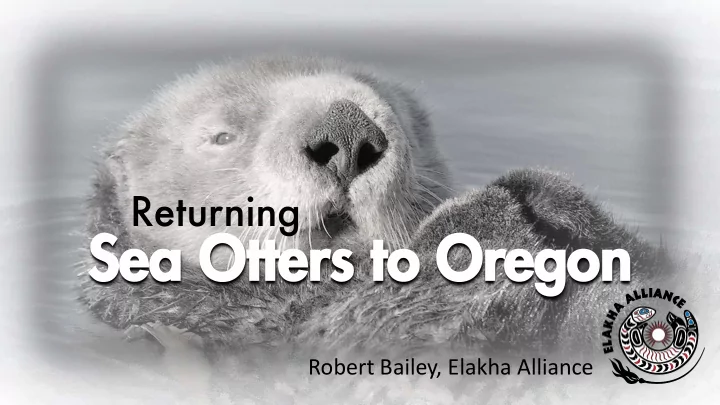
Sea Otters to Oregon

Returning

Robert Bailey, Elakha Alliance
slide-2
SLIDE 2
  • Once contiguous population

between Northern Japan and Baja California.

  • ~300,000 animals.
  • China Fur Trade 1741 –

1850 killed all but a few remnant populations.

Once, The Once, They W y Were ere Here. Here.

slide-3
SLIDE 3

Sea otters present Sea otters absent

Populations Populations today today

800-mile gap

slide-4
SLIDE 4

We ca e care re becaus because e Sea otters Sea otters are a are a keystone keystone species species

With disproportionate influence beyond immediate food & space; influences ecosystem structure & function.

An ecosystem engineer

slide-5
SLIDE 5

Sea otters present …… sea otters absent

Sea otters Sea otters promote promote ecosystem ecosystem health. health.

slide-6
SLIDE 6

When sea otters are present:

  • Improved water quality
  • Increased biological productivity
  • Habitat for salmon smolts,
  • ther juvenile fish

Sea ott Sea otters ers benefit es benefit estuaries, tuaries, too. too.

slide-7
SLIDE 7

Sea otters Sea otters help help fight fight climate climate change. change.

With kelp: 1,867 lbs/acre Without kelp: 21 lbs/acre

Pounds of Carbon Stored/Acre*

Photo: Annie Crawley Photo: Jackie Hildering * Wilmers et al (2012) Frontiers in Ecology & Environment

slide-8
SLIDE 8

Witho Without ut sea otters, ur sea otters, urchins chins are att are attacking acking Oregon’s kelp forests.

Port Orford: Same spot

June 2016 August 2018 Photos courtesy of Dr. Leigh Torres, OSU Marine Mammal Institute

slide-9
SLIDE 9

Ecological benefits:

  • More biological productivity in nearshore
  • cean and coastal estuaries;
  • More complex, resilient food webs;
  • More eggs, larvae retained;
  • More habitat, food for 20+ species of fish;
  • Increased substrate for herring spawn,

invertebrate grazers;

  • Shelter for juvenile salmon, rockfish.

Photo by Alex Mustard

Benefits Benefits from restoration: from restoration:

slide-10
SLIDE 10

Cultural/Economic benefits

  • Restored connection between sea otters

and coastal Indian tribes;

  • Improved habitat for commercial and

recreational fish species;

  • Increased ecosystem resilience supporting

all marine life;

  • Economic boon: tourism, wildlife viewing.

(Gregr, et al study June 2020)

Benefits Benefits from restoration: from restoration:

slide-11
SLIDE 11

Possible conflicts

  • Local competition with commercial harvest of Dungeness crab, red urchins;
  • Local competition with recreational crabbers and clam diggers.

Potential Potential negatives negatives from restoration from restoration

slide-12
SLIDE 12

Abou About the t the Elakha Elakha Alliance Alliance

slide-13
SLIDE 13
  • An Oregon non-profit begun in early 2000 by Dave Hatch,

member of the Confederated Tribes of Siletz Indians.

  • Formally organized in 2018.
  • Approved 501(c)(3) non-profit status from IRS.
  • Oregon Wildlife Foundation is fiscal sponsor.

Elakha Alliance: Elakha Alliance:

slide-14
SLIDE 14

Our Mission: To restore a healthy population of sea

  • tters to the Oregon coast and, in the

process, help make Oregon’s marine ecosystem more robust and resilient.

Elakha Alliance: Elakha Alliance:

slide-15
SLIDE 15

What w What we e are are doing doing:

2020 - 2021:

  • Begun work on a science-based Feasibility Study (USFWS funding) -

Public draft by end of January, 2021 -- Final by end of September 2021;

  • Dr. Tim Tinker is lead author;
  • 12-member Scientific & Technical Advisory Committee.
slide-16
SLIDE 16

What w What we e are are doing doing:

2020 - 2021:

  • Connecting with people and organizations about our mission

(funding from Meyer Memorial Trust).

Mid-Coast Watershed Council Saltwater Sportsman Show

slide-17
SLIDE 17

What w What we e are are doing doing:

2020 - 2021:

  • Using our website and social media to connect with people about our

mission (funding from Meyer Memorial Trust).

slide-18
SLIDE 18

What w What we plan e plan to d to do:

  • :

2020 - 2021:

  • Complete an Economic Impact Assessment (funding pending, USMCC);
  • Assist Confederated Tribes of Siletz Indians to submit a proposal to

USFWS TWG to assess existing habitat/prey information and identify research priorities; coordinate with ODFW, OSU and others;

  • Engage with community efforts in Port Orford to address loss of kelp;
  • Hold a scientific Status of Knowledge Symposium in October 2021;
  • Build long-term strategic relationships.
slide-19
SLIDE 19

bob@elakhaalliance.org www.elakhaalliance.org

slide-20
SLIDE 20

2020

next: legal and administrative framework for restoration