
SLIDE 1
Not the sea and not a lake: meromictic water bodies separated from the White Sea
Elena Krasnova, White Sea Biological Station, Lomonosov Moscow State University, Russia
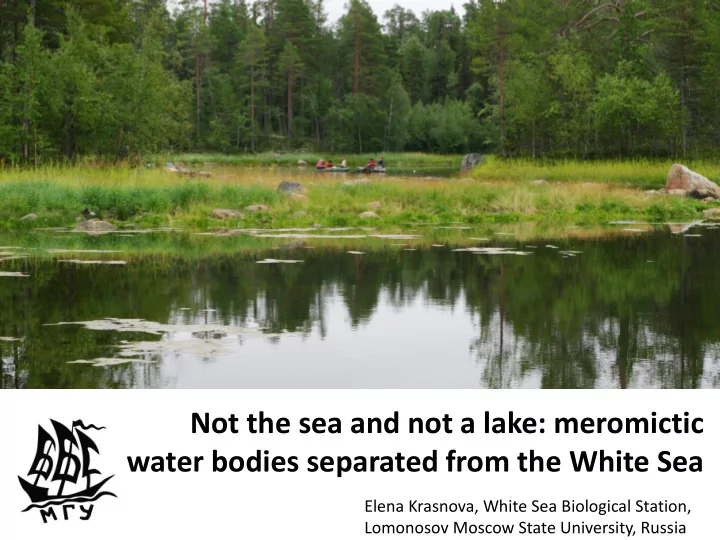
Not the sea and not a lake: meromictic water bodies separated from - - PowerPoint PPT Presentation
Not the sea and not a lake: meromictic water bodies separated from the White Sea Elena Krasnova, White Sea Biological Station, Lomonosov Moscow State University, Russia White Sea Biological Station of MSU Vertical structure of meromictic lake
Elena Krasnova, White Sea Biological Station, Lomonosov Moscow State University, Russia
White Sea Biological Station of MSU
Holomictic dimictic lake Bacterial sulfate-reduction: CH4 + SO4
2− → HCO3 − + HS− + H2O
Cause 1. Eutrofication. Bacterial sulfate-reduction: CH4 + SO4
2− → HCO3 − + HS− + H2O
Cause 2. Stratification.
Cause 3. Global warming.
Black Sea – up to 9 mg/l. Norwegian fjord Framavaren, a leader among the open marine areas – up to 200 mg/l. Lake Trekhtzvetnoe – up to 600-900 mg/l H2S in its bottom water!
Lake Trekhtzvetnoe
Layer of autotrophic bacteria
Photo: V. Lyagushkin
In the lake Trekhtzvetnoe In the lake Nizhnee Ershovskoe In the lake Elovoe In the lake Bolshye Khruslomeny In the lake Nizhnee Ershovskoe
F L O w Organic matter
Biogenic elements,
bacteria
Brackish «greenhouse roof» Photic zone: oxygenic photosynthesis,
Rhodomonas layer provides upflow of
Anoxygenic photosynthesis Aerobic zone, decomposition of organic matter
Dinoflagellates Oxyrrhis marina Cryptophytes Rhodomonas Green sulfur bacteria (photo: A.S. Savvichev)
Rotifers Synchaeta sp..
N E К Т О N B Е N ТH О S
Stickleback, bivalve Macoma balthica
Green sulfur bacteria were main photosynthetic organisms before the Great Oxygenation Event
Crater Gale in the Mars was once meromictic lake? What about green sulfur bacteria?