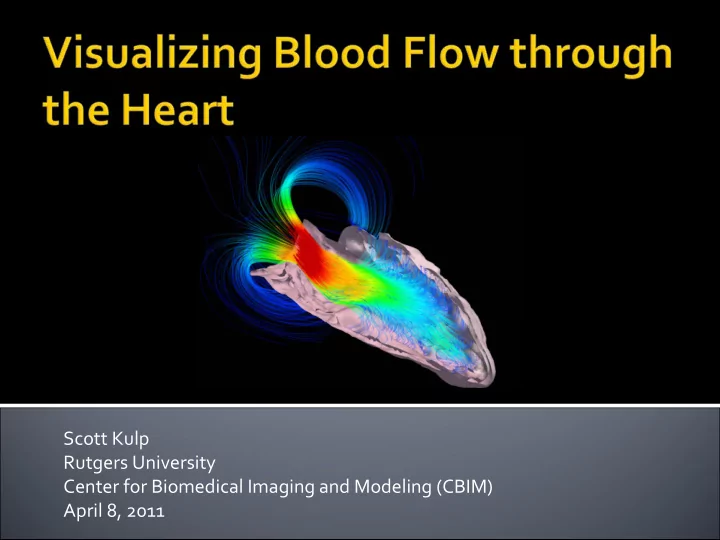
SLIDE 1
Scott Kulp Rutgers University Center for Biomedical Imaging and Modeling (CBIM) April 8, 2011
SLIDE 2
Many cardiovascular conditions, such as a heart attack or
arrhythmia, will cause abnormal motion of the heart walls.
This change of heart wall movement would affect the
blood flow pattern within the heart, potentially increasing the risk of blood clot and stroke.
Current imaging techniques (MRI, ultrasound) can be used
to retrieve flow information, but the spatial resolution is low.
Our goal is to simulate the blood flow through a patient’s
heart using models that have been retrieved through high‐ resolution imaging.
SLIDE 3
The walls of the left
ventricle are lined with complex trabeculae, which can interact with blood flow.
Capturing these
details and simulating the blood flow through them is difficult with MRI or ultrasound
http://biology.clc.uc.edu
SLIDE 4 We use high‐resolution CT
images acquired from a 320‐ MSCT scanner to generate the heart models.
Ten CT images were taken
- ver the course of a single
heart beat cycle ‐‐ high spatiotemporal resolution.
The acquired data has an in‐
plane resolution of 512x512 pixels, and 500 slices, with 0.5mm between slices.
SLIDE 5
To generate a 3D mesh
sequence, the CT data is segmented, and a detailed mesh is created from an isosurface of the segmentation.
Then, the high resolution mesh
to deformed to match the shape of the heart in each consecutive frame.
Since valves are thin and move
fast, the CT data is not able to capture them, and so we add them manually.
SLIDE 6
SLIDE 7
The motion of an incompressible fluid is
governed by the laws of conservation of momentum and mass, modeled by the Navier‐ Stokes equations:
We solve these equations for the three
components of velocity and the pressure everywhere at each time step.
SLIDE 8
SLIDE 9
SLIDE 10
Used framework from [1] to run a fluid simulation on
the mesh sequence on a 96x96x96 grid to simulate blood flow.
The blood is modeled as a Newtonian fluid, with
viscosity set at 4mPa*s and density set at 1060kg/m3.
Each two‐cycle simulation took between 4‐6 days to
complete.
[1] Mihalef et al, “Atrioventricular blood flow
simulation based on patient‐specific data,” in Proceedings of FIMH 2009, 2009.
SLIDE 11
SLIDE 12
SLIDE 13
SLIDE 14 Stagnant blood within the heart has high risk of clotting. We
therefore seek a method to determine the average residence time
Randomly generate particles within the heart at the initial time
- step. Each consecutive time step, use velocity field to move
existing particles, and generate new particles near the valves.
SLIDE 15
SLIDE 16 We can compare the visualizations of
velocity and average residency time between normal and diseased hearts.
We ran a simulation with one healthy heart,
- ne heart with simulated hypokinesis, and
- ne with significant dissynchronization of
the heart walls.
SLIDE 17
SLIDE 18
Normal Hypokinesis Dyssynchronized
SLIDE 19
SLIDE 20
For the first time, we are able to capture some of the
complex details of the trabeculae at theheart’s walls and simulate the blood flow around them.
Next steps Faster, fully‐automated mesh generation Development of faster numerical technique for solving
fluid flow
More streamlined, unified software for use by doctors
SLIDE 21
- This material is based upon work supported by the U.S. Department of
Homeland Security under Grant Award Number 2007‐ST‐104‐000006. The views and conclusions contained in this document are those of the authors and should not be interpreted as necessarily representing the
- fficial policies, either expressed or implied, of the U.S. Department of
Homeland Security.