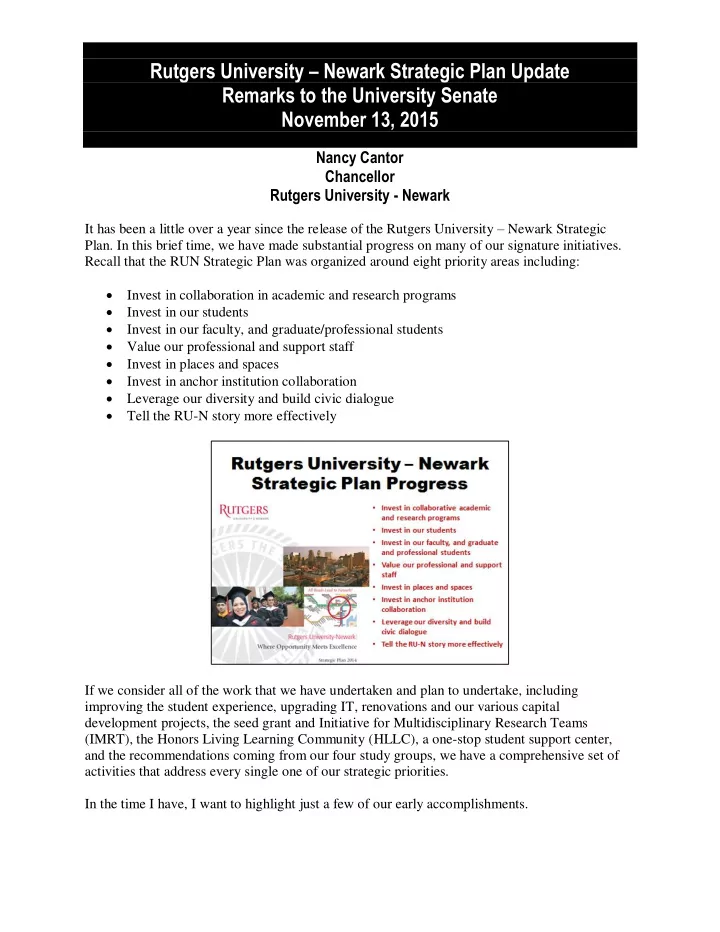
SLIDE 1 Rutgers University – Newark Strategic Plan Update Remarks to the University Senate November 13, 2015
Nancy Cantor Chancellor Rutgers University - Newark
It has been a little over a year since the release of the Rutgers University – Newark Strategic
- Plan. In this brief time, we have made substantial progress on many of our signature initiatives.
Recall that the RUN Strategic Plan was organized around eight priority areas including: Invest in collaboration in academic and research programs Invest in our students Invest in our faculty, and graduate/professional students Value our professional and support staff Invest in places and spaces Invest in anchor institution collaboration Leverage our diversity and build civic dialogue Tell the RU-N story more effectively If we consider all of the work that we have undertaken and plan to undertake, including improving the student experience, upgrading IT, renovations and our various capital development projects, the seed grant and Initiative for Multidisciplinary Research Teams (IMRT), the Honors Living Learning Community (HLLC), a one-stop student support center, and the recommendations coming from our four study groups, we have a comprehensive set of activities that address every single one of our strategic priorities. In the time I have, I want to highlight just a few of our early accomplishments.
SLIDE 2 RU-N Strategic Plan Update to University Senate
2
INVEST IN STUDENTS Among the many things we are doing to invest in our students, the Honors Living-Learning Community (HLLC) is one of the gems. RU-N is committed to exploring bold innovations that set new expectations for students from Greater Newark - and across urban America - to thrive in
- college. The HLLC is an inclusive and cohort-based living-learning community with an
interdisciplinary curriculum centered on “Local Citizenship in a Global World” and a comprehensive mentoring program dedicated to ensuring student success and the high quality learning that RU-N already offers. This is an honors community in the deepest meaning of the term - one in which we honor the potential evident in a wide array of talents and skills including leadership, innovation, and citizenship, and strengthening the legacy of RU-N as a seeder of
- pportunity and excellence.
We are delighted to report that we have recruited our first cohort of 30 students. They are exceptional young people representing a wide variety of interests and talents; all with a drive to achieve and lots of enthusiasm. As we move forward, we will be building a new state-of-the-art facility that will house upwards of 500 of these talented undergraduate students, with dining, recreational, and academic space. We believe that a key to the success of the HLLC students is the integrated living experience, and at the same time recognize that living in the residence halls is costly. These exceptional students have been awarded scholarships to be able to fully participate in the HLLC experience. Each one is a Clem Price Scholar. What better way to honor our dear friend and colleague. Since 2009, Rutgers University Newark has served as the lead institution of the Garden State Louis Stokes Alliance for Minority Participation (GSLSAMP) program during which time GSLSAMP has seen an 84% increase in Latinos/as graduating in STEM fields of study. The program establishes pipelines from local high schools and participating community colleges though partner colleges and universities; provides academic support and creates a learning community to encourage academic success and timely graduation; and prepares graduates for careers and graduate school in STEM fields
SLIDE 3 RU-N Strategic Plan Update to University Senate
3
In September, the GSLSAMP program was recognized as a “Bright Spot in Hispanic Education” by the White House Initiative on Educational Excellence for Hispanics. We could not be more proud, or honored, to see the Garden State LSAMP program, under the passionate and inspiring leadership of Dr. Alec Gates, recognized in this way. To the initial eight colleges and universities in northern New Jersey, of which five are “Hispanic Serving Institutions or Emerging Hispanic Serving Institutions,” (including Rutgers University - Newark), five community colleges, all of which are “Hispanic Serving Institutions,” were added as associate members of the GSLSAMP, and designated the “Northern New Jersey Bridges to the Baccalaureate (B2B) Program” providing us with an incredibly robust collaboration to support
- ur students in achievement in STEM fields.
And, speaking of bridges that unleash talent and honor striving, in February 2015, Rutgers University - Newark hosted a college fair, UndocuRutgers, for DREAMers. This first-time event was filled to capacity by 200 potential students and their parents seeking information on how to access college opportunities. We are actively following up on this event in our student recruitment and looking for ways to raise financial aid support for these fabulous students, teaming up with national organizations committed to this American dream. And speaking of student support, a team of senior leaders across the institution (lead by Shirley Collado) is working hard to create a one-stop student support center to pull together all of our resources and stream-line the support system while using new technologies and predictive analytics to direct timely and tailored feedback to students all along the process. This year we have seen our students excel all around the nation, globe, and at home. In addition to the recognition of GSLSAMP program, our Debate Team started the 2015-16 season with a bang, ranking number one in the country among more than 75 collegiate policy debate programs after its victory at the Baby Jo Memorial Debate Tournament. (It is worth noting that the duo responsible for our win are a junior from Ferguson, Missouri and a junior from Newark.) RU-N has built a phenomenally successful debate program largely by cultivating talent from right at home in Newark. This speaks volumes about the incredible wellspring of talent to be tapped here, which, in turn, attracts more talent from well beyond Newark and New Jersey. We are
SLIDE 4 RU-N Strategic Plan Update to University Senate
4
thrilled with the team’s success and even more so encouraged by what all of that says about our partnership with Newark schools and the future of this remarkable city. Not only are we investing in our undergraduates, AND achieving successes, but we are also investing in our graduate and professional students. For example, six Rutgers University– Newark (RU–N) graduate students recently returned from a two-month fellowship experience in Cape Town, South Africa funded by USAID and GS-N. Collaborating with The Community Chest of the Western Cape, a South African organization devoted to social change and community development, they researched topics ranging from sanitation systems to the improvement of STEM (science, technology, engineering, and mathematics) education for youth. The longstanding relationship between the Dean of the Graduate School – Newark, Kyle Farmbry, and the Community Chest lead to the creation of the Innovation Alliance for Social Enterprise Development fellowship designed to translate students’ research into potentially commercial applications and innovative solutions for social change. These are life changing experiences leading one of our students to observe, “Going there, I thought I was going to have an impact on people, I’m there to do research and I’m there to change this community. But the first week, I began to understand that the impact that I thought I was having on folks was the
- ther way around. They’re impacting me. If there could be any measurement of what I’m doing
for them, it can’t even compare to what they’re doing for me.” We are also creating new supports in one of our premier master’s programs. Although the MFA in Creative Writing at RU-N is less than a decade old, it is considered one of the finest programs in the Unites States. And now it’s getting even better. Beginning in the fall semester 2016, we will fully fund 14 extremely talented, fulltime students a year into our two- year program. Each will receive full in-state tuition remission, as well as a $15,000 Chancellor’s Stipend each year (and are eligible for other types of financial assistance.) We have worked hard to build a nurturing environment for early career writers, and now incoming MFA students can fully focus their energies on their graduate studies, their professional development and their creative
- projects. Since its inception, the MFA in Creative Writing Program has focused on the real world
experience its students bring to the classroom, and on creative exchange beyond the university
- campus. As part of this initiative, six MFA students will participate in inter-generational
conversations as Chancellor’s MFA Mentors in local Newark high schools.
SLIDE 5 RU-N Strategic Plan Update to University Senate
5
COLLABORTIVE RESEARCH AND PROGRAMS We understood early on that one of the best ways to move our strategic priorities forward was to engage faculty through investing in collaborative research and academic programs. This past year we have contributed more than $4 million in seed grants to more than 50 teams and more than $420,000 in multidisciplinary research grants. The Chancellor’s Seed Grant Program awards fund new and creative projects that support economic development; strong, healthy neighborhoods; diversity and social justice; new RU-N degrees; K-20 education; arts and culture; and science. For example, the Institute for Gender and Sexuality Law and Policy (IGSLP) at Rutgers University - Newark represents one of the many ways we carry out the Rutgers University-Newark Strategic Plan. From its location in the urban center of Newark, the Institute is specially situated to address the complex ways in which gender and sexuality interact with a range of dimensions, such as race, ethnicity, class, health, ability, citizenship, and geography, to reflect and reinforce social inequality. Bridge-building initiatives with organizations outside of Rutgers and partnerships within the university will provide an
- pportunity for faculty and students to collaborate with community entities to develop solutions
to pressing equality challenges. For instance, a partnership with Garden State Equality, New Jersey’s only statewide LGBT advocacy organization, focuses on research to improve health provision to LGBT communities throughout the state, bringing together experts in health, medicine, law, psychology, sociology, social work, and public policy. Institute programming will continue to support dialogue between scholars throughout Rutgers University and from other leading institutions. For example, collaboration with the Rutgers Institute for Women’s Leadership, the Institute co-hosted a major conference, Beijing+20 in September of this year, celebrating the 20th anniversary of the United Nations World Conference on Women bringing together pioneering women’s rights leader Gloria Steinem and leading experts from within and beyond Rutgers to discuss continued barriers to equality. At the end of last year, 25 percent of our fulltime student population identified as Hispanic, making RU-N eligible for designation as a Hispanic Serving Institution (HSI). The range of countries these students and their families hail from is no less remarkable: Puerto Rico, Dominican Republic, Mexico, Guatemala, Colombia, Peru, Cuba, and Ecuador, just to name a
SLIDE 6 RU-N Strategic Plan Update to University Senate
6
- few. So, it’s hardly surprising that a new initiative is underway at RU-N—the Latina/o Studies
Working Group (LSWG)—aimed at building a scholarly and cultural foundation for both students and faculty alike, while forging ties with community partners in Newark, other parts of New Jersey, and the greater New York metropolitan area. The LSWG, funded through the Chancellors Seed Grant program, composed of RU-N faculty and staff, is getting off the ground with a promising Fall 2015 lineup of arts programming and lectures. It kicked off its activities last month with the Latina/o Arts Festival; the Lourdes Casal Speaker Series will host its first speaker, Roberto Zurbano, on Nov. 18; and Dana Library will host an exhibit, “Newark ’74: Remembering the Puerto Rican Rebellion,” from late November to early February. In addition to the funding available to faculty and staff through the seed grants, a second funding stream was also created this past year. The Initiative for Multidisciplinary Research Teams (IMRT) awards support the establishment and growth of research collaborations among faculty to enable them to compete more effectively for external funding. A great example of how innovative ideas can spur on new collaborations and secure external funding, in the Center for Molecular and Behavioral Neuroscience/Faculty of Arts and Sciences, Professor Mark Gluck’s “The Rutgers University – Newark Center of Excellence in Community-Based Participatory Research on African-American Brain Health” was funded to investigate five interrelated and critical factors that influence African-American brain health: sleep, aging, exercise, stress, and
- depression. The Center in partnership with the state of New Jersey Department of Health
received a five-year grant from the US Department of Health and Human Services’ “Minority Health State Partnership Program” totaling $1 million dollars entitled, “Improving Mental Health and Physical Activity in Older African Americans in Newark: A State-University-Church Partnership” Other collaborations have advanced our mission as well. The Newest Americans is a unique multimedia digital publication spearheaded by Tim Raphael, director of the Center for Migration and the Global City (CMGC) at Rutgers University–Newark in collaboration with Talking Eyes (non-profit production company whose work stimulates public dialogue and advocates for positive social change) and VII Photo (representing 20 of the world’s preeminent photojournalists). Newest Americans is dedicated is dedicated to storytelling from a global perspective and features the work of professional journalists, documentary filmmakers, artists, research faculty and students. The inaugural issue contained brilliant works, such as “Notes For My Homeland,” a short film with original music from Malek Jandali, a Syrian-American composer and “From Where I Stand,” audio essays by RU–N students from Nigeria, Egypt and Newark, assessing the challenges and opportunities that present themselves from their perspectives.
SLIDE 7
RU-N Strategic Plan Update to University Senate
7
SPACES AND PLACES When we did our strategic planning a little more than a year ago, we all agreed that a high priority for us (priority #5, but who’s counting?) was to “invest in the spaces and places where we live, learn, create, and engage the world.” With input and participation from across RU-N, we are doing just that and in ways big and small, all over our physical campus and the adjoining streets and spaces. Perhaps the most obvious example is the historic renovation of the neo-classical building, 15 Washington Street, now home to 333 students, including 233 graduate and professional, and 100 undergraduate, students and where we are busy outfitting all the remarkable grand public spaces, including the truly magnificent Great Hall for performances, conferences, and lectures and other university-community public gatherings, such as the Creative Writing Program’s famed Writers in Newark series starting next January. This wonderful space will also be home to Clement’s, a place for people to gather around food and conversations. Our own IJS executive director, Wayne Winborne, will be in charge of the music and spoken word programming for this remarkable space. AND, if you would like to see the new renovations, the grand re-opening of 15 Washington is scheduled for November 17th from 4 to 6 pm. There also have been numerous upgrades to teaching, learning, and social spaces: dozens of classrooms have seen renovations from top to bottom – and no detail is too small to bring a space alive – so in many we’ve added new furniture (including some state-of-the-art moveable arm chairs), new electrical outlets for ease of plugging in, and new, actually readable, signage. You might not even recognize the interior of Stonsby Cafeteria and lounge, which have had a complete makeover, and all residence halls now have a new package distribution locker system. While these amenities might not seem central to our academic mission, never underestimate what they will do for our spirits! Meanwhile, some of the renovations are decidedly about our intellectual life in a new more thoroughly connected world. We’ve begun to address in earnest long-standing information technology (IT) needs, including having added new high-definition projection screens in three
SLIDE 8 RU-N Strategic Plan Update to University Senate
8
dozen classrooms, upgraded networking in five dozen, 175 computer upgrades, and nearly 700 new indoor wifi access points—including completion of wifi availability in all residence halls. There is even more on the horizon: construction has begun on Life Sciences 2 and renovations are well along at the massive, former Hahne & Co. building that will house Express Newark: A University-Community Collaboratory focused on the arts and cultural disciplines. The Paul Robeson Campus Center (PRCC) will see upgrades to the game room and work will begin on an interfaith prayer space. We have also acquired an iconic former mansion on Washington Street to be the new alumni house, encouraging RU-N graduates’ continuing interaction with the university community. And in the not-too-distant future, we’ll see our Social Justice Learning Community (newly mounted this fall with 30 fabulous students) evolve rapidly into an Honors Living-Learning Community with a new residence hall and academic space for 500 student members, including of course the extraordinarily talented next generation from right here in Greater Newark. And plans are afoot for a renovation design for the Dana Library, including the unused 3rd floor space. To make it easier to get all around our campus and to all the parking decks in its nearby environs, from the Golden Dome to 15 Washington and the Rutgers Business School in the late afternoon and evening, we’ve introduced a new shuttle route—the RUN Run—from 4 p.m. to midnight seven days a week. At the same time, we are talking to NJ Transit to team up in ways that can encourage us all to use the light rail system to ease traffic between Newark Penn and our campus area – we think this is a better, more sustainability-conscious, long-term approach to supporting
- ur transportation needs. And, this fall we are beginning the design planning for a new
“commuter hub” attached to Conklin Hall – a place for mixing, relaxing, and rejuvenating before and after a commute to RU-N. ANCHOR PROJECTS “Being of Newark, not just in Newark” emerged as a key element of RU-N’s identity, and enhancing our anchor institution agenda is one of the highest priorities emerging from our strategic visioning process. Our goal is to continue to build the capacities of our world class research university as an anchor institution that is a key force in working on challenges that are
SLIDE 9 RU-N Strategic Plan Update to University Senate
9
manifest locally, but are representative of those faced globally, including (1) improving the economic base of Newark and Northern New Jersey, (2) helping to improve economic and governance networks that create opportunity for the students and residents that we serve, and (3) in the process, building models of innovative collaborative, cross-sector problem solving and intellectual innovation that advance scholarship in our disciplines, strengthen the education of
- ur students, and increase the broader impacts of our work that ripple out across our local and
global communities.” Educational Attainment: One of our ongoing activities that will have the greatest impact on our city is the Newark City of Learning Collaborative (NCLC), a city-wide collaborative (engaging all the higher education institutions, the corporate anchors, the NPS, the City of Newark, college-pipeline CBOs) that seeks to increase college attainment for Newark residents from 13/17% to 25% by 2025. This includes creating cohorts (Newark Achieves in high schools), working with “disconnected youth,” and adults with some credits but no degrees, smoothing pathways from community colleges to four year and professional programs and enhancing career and technical pathways, leadership training, and workforce investment. Economic Development: We have many assets here at Rutgers University-Newark to bring to bear on the issue of economic development, such as the RBS’ Center for Urban Entrepreneurship and Economic Development and Center for Supply Chain Management’s Halsey Street Initiative that is working to revitalize the retail corridor bordering RU-N’s campus and the Newark Industrial Solutions Center, whose mission is to develop, strengthen, and promote Newark’s industrial competitiveness for the 400+ small to mid-sized manufacturers. These initiatives engage local business owners, the City of Newark, Newark Regional Business Partnership, Newark Workforce Investment Board, New Jersey Institute of Technology, and the New Jersey Manufacturing Extension Program among others. Arts & Culture & Public History: The Institute on Ethnicity, Culture and the Modern Experience has been renamed in honor of Clement Alexander Price, its founder and director. Reflecting recognition of his scholarship and his love of this great city of Newark, over $5 million has been donated to date to support Dr. Price’s legacy. The Andrew W. Mellon Foundation has awarded Rutgers University – Newark (RU-N) a $2 million challenge grant to create an endowed chair honoring a member of the community who so personified the city in which he studied, taught, and lived, but whose scholarship and teaching resonate powerfully nationwide. As director of the newly named Price Institute, the new chair will work across disciplines with scholars, community partners, and students to advance research on public history, race, and ethnicity. On December 8, the organizing committee for the Action Agenda for Historic Preservation in Legacy Cities and Rutgers University – Newark will hold a free public event: Legacy City Preservation: A National Conversation on Innovation and Practice. The event will celebrate the
SLIDE 10 RU-N Strategic Plan Update to University Senate
10
release of the action agenda and showcase the breadth of work underway in legacy cities to make them more prosperous, equitable, and sustainable, while preserving their heritage. The preservation and rehabilitation of the Hahne & Co. Building, (and the actualization of Express Newark), is a paragon of effective engagement by anchor institutions partnering in one legacy city’s revitalization. Rutgers University - Newark’s partnership with L+M Development and Prudential to realize the Hahne’s building project embodies core strategies of the action agenda. In reclaiming this icon of Newark’s prosperity and reinventing it as a beacon of democratic practice, the perception of what is possible for the city is transformed. Strong, Healthy, Safe Neighborhoods: A key focus of our anchor institution work for some time now has been to collaborate with CBOs and the City of Newark to build stronger, healthier, safer neighborhoods – and this work is flourishing, and building new ties with RBHS as well. This work builds upon our close relationship with the City of Newark, as exemplified by the work of SPAA and RBS on the 311 App. And, although we work throughout the City of Newark, the West Ward has been a particular focus with the Fairmount Promise Neighborhood Alliance (spurred by the work of Diane Hill and the Office of University-Community Partnerships), and much of the efforts of our criminal justice and law faculty. For example, in collaboration with one of our faculty members, Paul Boxer, the City of Newark was the recipient of a $1 million grant from the US Department of Justice, Office for Victims of Crime to reduce criminal victimization and improve wellness in the West Ward by conducting a variety of intervention activities including environmental modifications; carefully directed patrolling; street worker outreach; and social worker outreach, brief counseling, and referral to higher levels of care. We plan to serve at least 50 crime victims directly while providing services that can benefit the wider community more generally. Consistent with this work, Paul also leads the Greater Newark Youth Violence Consortium, a multi-disciplinary, multi-agency collaborative of government entities, nonprofit service agencies, and university researchers dedicated to reducing and preventing youth violence and delinquency in the greater Newark metropolitan region. The primary goal of the consortium is to establish cross-sector partnerships to develop, promote, and support prevention and intervention programming. There are approximately 30 different entities represented on the consortium at this time. LandCare Newark, also funded through the seed grants, is an innovative method of reducing crime and other physical and psychological problems faced by many Newark residents. Instead
- f focusing on treatment or punishment, high cost methods of intervening in a small number of
people’s lives, this is an affordable and sustainable place-based solution that cleans and greens vacant lots (and Newark has nearly 3,000) to improve all community members’ lives while increasing land values, providing open space for public use, and beautifying the neighborhood. The project is a partnership involving RU-N, RBHS, the Greater Newark Conservancy, YouthBuild Newark, and the City of Newark. The team has been developing strategies to pilot this land care program in select areas of the city of Newark and to enhance youth development and civic engagement.
SLIDE 11 RU-N Strategic Plan Update to University Senate
11
In line with these particular efforts are a range of city-wide initiatives that Todd Clear and others have spurred to create a Safer Newark Council and more particularly to support the re-entry of Newarkers after incarceration. In this vein, the highlight of our year was the visit by President Barak Obama, Senator Cory Booker and Mayor Ras Baraka to our University. President Obama’s speech was focused on mass incarceration and re-entry and new legislative efforts to help people get back on track by giving them a true second chance. Our NJ Step program, teaching in both the prisons and at RU-Newark and NB, is a model effort in this arena and we are very proud of it. As President Obama noted in his remarks on mass incarceration and re-entry, NJ STEP, the New Jersey Scholarship and Transformative Education in Prisons program, is gaining attention and
- momentum. NJ STEP, coordinated by Rutgers University - Newark’s School of Criminal Justice,
works in partnership with the New Jersey Department of Corrections, the State Parole Board, and a network of public and private, two- and four-year colleges to provide higher education courses to eligible individuals who are incarcerated in one of New Jersey’s seven correctional facilities. Since 2013, nearly 825 people have taken at least one of NJ-STEP’s college-level courses. By the end of next semester, about 100 students will have obtained their associate’s degrees through the program and another 150 by the end of the fall of 2017. Plans are now in progress to offer a bachelor’s degree in sociology with a minor in entrepreneurship. The program also assists in the transition to college life of released students. This fall Rutgers University - Newark welcomed its first cohort of 10 NJ-STEP students. This is a remarkable program, as an avenue of educational
- pportunity for individuals that has critical and broader benefits, enhancing economic well-being
and public safety particularly in neighborhoods where large numbers of people return from prison every year.
SLIDE 12 RU-N Strategic Plan Update to University Senate
12
MOVING AHEAD FROM STUDY GROUP RECOMMENDATIONS Over the past year, study groups have been working diligently to analyze, assess and make recommendations for next steps in four priority areas, including: the anchor mission, leveraging
- ur diversity, the new professoriate and staffing for the new mission. In early October, all groups
submitted their reports. Recommendations from these reports will continue to move us forward
- n many of our strategic priorities.
A recurrent theme in our strategic planning process was making the most of our diversity and the diversity around us in Newark and the region-to recognize our diversity as an enormous asset to scholarship, pedagogy, civic life and community well-being. That means that we need to deliberately foster “dialogues across difference” and build on the full range of experiences,
- pinions, values, cultural traditions encompassed here, both in the curriculum and in public
events and convenings. We are now beginning to explore what an intercultural center that furthers these conversations might look like under the leadership of Corlisse Thomas and a faculty-student-staff team, while also leveraging our existing resources, such as the Price Institute (and the Marion Thompson Wright Lecture Series), the Cornwall Center (Brick City Conversations) and the Center for Migration and the Global City. We are also launching a RU-N Chancellor’s Commission on Diversity and Transformation group to actively engage these issues and push RU-N to be a national model for understanding the complexity of diversity in a changing demographic landscape, issues of intersectionality, and the effect of historical biases as they are rendered in contemporary community. We want to unpack diversity, equity, and inclusion, both from a scholarly and curricular and campus community and anchor institution
- perspective. This Commission will be co-chaired by Provost Jerome Williams and Executive
Vice Chancellor Shirley Collado and will include key stakeholders from the faculty, staff and student body who want to make a difference and activate intentional change at the university. If you want to know what American higher education will look like in 20 years, all you have to do is look at RU-N’s student body. We know that the professoriate of the future will also be more diverse, and in every way possible; ethnically and racially, in their scholarship, and in their faculty lives. The current and future professoriate is made richer from increasing opportunities for people who historically have not sought or been hired for faculty positions. We expect that
SLIDE 13 RU-N Strategic Plan Update to University Senate
13
new members of the professoriate will come from many different kinds of communities, both geographic and intentional, that they will increasingly engage in scholarship with members of those communities and to be better prepared to teach a richly diverse student population. We also expect it to continue to be comprised of non-tenure track faculty (NTTs), part-time lecturers (PTLs) and professors of practice—a diverse faculty of dedicated instructors who often connect the institutional learning experience to the lived work experience outside academia. We expect a growing interest in publicly-engaged scholarship (as institutions across the nation are seeing and embracing) as our many publics continue to ask higher education to contribute high impact scholarship to meet the needs of a challenged world. Those challenges are messy and will require collaboration across disciplines to tackle questions of significant impact. The men and women of the new professoriate, therefore, are a bridge to more experiences, fuller meanings and new possibilities. In order to prepare for the next generation of students and faculty, we need to explore various mechanisms for recruiting, retaining and advancing scholars of color. And to support the emerging new professoriate as a whole and its needs, we will explore the development of graduate student career training to prepare graduate students for more diverse career trajectories, both academic and non-academic; faculty development that can assist faculty in conducting publicly engaged scholarship, provide leadership development and mentoring; and closely associated with the faculty development, teaching excellence and innovation to assist faculty in enhancing teaching skills, learning innovative and effective teaching methods, and mastering the use of technology in the classroom. Under the guidance of Bonnie Vecsey (and in conversation with Consuella Askew), we have begun planning for a faculty center that would serve the needs I just discussed while providing creative spaces for scholarship and collaboration. We are planning to renovate the third floor of the Dana Library for this center. Among the most important activities over the next year will be engaging the schools and colleges in discussions about advancing publicly engaged scholarship among faculty at RU-N. Over the next few months, our wonderful newly-appointed Provost, Jerome Williams, will lead conversations with deans and departmental faculty and the Newark Faculty Council about how individual disciplines currently engage in this scholarship and how to value, assess and reward publicly engaged scholarship in the tenure and promotion process. (And, I should say that this is intended simply to expand our ways of rewarding scholarly efforts, not in any way to add burdens to those who don’t want to do it nor to turn away from traditional outlets for scholarly productivity.) Students are at the center of our mission, but we could not achieve our educational, scholarship
- r service missions without our professional and support staff. The Staffing for the New Mission
study group created a comprehensive plan to develop our current staff while identifying ways to recruit and retain new talent that would support our many activities and initiatives make RU-N the employer of choice. To a large degree, Rutgers University - Newark has moved forward with adopting a talent management orientation, under the expert guidance of newly-appointed Assistant Chancellor and Director of HR, Bil Leipold. This takes us beyond the transactional nature of human resources and creates a culture of investment in staff and staff development. At Rutgers University-Newark, opportunity is not bestowed upon a select few, but deliberately cultivated for many. RU-N employees, their development, career growth, engagement, and
SLIDE 14
RU-N Strategic Plan Update to University Senate
14
commitment are central to the success of our mission. Taking on this orientation on means changing our recruitment strategies, on-boarding, and career development opportunities. Many of our staff are deeply committed to the future of Greater Newark and we want to expand their opportunities for leadership and engagement in this arena. For example, not only do staff get involved in our anchor institution collaborations but we want to enhance their visibility as the future of this city’s leadership cadre – so we are sponsoring five staff members to Leadership Newark every year. There are so many benefits to both the university and the community through leveraging the talent of our staff as active citizens and leaders. We understand that the know-how to make things happen exists in our staff. We believe that we would benefit from staff engagement at the highest levels of leadership. Establishing a Staff Council to represent all staff, both union and non-union, is a concrete and potentially powerful vehicle for empowering staff and ensuring that their knowledge and views are known by university leadership and the university community at large. As we move toward more shared governance structures, the staff council will be involved together with the Student Governing Association (SGA) and the Newark Faculty Council (NFC) and the Chancellor’s leadership team in setting the course for RU-N. As we said in our strategic plan, we go by the great lyric from the civil rights era, “We are the Ones We are Waiting for,” and so collaboration is the key thread that weaves all of our activities together as RU-N moves forward and as we tell our story nationally.