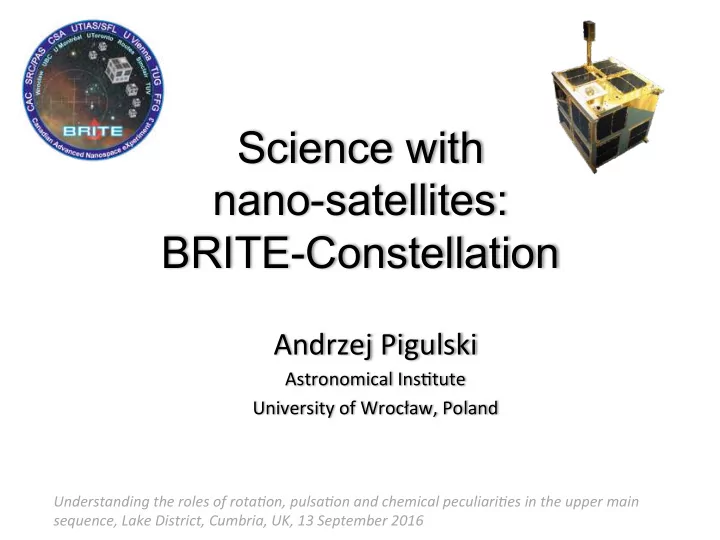
Science with nano-satellites: BRITE-Constellation Andrzej Pigulski - - PowerPoint PPT Presentation

science with nano satellites brite constellation
SMART_READER_LITE
LIVE PREVIEW

Science with nano-satellites: BRITE-Constellation Andrzej Pigulski - - PowerPoint PPT Presentation

Science with nano-satellites: BRITE-Constellation Andrzej Pigulski Astronomical Ins6tute University of Wrocaw, Poland Understanding the roles of rota0on, pulsa0on and chemical peculiari0es in the upper main sequence, Lake District, Cumbria,


slide-1
SLIDE 1

Understanding the roles of rota0on, pulsa0on and chemical peculiari0es in the upper main sequence, Lake District, Cumbria, UK, 13 September 2016

Science with nano-satellites: BRITE-Constellation

Andrzej Pigulski

Astronomical Ins6tute University of Wrocław, Poland

slide-2
SLIDE 2

Bright star photometry with nano-satellites

Why bright stars?

  • Photometry is difficult from the ground.
  • Easy or exis6ng (6me-series) spectroscopy.
  • Visual + SB2 orbits for binaries -> masses.
  • Accurate parallaxes.
  • Low ex6nc6on & reddening.

Why nano-satellites?

  • Small telescope = small satellite.
  • Low-cost.
  • Tes6ng new techniques.
slide-3
SLIDE 3

BRITE

BRIght Target Explorer

nanosatellite size: 20 × 20 × 20 cm mass: 7 kg telescope diameter: 3 cm launched: 2013-2014 Scien6fic goal: variability

  • f bright (luminous) stars

BRITE-Constella;on

6 satellites, 3 equipped with red (R), 3 with blue (B) filter

Slavek Rucinski Austria Canada Poland

slide-4
SLIDE 4

BRITE sky ≈ naked-eye sky

slide-5
SLIDE 5

Pulsa;ng stars in the H-R diagram

BRITE targets: Stars:

  • bright,
  • massive,
  • young.

J.Christensen-Dalsgaard

β Cephei SPB

slide-6
SLIDE 6

BRITE-Constella;on

BRITE-Austria (BAb) UniBRITE (UBr) Lem (BLb) Heweliusz (BHr) BRITE-Montréal (BMb) BRITE-Toronto (BTr) 25.02.2013 43 months 25.02.2013 43 months 21.11.2013 34 months 19.08.2014 25 months 19.06.2014 27 months 19.06.2014 27 months

R B

Launch date In space for

slide-7
SLIDE 7

Field of view

slide-8
SLIDE 8

Orion field

slide-9
SLIDE 9

BRITE photometry

UBr

Images courtesy Rainer Kuschnig & Adam Popowicz

BAb

  • rasters,
  • defocusing,
  • aperture photometry.
slide-10
SLIDE 10

Rasters/windows, modes of observing

Normal mode Chopping mode

Pigulski et al. (2016) Popowicz et al. (2016)

slide-11
SLIDE 11

Removing instrumental effects: an example

Cen: HD 128898, BAb, 4 (α Cir)

slide-12
SLIDE 12

Removing instrumental effect: an example

BEFORE:

AFTER:

~150 days, two-colour

slide-13
SLIDE 13

BRITE sky

slide-14
SLIDE 14

Summary of up-to-date observa;ons

Heweliusz Lem Toronto UniBRITE BRITE-Austria Y E A R

slide-15
SLIDE 15

Summary of the up-to-date observa;ons

Observa6ons obtained for 14 fields (337 stars). Data delivered for 13 fields (300 stars). This includes 70% of all OB stars brighter than V = 4 mag. Ongoing observa6ons of 3 next fields. The associated spectropolarimetric survey (~500 stars, C.Neiner) BRITE-Constella6on Web page:

hip://www.univie.ac.at/brite-constella6on/

BRITE-Constella6on Wiki page:

hip://brite.craq-astro.ca/doku.php?id=start

BRITE-Constella6on Facebook page:

hips://www.facebook.com/briteconstella6on

Two technical papers published. The first three scien6fic papers published. Two papers submiied. Next 20 – 25 papers at different stages of prepara6on.

slide-16
SLIDE 16

Summary of the up-to-date BRITE targets

slide-17
SLIDE 17

α Circini (HD 128898, A7 Vp SrCrEu, V = 3.19)

P = 6.8 minutes

Kurtz & Cropper (1981) Kurtz et al. (1981)

slide-18
SLIDE 18

α Circini from WIRE

Bruni, Kurtz, et al. (2009)

rota6on pulsa6ons

slide-19
SLIDE 19

α Circini from BRITE: rota;on

Weiss et al. (2016)

slide-20
SLIDE 20

α Circini from BRITE: pulsa;ons

Weiss et al. (2016)

f1 and f7 (marginally) detected

slide-21
SLIDE 21

β Centauri (HD 122451 = Agena, B1 V + B + ..., V = 0.6)

Aa – Ab system

Pigulski et al. (2016)

slide-22
SLIDE 22

β Centauri: A-B system

8.32 ± 0.50

(van Leeuwen 2007)

e = 0.6 – 0.8 Porb = 125 – 220 lat ω = 150 – 240° T0 = 2024 – 2032 Ω = 67 – 110° i = 118 - 130°

A – B system

slide-23
SLIDE 23

β Centauri: two massive components

Ground-based observa;ons:

f2, f3 or their aliases (spectroscopy) nothing reliable from photometry

Vrot sin i: Aa: 200 - 250 km/s Ab: 70 - 120 km/s

(Ausseloos et al. 2006)

slide-24
SLIDE 24

β Centauri: BRITE, frequency spectrum

8 g modes 9 p modes 2 combina6ons another β Cep/SPB hybrid

Pigulski et al. (2016)

slide-25
SLIDE 25

β Centauri: BRITE, frequency spectra

  • 1. f1 & f2 are intrinsic, f3 = f1 + f2, f19 = f1 + 2f2
  • 2. f2 & f3 are intrinsic, f1 = f3 − f2, f19 = f2 + f3
slide-26
SLIDE 26

β Centauri: BRITE, frequency spectra

slide-27
SLIDE 27

β Lupi (HD 132058, B2 IV, V = 2.7)

15 g modes

Cugier et al. (in prep.)

slide-28
SLIDE 28

η Centauri (HD 127973, B1.5 Vne, V = 2.3)

long-term variability, P ≈ 29.4 d

Baade et al. (2016)

slide-29
SLIDE 29

η Centauri (HD 127973, B1.5 Vne, V = 2.31)

Štefl frequency, fS ≈ 1.556 d−1

Baade et al. (2016)

slide-30
SLIDE 30

η Centauri (HD 127973, B1.5 Vne, V = 2.31)

Frequency spectrum of residuals

2fS Δf f1 − f2 = Δf fS

Baade et al. (2016)

slide-31
SLIDE 31

δ Pictoris (HD 42933, B0 III)

Porb = 1.67254 d

BRITE data (Heweliusz)

slide-32
SLIDE 32

δ Pictoris (HD 42933, B0 III)

slide-33
SLIDE 33

δ Pictoris (HD 42933, B0 III)

Pulsa6ons originate in the primary star !

slide-34
SLIDE 34
slide-35
SLIDE 35

Conclusions

  • 1. BRITE data are as good as expected.

Periodic variability with amplitudes down to 0.2 – 0.3 mmag can be detected. This proves that nano-satellites can be used for science.

  • 2. BRITEs will allow asteroseismology of a large sample
  • f Beta Cep/SPB stars with a significant number of modes

(10 – 20).

  • 3. Beta Cep/SPB hybridity seems to be widespread.
  • 4. Observa6ons of a large sample of Be stars may bring

a breakthrough in understanding the role of pulsa6ons in transferring maier to circumstellar disk.

  • 5. Precise masses and radii of many massive stars will be

determined.

slide-36
SLIDE 36

Thank you, Don, for your excellent work and for inspiring many colleagues with new ideas. Have a lot of fun con6nuing work on stars...

With best gree0ngs from (non-rapidly oscilla0ng) AP