
SLIDE 1
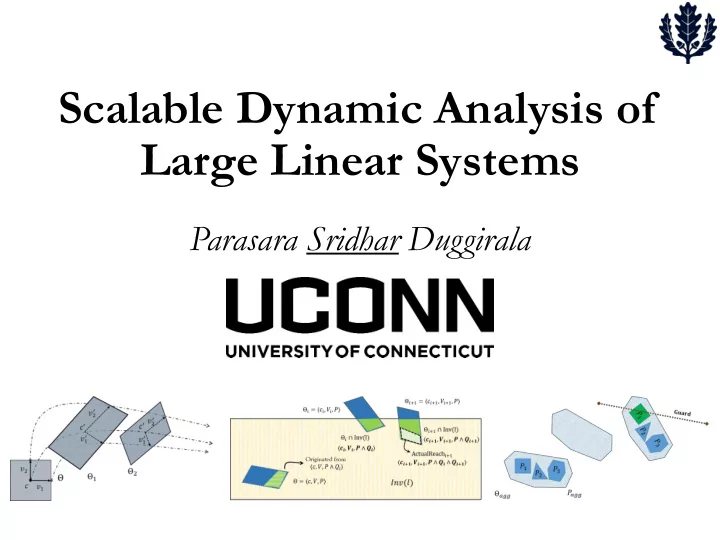
Scalable Dynamic Analysis of Large Linear Systems Parasara Sridhar - - PowerPoint PPT Presentation
Scalable Dynamic Analysis of Large Linear Systems Parasara Sridhar Duggirala Joint Work Mahesh Viswanathan UIUC Stanley Bak - AFRL P. S. Duggirala, M. Viswanathan. Parsimonous , Simulation Based Verification of Linear Systems
Mahesh Viswanathan – UIUC Stanley Bak - AFRL
CPS V&V I&F - CMU 2
International Conference on Computer Aided Verification (CAV) 2016.
Tools and Algorithms for Construction and Analysis of Systems (TACAS) 2017.
Hybrid Systems Computation and Control (HSCC) 2017.
Applied Continuous and Hybrid Systems Verification Workshop (ARCH) 2017. Best Paper Award
International Conference on Computer Aided Verification (CAV) 2017.
leader follower
s
velocity = 𝑤; acceleration = 𝑏; velocity = 𝑤𝑔; acceleration = 0;
CPS V&V I&F - CMU
Physical Plant 𝐃𝟐 𝐃𝟑 𝐃𝐨
Logic
ሶ 𝐲 = 𝐠𝟐(𝐲) ሶ 𝐲 = 𝐠𝟑(𝐲) ሶ 𝐲 = 𝐠𝟒(𝐲)
Linear Hybrid Automata 𝐻1 𝐻2 𝐻3 𝑔
𝑗 𝑦 = 𝐵𝑗𝑦 + 𝐶𝑗
Dynamics of the system ሶ 𝑡 = 𝑤𝑔 − 𝑤; ሶ 𝑤 = 𝑏 − 𝑙𝑏𝑓𝑠𝑝𝑤; ሶ 𝑏 = 𝑣; 𝑙𝑏𝑓𝑠𝑝 is the air–drag Control Law
if(cond1) then 𝑣 = −2𝑏 − 2(𝑤 − 𝑤𝑔); if(cond2) then 𝑣 = −3𝑏 − 2(𝑤 − 𝑤𝑔);
3
▪ Given a Linear Hybrid Automata 𝐼, with initial set Θ and unsafe set 𝑉, are all the behaviors starting from Θ for bounded time 𝑈𝑐 are safe?
CPS V&V I&F - CMU
ሶ 𝐲 = 𝐠𝟐(𝐲) ሶ 𝐲 = 𝐠𝟑(𝐲) ሶ 𝐲 = 𝐠𝟒(𝐲)
Θ
𝑔
𝑗 𝑦 = 𝐵𝑗𝑦 + 𝐶𝑗
𝐻1 𝐻2 𝐻3 Linear Hybrid Automata
4
▪ Given a Linear Hybrid Automata 𝐼, with initial set Θ and unsafe set 𝑉, are all the behaviors starting from Θ for bounded time 𝑈𝑐 are safe? ▪ One technique: Use a safety verification tool such as KeyMeara, SpaceEx, Flow*, or CORA, etc.
CPS V&V I&F - CMU
ሶ 𝐲 = 𝐠𝟐(𝐲) ሶ 𝐲 = 𝐠𝟑(𝐲) ሶ 𝐲 = 𝐠𝟒(𝐲)
Θ
𝑔
𝑗 𝑦 = 𝐵𝑗𝑦 + 𝐶𝑗
Linear Hybrid Automata 𝐻1 𝐻2 𝐻3
5
▪ Given a Linear Hybrid Automata 𝐼, with initial set Θ and unsafe set 𝑉, are all the behaviors starting from Θ for bounded time 𝑈𝑐 are safe? ▪ One technique: Use a safety verification tool such as KeyMeara, SpaceEx, Flow*, or CORA, etc. ▪ However, most of design analysis is done using simulations.
CPS V&V I&F - CMU
ሶ 𝐲 = 𝐠𝟐(𝐲) ሶ 𝐲 = 𝐠𝟑(𝐲) ሶ 𝐲 = 𝐠𝟒(𝐲)
Θ
𝑔
𝑗 𝑦 = 𝐵𝑗𝑦 + 𝐶𝑗
Linear Hybrid Automata 𝐻1 𝐻2 𝐻3
6
▪ Given a Linear Hybrid Automata 𝐼, with initial set Θ and unsafe set 𝑉, are all the behaviors starting from Θ for bounded time 𝑈𝑐 are safe? ▪ One technique: Use a safety verification tool such as KeyMeara, SpaceEx, Flow*, or CORA, etc. ▪ However, most of design analysis is done using simulations.
CPS V&V I&F - CMU
ሶ 𝐲 = 𝐠𝟐(𝐲) ሶ 𝐲 = 𝐠𝟑(𝐲) ሶ 𝐲 = 𝐠𝟒(𝐲)
Θ
𝑔
𝑗 𝑦 = 𝐵𝑗𝑦 + 𝐶𝑗
Linear Hybrid Automata 𝐻1 𝐻2 𝐻3
7
Linear Hybrid Automata 𝐼 = ⟨𝑀𝑝𝑑, 𝑌, 𝐺𝑚𝑝𝑥, 𝐽𝑜𝑤, 𝑈𝑠𝑏𝑜𝑡, 𝐻𝑣𝑏𝑠𝑒⟩
CPS V&V I&F - CMU
Modes State space Dynamics ሶ 𝑦 = 𝐵𝑗𝑦 + 𝐶𝑗 Invariants Discrete transitions Guards
𝐽𝑜𝑤1 𝐽𝑜𝑤2
ሶ 𝑦 = 𝐵1𝑦 + 𝐶1 ሶ 𝑦 = 𝐵2𝑦 + 𝐶2
8
Linear Hybrid Automata 𝐼 = ⟨𝑀𝑝𝑑, 𝑌, 𝐺𝑚𝑝𝑥, 𝐽𝑜𝑤, 𝑈𝑠𝑏𝑜𝑡, 𝐻𝑣𝑏𝑠𝑒⟩
CPS V&V I&F - CMU
Modes State space Dynamics ሶ 𝑦 = 𝐵𝑗𝑦 + 𝐶𝑗 Invariants Discrete transitions Guards
𝐽𝑜𝑤1 𝐽𝑜𝑤2
ሶ 𝑦 = 𝐵1𝑦 + 𝐶1 ሶ 𝑦 = 𝐵2𝑦 + 𝐶2
9
Linear Hybrid Automata 𝐼 = ⟨𝑀𝑝𝑑, 𝑌, 𝐺𝑚𝑝𝑥, 𝐽𝑜𝑤, 𝑈𝑠𝑏𝑜𝑡, 𝐻𝑣𝑏𝑠𝑒⟩
CPS V&V I&F - CMU
Modes State space Dynamics ሶ 𝑦 = 𝐵𝑗𝑦 + 𝐶𝑗 Invariants Discrete transitions Guards
𝐽𝑜𝑤1 𝐽𝑜𝑤2
ሶ 𝑦 = 𝐵1𝑦 + 𝐶1 ሶ 𝑦 = 𝐵2𝑦 + 𝐶2
10
Q) Given dynamics ሶ 𝑦 = 𝐵𝑦 + 𝐶, initial set Θ, and time instance 𝑢, how many simulations does it take to compute 𝑆𝑓𝑏𝑑ℎ(Θ, 𝑢)?
CPS V&V I&F - CMU 11
Q) Given dynamics ሶ 𝑦 = 𝐵𝑦 + 𝐶, initial set Θ, and time instance 𝑢, how many simulations does it take to compute 𝑆𝑓𝑏𝑑ℎ(Θ, 𝑢)? A) Answer (in early 2000s), depends on Θ. If Θ is a convex polytope, simulate the vertices of Θ to get the vertices of 𝑆𝑓𝑏𝑑ℎ(Θ, 𝑢).
CPS V&V I&F - CMU 12
Q) Given dynamics ሶ 𝑦 = 𝐵𝑦 + 𝐶, initial set Θ, and time instance 𝑢, how many simulations does it take to compute 𝑆𝑓𝑏𝑑ℎ(Θ, 𝑢)? A) Answer (in early 2000s), depends on Θ. If Θ is a convex polytope, simulate the vertices of Θ to get the vertices of 𝑆𝑓𝑏𝑑ℎ(Θ, 𝑢).
Can we do better?
CPS V&V I&F - CMU 13
Q) Given dynamics ሶ 𝑦 = 𝐵𝑦 + 𝐶, initial set Θ, and time instance 𝑢, how many simulations does it take to compute 𝑆𝑓𝑏𝑑ℎ(Θ, 𝑢)? A) Answer (in early 2000s), depends on Θ. If Θ is a convex polytope, simulate the vertices of Θ to get the vertices of 𝑆𝑓𝑏𝑑ℎ(Θ, 𝑢).
Can we do better?
Yes, the number of simulations is independent of Θ. If 𝑦 is 𝑜 dimensional, you need a mere 𝑜 + 1 simulations!
CPS V&V I&F - CMU 14
1. The representation: Generalized stars. 2. The property of linear systems: Superposition principle. 3. The reachable set computing technique: Safety verification of an 𝒐 dimensional system using 𝒐 + 𝟐 simulations.
CPS V&V I&F - CMU
P.S.Duggirala, M.Viswanathan, “Parsimonious, Simulation Based Verification of Linear Systems”, International Conference on Computer Aided Verification (CAV) 2016.
15
▪ Generalized star is represented as 〈𝑑, 𝑊, 𝑄〉 ▪ 𝑑 – center, 𝑊 – set of vectors, 𝑄 – predicate.
CPS V&V I&F - CMU
𝑑, 𝑊, 𝑄 = 𝑦 ∃ ത 𝛽 = (𝛽1, … , 𝛽𝑜), c + Σ𝑗𝛽𝑗𝑤𝑗 = 𝑦, 𝑄 ത 𝛽 = ⊤}
𝑤1 𝑤2 𝑑1
𝑄 𝛽1, 𝛽2 ≜ 𝛽1 ≤ 1 ∧ 𝛽2 ≤ 1
𝑑1 + 𝛽1𝑤1 + 𝛽2𝑤2
16
▪ Generalized star is represented as 〈𝑑, 𝑊, 𝑄〉 ▪ 𝑑 – center, 𝑊 – set of vectors, 𝑄 – predicate.
CPS V&V I&F - CMU
𝑑, 𝑊, 𝑄 = 𝑦 ∃ ത 𝛽 = (𝛽1, … , 𝛽𝑜), c + Σ𝑗𝛽𝑗𝑤𝑗 = 𝑦, 𝑄 ത 𝛽 = ⊤}
𝑄 𝛽1, 𝛽2 ≜ 𝛽1 ≤ 1 ∧ 𝛽2 ≤ 1 ∧ 𝛽1 + 𝛽2 ≤ 1.5
𝑤1 𝑤2 𝑑1
17
▪ Generalized star is represented as 〈𝑑, 𝑊, 𝑄〉 ▪ 𝑑 – center, 𝑊 – set of vectors, 𝑄 – predicate.
CPS V&V I&F - CMU 18
𝑑, 𝑊, 𝑄 = 𝑦 ∃ ത 𝛽 = (𝛽1, … , 𝛽𝑜), c + Σ𝑗𝛽𝑗𝑤𝑗 = 𝑦, 𝑄 ത 𝛽 = ⊤}
𝑄 𝛽1, 𝛽2 ≜ 𝛽1 ≤ 1 − 𝛽2
2 𝑤1
𝑤2 𝑑1
▪ Generalized star is represented as 〈𝑑, 𝑊, 𝑄〉 ▪ 𝑑 – center, 𝑊 – set of vectors, 𝑄 – predicate.
CPS V&V I&F - CMU 19
𝑑, 𝑊, 𝑄 = 𝑦 ∃ ത 𝛽 = (𝛽1, … , 𝛽𝑜), c + Σ𝑗𝛽𝑗𝑤𝑗 = 𝑦, 𝑄 ത 𝛽 = ⊤}
𝑄 𝛽1, 𝛽2 ≜
𝑤1 𝑤2 𝑑1
𝟐. 𝟔 ∗ 𝒕𝒓𝒔𝒖
∗ 𝒃𝒄𝒕 𝟒 – 𝒃𝒄𝒕 𝒚 𝒃𝒄𝒕 𝒚 – 𝟐 ∗ 𝟒 – 𝒃𝒄𝒕 𝒚 ∗ 𝟐 + 𝒃𝒄𝒕 𝒃𝒄𝒕 𝒚 – 𝟒 𝒃𝒄𝒕 𝒚 − 𝟒 ∗ 𝒕𝒓𝒔𝒖 𝟐 – 𝒚 𝟖
𝟑+ 𝟓. 𝟔 + 𝟏. 𝟖𝟔 ∗ 𝒃𝒄𝒕 𝒚 – 𝟏.𝟔 + 𝒃𝒄𝒕 𝒚 + 𝟏. 𝟔 – 𝟑. 𝟖𝟔 ∗ 𝒃𝒄𝒕 𝒚 − 𝟏. 𝟖𝟔 + 𝒃𝒄𝒕 𝒚 + 𝟏. 𝟖𝟔 ∗ 𝟐 + 𝒃𝒄𝒕 𝟐 – 𝒃𝒄𝒕 𝒚 𝟐 – 𝒃𝒄𝒕 𝒚
𝟖
𝟑∗ 𝒕𝒓𝒔𝒖 𝒃𝒄𝒕 𝒃𝒄𝒕 𝒚 – 𝟓 𝒃𝒄𝒕 𝒚 − 𝟓 , 𝒃𝒄𝒕 𝒚 𝟑 – 𝟏. 𝟏𝟘𝟐𝟒𝟖𝟑𝟑 ∗ 𝒚𝟑 − 𝟒 + 𝒕𝒓𝒔𝒖 𝟐 – 𝒃𝒄𝒕 𝒃𝒄𝒕 𝒚 – 𝟑 – 𝟐 𝟑 , (𝟑. 𝟖𝟐𝟏𝟔𝟑 + 𝟐. 𝟔 – 𝟏. 𝟔 ∗ 𝒃𝒄𝒕(𝒚) – 𝟐. 𝟒𝟔𝟔𝟑𝟕 ∗ 𝒕𝒓𝒔𝒖(𝟓 – (𝒃𝒄𝒕(𝒚) – 𝟐)^𝟑)) ∗ 𝒕𝒓𝒔𝒖(𝒃𝒄𝒕(𝒃𝒄𝒕(𝒚) – 𝟐)/(𝒃𝒄𝒕(𝒚) – 𝟐))
CPS V&V I&F - CMU
𝜊(𝑦0, 𝑢) 𝜊(𝑦1, 𝑢) 𝜊(𝑦2, 𝑢)
v1
′
v2
′
𝑦0 𝑦1 𝑦2 v2 v1
20
CPS V&V I&F - CMU
𝜊(𝑦0, 𝑢) 𝜊(𝑦1, 𝑢) 𝜊(𝑦2, 𝑢)
v1
′
v2
′
𝑦0 𝑦1 𝑦2 v2 v1
𝑦0 + 𝛽1v1 + 𝛽2v2
21
CPS V&V I&F - CMU
𝜊(𝑦0, 𝑢) 𝜊(𝑦1, 𝑢) 𝜊(𝑦2, 𝑢) 𝜊(𝑦0 + 𝛽1𝑤1 + 𝛽2𝑤2, 𝑢)
v1
′
v2
′
𝑦0 𝑦1 𝑦2 v2 v1
𝑦0 + 𝛽1v1 + 𝛽2v2
22
CPS V&V I&F - CMU
𝜊(𝑦0, 𝑢) 𝜊(𝑦1, 𝑢) 𝜊(𝑦2, 𝑢)
v1
′
v2
′
𝛽1v1
′ + 𝛽2v2 ′
𝑦0 𝑦1 𝑦2 v2 v1
𝑦0 + 𝛽1v1 + 𝛽2v2
𝜊 𝑦0 + 𝛽1𝑤1 + 𝛽2𝑤2, 𝑢 = 𝜊 𝑦0, 𝑢 + 𝛽1𝑤1
′ + 𝛽2𝑤2 ′
23
CPS V&V I&F - CMU
𝜊(𝑦0, 𝑢) 𝜊(𝑦1, 𝑢) 𝜊(𝑦2, 𝑢)
v1
′
v2
′
𝛽1v1
′ + 𝛽2v2 ′
𝑦0 𝑦1 𝑦2 v2 v1
𝑦0 + 𝛽1v1 + 𝛽2v2
From simulations 𝜊0, 𝜊1, and 𝜊2, we can construct any simulation starting from a linear span of 𝑦0, 𝑤1, and 𝑤2.
𝜊 𝑦0 + 𝛽1𝑤1 + 𝛽2𝑤2, 𝑢 = 𝜊 𝑦0, 𝑢 + 𝛽1𝑤1
′ + 𝛽2𝑤2 ′
24
▪ Given initial set Θ = ⟨𝑑, 𝑊, 𝑄⟩, the Reach is computed not as new predicate, but is done by changing the center and the basis vectors.
CPS V&V I&F - CMU
𝑑 𝑤1 𝑤2
Θ ≜ 〈𝑑, 𝑊, 𝑄〉
𝛽1 ≤ 1 ∧ 𝛽2 ≤ 1
𝑑′ 𝑤2
′
𝑤1
′
𝛽1 ≤ 1 ∧ 𝛽2 ≤ 1
Reach(Θ, t) ≜ 〈𝑑′, 𝑊′, 𝑄〉
P.S.Duggirala, M.Viswanathan, “Parsimonious, Simulation Based Verification of Linear Systems”, International Conference on Computer Aided Verification (CAV) 2016.
25
Given Θ ≜ 〈𝑑, 𝑊, 𝑄〉 to compute reachable set
CPS V&V I&F - CMU
𝑑 𝑤1 𝑤2
Θ ≜ 〈𝑑, 𝑊, 𝑄〉
𝛽1 ≤ 1 ∧ 𝛽2 ≤ 1
26
Given Θ ≜ 〈𝑑, 𝑊, 𝑄〉 to compute reachable set
1. Simulate from 𝑑 2. Simulate from 𝑑 + 𝑤𝑗 for each 𝑗
CPS V&V I&F - CMU
𝑑 𝑤1 𝑤2
𝛽1 ≤ 1 ∧ 𝛽2 ≤ 1
Θ ≜ 〈𝑑, 𝑊, 𝑄〉
27
Given Θ ≜ 〈𝑑, 𝑊, 𝑄〉 to compute reachable set
1. Simulate from 𝑑 2. Simulate from 𝑑 + 𝑤𝑗 for each 𝑗
Reachable set at time 𝑢 is given by 〈𝑑′, 𝑊′, 𝑄〉 where
1. 𝑑′ is the simulation corresponding to 𝑑 2. 𝑤𝑗′ is the difference of simulations from 𝑑 + 𝑤𝑗 and from 𝑑
CPS V&V I&F - CMU
𝑑 𝑤1 𝑤2 𝑑′ 𝑤2
′
𝑤1
′
𝛽1 ≤ 1 ∧ 𝛽2 ≤ 1
Θ ≜ 〈𝑑, 𝑊, 𝑄〉
28
Given Θ ≜ 〈𝑑, 𝑊, 𝑄〉 to compute reachable set
1. Simulate from 𝑑 2. Simulate from 𝑑 + 𝑤𝑗 for each 𝑗
Reachable set at time 𝑢 is given by 〈𝑑′, 𝑊′, 𝑄〉 where
1. 𝑑′ is the simulation corresponding to 𝑑 2. 𝑤𝑗′ is the difference of simulations from 𝑑 + 𝑤𝑗 and from 𝑑
CPS V&V I&F - CMU
𝑑 𝑤1 𝑤2 𝑑′ 𝑤2
′
𝑤1
′
𝛽1 ≤ 1 ∧ 𝛽2 ≤ 1 𝛽1 ≤ 1 ∧ 𝛽2 ≤ 1
Θ ≜ 〈𝑑, 𝑊, 𝑄〉 Reach(Θ, t) ≜ 〈𝑑′, 𝑊′, 𝑄〉
29
Given Θ ≜ 〈𝑑, 𝑊, 𝑄〉 to compute reachable set
1. Simulate from 𝑑 2. Simulate from 𝑑 + 𝑤𝑗 for each 𝑗
Reachable set at time 𝑢 is given by 〈𝑑′, 𝑊′, 𝑄〉 where
1. 𝑑′ is the simulation corresponding to 𝑑 2. 𝑤𝑗′ is the difference of simulations from 𝑑 + 𝑤𝑗 and from 𝑑
CPS V&V I&F - CMU
𝑑 𝑤1 𝑤2 𝑑′ 𝑤2
′
𝑤1
′
Observation: 𝑺𝒇𝒃𝒅𝒊 preserves the “shape” of the initial set.
𝛽1 ≤ 1 ∧ 𝛽2 ≤ 1 𝛽1 ≤ 1 ∧ 𝛽2 ≤ 1
Θ ≜ 〈𝑑, 𝑊, 𝑄〉 Reach(Θ, t) ≜ 〈𝑑′, 𝑊′, 𝑄〉
30
Given Θ ≜ 〈𝑑, 𝑊, 𝑄〉 to compute reachable set
1. Simulate from 𝑑 2. Simulate from 𝑑 + 𝑤𝑗 for each 𝑗
Reachable set at time 𝑢 is given by 〈𝑑′, 𝑊′, 𝑄〉 where
1. 𝑑′ is the simulation corresponding to 𝑑 2. 𝑤𝑗′ is the difference of simulations from 𝑑 + 𝑤𝑗 and from 𝑑
CPS V&V I&F - CMU
𝑑 𝑤1 𝑤2 𝑑′ 𝑤2
′
𝑤1
′
𝛽1 ≤ 1 ∧ 𝛽2 ≤ 1 ∧ 𝛽1 + 𝛽2 ≤ 1.5 𝛽1 ≤ 1 ∧ 𝛽2 ≤ 1 ∧ 𝛽1 + 𝛽2 ≤ 1.5
Observation: 𝑺𝒇𝒃𝒅𝒊 preserves the “shape” of the initial set.
Θ ≜ 〈𝑑, 𝑊, 𝑄〉 Reach(Θ, t) ≜ 〈𝑑′, 𝑊′, 𝑄〉
31
Given Θ ≜ 〈𝑑, 𝑊, 𝑄〉 to compute reachable set
1. Simulate from 𝑑 2. Simulate from 𝑑 + 𝑤𝑗 for each 𝑗
Reachable set at time 𝑢 is given by 〈𝑑′, 𝑊′, 𝑄〉 where
1. 𝑑′ is the simulation corresponding to 𝑑 2. 𝑤𝑗′ is the difference of simulations from 𝑑 + 𝑤𝑗 and from 𝑑
CPS V&V I&F - CMU 32
𝑑 𝑤1 𝑤2 𝑑′ 𝑤1
′
𝑤2
′
𝛽1 ≤ 1 − 𝛽2
2
𝛽1 ≤ 1 − 𝛽2
2
Observation: 𝑺𝒇𝒃𝒅𝒊 preserves the “shape” of the initial set.
Θ ≜ 〈𝑑, 𝑊, 𝑄〉 Reach(Θ, t) ≜ 〈𝑑′, 𝑊′, 𝑄〉
Given Θ ≜ 〈𝑑, 𝑊, 𝑄〉 to compute reachable set
1. Simulate from 𝑑 2. Simulate from 𝑑 + 𝑤𝑗 for each 𝑗
Reachable set at time 𝑢 is given by 〈𝑑′, 𝑊′, 𝑄〉 where
1. 𝑑′ is the simulation corresponding to 𝑑 2. 𝑤𝑗′ is the difference of simulations from 𝑑 + 𝑤𝑗 and from 𝑑
CPS V&V I&F - CMU 33
𝑑 𝑤1 𝑤2 𝑑′ 𝑤1
′
𝑤2
′
Problem: Exact simulations requires computing 𝒇𝑩𝒖 and is not necessarily finitely representable
𝛽1 ≤ 1 − 𝛽2
2
𝛽1 ≤ 1 − 𝛽2
2
Observation: 𝑺𝒇𝒃𝒅𝒊 preserves the “shape” of the initial set.
Θ ≜ 〈𝑑, 𝑊, 𝑄〉 Reach(Θ, t) ≜ 〈𝑑′, 𝑊′, 𝑄〉
CPS V&V I&F - CMU 34
𝜊 𝑦0, 𝑢 𝑦0
𝑤𝑏𝑚𝑇𝑗𝑛(𝑦0, 𝑢) returns sequence of regions such that 𝜊 𝑦0, 𝑢 ∈ 𝑆𝑚 when 𝑢 ∈ [𝑢𝑚, 𝑢𝑚+1] 𝑒𝑗𝑏𝑛𝑓𝑢𝑓𝑠 𝑆𝑚 → 0 as |t𝑚+1 − 𝑢𝑚| → 0
▪ Problem – exact value of 𝑑, 𝑤1
′, and 𝑤2 ′ is not known!
CPS V&V I&F - CMU 35
𝑑 𝑤1 𝑤2
𝛽1 ≤ 1 ∧ 𝛽2 ≤ 1
Θ ≜ 〈𝑑, 𝑊, 𝑄〉
𝑆0 𝑆1 𝑆2
▪ Problem – exact value of 𝑑, 𝑤1
′, and 𝑤2 ′ is not known!
CPS V&V I&F - CMU 36
𝑑 𝑤1 𝑤2
𝛽1 ≤ 1 ∧ 𝛽2 ≤ 1
Θ ≜ 〈𝑑, 𝑊, 𝑄〉
𝑑′ 𝑤1
′
𝑤2
′
▪ Problem – exact value of 𝑑, 𝑤1
′, and 𝑤2 ′ is not known!
CPS V&V I&F - CMU 37
𝑑 𝑤1 𝑤2
𝛽1 ≤ 1 ∧ 𝛽2 ≤ 1
Θ ≜ 〈𝑑, 𝑊, 𝑄〉
▪ Problem – exact value of 𝑑, 𝑤1
′, and 𝑤2 ′ is not known!
CPS V&V I&F - CMU 38
𝑑 𝑤1 𝑤2
𝛽1 ≤ 1 ∧ 𝛽2 ≤ 1
Θ ≜ 〈𝑑, 𝑊, 𝑄〉
𝑑′ 𝑤1
′
𝑤2
′
▪ Problem – exact value of 𝑑, 𝑤1
′, and 𝑤2 ′ is not known!
CPS V&V I&F - CMU 39
𝑑 𝑤1 𝑤2
𝛽1 ≤ 1 ∧ 𝛽2 ≤ 1
Θ ≜ 〈𝑑, 𝑊, 𝑄〉
▪ Problem – exact value of 𝑑, 𝑤1
′, and 𝑤2 ′ is not known!
CPS V&V I&F - CMU 40
𝑑 𝑤1 𝑤2
𝛽1 ≤ 1 ∧ 𝛽2 ≤ 1
Θ ≜ 〈𝑑, 𝑊, 𝑄〉
▪ Problem – exact value of 𝑑, 𝑤1
′, and 𝑤2 ′ is not known!
CPS V&V I&F - CMU 41
𝑑 𝑤1 𝑤2
𝛽1 ≤ 1 ∧ 𝛽2 ≤ 1
Θ ≜ 〈𝑑, 𝑊, 𝑄〉
Over–approximation is the union of all such stars Under–approximation is the intersection of all such stars
▪ Problem – exact value of 𝑑, 𝑤1
′, and 𝑤2 ′ is not known!
CPS V&V I&F - CMU 42
𝑑 𝑤1 𝑤2
𝛽1 ≤ 1 ∧ 𝛽2 ≤ 1
Θ ≜ 〈𝑑, 𝑊, 𝑄〉
Over–approximation is the union of all such stars Under–approximation is the intersection of all such stars 𝑃𝐵 = 𝑦 ∃𝑑, ∃𝑤1, ∃𝑤2 ∃ ത 𝛽, 𝑦 = 𝑑 + 𝛽1𝑤1 + 𝛽2𝑤2} 𝑉𝐵 = 𝑦 ∀𝑑, ∀𝑤1, ∀𝑤2 ∃ ത 𝛽, 𝑦 = 𝑑 + 𝛽1𝑤1 + 𝛽2𝑤2}
▪ Problem – exact value of 𝑑, 𝑤1
′, and 𝑤2 ′ is not known!
CPS V&V I&F - CMU 43
𝑑 𝑤1 𝑤2
𝛽1 ≤ 1 ∧ 𝛽2 ≤ 1
Θ ≜ 〈𝑑, 𝑊, 𝑄〉
Provided in paper: 1. Computing overapproximation 2. Checking safety violation without using QE for bounded initial sets
Initial set Θ ≜ ⟨𝑑, 𝑊, 𝑄⟩; Simulation engine 𝜍; step size ℎ; For computing the reachable set at time 𝑘 ⋅ ℎ instant 1. Generate simulation 𝜍(𝑑, 𝑘 ⋅ ℎ); 2. For each 𝑤𝑗 ∈ 𝑊, generate simulation 𝜍(𝑑 + 𝑤𝑗, 𝑘 ⋅ ℎ); 3. Reachable set denoted as Θ𝑘 is defined as ⟨𝑑′, 𝑊′, 𝑄⟩ where
1. 𝑑′ = 𝜍(𝑑, 𝑘 ⋅ ℎ); 2. 𝑤𝑗
′ = 𝜍 𝑑 + 𝑤𝑗, 𝑘 ⋅ ℎ − 𝜍(𝑑, 𝑘 ⋅ ℎ);
CPS V&V I&F - CMU 44
Initial set Θ ≜ ⟨𝑑, 𝑊, 𝑄⟩; Simulation engine 𝜍; step size ℎ; For computing the reachable set at time 𝑘 ⋅ ℎ instant 1. Generate simulation 𝜍(𝑑, 𝑘 ⋅ ℎ); 2. For each 𝑤𝑗 ∈ 𝑊, generate simulation 𝜍(𝑑 + 𝑤𝑗, 𝑘 ⋅ ℎ); 3. Reachable set denoted as Θ𝑘 is defined as ⟨𝑑′, 𝑊′, 𝑄⟩ where
1. 𝑑′ = 𝜍(𝑑, 𝑘 ⋅ ℎ); 2. 𝑤𝑗
′ = 𝜍 𝑑 + 𝑤𝑗, 𝑘 ⋅ ℎ − 𝜍(𝑑, 𝑘 ⋅ ℎ);
CPS V&V I&F - CMU
Given initial set 𝚰, procedure 𝐒𝐟𝐛𝐝𝐢(𝚰, 𝐢, 𝐥 ⋅ 𝒊) returns 𝚰𝟐, 𝚰𝟑, … , 𝚰𝒍 where 𝚰𝐤 = 𝒅𝒌, 𝑾𝒌, 𝑸 is the reachable set from Θ at time instance 𝑘 ⋅ ℎ.
45
Scalability with respect to number of dimensions.***
CPS V&V I&F - CMU
http://stanleybak.com/hylaa/ *** accurate comparison of tools is very hard owing to semantics and parameters during verification. HyPro might be a good solution.
46
CPS V&V I&F - CMU
* "Large-scale linear systems from order-reduction", H. D. Tran, L. V. Nguyen, and T. T. Johnson, 3rd Applied Verification for Continuous and Hybrid Systems Workshop (ARCH 2016)
47
▪ Uses floating point for computation – not “fully rigorous”. ▪ Counterexamples from safety are validated using high accuracy simulation engine – accuracy of the order 10−7. ▪ Discrete time verification – might miss safety violation in between time instances. ▪ Building benchmark (50 dims) had safety violation at time instances in 0.07,0.09 sec. So a step size of 0.1 could not catch the safety violation. ▪ Numerical simulation seems to work faster than matrix exponential. ▪ Verifying 10,000 dimensional model required a fair amount of
representation, using sparse representation for LP as well.
CPS V&V I&F - CMU 48
Won the Best Paper Award at ARCH workshop
1. The discrete time reachable set doesn’t change the predicate associated with the star.
CPS V&V I&F - CMU
𝑑 𝑤1 𝑤2
Θ ≜ 〈𝑑, 𝑊, 𝑄〉
𝛽1 ≤ 1 ∧ 𝛽2 ≤ 1
𝑑′ 𝑤2
′
𝑤1
′
𝛽1 ≤ 1 ∧ 𝛽2 ≤ 1
Θ𝑗 ≜ 〈𝑑′, 𝑊′, 𝑄〉
49
1. The discrete time reachable set doesn’t change the predicate associated with the star.
CPS V&V I&F - CMU
Θ ≜ 〈𝑑, 𝑊, 𝑄〉
𝑑 𝑤1 𝑤2
𝛽1 ≤ 1 ∧ 𝛽2 ≤ 1 ∧ 𝛽1 + 𝛽2 ≤ 1.5
𝑑′ 𝑤2
′
𝑤1
′
𝛽1 ≤ 1 ∧ 𝛽2 ≤ 1 ∧ 𝛽1 + 𝛽2 ≤ 1.5
Θ𝑗 ≜ 〈𝑑′, 𝑊′, 𝑄〉
50
CPS V&V I&F - CMU
𝑸𝟐 𝑸𝟑
𝚰𝟐 = ⟨𝒅, 𝑾, 𝑸𝟐⟩ 𝚰𝟑 = ⟨𝒅, 𝑾, 𝑸𝟑⟩
Notice: all have same center and basis in their representation
51
CPS V&V I&F - CMU
𝑸𝟐 𝑸𝟑 𝚰𝒃𝒉𝒉 = ⟨𝒅, 𝑾, 𝑸𝒃𝒉𝒉⟩
𝚰𝟐 = ⟨𝒅, 𝑾, 𝑸𝟐⟩ 𝚰𝟑 = ⟨𝒅, 𝑾, 𝑸𝟑⟩ (𝑸𝟐 ∨ 𝑸𝟑) ⇒ 𝑸𝒃𝒉𝒉
𝑸𝟐 𝑸𝟑
Notice: all have same center and basis in their representation
52
CPS V&V I&F - CMU
𝑸𝟐 𝑸𝟑 𝚰𝒃𝒉𝒉 = ⟨𝒅, 𝑾, 𝑸𝒃𝒉𝒉⟩
𝚰𝟐 = ⟨𝒅, 𝑾, 𝑸𝟐⟩ 𝚰𝟑 = ⟨𝒅, 𝑾, 𝑸𝟑⟩ (𝑸𝟐 ∨ 𝑸𝟑) ⇒ 𝑸𝒃𝒉𝒉
Notice: all have same center and basis in their representation
53
CPS V&V I&F - CMU
𝑸𝟐 𝑸𝟑 𝚰𝒃𝒉𝒉 = ⟨𝒅, 𝑾, 𝑸𝒃𝒉𝒉⟩
𝚰𝟐 = ⟨𝒅, 𝑾, 𝑸𝟐⟩ 𝚰𝟑 = ⟨𝒅, 𝑾, 𝑸𝟑⟩ (𝑸𝟐 ∨ 𝑸𝟑) ⇒ 𝑸𝒃𝒉𝒉
𝚰𝒃𝒉𝒉
′
= ⟨𝒅′, 𝑾′, 𝑸𝒃𝒉𝒉⟩ Want to deaggregate?
Notice: all have same center and basis in their representation
54
CPS V&V I&F - CMU
𝑸𝟐 𝑸𝟑 𝚰𝒃𝒉𝒉 = ⟨𝒅, 𝑾, 𝑸𝒃𝒉𝒉⟩
𝚰𝟐 = ⟨𝒅, 𝑾, 𝑸𝟐⟩ 𝚰𝟑 = ⟨𝒅, 𝑾, 𝑸𝟑⟩ (𝑸𝟐 ∨ 𝑸𝟑) ⇒ 𝑸𝒃𝒉𝒉
𝚰𝒃𝒉𝒉
′
= ⟨𝒅′, 𝑾′, 𝑸𝒃𝒉𝒉⟩
𝚰𝟐
′ = ⟨𝒅′, 𝑾′, 𝑸𝟐⟩
𝚰𝟑
′ = ⟨𝒅′, 𝑾′, 𝑸𝟑⟩
𝑸𝟐 𝑸𝟑 Want to deaggregate? Just change the predicates!
Notice: all have same center and basis in their representation
55
CPS V&V I&F - CMU 56
▪ Given Θ1, Θ2, … , Θ𝑙 as discrete time reachable sets for a given mode, performing just Θ𝑘 ∩ 𝐽𝑜𝑤 only gives an overapproximation.
CPS V&V I&F - CMU
Θ𝑗 Θ𝑗+1 Θ𝑗 ∩ Inv(l) Θ𝑗+1 ∩ Inv(l) ActualReachi+1
𝐽𝑜𝑤(𝑚)
57
▪ Given Θ1, Θ2, … , Θ𝑙 as discrete time reachable sets for a given mode, performing just Θ𝑘 ∩ 𝐽𝑜𝑤 only gives an overapproximation.
CPS V&V I&F - CMU
Θ𝑗 Θ𝑗+1 Θ𝑗 ∩ Inv(l) Θ𝑗+1 ∩ Inv(l) ActualReachi+1
𝐽𝑜𝑤(𝑚) Q) How to compute 𝑩𝒅𝒖𝒗𝒃𝒎𝑺𝒇𝒃𝒅𝒊𝒋+𝟐? A) Use constraint propagation!
58
1. Convert 𝐽𝑜𝑤 into the center and basis of 𝑗𝑢ℎ star as ⟨𝑑𝑗, 𝑊
𝑗, 𝑅𝑗⟩.
𝑗, 𝑄 ∧ 𝑅𝑗⟩
CPS V&V I&F - CMU
𝐽𝑜𝑤(𝑚)
Θ𝑗 = ⟨𝑑𝑗, 𝑊
𝑗, 𝑄⟩
Θ𝑗+1 = ⟨𝑑𝑗+1, 𝑊
𝑗+1, 𝑄⟩
Θ𝑗 ∩ Inv(l) Θ𝑗+1 ∩ Inv(l) Θ = ⟨𝑑, 𝑊, 𝑄⟩
59
1. Convert 𝐽𝑜𝑤 into the center and basis of 𝑗𝑢ℎ star as ⟨𝑑𝑗, 𝑊
𝑗, 𝑅𝑗⟩.
𝑗, 𝑄 ∧ 𝑅𝑗⟩
CPS V&V I&F - CMU
𝐽𝑜𝑤(𝑚)
Θ𝑗 = ⟨𝑑𝑗, 𝑊
𝑗, 𝑄⟩
Θ𝑗+1 = ⟨𝑑𝑗+1, 𝑊
𝑗+1, 𝑄⟩
Θ𝑗 ∩ Inv(l) Θ𝑗+1 ∩ Inv(l) Θ = ⟨𝑑, 𝑊, 𝑄⟩ ⟨𝒅𝒋, 𝑾𝒋, 𝑹𝒋⟩
60
1. Convert 𝐽𝑜𝑤 into the center and basis of 𝑗𝑢ℎ star as ⟨𝑑𝑗, 𝑊
𝑗, 𝑅𝑗⟩.
𝑗, 𝑄 ∧ 𝑅𝑗⟩
CPS V&V I&F - CMU
𝐽𝑜𝑤(𝑚)
Θ𝑗 = ⟨𝑑𝑗, 𝑊
𝑗, 𝑄⟩
Θ𝑗+1 = ⟨𝑑𝑗+1, 𝑊
𝑗+1, 𝑄⟩
Θ𝑗 ∩ Inv(l) Θ𝑗+1 ∩ Inv(l) ⟨𝒅𝒋, 𝑾𝒋, 𝑸 ∧ 𝑹𝒋⟩ Θ = ⟨𝑑, 𝑊, 𝑄⟩ ⟨𝒅𝒋, 𝑾𝒋, 𝑹𝒋⟩
61
1. Convert 𝐽𝑜𝑤 into the center and basis of 𝑗𝑢ℎ star as ⟨𝑑𝑗, 𝑊
𝑗, 𝑅𝑗⟩.
𝑗, 𝑄 ∧ 𝑅𝑗⟩
CPS V&V I&F - CMU
𝐽𝑜𝑤(𝑚)
Θ𝑗 = ⟨𝑑𝑗, 𝑊
𝑗, 𝑄⟩
Θ𝑗+1 = ⟨𝑑𝑗+1, 𝑊
𝑗+1, 𝑄⟩
Θ𝑗 ∩ Inv(l) Θ𝑗+1 ∩ Inv(l) ⟨𝒅𝒋, 𝑾𝒋, 𝑸 ∧ 𝑹𝒋⟩ Θ = ⟨𝑑, 𝑊, 𝑄⟩ ⟨𝒅𝒋, 𝑾𝒋, 𝑹𝒋⟩ ⟨𝒅𝒋+𝟐, 𝑾𝒋+𝟐, 𝑹𝒋+𝟐⟩
62
1. Convert 𝐽𝑜𝑤 into the center and basis of 𝑗𝑢ℎ star as ⟨𝑑𝑗, 𝑊
𝑗, 𝑅𝑗⟩.
𝑗, 𝑄 ∧ 𝑅𝑗⟩
CPS V&V I&F - CMU
𝐽𝑜𝑤(𝑚)
Θ𝑗 = ⟨𝑑𝑗, 𝑊
𝑗, 𝑄⟩
Θ𝑗+1 = ⟨𝑑𝑗+1, 𝑊
𝑗+1, 𝑄⟩
Θ𝑗 ∩ Inv(l) Θ𝑗+1 ∩ Inv(l) ⟨𝒅𝒋, 𝑾𝒋, 𝑸 ∧ 𝑹𝒋⟩ ⟨𝒅𝒋+𝟐, 𝑾𝒋+𝟐, 𝑸 ∧ 𝑹𝒋+𝟐⟩ Θ = ⟨𝑑, 𝑊, 𝑄⟩ ⟨𝒅𝒋, 𝑾𝒋, 𝑹𝒋⟩ ⟨𝒅𝒋+𝟐, 𝑾𝒋+𝟐, 𝑹𝒋+𝟐⟩
63
1. Convert 𝐽𝑜𝑤 into the center and basis of 𝑗𝑢ℎ star as ⟨𝑑𝑗, 𝑊
𝑗, 𝑅𝑗⟩.
𝑗, 𝑄 ∧ 𝑅𝑗⟩
3. These should originate from ⟨𝑑, 𝑊, 𝑄 ∧ 𝑅𝑗⟩ in Θ
CPS V&V I&F - CMU
𝐽𝑜𝑤(𝑚)
Θ𝑗 = ⟨𝑑𝑗, 𝑊
𝑗, 𝑄⟩
Θ𝑗+1 = ⟨𝑑𝑗+1, 𝑊
𝑗+1, 𝑄⟩
Θ𝑗 ∩ Inv(l) Θ𝑗+1 ∩ Inv(l) ⟨𝒅𝒋, 𝑾𝒋, 𝑸 ∧ 𝑹𝒋⟩ ⟨𝒅𝒋+𝟐, 𝑾𝒋+𝟐, 𝑸 ∧ 𝑹𝒋+𝟐⟩ Θ = ⟨𝑑, 𝑊, 𝑄⟩ Θ𝑗 ∩ 𝐽𝑜𝑤 𝑚 Originated from ⟨𝑑, 𝑊, 𝑄 ∧ 𝑅𝑗⟩
64
1. Convert 𝐽𝑜𝑤 into the center and basis of 𝑗𝑢ℎ star as ⟨𝑑𝑗, 𝑊
𝑗, 𝑅𝑗⟩.
𝑗, 𝑄 ∧ 𝑅𝑗⟩
3. These should originate from ⟨𝑑, 𝑊, 𝑄 ∧ 𝑅𝑗⟩ in Θ 4. Propagate constraint 𝑅𝑗 forward --- add it to predicates of itself and all future stars.
CPS V&V I&F - CMU
𝐽𝑜𝑤(𝑚)
Θ𝑗 = ⟨𝑑𝑗, 𝑊
𝑗, 𝑄⟩
Θ𝑗+1 = ⟨𝑑𝑗+1, 𝑊
𝑗+1, 𝑄⟩
Θ𝑗 ∩ Inv(l) Θ𝑗+1 ∩ Inv(l) ActualReachi+1 ⟨𝒅𝒋, 𝑾𝒋, 𝑸 ∧ 𝑹𝒋⟩ ⟨𝒅𝒋+𝟐, 𝑾𝒋+𝟐, 𝑸 ∧ 𝑹𝒋+𝟐⟩ ⟨𝒅𝒋+𝟐, 𝑾𝒋+𝟐, 𝑸 ∧ 𝑹𝒋 ∧ 𝑹𝒋+𝟐⟩ Θ = ⟨𝑑, 𝑊, 𝑄⟩ Θ𝑗 ∩ 𝐽𝑜𝑤 𝑚 Originated from ⟨𝑑, 𝑊, 𝑄 ∧ 𝑅𝑗⟩
65
𝑑1, 𝑊
1, 𝑅1 , 𝑑2, 𝑊 2, 𝑅2 , … , 𝑑𝑙, 𝑊 𝑙, 𝑅𝑙
CPS V&V I&F - CMU 66
𝑑1, 𝑊
1, 𝑅1 , 𝑑2, 𝑊 2, 𝑅2 , … , 𝑑𝑙, 𝑊 𝑙, 𝑅𝑙
CPS V&V I&F - CMU 67
𝑑1, 𝑊
1, 𝑅1 , 𝑑2, 𝑊 2, 𝑅2 , … , 𝑑𝑙, 𝑊 𝑙, 𝑅𝑙
CPS V&V I&F - CMU 68
1. If Θ𝑗 ⊆ 𝐽𝑜𝑤, then 𝑄 ∧ 𝑅𝑗 ≡ 𝑄. Hence, no constraint is added. 2. If Θ𝑗 ⊆ 𝐽𝑜𝑤𝑑, then 𝑄 ∧ 𝑅𝑗 ≡ ⊥. Hence, no need to add 𝑅𝑗.
CPS V&V I&F - CMU 69
1. If Θ𝑗 ⊆ 𝐽𝑜𝑤, then 𝑄 ∧ 𝑅𝑗 ≡ 𝑄. Hence, no constraint is added. 2. If Θ𝑗 ⊆ 𝐽𝑜𝑤𝑑, then 𝑄 ∧ 𝑅𝑗 ≡ ⊥. Hence, no need to add 𝑅𝑗. 3. Add a constraint 𝑅𝑗 to 𝑄 ∧ 𝑅1 ∧ ⋯ ∧ 𝑅𝑗−1 if and only if ¬(𝑄 ∧ 𝑅1 ∧ ⋯ ∧ 𝑅𝑗−1 ⇒ 𝑅𝑗)
CPS V&V I&F - CMU 70
1. If Θ𝑗 ⊆ 𝐽𝑜𝑤, then 𝑄 ∧ 𝑅𝑗 ≡ 𝑄. Hence, no constraint is added. 2. If Θ𝑗 ⊆ 𝐽𝑜𝑤𝑑, then 𝑄 ∧ 𝑅𝑗 ≡ ⊥. Hence, no need to add 𝑅𝑗. 3. Add a constraint 𝑅𝑗 to 𝑄 ∧ 𝑅1 ∧ ⋯ ∧ 𝑅𝑗−1 if and only if ¬(𝑄 ∧ 𝑅1 ∧ ⋯ ∧ 𝑅𝑗−1 ⇒ 𝑅𝑗)
𝑅𝑗+1 and if 𝑅𝑗+1 is stronger than 𝑅𝑗, replace 𝑅𝑗 with 𝑅𝑗+1.
CPS V&V I&F - CMU 71
▪ Discrete transitions are enabled when the reachable set overlaps with the guard condition. ▪ If reachable set from Θ overlaps with guard 𝐻𝑗 at Θ𝑗,1, Θ𝑗,2, … , Θ𝑗,𝑚. That is, Θ has 𝑚 successor sets. ▪ After 𝑛 discrete transitions, the number of sets to keep track will be 𝑚𝑛. (exponential blow-up).
CPS V&V I&F - CMU 72
▪ Discrete transitions are enabled when the reachable set overlaps with the guard condition. ▪ If reachable set from Θ overlaps with guard 𝐻𝑗 at Θ𝑗,1, Θ𝑗,2, … , Θ𝑗,𝑚. That is, Θ has 𝑚 successor sets. ▪ After 𝑛 discrete transitions, the number of sets to keep track will be 𝑚𝑛. (exponential blow-up).
CPS V&V I&F - CMU 73
CPS V&V I&F - CMU 74
CPS V&V I&F - CMU 75
CPS V&V I&F - CMU 76
CPS V&V I&F - CMU 77
1. Aggregate all the sets by default and compute reachable set.
CPS V&V I&F - CMU
𝑄
1
𝑄3 𝑄2 𝑄
𝑏
Θ𝑏
78
1. Aggregate all the sets by default and compute reachable set.
CPS V&V I&F - CMU
𝑄
1
𝑄3 𝑄2 𝑄
𝑏
Θ𝑏
79
1. Aggregate all the sets by default and compute reachable set. 2. When the aggregated set intersects with a guard or unsafe set, then deaggregate.
CPS V&V I&F - CMU
𝑄
1
𝑄3 𝑄2 𝑄
𝑏
Θ𝑏
80
1. Aggregate all the sets by default and compute reachable set. 2. When the aggregated set intersects with a guard or unsafe set, then deaggregate.
CPS V&V I&F - CMU
𝑄
1
𝑄3 𝑄2 𝑄
𝑏
Θ𝑏
81
1. Aggregate all the sets by default and compute reachable set. 2. When the aggregated set intersects with a guard or unsafe set, then deaggregate.
CPS V&V I&F - CMU
𝑄
1
𝑄3 𝑄2 𝑄
𝑏
Θ𝑏
82
✓Motivation and Contributions. ✓Dynamic analysis technique for linear systems verification. ✓Observations of the dynamic analysis technique. ✓Invariant constraint propagation. ✓Dynamic deaggregation. ▪ Experimental evaluation. ▪ Conclusions and Future work.
CPS V&V I&F - CMU 83
CPS V&V I&F - CMU
http://stanleybak.com/hylaa/ 84
▪ Expensive to not have any aggregation. ▪ Completely aggregated introduces new transitions and doesn’t terminate. ▪ Dynamic deaggregation has 1.2x – 5x speedup based on the system.
CPS V&V I&F - CMU
http://stanleybak.com/hylaa/ 85
▪ Automotive drivetrain system with additional masses (8 + 2𝜄). ▪ In lower dimensions, the synchronous behavior of masses gives a better performance for aggregation. ▪ In higher dimensions, the benefits of aggregation are low because deaggregation is performed more often.
CPS V&V I&F - CMU
http://stanleybak.com/hylaa/ 86
▪ Notion of simulation equivalent reachable set and safety verification. ▪ New invariant constraint propagation methods for handling invariants. ▪ Dynamic aggregation and deaggregation for handling discrete transitions. ▪ Implemented these in a tool called HyLAA and demonstrated the benefits of these techniques. Future work ▪ Giving guarantees over dense-time semantics. ▪ Templates for aggregation and deaggregation. Recently verified 10,000 dimensional system using enhancements on HyLAA.
CPS V&V I&F - CMU
http://stanleybak.com/hylaa/
87
▪ Notion of simulation equivalent reachable set and safety verification. ▪ New invariant constraint propagation methods for handling invariants. ▪ Dynamic aggregation and deaggregation for handling discrete transitions. ▪ Implemented these in a tool called HyLAA and demonstrated the benefits of these techniques. Future work ▪ Giving guarantees over dense-time semantics. ▪ Templates for aggregation and deaggregation. Recently verified 10,000 dimensional system using enhancements on HyLAA.
CPS V&V I&F - CMU
http://stanleybak.com/hylaa/
88
Assumptions 1. We are provided with a simulation engine (oracle) that provides a discrete time simulation for a differential equation ሶ 𝑦 = 𝐵𝑦 + 𝐶. 2. All the sets encountered such as invariants, guards, initial set, and unsafe set are all conjunctions of linear predicates.
CPS V&V I&F - CMU 89
Assumptions 1. We are provided with a simulation engine (oracle) that provides a discrete time simulation for a differential equation ሶ 𝑦 = 𝐵𝑦 + 𝐶. 2. All the sets encountered such as invariants, guards, initial set, and unsafe set are all conjunctions of linear predicates.
Contributions
1. Compute simulation-equivalent reachable set (safety verification). 2. New technique called forward constraint propagation for handling invariants. 3. New on-the-fly aggregation and deaggregation techniques. 4. Sound and complete with respect to the simulation engine provided.
CPS V&V I&F - CMU 90
Assumptions 1. We are provided with a simulation engine (oracle) that provides a discrete time simulation for a differential equation ሶ 𝑦 = 𝐵𝑦 + 𝐶. 2. All the sets encountered such as invariants, guards, initial set, and unsafe set are all conjunctions of linear predicates.
Contributions
1. Compute simulation-equivalent reachable set (safety verification).
handling invariants.
4. Sound and complete with respect to the simulation engine provided.
CPS V&V I&F - CMU 91
✓Motivation and Contributions. ▪ Dynamic analysis technique for linear systems verification. ▪ A Few Observations. ▪ Invariant constraint propagation. ▪ Dynamic de-aggregation. ▪ Experimental evaluation. ▪ Conclusions and Future work.
CPS V&V I&F - CMU 92
CPS V&V I&F - CMU 93