Save Earth Fund CB SAVE EARTH FUND Quarterly update 31 December - - PowerPoint PPT Presentation

save earth fund
SMART_READER_LITE
LIVE PREVIEW

Save Earth Fund CB SAVE EARTH FUND Quarterly update 31 December - - PowerPoint PPT Presentation

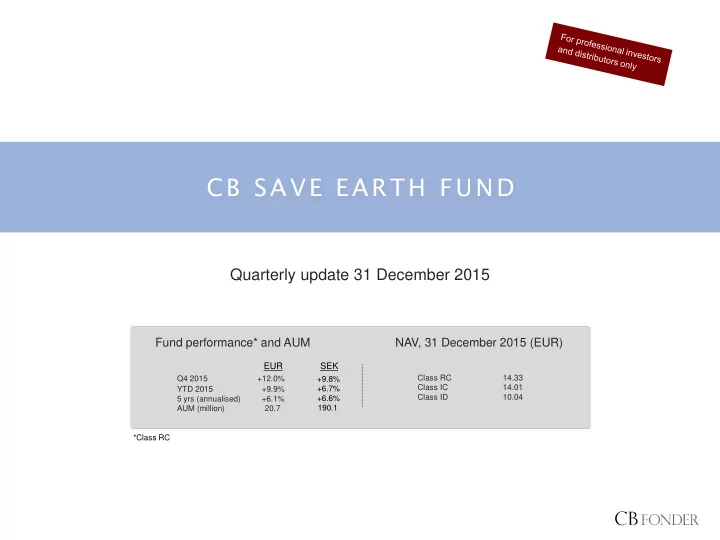
C B S A VE EA R T H F U ND Save Earth Fund CB SAVE EARTH FUND Quarterly update 31 December 2015 Fund performance* and AUM NAV, 31 December 2015 (EUR) EUR SEK Class RC 14.33 Q4 2015 +12.0% +9.8% Class IC 14.01 YTD 2015 +9.9% +6.7%


slide-1
SLIDE 1

Save Earth Fund

C B S A VE EA R T H F U ND

CB SAVE EARTH FUND

Q4 2015 +12.0% YTD 2015 +9.9% 5 yrs (annualised) +6.1% AUM (million) 20.70 Class RC 14.33 Class IC 14.01 Class ID 10.04

Fund performance* and AUM NAV, 31 December 2015 (EUR)

*Class RC

EUR SEK

+9.8% +6.7% +6.6% 190.1.

Quarterly update 31 December 2015

slide-2
SLIDE 2

2

The strategy and the team

C B S A V E E A R T H F U N D

Overview - CB Fonder Overview - CB Save Earth Fund The Team

  • A global environmental fund, three megatrends: renewable

energy, cleantech and water

  • The strategy was launched in 2008
  • Concentrated portfolio and a long-term perspective
  • Benchmark: MSCI World Net
  • Objective: Lower standard deviation than benchmark
  • Objective: Outperform benchmark over 12 months
  • Company founded in 1994
  • Family owned, acting under the supervision of the Swedish

Financial Supervisory Authority

  • Guidelines: active, ethical and long-term
  • An ethical and sustainable framework is applied in the portfolio

management

  • The team is based in Stockholm, Sweden; all fund

administration is performed in Luxembourg

Carl Bernadotte

Portfolio Manager & owner >25 years’ experience Born 1955 Owns shares in CB Save Earth Fund

Marcus Grimfors

Portfolio Manager 7 years’ experience Born 1981 Owns shares in CB Save Earth Fund

Alexander Jansson

Portfolio Manager & CEO 7 years’ experience Born 1983 Owns shares in CB Save Earth Fund

Erik Allenius Somnell

Business Development 3 years’ experience Born 1984 Owns shares in CB Save Earth Fund

slide-3
SLIDE 3

The strategy: Investment case - three mega trends

3

Three mega trends and a global exposure

C B S A V E E A R T H F U N D C B S A V E E A R T H F U N D Water Renewable energy Cleantech

Investment areas

Filtration Distribution Saving/efficiency Wastewater

Investment areas

Wind Solar Hydro Bio Geothermal

Investment areas

Energy storage Infrastructure Energy efficiency Material Recycling & Waste treatment Companies in area

  • Danaher
  • American Waterworks
  • Halma
  • Geberit

Companies in area

  • Vestas Wind
  • SunPower
  • Andritz
  • Novozymes
  • Nibe

Companies in area

  • Tesla
  • Legrand
  • Kingspan
  • Mayr-Melnhof
  • Tomra Systems
slide-4
SLIDE 4

The sector and the fund in media

4

C B S A V E E A R T H F U N D

The Swedish private savings guru, Claes Hemberg, recommended CB Save Earth Fund as a Christmas gift for the

  • children. As did the Swedish online savings magazine, Placera.

(N.B. in Swedish). Placera & Avanza, 11 & 14 Dec 2015 Despite the falling oil and gas prices, renewables had yet another record-breaking year in 2015. Bloomberg, 14 Jan 2016 The climate meeting in Paris, COP21, was widely regarded as a huge success. The Guardian, 14 Dec 2015 The incipient revolution for renewable energy has upended old business models: A Texas utility offers a nighttime special: free electricity. The New York Times, 8 Nov 2015

slide-5
SLIDE 5
  • 2%
  • 1%

0% 1% 2% 3% 4% Sep-15 Oct-15 Nov-15 Dec-15 CB Save Earth Fund RC vs MSCI World Net 95 100 105 110 115 120 Sep-15 Oct-15 Nov-15 Dec-15 CB Save Earth Fund RC MSCI World Net

  • 6%
  • 5%
  • 4%
  • 3%
  • 2%
  • 1%

0% 1% 2% Dec-14 Mar-15 Jun-15 Sep-15 Dec-15 CB Save Earth Fund RC vs MSCI World Net 95 100 105 110 115 120 125 Dec-14 Mar-15 Jun-15 Sep-15 Dec-15 CB Save Earth Fund RC MSCI World Net

Performance: The fund and the index

5

C B S A V E E A R T H F U N D

Source: MSCI, CB Fonder

  • The fund gained +12% in the forth quarter and during the last 12 months the fund has gained +10%.
  • The fund outperformed the benchmark index during the fourth quarter and regained almost all lost ground

from the three first quarters.

The fund and the benchmark index, 1 year (EUR) The fund and the benchmark index, Q4 2015 (EUR)

  • 0.5%

+9.9% +10.4% +12.0% +8.4% +3.3%

slide-6
SLIDE 6

6

25 50 75 100 125 150 175 200 225 Jun-08 Jun-09 Jun-10 Jun-11 Jun-12 Jun-13 Jun-14 Jun-15 Water index (S&P Global Water) MSCI World Net CB Save Earth Fund RC Cleantech index (CTIUS) Renewable energy index (Wilderhill)

The fund and benchmark indices, since fund inception in June 2008 (EUR)

+89.5% +32.7% +100.8%

  • 33.5%

+43.3%

Performance: The fund and the index

6

C B S A V E E A R T H F U N D

  • Renewable energy index (including dividends):

WilderHill New Energy Global Innovation Index

  • Water index (including dividends):

S&P Global Water Index

  • Cleantech index (including dividends):

The Cleantech Index

  • World index (including dividends after tax):

MSCI World

Source: MSCI, S&P, CB Fonder, Reuters, Bloomberg Daily data for the period 9 June 2008 – 31 December 2015

slide-7
SLIDE 7
  • 0.22

0.16 0.38 0.51 0.54 Renewable energy index (Wilderhill) Cleantech index (CTIUSTR) CB Save Earth Fund MSCI World Net Water index (S&P Global Water)

7

Performance: The fund and the index

  • CB Save Earth Fund has returned +4.9% p.a. since inception in 2008; the fund’s return has been higher

than for two of the three sectors it invests in (Water index +9.7% p.a.; Cleantech index +3.8% p.a.; Renewable energy index -5.3% p.a.).

  • The risk in the fund is significantly lower than in each of the three sectors in which it invests, and also lower

than the risk in MSCI World. The fund’s Sharpe ratio – the risk-adjusted return – is 0.38, which is higher than for two of the three sectors the fund invests in.

Source: Bloomberg, Reuters, S&P, CB Fonder Daily data for the period 9 June 2008 – 31 December 2015 (EUR).

C B S A V E E A R T H F U N D

Sharpe, since fund inception (EUR) Risk and return, since fund inception (EUR)

  • 6%
  • 4%
  • 2%

0% 2% 4% 6% 8% 10% 12% 0% 5% 10% 15% 20% 25% 30% Return p.a. Standard Deviation CB Save Earth Fund MSCI World Net Cleantech index (CTIUS) Water index (S&P Global Water) Renewable energy index (Wilderhill)

slide-8
SLIDE 8
  • 6%
  • 4%
  • 2%

0% 2% 4% 6% 8% 0% 5% 10% 15% 20% 25% 30% CB Save Earth Fund Handelsbanken Hållb. Energi DNB Renewable Energy BlackRock New Energy Nordea Klimatfond SAM Sustainable Climate Allianz Global EcoTrends Schroder Gl. Climate Change Parvest Global Env. C C RobecoSAM Sust. Water Fund Pictet - Water CB Save Earth Fund

  • 0.20
  • 0.17
  • 0.09

0.06 0.07 0.13 0.28 0.31 0.36 0.38 0.39 BlackRock New Energy Allianz Global EcoTrends DNB Renewable Energy SAM Sustainable Climate Nordea Klimatfond Handelsbanken Hållb. Energi Schroder Gl. Climate Change Parvest Global Env. C C RobecoSAM Sust. Water Fund CB Save Earth Fund Pictet - Water

8

Risk and return, since fund inception (EUR) Sharpe, since fund inception (EUR)

Performance: The fund and peers

  • CB Save Earth Fund’s objective is to offer investors a low risk alternative within a segment

characterised by high risk. The fund has, since inception in 2008, had a significantly lower risk than peers while delivering a highly competitive return; a combination that results in a high Sharpe ratio.

  • The water sector has been the best performer by far among the three environmental sectors.

Nevertheless, the fund has a competitive Sharpe ratio also compared to the water funds.

Standard deviation Return p.a.

C B S A V E E A R T H F U N D

Source: Bloomberg, CB Fonder Daily data for the period 9 June 2008 – 31 December 2015 (EUR).

slide-9
SLIDE 9

9

The portfolio: Holdings

The 10 largest company exposures, as of 31 December 2015

Source: FactSet, CB Fonder

9

C B S A V E E A R T H F U N D

Exposure to large companies with a long and proven track record i.e. no mayflies. A mixture

  • f

high- yielding utilities and growth companies.

Company Founded/ listed Country Sector Market cap € bn Share of AUM Geberit 1874/1999 Switzerland Water 11 5.0% Vestas Wind 1945/1998 Denmark Renewables 14 3.8% Nibe 1949/1997 Sweden Renewables 3 3.6% Andritz 1852/2001 Austria Renewables 5 3.6% Aalberts 1975/1987 Netherlands Water 3 3.6% Danaher 1969/1979 USA Water 56 3.5% Halma 1894/1972 UK Water 4 3.2% Idex Corp 1988/1989 USA Water 5 2.9% SunPower Corp 1985/2005 USA Renewables 3 2.8% Novozymes 2000/2000 Denmark Cleantech 13 2.7% Total/Average 12 34.6%

slide-10
SLIDE 10

0% 20% 40% 60% 80% 100% Asia Europe North America RoW Cash*

10

The portfolio: Historical allocation, share of AUM

Sector allocation, 36 months Geographical allocation, 36 months

Source: CB Fonder *Including cash in underlying funds

C B S A V E E A R T H F U N D

As of 31 December 2015 As of 31 December 2015 0% 20%

40% 60% 80% 100% Renewable energy Cleantech Water Cash* 13% 35% 45% 7% Renewable energy Cleantech Water Cash*

11% 54% 28% 0% 7% Asia Europe North America RoW Cash*

slide-11
SLIDE 11

11

Case: Geberit

Source: Geberit, Berenberg, CB Fonder

11

C B S A V E E A R T H F U N D

Market leader in sanitary technology and plumbing

  • Market leader in sanitary technology and plumbing in

Europe (that accounts for >90% of sales). Known in the Nordics under the brands IDO and Ifö.

  • Organic growth of 4-6% p.a. since 2010 despite a weak

European construction market.

  • High quality: ROE and ROCE >25%; profit margin ~20%.

Organic growth, YoY

Source: Berenberg, CB Fonder

Geberit, organic growth

Sales by market/region

1. Germany (36.5%) 2. Switzerland (12.9%) 3. Benelux (7.7%) 4. Italy (7.4%) 5. Central/Eastern Europe (7.0%) 6. Austria (6.4%) 7. Nordics (4.8%) 8. France (4.2%) 9. UK/Ireland (3.6%) 10. Iberian peninsula (0.7%) 11. America (3.5%) 12. Far East/Pacific (3.2%) 13. Middle East/Africa (2.1%) Medium term target: +4-6 % Average since 2000: +5.2 %

Source: Geberit, CB Fonder Index 2009 = 100

Construction output and Geberit sales in Europe 2010-2014

Geberit sales currency-adjusted in Europe Total building construction Total building renovation Total new building

Source: Geberit, CB Fonder

slide-12
SLIDE 12

12

Case: Vestas

Source: Vestas, Kepler Cheuvreux, Nordea Markets, CB Fonder

12

C B S A V E E A R T H F U N D

Global market leader in wind turbines

  • Global market leader in wind turbines.
  • New management and restructuring has got the

company back on its feet.

  • A good example of a maturing sector: this year 27%
  • f EBIT is expected to be generated from services

and other recurring business.

  • Since 2014 the company pays a dividend – a sign
  • f maturity.

Source: Vestas, CB Fonder

Services growing – a clear sign of a maturing sector Market shares 2014 (onshore and offshore), %

Vestas 12,3% Siemens 9,9% GE 9,1% Goldwind 9,0% Enercon 7,8% Suzlon Group 5,8% United Power 5,1% Gamesa 4,7% Mingyang 4,4% Envision 3,8% Other 28,1% Source: Nordea Markets, Kepler Cheuvreux

EBIT-split 2015E High margins in service Installed wind capacity – cumulative and YoY More sustainable growth rates – a sign of maturity

Source: Kepler Cheuvreux

slide-13
SLIDE 13

13

Case: Novozymes

Source: Novozymes, Berenberg, Kepler Cheuvreux, CB Fonder

13

C B S A V E E A R T H F U N D

Global market leader in enzymes

  • Global market leader with nearly 50% of the enzyme market.
  • Large focus on sustainability, e.g. through reduction of energy

and water consumption – but mainly through their products, which in 2014 are estimated to have reduced their customers’ carbon emissions at a level equivalent to the emissions from 25 million cars.

  • An ability to grow independent of the macroeconomic

environment: average organic growth has been 7% since 2008.

  • High quality: ROE and ROCE >20%; profit margin ~20%.

Global market leader in industrial enzymes

Source: Kepler Cheuvreux

Resource consumption ”decoupled” from economic growth – large focus on sustainability

Source: Novozymes

High organic growth

Novozymes, organic growth

Source: Berenberg, CB Fonder

slide-14
SLIDE 14

0,2 0,4 0,6 0,8 1,0 1,2 Dec-12 Jun-13 Dec-13 Jun-14 Dec-14 Jun-15 Dec-15 0% 5% 10% 15% 20% 25% 30% Dec-12 Jun-13 Dec-13 Jun-14 Dec-14 Jun-15 Dec-15 MSCI World CB Save Earth Fund RC

14

Risk profile: Standard deviation and beta

Source: MSCI, CB Fonder *36 months data on a 60-day rolling basis (EUR).

Standard deviation* Beta against MSCI World*

16.9% 11.2% +0.44

C B S A V E E A R T H F U N D

The fund’s beta is consistently below 1 The fund’s standard deviation is consistently lower/in line with that

  • f

the benchmark index, MSCI World. This becomes particularly evident when the risk in the market is rising.

slide-15
SLIDE 15

50 75 100 125 150 175 200 225 MSCI World Net Source: MSCI, CB Fonder *Data since fund inception in June 2008

The fund compared to MSCI World Net during the largest drawdowns (EUR)

The fund has consistently performed well compared to MSCI World during drawdowns

  • Our objective is that the fund shall offer a low-risk alternative within a segment characterised by high risk; we

believe that the fund’s performance in drawdowns proves that.

Risk profile: The fund’s ability to preserve capital

15

1 2 3 4 5 6

C B S A V E E A R T H F U N D

The fund has

  • utperformed the

benchmark also during the recent drawdown: +2.1%

slide-16
SLIDE 16
  • MSCI World is practically never the best performer; every year (with narrow exceptions in 2011 and 2014) an environmental

sector has performed better, why the prospects for active allocation are good.

  • Renewable energy, as a high-beta sector, has had very volatile returns: 2007 and 2013 were stellar years for the sector, while

2008 and 2010-2012 were lousy. In stark contrast stands the water sector which over the last 10 years has performed better or in line with the world index, which is why we argue that the sector provides a good base in our portfolio, whereas renewable energy (and cleantech) serves as satellites/complements.

  • The difference in returns between the sectors has decreased over time and converged with the returns for the world index – we

see this as a sign of maturity for the environmental sector.

Source: Reuters, Bloomberg, S&P, MSCI, CB Fonder. Data per 2015-12-31

16

Analysis: A more mature sector

Each sector’s excess return against the MSCI World Net index, per calendar year

The renewable energy and cleantech sectors have come to perform more in line with the world index – a sign of maturity.

C B S A V E E A R T H F U N D

Returns have differed significantly between the sectors – but variations have decreased continuously

slide-17
SLIDE 17

60 70 80 90 100 110 120 130 Jun-14 Sep-14 Dec-14 Mar-15 Jun-15 Sep-15 Dec-15 CB Save Earth Fund RC World Energy

17

  • Since the peak in June 2014, the oil price has fallen 65%, in USD. Historically, sharp declines in the oil price have always

been followed by significant underperformance in the environmental sector in general and in the renewable energy sector in particular – but this time is somewhat different.

  • The table shows the four largest drawdowns in the oil price over the last decade and the relative performance of the

environmental sectors against MSCI World Net during these periods. During each drawdown, the sector has underperformed against the world index, but this time the renewable energy sector has seen its best relative performance, despite the oil price drawdown being the second largest. We see that as a sign of a more mature industry less affected by external shocks. The water sector has performed best of the three sectors during each of the four drawdowns.

  • The graph shows the return for CB Save Earth Fund and the MSCI World Energy index since the oil price peak in June 2014.

The fund has performed substantially better than the index (oil/gas companies) and can be seen as a good hedge against weak performance from fossil fuel related companies (caused by low oil price, stranded assets etc.).

What are the implications of a falling oil price on the environmental sector?

Analysis: A more mature sector

The table shows the four largest drawdowns in the oil price (in USD) over the last decade, and the performance of each environmental sector relative to the MSCI World Net index during the same period.

Source: MSCI, CB Fonder

The fund has offered a good hedge against the falling oil price (EUR)

  • 26%

+13%

C B S A V E E A R T H F U N D

Source: MSCI, S&P, Reuters, Bloomberg, CB Fonder

Oil price Renewables Cleantech Water

  • 1. 2008-07-03 - 2008-12-19
  • 77%
  • 30%
  • 16%

0%

  • 2. 2011-04-29 - 2011-10-04
  • 34%
  • 30%
  • 13%

4%

  • 3. 2012-02-24 - 2012-06-28
  • 29%
  • 17%
  • 9%

3%

  • 4. 2014-06-20 - 2015-12-31
  • 65%
  • 13%
  • 8%
  • 4%

Relative performance vs. MSCI World

Period

slide-18
SLIDE 18

18

Analysis: A more mature sector

C B S A V E E A R T H F U N D

A more consolidated market – market shares for the 5 largest Chinese module makers 2009-2015E …leads to better margins for the producers, despite falling prices on solar panels.

  • The five largest Chinese producers of solar panels is expected to make up almost 40% of the world market in

2015; the entry barriers rise due to economies of scale and the producers become price makers (from being price takers).

  • A more mature industry creates conditions for profitable growth: the gross margin was 2% for the module makers

in Q4 2012; in Q2 2015 it had risen to more than 20%.

Source: Bernstein Research, CB Fonder Source: Bernstein Research, CB Fonder Source: Bernstein Research, CB Fonder

slide-19
SLIDE 19

19

Analysis: Adoption curves are not linear, they are exponential

C B S A V E E A R T H F U N D

Source: Bernstein Research, CB Fonder

The price of solar energy (real, in $/MMBTU) has fallen sharply during the last years

  • The

figure illustrates the price development of the five different types of energy: Natural gas ("Henry Hub"), coal ("US Bitumous Coal"),

  • il

("Brent"), liquefied natural gas ("LNG") and solar energy ("solar").

  • The price of solar energy has in recent

years fallen sharply and is now a competitive alternative to

  • ther

more established forms of energy.

  • The

energy market is becoming technology-based, which implies that higher demand gives lower prices (comp. Moore’s law). A new world order...

  • Most adoption curves are so-called S-

curves, which implies exponential rather than linear growth. When the new technology reaches 10% market share it’s game

  • ver:

the new technology substitutes the old one.

  • Solar and wind currently accounts for a

small fraction of the global energy market (1.6%), but the proportion has increased 8x in 10 years. What is interesting is that solar and wind today represents more than 20% of the new capacity installed globally. Renewable energy is still marginal, but it begins to have a significant impact on the margin.

Solar and wind, percentage of the global energy market Adoption curves for colour TVs

% Source: Technology Futures, Inc Source: Bernstein Research, CB Fonder Source: Bernstein Research, CB Fonder
slide-20
SLIDE 20

20

Analysis: Adoption curves are not linear, they are exponential

C B S A V E E A R T H F U N D

Source: Bernstein Research, CB Fonder Source: IEA, EIA, Citi Research

Eras of energy production: history speaks for substitution

  • Historically, new technologies have substituted old; old technologies (fossil energy) is becoming more expensive

and less accessible, while new technologies become cheaper and more easily available - hence a “waterfall development".

  • The forecast is "blind": new technologies are almost impossible to foresee; just as we know very little today about

the technologies of coming decades, as little did we know about solar energy a couple of decades ago.

slide-21
SLIDE 21

21

What can go wrong? A lot, as always…

C B S A V E E A R T H F U N D

Small Medium Big Huge

Impact

Low Medium High

Probability Downside risks

Unknown unknowns (black swans etc.) Hard landing in Brazil, China and Russia Brexit A strong USD and/or prematurely interest rate hikes (compare 1937) suppresses the U.S economy. Geopolitics: Russia, Japan/China, North Korea, IS etc. Grexit

1 2 3 4 6 7 8 9 5

Continued low electricity and oil prices Rising interest rates

Risks that may pose a bigger threat to the environmental sector

The expectations in the market cannot be met; low oil price, a weak euro and expansionary fiscal and monetary policy is not enough – what then?

1 2 3 5 6 7 4 8 9

slide-22
SLIDE 22
  • 0.20
  • 0.17
  • 0.09

0.06 0.07 0.13 0.28 0.31 0.36 0.38 0.39 BlackRock New Energy Allianz Global EcoTrends DNB Renewable Energy SAM Sustainable Climate Nordea Klimatfond Handelsbanken Hållb. Energi Schroder Gl. Climate Change Parvest Global Env. C C RobecoSAM Sust. Water Fund CB Save Earth Fund Pictet - Water

22

The investment case for CB Save Earth Fund

Competitive returns (Sharpe)

Source: Bloomberg, CB Fonder Daily data for the period 9 June 2008 – 31 December 2015 (EUR).

C B S A V E E A R T H F U N D

  • A green and global exposure: long-term structural growth.
  • Competitive returns, a consistently lower risk as well as a

better ability to preserve capital in drawdowns compared to both peers and benchmark, MSCI World Net.

  • An ethical and sustainable framework; no exposure to

fossil energy (stranded assets).

  • The portfolio holdings consists of high-yielding utilities and

growth companies.

  • The distributing share class (ID) pays a dividend amounting

to 6% of the NAV each year (ex date: 31 October).

slide-23
SLIDE 23

23

Share classes

CB Save Earth Fund, RC

  • Management fee:1.0%
  • Performance fee: No
  • Dividend: No
  • ISIN: LU0354788688

CB Save Earth Fund, IC

  • Management fee: 0.5%
  • Performance fee: 20% of return > MSCI World Net, with collective, eternal and relative

High-Water Mark; the share class is 9% below HWM as of 31 December 2015

  • Dividend: No
  • ISIN: LU0354788506

CB Save Earth Fund, ID

  • Management fee: 0.5%
  • Performance fee: 20% of return > MSCI World Net, with collective, eternal and relative

High-Water Mark; the share class is 8% below HWM as of 31 December 2015

  • Dividend: Yes, 6% of NAV as of 31 October each year
  • ISIN: LU1053083884

C B S A V E E A R T H F U N D

slide-24
SLIDE 24
  • Fund name:

CB Save Earth Fund

  • Manager:

CB Asset Management AB

  • Domicile:

Luxembourg

  • Mgmt company / Custodian:

SEB Fund Services / SEB SA, Luxembourg

  • Auditor:

PricewaterhouseCoopers S.ár.I.

  • UCITS:

Yes

  • Currency:

EUR

  • Liquidity/NAV:

Daily/Daily

  • Subscription/redemption fee

RC: No/No, IC: No/No, ID: No/Yes*

  • Fund launch:

9 June 2008

  • Minimum investment:

RC: None, IC/ID: €500 000

  • ISIN/Bloomberg:

RC: LU0354788688 / CBSVERC LX IC: LU0354788506 / CBSICAE LX ID: LU1053083884 / CBIDLUX LX

*Max 1%, dependent on client relationship

Fund facts

24

C B S A V E E A R T H F U N D

slide-25
SLIDE 25

25

Disclaimer

Issued by CB Asset Management AB. It is intended solely to provide certain information (the “Information”) about CB Save Earth Fund (the “Fund”). CB Asset Management AB has taken all reasonable care to ensure correctness and accuracy of the Information published in that Article, at the time of its publication. Share prices and values may increase or decrease and investments are always associated with a risk of

  • loss. Past performance is never a guarantee for future performance. The information provided in this report

is what we to our knowledge believe are correct based on the information made available to us for the purpose of this document. No representation or warranty of any nature, express or implied, is made about its completeness, accuracy, reliability or suitability. Nothing contained in this document shall be deemed to constitute a financial, legal, tax or other advice of any kind and no information in this document shall constitute or deem to constitute a solicitation or an offer to purchase, or invest in, any financial products which are referred to on it. The offering of the shares of the Fund is restricted in many jurisdictions and must not be marketed or

  • ffered in or to residents of any such jurisdictions unless such marketing or offering is made in compliance

with applicable exemptions for the private placement of collective investment schemes and other applicable jurisdictional rules and regulations. It is the responsibility of every recipient to inform themselves and observe applicable regulations and restrictions in their jurisdiction. Potential investors in the Fund should inform themselves of the applicable laws and regulations of the countries of their citizenship, residence or domicile and which might be relevant to the subscription, purchase, holding, conversion and redemption of shares in the Funds. Should you wish to obtain further information on the Fund, please consult our website, where the Prospectus, the latest available annual and semi-annual reports, and the Key Investor Information Document (KIID) of the Fund are provided.

C B S A V E E A R T H F U N D

slide-26
SLIDE 26