CB Save Earth Fund Quarterly update 30 June 2016 Placera (Avanza) - - PowerPoint PPT Presentation

cb save earth fund
SMART_READER_LITE
LIVE PREVIEW

CB Save Earth Fund Quarterly update 30 June 2016 Placera (Avanza) - - PowerPoint PPT Presentation

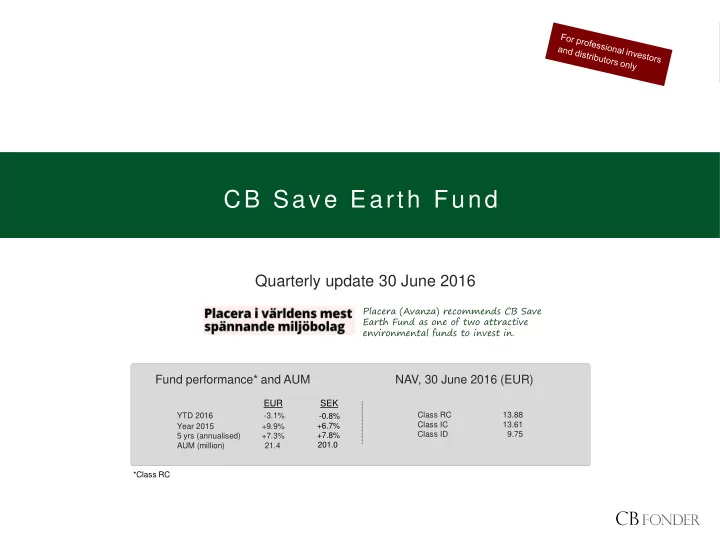
CB Save Earth Fund Quarterly update 30 June 2016 Placera (Avanza) recommends CB Save Earth Fund as one of two attractive environmental funds to invest in. Fund performance* and AUM NAV, 30 June 2016 (EUR) EUR SEK Class RC 13.88 YTD 2016


slide-1
SLIDE 1

Quarterly update 30 June 2016

CB Save Earth Fund

YTD 2016

  • 3.1%

Year 2015 +9.9% 5 yrs (annualised) +7.3% AUM (million) 21.40 Class RC 13.88 Class IC 13.61 Class ID 9.75

Fund performance* and AUM NAV, 30 June 2016 (EUR)

*Class RC

EUR SEK

  • 0.8%

+6.7% +7.8% 201.0.

Placera (Avanza) recommends CB Save Earth Fund as one of two attractive environmental funds to invest in.

slide-2
SLIDE 2

The strategy and the team

2

C B S A V E E A R T H F U N D

Overview - CB Fonder Overview - CB Save Earth Fund

  • A global environmental fund, three megatrends: renewable

energy, cleantech and water

  • The strategy was launched in 2008
  • Concentrated portfolio and a long-term perspective
  • Benchmark: MSCI World Net
  • Objectives:
  • Lower standard deviation than benchmark
  • Outperform benchmark over 12 months
  • Company founded in 1994
  • Family owned, acting under the supervision of the Swedish

Financial Supervisory Authority

  • Guidelines: active, ethical and long-term
  • An ethical and sustainable framework is applied in the portfolio

management

  • The team is based in Stockholm, Sweden. All fund

administration is performed in Luxembourg

The team

Carl Bernadotte, Portfolio manager & owner

>30 years’ experience Born 1955 Owns shares in CB Save Earth Fund

Marcus Grimfors, Portfolio manager

8 years’ experience Born 1981 Owns shares in CB Save Earth Fund

Alexander Jansson, Portfolio manager & CEO

8 years’ experience Born 1983 Owns shares in CB Save Earth Fund

Viktor Sonebäck, Intern

KTH 2012-2017 Born 1993

Emil Brismar, Intern

KTH 2014-2019 Born 1994

slide-3
SLIDE 3

The strategy: Investment case - three mega trends

3

C B S A V E E A R T H F U N D C B S A V E E A R T H F U N D

Three mega trends and a global exposure

Water Renewable energy Cleantech

Investment areas

Filtration Distribution Saving/efficiency Wastewater

Investment areas

Wind Solar Hydro Bio Geothermal

Investment areas

Energy storage Infrastructure Energy efficiency Material Recycling & Waste treatment Companies in area

  • Danaher
  • American Waterworks
  • Halma
  • Geberit

Companies in area

  • Vestas Wind
  • SunPower
  • Andritz
  • Novozymes
  • Nibe

Companies in area

  • Tesla
  • Legrand
  • Kingspan
  • Mayr-Melnhof
  • Tomra Systems
slide-4
SLIDE 4

The sector and the fund in media

4

C B S A V E E A R T H F U N D

Pär Ståhl, fund expert at Placera/Avanza, writes about long term savings for children and occupational pension where CB Save Earth Fund can be found as one of 8 attractive funds in the portfolio for the children, and as one of 9 funds in the

  • ccupational pension portfolio. (N.B. in Swedish).

Placera.nu, 6 & 17 May 2016 CEO & fund manager Alexander Jansson in an interview with the Swedish business magazine VA Finans about investments in the environmental sector and why solar energy will beat wind energy. (N.B. in Swedish). Veckans Affärer Finans, 8 July 2016 The Swedish business magazine Veckans Affärer highlights the need for clean water and looks at the sector from an investment

  • perspective. CB Fonder’s CEO and fund manager Alexander

Jansson is invited to comment on the story. (N.B. in Swedish). Veckans Affärer, 6 May 2016

slide-5
SLIDE 5
  • 4%
  • 3%
  • 2%
  • 1%

0% 1% 2% 3% 4% Dec-15 Feb-16 Apr-16 Jun-16 CB Save Earth Fund RC vs MSCI World Net 80 85 90 95 100 105 Dec-15 Feb-16 Apr-16 Jun-16 CB Save Earth Fund RC (EUR) MSCI World Net (EUR)

  • 4%
  • 3%
  • 2%
  • 1%

0% 1% 2% 3% 4% 5% 6% Jun-15 Aug-15 Oct-15 Dec-15 Feb-16 Apr-16 Jun-16 CB Save Earth Fund RC vs MSCI World Net 80 85 90 95 100 105 110 Jun-15 Aug-15 Oct-15 Dec-15 Feb-16 Apr-16 Jun-16 CB Save Earth Fund RC (EUR) MSCI World Net (EUR)

Performance: The fund and the index

5

C B S A V E E A R T H F U N D

  • The fund has returned -3% during the last 12 months, which is in line with MSCI World.
  • The last six months the fund has returned -3%, compared to -2% for the benchmark.

The fund and the benchmark index, 1 year (EUR) The fund and the benchmark index, 6 months (EUR)

  • 0.2%
  • 2.7%
  • 2.5%
  • 3.1%
  • 1.6%
  • 1.6%

Source: MSCI, CB Fonder Data as of 2016-06-30

slide-6
SLIDE 6

25 50 75 100 125 150 175 200 225 Jun-08 Jun-09 Jun-10 Jun-11 Jun-12 Jun-13 Jun-14 Jun-15 Jun-16 Water index (S&P Global Water) MSCI World Net CB Save Earth Fund RC Cleantech index (CTIUS) Renewable energy index (Wilderhill)

Performance: The fund and indices

6

C B S A V E E A R T H F U N D

The fund and benchmark indices, since fund inception in June 2008 (EUR)

+86.5% +33.4% +117.0%

  • 39.5%

+38.8%

  • Renewable energy index (including dividends):

WilderHill New Energy Global Innovation Index

  • Water index (including dividends):

S&P Global Water Index

  • Cleantech index (including dividends):

The Cleantech Index

  • World index (including dividends after tax):

MSCI World

Source: MSCI, S&P, CB Fonder, Reuters, Bloomberg Daily data for the period 9 June 2008 – 30 June 2016

slide-7
SLIDE 7
  • 0.25

0.16 0.33 0.46 0.57 Renewable energy index (Wilderhill) Cleantech index (CTIUSTR) CB Save Earth Fund MSCI World Net Water index (S&P Global Water)

  • 8%
  • 6%
  • 4%
  • 2%

0% 2% 4% 6% 8% 10% 12% 0% 5% 10% 15% 20% 25% 30% Return p.a. Standard Deviation CB Save Earth Fund MSCI World Net Cleantech index (CTIUS) Water index (S&P Global Water) Renewable energy index (Wilderhill)

Performance: The fund and indices

7

C B S A V E E A R T H F U N D

  • CB Save Earth Fund has returned +4.2% p.a. since inception in 2008; the fund’s return has been higher

than for two of the three sectors it invests in (Water index +10.1% p.a.; Cleantech index +3.6% p.a.; Renewable energy index -6.1% p.a.).

  • The risk in the fund is significantly lower than in each of the three sectors in which it invests, and also lower

than the risk in MSCI World. The fund’s Sharpe ratio – the risk-adjusted return – is 0.33, which is higher than for two of the three sectors the fund invests in.

Sharpe, since fund inception (EUR) Risk and return, since fund inception (EUR)

Source: MSCI, S&P, CB Fonder, Reuters, Bloomberg Daily data for the period 9 June 2008 – 30 June 2016

slide-8
SLIDE 8
  • 0.21
  • 0.20
  • 0.15

0.03 0.05 0.09 0.23 0.30 0.33 0.38 0.39 BlackRock New Energy Allianz Global EcoTrends DNB Renewable Energy SAM Sustainable Climate Nordea Klimatfond Handelsbanken Hållb. Energi Schroder Gl. Climate Change Parvest Global Env. C C CB Save Earth Fund RobecoSAM Sust. Water Fund Pictet - Water

  • 6%
  • 4%
  • 2%

0% 2% 4% 6% 8% 0% 5% 10% 15% 20% 25% 30% CB Save Earth Fund Handelsbanken Hållb. Energi DNB Renewable Energy BlackRock New Energy Nordea Klimatfond SAM Sustainable Climate Allianz Global EcoTrends Schroder Gl. Climate Change Parvest Global Env. C C RobecoSAM Sust. Water Fund Pictet - Water CB Save Earth Fund

Performance: The fund and peers

8

C B S A V E E A R T H F U N D

Risk and return, since fund inception (EUR) Sharpe, since fund inception (EUR)

  • CB Save Earth Fund’s objective is to offer investors a low risk alternative within a segment

characterised by high risk. The fund has, since inception in 2008, had a significantly lower risk than peers while delivering a highly competitive return; a combination that results in a high Sharpe ratio.

  • The water sector has by far been the best performer among the three environmental sectors.

Nevertheless, the fund has a competitive Sharpe ratio also compared to the water funds.

Standard deviation Return p.a. Source: Bloomberg, CB Fonder Daily data for the period 9 June 2008 – 30 June 2016 (EUR).

slide-9
SLIDE 9
  • 0,6%
  • 0,4%
  • 0,2%

0,0% 0,2% 0,4% 0,6%

The Portfolio: Contributors and detractors

9

*Average values in Q2 2016. Source: Bloomberg, CB Fonder

Company Contr./Detr.%

  • Avg. weight*, % Performance, %

American Water Works Geberit Danaher Sunpower Andritz First Solar +0.54 +0.34 +0.27

  • 0.32
  • 0.35
  • 0.55

+26.3 +5.7 +9.3

  • 28.9
  • 9.4
  • 27.4

2.2 5.9 2.9 0.9 3.6 1.5

Top three quarterly contributors and detractors, Q2 2016 (EUR)

  • The American water utility American Water Works – whose revenue stems from delivering water to their 15 million US customers – benefitted from

two characteristics that define utilities: a business model independent of the business cycle and a high and stable dividend. The share gained 26 % during Q2, in EUR.

  • Swiss Geberit – the fund’s largest holding – is the market leader in sanitary technology and plumbing in Europe. Since the acquisition of Sanitec, the

company owns well-known brands such as IDO and lfö. The company is exposed towards a weak construction market in Europe but thanks to a high market share and exposure towards the “better” markets (Germany and Switzerland add up to 50 % of the sales) they have delivered an organic growth of 4-6 % the latest years, which is in line with the company’s target. The share rose 6 % during Q2, in EUR.

  • Danaher – an American high quality industrial company with global exposure – operates within the water sector and is the market leader in tests and

measurements with their brand Hach Lange. Through the brands Chemtreat and Trojan technologies Danaher also operates within water treatment. The company objective is organic growth of “low to mid single digit” through the cycle, which is possible due to their diverse profile and as market leaders in the respective end market. The company offers a high quality exposure towards the structural growth in the water sector. The share gained 9 % during Q2, in EUR.

  • First Solar and Sunpower – both American companies with a market leading position in the global solar panel market – underperformed due to

continued overcapacity within the sector and sharply declining prices on solar panels (which is positive for the development of the sector but in the short term painful for the companies) especially driven by Chinese companies. First Solar declined 27 % during Q2 and Sunpower 29 %, in EUR.

  • The Austrian engineering company Andritz manufactures, amongst other things, water turbines and benefits from an expansion of hydro power in

emerging markets and renovations/renewals of current installations in developed markets (eg. Sweden). Andritz also manufactures separators for wastewater treatment and biofuel. The company has a leading position within all of their end markets. The share declined 9 % during Q2, in EUR.

C B S A V E E A R T H F U N D

slide-10
SLIDE 10

9% 8% 14% 27% 13% 14% 13% 8% 4% 6% 5%

  • 3%

4% 1%

  • 5%

0% 5% 10% 15% 20% 25% 30% 2011 2012 2013 2014 2015 Average 11-15 2016E CB Save Earth Fund MSCI World 8% 9% 6% 6% 6% 7% 6% 7% 3% 2% 1%

  • 3%

2% 0%

  • 4%
  • 2%

0% 2% 4% 6% 8% 10% 2011 2012 2013 2014 2015 Average 11-15 2016E CB Save Earth Fund MSCI World

The Portfolio: Holdings

10

C B S A V E E A R T H F U N D

The 20 largest company exposures, as of 30 June 2016

Source: Bloomberg, Deutsche Bank, CB Fonder

Revenue growth, the portfolio and index EPS-growth, the portfolio and index

Exposure to large companies with a long and proven track record. Concentrated portfolio: the 20 largest holdings make up 48% of AUM. Structural growth – consistently higher growth than index.

Company Country Sector Market cap € bn Share of AUM

Geberit Sw itzerland Water 12.2 5.8% Danaher Corp USA Water 50.0 3.4% Andritz Austria Renew ables 4.4 3.3% Xylem Inc USA Water 7.2 3.2% Pentair Ireland Water 9.4 2.8% Idex Corp USA Water 5.5 2.7% Vestas Wind Denmark Renew ables 13.0 2.6% Halma Plc UK Water 4.4 2.4% Aalberts Industries Netherlands Water 2.9 2.4% American Water Works USA Water 13.6 2.4% Novozymes Denmark Cleantech 13.4 2.2% Nibe Sw eden Renew ables 3.3 2.2% Legrand France Cleantech 12.4 2.0% Spirax Sarco UK Cleantech 3.2 2.0% SGS SA Sw itzerland Cleantech 15.9 1.9% A.O. Smith USA Water 6.8 1.6% First Solar Inc USA Renew ables 4.4 1.4% Tomra Systems Norw ay Cleantech 1.4 1.3% Melexis Belgium Cleantech 2.2 1.2% Continental USA Cleantech 34.0 1.2%

Median/Total 7.0 48.0%

slide-11
SLIDE 11

The Portfolio: Historical allocation, share of AUM

11

C B S A V E E A R T H F U N D

Sector allocation, 36 months Geographic allocation, 36 months

Source: Bloomberg, CB Fonder *Including cash in underlying funds As of 30 June 2016 As of 30 June 2016 0% 20% 40% 60% 80% 100% Asia (10%) Europe (52%) North America (31%) RoW (1%) Cash* (5%) 0% 20% 40% 60% 80% 100% Renewable energy (11%) Cleantech (36%) Water (49%) Cash* (5%) Industrials (51%) IT (12%) Utilities (11%) Health Care (6%) Materials (5%) Other (8%) Cash* (5%)

USA (30%) Switzerland (9%) UK (8%) Germany (6%) France (5%) Denmark (5%) Austria (4%) Netherlands (4%) Ireland (3%) Belgium (3%) Other (17%) Cash* (5%)

slide-12
SLIDE 12

Case: Geberit

12

C B S A V E E A R T H F U N D

Source: Geberit, Berenberg, CB Fonder

Market leader in sanitary technology and plumbing

  • Market leader in sanitary technology and plumbing in

Europe (that accounts for >90% of sales). Known in the Nordics under the brands IDO and Ifö.

  • Organic growth of 4-6% p.a. since 2010 despite a weak

European construction market.

  • High quality: ROE and ROCE >25%; profit margin ~20%.

Organic growth, YoY

Source: Berenberg, CB Fonder

Geberit, organic growth

Sales by market/region

1. Germany (36.5%) 2. Switzerland (12.9%) 3. Benelux (7.7%) 4. Italy (7.4%) 5. Central/Eastern Europe (7.0%) 6. Austria (6.4%) 7. Nordics (4.8%) 8. France (4.2%) 9. UK/Ireland (3.6%) 10. Iberian peninsula (0.7%) 11. America (3.5%) 12. Far East/Pacific (3.2%) 13. Middle East/Africa (2.1%) Medium term target: +4-6 % Average since 2000: +5.2 %

Source: Geberit, CB Fonder Index 2009 = 100

Construction output and Geberit sales in Europe 2010-2014

Geberit sales currency-adjusted in Europe Total building construction Total building renovation Total new building

Source: Geberit, CB Fonder

slide-13
SLIDE 13

Goldwind 12.8% Vestas 12.0% GE 9.2% Siemens 7.7% Gamesa 5.5% Enercon 5.1% United Power 4.7% Ming Yang 3.8% Envision 3.5% Haizhuang 3.4% Other 32.3%

Case: Vestas

13

C B S A V E E A R T H F U N D

Source: Navigant Research, Vestas, Kepler Cheuvreux, Nordea Markets, CB Fonder

Market leading position in wind turbines

Source: Navigant Research, CB Fonder

Services growing – a clear sign of a maturing sector Market shares 2015 (onshore and offshore), %

Source: Nordea Markets, Kepler Cheuvreux

EBIT-split 2015 High margins in service Installed wind capacity – cumulative and YoY More sustainable growth rates – a sign of maturity

Source: Kepler Cheuvreux

  • Market leading position in wind turbines.
  • New management and restructuring has got the

company back on its feet.

  • A good example of a maturing sector: this year

27% of EBIT is expected to be generated from services and other recurring business.

  • Since 2014 the company pays a dividend – a sign
  • f maturity.
slide-14
SLIDE 14

14

Case: Novozymes

C B S A V E E A R T H F U N D

Source: Novozymes, Berenberg, Kepler Cheuvreux, CB Fonder

Global market leader in enzymes

  • Global market leader with nearly 50% of the enzyme market.
  • Large focus on sustainability, e.g. through reduction of energy

and water consumption but mainly through their products, which in 2014 are estimated to have reduced their customers’ carbon emissions at a level equivalent to the emissions from 25 million cars.

  • An ability to grow independent of the macroeconomic

environment: average organic growth has been 7% since 2008.

  • High quality: ROE and ROCE >20%; profit margin ~20%.

Global market leader in industrial enzymes

Source: Kepler Cheuvreux

Resource consumption ”decoupled” from economic growth – large focus on sustainability

Source: Novozymes

High organic growth

Novozymes, organic growth

Source: Berenberg, CB Fonder

slide-15
SLIDE 15

16% 13% 13% 15% 19% 15% 15% 19% 5% 10% 15% 20% 1 year 3 year 5 year Inception Stök MSCI World Net CB Save Earth Fund 0.74 0.70 0.72 0.68 0.1 0.2 0.3 0.4 0.5 0.6 0.7 0.8 1 year 3 year 5 year Inception Stök CB Save Earth Fund 0,0 0,2 0,4 0,6 0,8 1,0 1,2 Jun-13 Sep-13 Dec-13 Mar-14 Jun-14 Sep-14 Dec-14 Mar-15 Jun-15 Sep-15 Dec-15 Mar-16 0% 5% 10% 15% 20% 25% 30% Jun-13 Sep-13 Dec-13 Mar-14 Jun-14 Sep-14 Dec-14 Mar-15 Jun-15 Sep-15 Dec-15 Mar-16

CB Save Earth Fund RC MSCI World

Risk profile: Standard deviation and beta

15

C B S A V E E A R T H F U N D

Source: MSCI, CB Fonder *Weekly data (EUR)

Standard deviation – consistently lower than index*

Standard deviation on a 12-week rolling basis, 3 years

Beta against MSCI World Net – consistently <1*

Beta on a 12-week rolling basis, 3 years Standard deviation, 1-8 years Beta, 1-8 years

slide-16
SLIDE 16

50 75 100 125 150 175 200 225 MSCI World Net

Risk profile: The fund’s ability to preserve capital

16

C B S A V E E A R T H F U N D

Source: MSCI, CB Fonder *Data since fund inception in June 2008

The fund compared to MSCI World Net during the largest drawdowns (EUR)

The fund has consistently performed well compared to MSCI World during drawdowns

  • Our objective is that the fund shall offer a low-risk alternative within a segment characterised by high risk; we

believe that the fund’s performance in drawdowns proves that.

1 2 3 4 5 6

The fund has

  • utperformed the

benchmark also during the recent drawdown: +3.4%

slide-17
SLIDE 17
  • 40%
  • 20%

0% 20% 40% 60% 80% 100% 120% Jun-01 Jun-03 Jun-05 Jun-07 Jun-09 Jun-11 Jun-13 Jun-15

MSCI Sweden vs MSCI World Net

  • 50%

0% 50% 100% 150% 200% 250% Jun-01 Jun-03 Jun-05 Jun-07 Jun-09 Jun-11 Jun-13 Jun-15

MSCI EM vs MSCI World Net

Analysis: Allocation – World versus EM and Sweden

17

  • MSCI

Sweden has been an great market for many years and has

  • utperformed

the MSCI World Net index.

  • Part of the explanation is to be found in

the many and successful exporting companies, that prospered during the boom years in EM (2001-2011).

  • Since 2011 – when the boom in EM

started to fade – Sweden has underperformed World – and continue to do so.

MSCI Sweden relative to MSCI World Net, 15 years in same currency

  • Emerging markets (EM) outperformed

the World index massively during the period 2001-2011.

  • World has outperformed emerging

markets during the last five years – and the trend remains favorable for World.

MSCI Emerging Markets relative to MSCI World Net, 15 years in same currency

Source: MSCI, CB Fonder

C B S A V E E A R T H F U N D

slide-18
SLIDE 18

Analysis: Allocation – SEF vs Sweden

18

Source: MSCI, CB Fonder *Data as of 2016-06-30

Key figures (5 yrs)* SEF Sweden

Performance, % Standard deviation, % Sharpe (0%) Maximum drawdown, % Beta against MSCI Sweden Alfa against MSCI Sweden, % p.a. +41.92 11.58 +0.63

  • 19.25

+0.13 +6.54 +31.15 22.89 +0.24

  • 27.77

Key figures (1 yr)* SEF Sweden

Performance, % Standard deviation, % Sharpe (0%) Maximum drawdown, % Beta against MSCI Sweden Alfa against MSCI Sweden, % p.a.

  • 2.66

12.92

  • 0.21
  • 14.91

+0.30 +0.86

  • 11.90

27.27

  • 0.44
  • 25.13

SEF and MSCI Sweden Net, 5 years in EUR SEF and MSCI Sweden Net, 1 year in EUR

60 80 100 120 140 160 180 Jun-11 Jun-12 Jun-13 Jun-14 Jun-15 Jun-16 CB Save Earth Fund RC MSCI Sweden Net 70 80 90 100 110 Jun-15 Aug-15 Oct-15 Dec-15 Feb-16 Apr-16 Jun-16 CB Save Earth Fund RC MSCI Sweden Net

C B S A V E E A R T H F U N D

slide-19
SLIDE 19
  • 40%
  • 30%
  • 20%
  • 10%

0% 10% 20% 30% 40% 50% 2006 2007 2008 2009 2010 2011 2012 2013 2014 2015 2016 Return relative to MSCI World Cleantech Renewable energy Water

Analysis: A more mature sector

19

C B S A V E E A R T H F U N D

  • MSCI World is practically never the best performer; every year (with narrow exceptions in 2011 and 2014) an

environmental sector has performed better, why the prospects for active allocation are good.

  • The water sector provides a solid base in our portfolio; cleantech and renewable energy (in particular)

serve as complements.

  • The differences in returns between the sectors have decreased over time and converged with the returns for

the world index – we see this as a sign of maturity for the environmental sector.

Source: Reuters, Bloomberg, S&P, MSCI, CB Fonder. Data as of 2016-06-30

Each sector’s excess return against the MSCI World Net index, per calendar year

The renewable energy and cleantech sectors have come to perform more in line with the world index – a sign of maturity.

Decreased variations between the sectors - a sign of maturity

slide-20
SLIDE 20

Source: MSCI, CB Fonder

60 70 80 90 100 110 120 130 Jun-14 Sep-14 Dec-14 Mar-15 Jun-15 Sep-15 Dec-15 Mar-16 Jun-16 CB Save Earth Fund RC World Energy

Analysis: A more mature sector

20

C B S A V E E A R T H F U N D

  • Since the peak in June 2014, the oil price has fallen 55%, in USD. Historically, sharp declines in the oil price have always

been followed by significant underperformance in the environmental sector in general and in the renewable energy sector in particular – but this time is somewhat different.

  • The table shows the four largest drawdowns in the oil price over the last decade and the relative performance of the

environmental sectors against MSCI World Net during these periods. During each drawdown, the sector has underperformed against the world index, but this time the renewable energy sector has seen its best relative performance, despite the oil price drawdown being the second largest. We see this as a sign of a more mature industry less affected by external shocks. The water sector is relatively independent of the oil price.

  • The fund has performed substantially better than the MSCI World Energy index (oil/gas companies) and can be seen as a

good hedge against weak performances from fossil fuel related companies (caused by low oil price, stranded assets etc.).

What are the implications of a falling oil price on the environmental sector?

The table shows the four largest drawdowns in the oil price (in USD) over the last decade, and the performance of each environmental sector relative to the MSCI World Net index during the same period.

The fund has offered a good hedge against the falling oil price (EUR)

  • 15%

+9%

Source: MSCI, S&P, Reuters, Bloomberg, CB Fonder

Oil price Renewables Cleantech Water

  • 1. 2008-07-03 - 2008-12-19
  • 77%
  • 30%
  • 16%

0%

  • 2. 2011-04-29 - 2011-10-04
  • 34%
  • 30%
  • 13%

4%

  • 3. 2012-02-24 - 2012-06-28
  • 29%
  • 17%
  • 9%

3%

  • 4. 2014-06-20 - 2016-06-30
  • 55%
  • 20%
  • 6%

6% Relative performance vs. MSCI World

Period

slide-21
SLIDE 21

Analysis: Adoption curves are not linear, they are exponential

21

C B S A V E E A R T H F U N D

The price of solar panels and batteries follow the same learning curve

  • The price of solar panels has fallen by

99% since 1976 and 80% since 2008. For each doubling in production, prices fall around 20% (Swanson’s law).

  • Batteries follow the same curve as solar

panels and will see declining prices with an increase in demand, partially driven by electric cars.

  • The

energy market is becoming technology-based, which implies that higher demand gives lower prices (comp. Moore’s law).

  • Most adoption curves are so-called S-

curves, which implies exponential rather than linear growth. When the new technology reaches 10% market share it’s game

  • ver:

the new technology substitutes the old one.

  • History is filled with examples of shifts in

the technological landscape. They are impossible to predict but when they occur they are becoming more and more rapid. Renewable energy is still marginal, but history tells us that the shift in technology might happen quickly.

Adoption on the American market (as of 1997) Adoption curves for colour TVs

% Source: Technology Futures, Inc Source: Bloomberg New Energy Finance, Maycock, Battery University, MIIT Source: Forbes Magazine
slide-22
SLIDE 22

Analysis: Adoption curves are not linear, they are exponential

22

C B S A V E E A R T H F U N D

Source: IEA, EIA, Citi Research

Eras of energy production: history speaks for substitution

  • Historically, new technologies have substituted old; old technologies (fossil energy) become more expensive

and less accessible, while new technologies become cheaper and more easily available - hence a “waterfall development".

  • The forecast is "blind“. New technologies are almost impossible to foresee; just as we know very little today about

the technologies of coming decades, as little did we know about solar energy a couple of decades ago.

slide-23
SLIDE 23
  • 80%
  • 70%
  • 60%
  • 50%
  • 40%
  • 30%
  • 20%
  • 10%

0% 5 10 15 20 25 30 35 40 45 50 55 60 65 70 75 MSCI World IT, underperformance WilderHill New Energy Index, underperformance 0% 10% 20% 30% 40% 50% 60% 10 20 30 40 50 60 70 80 90 100 110 MSCI World IT, outperformance WilderHill New Energy Index, outperformance Months from trough

Analysis: Technology shifts – IT and renewable energy

23

C B S A V E E A R T H F U N D

Source: CB Fonder, Bloomberg, MSCI

  • The American IT company Gartner uses a “Hype cycle” to

describe a technology’s maturity and adoption in the market - a cycle that both the IT sector and the sector for renewable energy have followed.

  • Both IT and renewable energy have followed ”the usual”

emergence of a new sector: a boom and bust, followed by a long-term sound development. The market crashes (2000 and 2007 respectively) were about as bad for both sectors, measured as underperformance vs. MSCI World. The recovery (2006 and 2012 respectively), measured as outperformance vs. MSCI World, is about the same for renewable energy as it was for IT by the same time from the market trough.

  • The underlying driver is a technology shift driven by sharply

falling prices.

Months from peak

Gartner’s Hype Cycle

Source: Digital Tech Diary, Gartner

Underperformance vs. MSCI World since peak for each sector Outperformance vs. MSCI World since trough for each sector

slide-24
SLIDE 24
  • 60%
  • 50%
  • 40%
  • 30%
  • 20%
  • 10%

0% 50 100 150 200 250 300 350 400 450 500 550 600 1950-06-12 1953-01-05 1955-09-23 1956-08-03 1959-08-03 1961-12-12 1966-02-09 1967-09-25 1968-11-29 1973-01-03 1980-11-28 1983-10-10 1987-08-25 1990-07-16 1997-10-07 1998-07-17 1999-07-16 2000-03-24 2007-10-05 2015-05-21

Analysis: The market – historical drawdowns for USA

24

Number of trading days

Study of historical drawdowns for S&P 500, daily data in USD (as of 2016-07-11)

Drawdown Market peaks New high as of 11 July 2016!

C B S A V E E A R T H F U N D

Source: S&P, CB Fonder Data from 1950-01-03 to 2016-07-11

slide-25
SLIDE 25
  • 30%
  • 20%
  • 10%

0% 10% 20% 30% 40% 50% 20 40 60 80 100 120 140 160 180 200 220 240

1950-09-22 1954-03-11 1955-11-14 1958-09-24 1961-01-27 1963-09-03 1967-05-04 1972-03-06 1980-07-17 1982-11-03 1985-01-21 1989-07-26 1990-05-29 1991-02-13 1997-12-05 1998-11-23 1999-11-16 2007-05-30 2013-03-28

Analysis: The market – positive signal after a new high

25

Number of trading days

Study of periods after new high for S&P 500, daily data in USD

Performance after new high Date of new high

  • 18 out of 19 times one would have made money if investing after a

new high and keeping the investment for 180 trading days.

  • The

average 12-month return after an ATH is 11.4%, in comparison to 8.7% which is the average for any 12-month period between 1950-2016.

  • The recent drawdown had many similarities with the drawdown 1983

– 1985. The performance after the peak in 1985 was better than average.

1 month 3 months 6 months 12 months Average since 1950 1% 2% 4% 9% Average after new high 1% 2% 6% 11% Worst scenario after new high

  • 6%
  • 11%
  • 12%
  • 9%

Best scenario after new high 4% 10% 15% 37% 1985-01-21 - 3% 3% 11% 17% S&P 500 performance

Source: S&P, CB Fonder Data from 1950-01-03 to 2016-07-11

C B S A V E E A R T H F U N D

slide-26
SLIDE 26

Risks

26

C B S A V E E A R T H F U N D

Small Medium Big Huge

Impact

Low Medium High

Probability Downside risks

Unknown unknowns (black swans etc.) Hard landing in Brazil, China and Russia Brexit A strong USD and/or premature interest rate hikes (compare 1937) suppresses the U.S economy. Geopolitics: Russia, Japan/China, North Korea, IS etc. Grexit and other Eurozone problems

1 2 3 4 6 7 8 9 5

Continued low electricity and oil prices Rising interest rates

Risks that may pose a bigger threat to the environmental sector

Currency war

1 2 3 5 6 7 4 8 9

slide-27
SLIDE 27

The investment case for CB Save Earth Fund

27

C B S A V E E A R T H F U N D

  • A green and global exposure: long-term structural growth.
  • Competitive returns, a consistently lower risk as well as a

better ability to preserve capital in drawdowns compared to peers and benchmark, MSCI World Net.

  • An ethical and sustainable framework; no exposure to fossil

energy (stranded assets).

  • With a relatively low correlation with environmental indices the

fund offers a well diversified exposure to the environmental

  • sector. Meanwhile, the high correlation with MSCI World

makes the fund a good alternative to a global fund.

  • The distributing share class (ID) pays a dividend amounting

to 6% of the NAV each year (ex date: 31 October).

The fund and the benchmark index, 12 months as of 30 June (EUR)

  • 4%
  • 3%
  • 2%
  • 1%

0% 1% 2% 3% 4% 5% 6% Jun-15 Aug-15 Oct-15 Dec-15 Feb-16 Apr-16 Jun-16 CB Save Earth Fund RC vs MSCI World Net 80 85 90 95 100 105 110 Jun-15 Aug-15 Oct-15 Dec-15 Feb-16 Apr-16 Jun-16 CB Save Earth Fund RC (EUR) MSCI World Net (EUR)

  • 0.2%
  • 2.5%
  • 2.7%

Source: Bloomberg, CB Fonder Daily data for the period 9 June 2008 – 30 June 2016 (EUR)

slide-28
SLIDE 28

Share classes

28

C B S A V E E A R T H F U N D CB Save Earth Fund, RC

  • Management fee:1.0%
  • Performance fee: No
  • Dividend: No
  • ISIN: LU0354788688

CB Save Earth Fund, IC

  • Management fee: 0.5%
  • Performance fee: 20% of return > MSCI World Net, with collective, eternal and relative

High-Water Mark; the share class is 10% below HWM as of 30 June 2016

  • Dividend: No
  • ISIN: LU0354788506

CB Save Earth Fund, ID

  • Management fee: 0.5%
  • Performance fee: 20% of return > MSCI World Net, with collective, eternal and relative

High-Water Mark; the share class is 9% below HWM as of 30 June 2016

  • Dividend: Yes, 6% of NAV as of 31 October each year
  • ISIN: LU1053083884
slide-29
SLIDE 29

Fund facts

29

C B S A V E E A R T H F U N D

  • Fund name:

CB Save Earth Fund

  • Manager:

CB Asset Management AB

  • Domicile:

Luxembourg

  • Mgmt company / Custodian:

SEB Fund Services / SEB SA, Luxembourg

  • Auditor:

PricewaterhouseCoopers S.ár.I.

  • UCITS:

Yes

  • Currency:

EUR

  • Liquidity/NAV:

Daily/Daily

  • Subscription/redemption fee

RC: No/No, IC: No/No, ID: No/Yes*

  • Fund launch:

9 June 2008

  • Minimum investment:

RC: None, IC/ID: €500 000

  • ISIN/Bloomberg:

RC: LU0354788688 / CBSVERC LX IC: LU0354788506 / CBSICAE LX ID: LU1053083884 / CBIDLUX LX

*Max 1%, dependent on client relationship

slide-30
SLIDE 30

Disclaimer

30

C B S A V E E A R T H F U N D

Issued by CB Asset Management AB. It is intended solely to provide certain information (the “Information”) about CB Save Earth Fund (the “Fund”). CB Asset Management AB has taken all reasonable care to ensure correctness and accuracy of the Information published in that Article, at the time of its publication. Share prices and values may increase or decrease and investments are always associated with a risk of

  • loss. Past performance is never a guarantee for future performance. The information provided in this report

is what we to our knowledge believe are correct based on the information made available to us for the purpose of this document. No representation or warranty of any nature, express or implied, is made about its completeness, accuracy, reliability or suitability. Nothing contained in this document shall be deemed to constitute a financial, legal, tax or other advice of any kind and no information in this document shall constitute or deem to constitute a solicitation or an offer to purchase, or invest in, any financial products which are referred to on it. The offering of the shares of the Fund is restricted in many jurisdictions and must not be marketed or

  • ffered in or to residents of any such jurisdictions unless such marketing or offering is made in compliance

with applicable exemptions for the private placement of collective investment schemes and other applicable jurisdictional rules and regulations. It is the responsibility of every recipient to inform themselves and observe applicable regulations and restrictions in their jurisdiction. Potential investors in the Fund should inform themselves of the applicable laws and regulations of the countries of their citizenship, residence or domicile and which might be relevant to the subscription, purchase, holding, conversion and redemption of shares in the Funds. Should you wish to obtain further information on the Fund, please consult our website, where the Prospectus, the latest available annual and semi-annual reports, and the Key Investor Information Document (KIID) of the Fund are provided.

slide-31
SLIDE 31
  • Appendix. Correlations

31

The fund’s (SEF) correlation with different indices, 5 years*

With a relatively low correlation with environmental indices the fund offers a well diversified exposure to the environmental

  • sector. Meanwhile, the high

correlation with MSCI World makes CB Save Earth Fund a good alternative to a global fund.

Source: MSCI, CB Fonder, Bloomberg, S&P *Monthly data for the period 30 June 2011 – 30 June 2016 (EUR)

Regional and country indices (MSCI) Sector indices Market cap indices (MSCI) C B S A V E E A R T H F U N D

SEF Europe World EM Sweden SEF 1.00 0.88 0.92 0.76 0.86 Europe 1.00 0.91 0.68 0.91 World 1.00 0.72 0.85 EM 1.00 0.69 Sweden 1.00 SEF World Renewables Cleantech Water SEF 1.00 0.92 0.78 0.87 0.87 World 1.00 0.68 0.87 0.89 Renewables 1.00 0.82 0.64 Cleantech 1.00 0.82 Water 1.00 SEF World World Large Cap World Mid Cap World Small Cap SEF 1.00 0.92 0.91 0.94 0.91 World 1.00 1.00 0.97 0.92 World large cap 1.00 0.96 0.91 World mid cap 1.00 0.97 World small cap 1.00

slide-32
SLIDE 32