
SLIDE 1
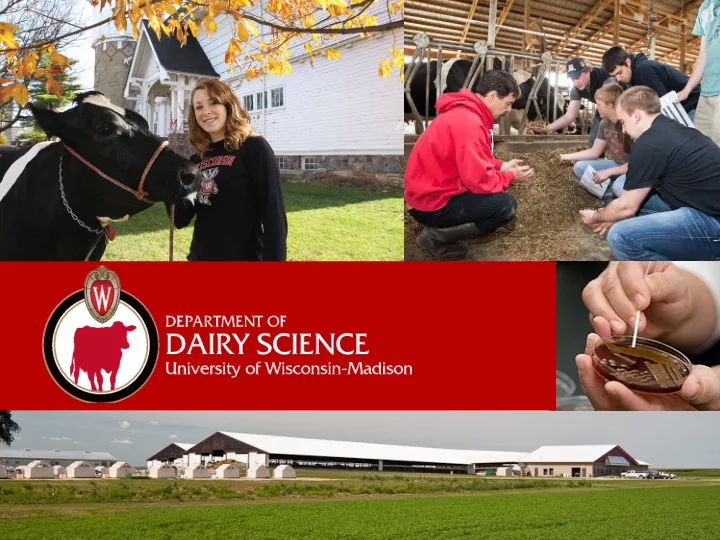
Sample of Current Dairy Science Projects at CALS Agricultural - - PowerPoint PPT Presentation
Sample of Current Dairy Science Projects at CALS Agricultural Experiment Stations Dr. Kent A. Weigel Department of Dairy Science University of Wisconsin Madison EDUCATION DISCOVERY about 1300 undergraduates degrees in Dairy
A Century of Excellence in Education and Discovery
DISCOVERY
Nutrition 1898 First publication of Feeds and Feeding (Henry, later by Morrison) 1905 Salt requirement experiments 1924 Generation of Vitamin D activity in foods by irradiation 1940 NPN utilization by ruminants established 1940 Trace mineral salt experiments 1951 Low milk fat test related to changes in rumen acids 1951 Identification of rumen acids (acetic, propionic, butyric) 1951 Propionic acid shown to reduce ketosis 1971 Active forms of Vitamin D discovered 1974 Ammonia requirements for microbial protein production 1983 Use of forage particle length to calculate roughage indexes 1988 Limited hepatic lipoprotein secretion causes fatty liver 1993 Effectiveness of fiber in byproducts quantified 1998 Use of NIR for analysis of forage digestible fiber and degradable protein 2000 Effects of processing corn silage nutritive value 2000 Phosphorus management on dairy farms 2004 Use of choline to prevent fatty liver 2005 Incorporation of milk urea nitrogen analysis and use in management software Management 1890 Babcock Test for milk fat introduced 1891 Round silo promoted 1906 First cow test association formed 1941 Initiation of dairy cattle housing and milking parlor research 1950 Research on environmental influences on production in 50 herds 1967 Dairy beef project initiated 1968 Shift from Babcock test to infra-red technology and automated milk analysis 1970 Post-milking teat dip experiment 1973 Computerized ration balancing made available 1975 AM-PM and test interval adjustment factors implemented 1981 Milk yield loss associated with subclinical mastitis as indicated by SCC 1991 Model for marginal increases in feed costs for milk, fat, protein, and lactose 2002 Development of “Milk Money” program to improve milk quality Physiology 1895 First use of Tuberculin test 1917 First use of diagnostic test for Johne’s Disease 1934 Brucellosis eradication program initiated 1939 2000 cows artificially inseminated in Wisconsin 1940 Egg-yolk buffer medium developed as semen extender 1949 Dicoumarol as cause of bleeding in cows fed spoiled sweet clover hay 1949 Research on embryo mortality 1959 Rate of milking studies 1963 Early breeding of heifers studies 1964 Wisconsin Mastitis Test developed 1970 Somatic Cell Test based on DNA developed and used in DHI laboratories 1978 Concept of estrogen receptors in the uterus developed 1982 Bovine placental lactogen isolated and characterized 1994 Development of Ovsynch program 2004 Increased steroid metabolism link in high milk production and reproduction Animal Breeding and Genetics 1912 First genetics experiments conducted 1935 Sire proving program started 1940 Experimental bull stud established on campus 1953 Inbreeding, line breeding and out-crossing research at Emmons Blaine farm 1951 First successful embryo transplants in cattle 1957 Dairy Herd Improvement records computerized 1980 Non-surgical ova transfer procedure developed 1982 Scoring system for SCC with optimum statistical properties 1989 First sire evaluations for SCC 1991 Genetic markers for milk production identified 2004 Gene identification through crossbreeding experiments
Historic Moments
Under the guidance of the first professor of agriculture, William A. Henry, the University of Wisconsin provided scientific research to expand the state’s dairy industry in the late 19th century. Using the university farm and the newly created experimental station, Henry promoted the use of round silos for storing feed for cattle during the winter. In 1887 Henry hired Stephen Babcock who developed the first test for butterfat content of milk. This simple test enabled cheese makers to give farmers a fair price for their
leading to practical methods of milk pasteurization. Working with fellow New Yorker William D. Hoard, Henry helped establish the powerful and progressive Wisconsin Dairyman’s Association in Watertown in 1872. The Dairyman’s Association provided education in new dairying methods through its publications and meetings even though its primary function was to help farmers market their dairy products. In 1886 the university offered its first winter agricultural “short course”. Stephen Babcock established the first “Dairy School” in the nation in 1890. Created with support from the legislature, these schools were significant in moving farmers from wheat production to dairying. University sponsored “Farmers Institute held across the state brought farmers and scientists together to share ideas. In 1895, Dean Russell proved to farmers that the recently developed Tuberculin test was accurate. Twenty-eight normal appearing dairy animals from the UW herd that had tested positive for TB were slaughtered before a large crowd of farmers on campus. Russell’s dramatic demonstration proved the TB test was effective and reliable. All
In 1907 UW scientists S.M. Babcock and E.B. Hart set the stage for the discovery of vitamins and essential trace minerals by feeding diets of single grains to 16 dairy heifers. These experiments proved that micro- components other than fats, proteins, carbohydrates, and salts were necessary for life and reproduction. These results changed forever the way scientists look at the diets of animals and humans. In 1933 a farmer brought a bucket of blood to the UW from a cow that had died for no apparent reason. Professor K.P. Linn determined the cause of death was internal bleeding due to the presence of dicoumarol, a blood thinner, found in moldy sweet clover hay. Dicoumoral continues to have extensive use as a rat poison and a blood thinner in humans. In the mid-1930’s, Wisconsin dairy breed organizations petitioned Agriculture Dean C.C. Christensen to establish a Department of Dairy Husbandry at the
EDUCATION LANDMARK EVENTS
University of Wisconsin. With the full support of the state legislature, Christensen moved several extension faculty members specializing in dairy from Animal Husbandry to create the new department in 1938. Dr. E.E. Heizer, a Holstein specialist, moved from Ohio to Wisconsin to become the first Chairman of Dairy Husbandry. One of his early decisions was to improve the research and teaching herds by importing two carloads of registered Holstein heifers from Colony Farms in British
in 1962. The National Dairy Cattle Congress in Waterloo, Iowa, began experiencing financial difficulties in the mid-1960’s. Dr. James W. Crowley, working with several prominent dairy cattle breeders from Wisconsin, made plans to establish a World Dairy Expo in Madison. CALS Dean Glenn Pound wholeheartedly supported the project and
conducting the show. The first show, held in 1968, and every subsequent World Dairy Expo has had the full support of CALS. Dairy Science faculty, staff, and members of the Badger Dairy Club continue to provide valuable assistance in the operation of the premier dairy exposition in the world. 1883 Wisconsin legislature appropriates funding for establishment of an agricultural experiment station 1885 W.D. Hoard publishes first Hoard’s Dairyman magazine 1886 First Short Course in Agriculture established 1887 Dean W.A. Henry hires S.M. Babcock 1890 Establishment of the “First Dairy School in the World” 1898 Campus dairy barn and teaching center completed 1938 Dairy Husbandry Department formed (Heizer, Chair) 1954 Dairy Cattle Instruction and Research Center constructed on campus 1955 Sale of Hill Farm research facility results in purchase of Arlington research farm and expansion of research herd 1972 Animal Science building constructed 1981 US Dairy Forage Research Center established on UW campus 2003 Construction of Integrated Dairy Facilities initiated
EXCELLENCE
(L-R) I.W. Rupel (1963), R.P. Niedermeier (1977), L.H. Schultz (1983), B.R. Baumgardt (1985), N.A. Jorgensen (1991), L.D. Satter (1997)
L.H. Schultz, D.A. Wieckert, C.C. Olson, W.T. Howard, and D.P. Dickson