ANATOMY, HISTOLOGY AND EMBRYOLOGY II LIST OF SLIDES FOR THE FINAL - - PDF document

anatomy histology and embryology ii list of slides for
SMART_READER_LITE
LIVE PREVIEW

ANATOMY, HISTOLOGY AND EMBRYOLOGY II LIST OF SLIDES FOR THE FINAL - - PDF document

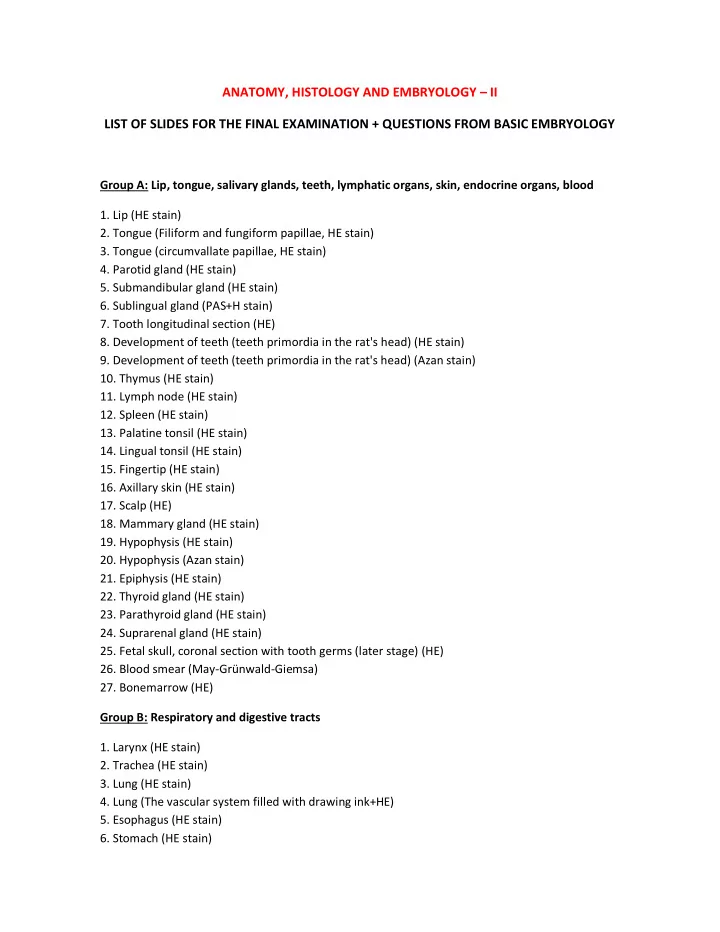
ANATOMY, HISTOLOGY AND EMBRYOLOGY II LIST OF SLIDES FOR THE FINAL EXAMINATION + QUESTIONS FROM BASIC EMBRYOLOGY Group A: Lip, tongue, salivary glands, teeth, lymphatic organs, skin, endocrine organs, blood 1. Lip (HE stain) 2. Tongue


slide-1
SLIDE 1

ANATOMY, HISTOLOGY AND EMBRYOLOGY – II LIST OF SLIDES FOR THE FINAL EXAMINATION + QUESTIONS FROM BASIC EMBRYOLOGY

Group A: Lip, tongue, salivary glands, teeth, lymphatic organs, skin, endocrine organs, blood

  • 1. Lip (HE stain)
  • 2. Tongue (Filiform and fungiform papillae, HE stain)
  • 3. Tongue (circumvallate papillae, HE stain)
  • 4. Parotid gland (HE stain)
  • 5. Submandibular gland (HE stain)
  • 6. Sublingual gland (PAS+H stain)
  • 7. Tooth longitudinal section (HE)
  • 8. Development of teeth (teeth primordia in the rat's head) (HE stain)
  • 9. Development of teeth (teeth primordia in the rat's head) (Azan stain)
  • 10. Thymus (HE stain)
  • 11. Lymph node (HE stain)
  • 12. Spleen (HE stain)
  • 13. Palatine tonsil (HE stain)
  • 14. Lingual tonsil (HE stain)
  • 15. Fingertip (HE stain)
  • 16. Axillary skin (HE stain)
  • 17. Scalp (HE)
  • 18. Mammary gland (HE stain)
  • 19. Hypophysis (HE stain)
  • 20. Hypophysis (Azan stain)
  • 21. Epiphysis (HE stain)
  • 22. Thyroid gland (HE stain)
  • 23. Parathyroid gland (HE stain)
  • 24. Suprarenal gland (HE stain)
  • 25. Fetal skull, coronal section with tooth germs (later stage) (HE)
  • 26. Blood smear (May-Grünwald-Giemsa)
  • 27. Bonemarrow (HE)

Group B: Respiratory and digestive tracts

  • 1. Larynx (HE stain)
  • 2. Trachea (HE stain)
  • 3. Lung (HE stain)
  • 4. Lung (The vascular system filled with drawing ink+HE)
  • 5. Esophagus (HE stain)
  • 6. Stomach (HE stain)
slide-2
SLIDE 2
  • 7. Stomach (PAS+H stain)
  • 8. Gastro-duodenal junction (HE stain)
  • 9. Gastro-duodenal junction (PAS+H stain)
  • 10. Jejunum (HE stain)
  • 11. Ileum (jejunum) (Goldner's stain)
  • 12. Colon (HE stain)
  • 13. Appendix (HE stain)
  • 14. Rectum (HE stain)
  • 15. Pancreas (HE stain)
  • 16. Liver from pig (HE stain)
  • 17. Liver from pig (Azan stain)
  • 18. Human liver (HE stain)
  • 19. Liver from rat (Trypan blue vital stain + Nuclear fast red stain)
  • 20. Gall bladder (HE)

Group C: Urogenital system

  • 1. Kidney - coronal section (HE stain)
  • 2. Kidney - tangential section (HE stain)
  • 3. Ureter (HE stain)
  • 4. Urinary bladder (HE stain)
  • 5. Urethra masculina (HE stain)
  • 6. Cross section of an embryonic penis (HE stain)
  • 7. Testis and epididymis (HE stain)
  • 8. Spermatic cord (HE stain)
  • 9. Seminal vesicle (HE stain)
  • 10. Prostate (HE stain)
  • 11. Vagina (HE stain)
  • 12. Ovary (HE stain)
  • 13. Ovary with corpus luteum (HE stain)
  • 14. Uterine tube (HE stain)
  • 15. Uterus - proliferative stage (HE stain)
  • 16. Uterus - secretory stage (HE stain)
  • 17. Pregnant uterus (HE stain)
  • 18. Placenta (HE stain)

Basic Embryology

  • 1. Primordial germ cells. Mitosis and meiosis. Development of gonads.
  • 2. Maturation of gametes: oogenesis. Body cavities in the early phase of embryonic development:

blastocyst cavity, amnion, chorionic cavity, primitive and definitive yolk sac.

  • 3. Maturation of gametes: spermatogenesis and spermiogenesis. Migration of primordial germ

cells and its role in the development of gonads

slide-3
SLIDE 3
  • 4. Cellular and hormonal background of menstrual cycle.
  • 5. Fertilization.
  • 6. Segmentation. Formation of blastocyst. Implantation. Major characteristics of embryonic and

adult stem cells.

  • 7. Formation and early differentiation of embryoblasts and trophoblasts. Teratogenicity.
  • 8. Formation and derivatives of extraembryonic mesoderm. Early steps of placentation.
  • 9. Gastrulation, the formation of the trilaminar germ disc. Formation of notochord.
  • 10. Differentiation of ectoderm and its derivatives. Neurulation.
  • 11. Differentiation of ectoderm and its derivatives. Neural crest and its derivatives. Definition and

significance in development of epithelo-mesenchymal and mesenchymal-epithelial transitions.

  • 12. Differentiation of ectoderm and its derivatives. Placods and its derivatives. Ectomesenchyme.
  • 13. Differentiation and derivatives of intraembryonic mesoderm. Paraxial mesoderm.
  • 14. Differentiation and derivatives of intraembryonic mesoderm. Intermediate and lateral plate
  • mesoderm. Early steps of the formation of intraembryonic body cavities.
  • 15. Differentiation and derivatives of the endoderm.
  • 16. Definition of organogenesis. Cephalo-caudal and lateral folding of the embryo.
  • 17. Foetal development (changes of the external features). External features of the mature foetus

(newborn).

  • 18. Foetal membranes, amniotic fluid. Lanugo fetalis, vernix caseosa. Twin pregnancy.
  • 19. Hemopoiesis before and after birth. Erythropoiesis. Formation of megakaryocytes.

Thrombopoiesis.

  • 20. Granulopoiesis. Monopoiesis. Lymphopoiesis. Development of thymus.
  • 21. Development of teeth. Dentition.
  • 22. Development of kidneys, formation of uropoietic (urine producing) elements.
  • 23. Development of muscular system and smooth muscle tissue of internal organs.
  • 24. Development of skin, formation of skin appendages, including mammary gland.
  • 25. Development and maturation of lung tissue. Respiratory distress syndrome.