Saginaw Bay Spawning Reefs; Pre- Restoration Assessment A new study - - PowerPoint PPT Presentation

saginaw bay spawning reefs pre
SMART_READER_LITE
LIVE PREVIEW

Saginaw Bay Spawning Reefs; Pre- Restoration Assessment A new study - - PowerPoint PPT Presentation

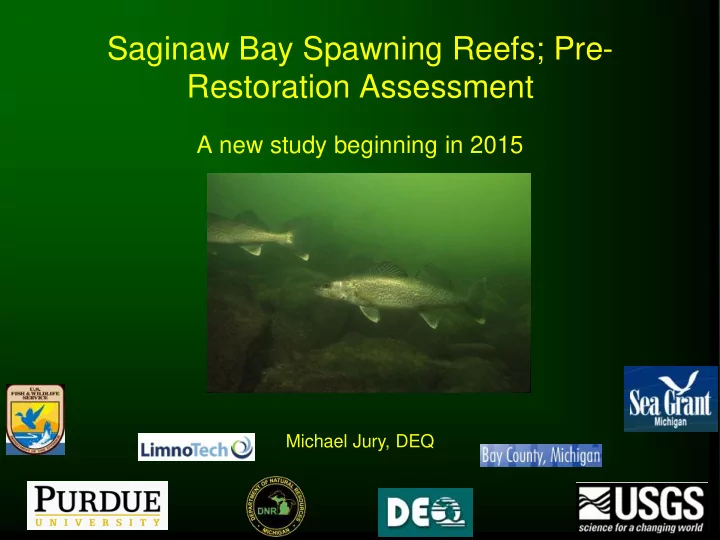
Saginaw Bay Spawning Reefs; Pre- Restoration Assessment A new study beginning in 2015 Michael Jury, DEQ Historic Walleye Harvest from Saginaw Bay 1000 Commercial Harvest 800 (metric tons) Pre 1945 Ave. ~453.6 Tonnes or about 1 600

slide-1
SLIDE 1

Saginaw Bay Spawning Reefs; Pre- Restoration Assessment

A new study beginning in 2015

Michael Jury, DEQ

slide-2
SLIDE 2

200 400 600 800 1000 1880 1901 1922 1932 1945 1962 Year Commercial Harvest (metric tons)

Pre 1945 Ave. ~453.6 Tonnes or about 1 million lbs.

Historic Walleye Harvest from Saginaw Bay

slide-3
SLIDE 3

Reef restoration for Saginaw Bay first conceived as:

  • A recovery

strategy in the Saginaw Bay walleye recovery plan

  • A demonstration

project

slide-4
SLIDE 4

Premise:

  • Historically the bay’s walleye population was

supported by both reef and river spawning fish

  • Populations hailing from multiple spawning

sources are more resilient to perturbation

  • Walleye recovery should seek to achieve

sources and population structure, not just numbers.

  • Potential benefit for other species too (lake

whitefish, lake trout, cisco)

slide-5
SLIDE 5

Saginaw Bay Walleye Open Water Angler Catch Rate and Abundance of Walleye from the Gillnet Survey 1994 - 2013

0.05 0.1 0.15 0.2 0.25 0.3 0.35 0.4 0.45 5 10 15 20 25 30 35 40 45 50

1994 1995 1996 1997 1998 1999 2000 2001 2002 2003 2004 2005 2006 2007 2008 2009 2010 2011 2012 2013

Angler CPUE (walleye/hr) Abundance (gillnet CPUE)

Walleye abundance Alewife abundance Angler CPUE

slide-6
SLIDE 6

Background: Inner Bay Reefs

From Organ et al. (1979) & Goodyear et al. (1982)

slide-7
SLIDE 7

From Fielder (2002)

slide-8
SLIDE 8

Study and Proposed Restoration Sites:

slide-9
SLIDE 9

Information needed before restoration can begin:

  • Before we can invest in reef habitat restoration we need

to know:

– The full status of remaining historic reef habitat in the inner bay. There is still some remnant habitat, what shape is it in? – What’s spawning there? – What is the condition of the proposed restoration sites?

Basically we need a “before” look at things.

slide-10
SLIDE 10

Specific study objectives:

  • Obj. 1: Determine habitat suitability of remnant outer bay and

proposed inner bay reef sites by assessing substrate conditions, water quality and potential egg predators.

  • Obj. 2: Evaluate reproductive usage by adult fish during both the

spring and fall spawning periods.

  • Obj. 3: Assess the genetic and phenotypic characteristics of the

Saginaw Bay walleye and lake whitefish populations.

  • Obj. 4: Develop and execute a plan to engage local stakeholders in

Saginaw Bay reef restoration.

slide-11
SLIDE 11

Sedimentation Model-Predicted Deposition (2009)

11

slide-12
SLIDE 12

Follow up work will be to propose two reefs for restoration:

  • Conceptually:
  • Each 0.4 ha in area and 1 m in relief
  • Each reef will amount to 4,000 m3 of

material

  • 25% cobble, 75% gravel, native

material, glacial till

  • Placement by barge and crane
  • New effective depth of 1.4 – 2.2 m

post construction

slide-13
SLIDE 13

Some of the field work involved in this study:

  • Sedimentation and hydrodynamic model predictions to

refine reef placement

  • Spring and fall evaluations
  • Gillnet collections (spawners) and egg collections (spring

pumping and fall traps)

  • Genetic analysis
  • Microzone water quality monitoring
  • Visual inspection and side scan habitat mapping
slide-14
SLIDE 14

Example of Side Scan Sonar Mapping

slide-15
SLIDE 15

Purdue Research Boat

slide-16
SLIDE 16

Egg Sampling on Reefs

slide-17
SLIDE 17

Netting to Sample for Evidence of Spawners

slide-18
SLIDE 18

Preparing to Set a Net

slide-19
SLIDE 19

Retrieving a Net

slide-20
SLIDE 20

A Nice Whitefish

slide-21
SLIDE 21

Some of the Day’s Catch

slide-22
SLIDE 22

The End of a Productive Day

slide-23
SLIDE 23

Evaluating the Catch

slide-24
SLIDE 24

There’s Always Paperwork to do

slide-25
SLIDE 25

Genetic Analysis of Spawners

slide-26
SLIDE 26

2015 2016

Timeline:

Funding provided by The Great Lakes Fish & Wildlife Restoration Act and project partners.