Safety and Security issues in the light of the accident at TEPCOs - - PowerPoint PPT Presentation

safety and security issues in the light of the accident
SMART_READER_LITE
LIVE PREVIEW

Safety and Security issues in the light of the accident at TEPCOs - - PowerPoint PPT Presentation

2011/12/15 Safety and Security issues in the light of the accident at TEPCOs Fukushima Daiichi NPP Part I Implications on nuclear security Part II Why failed to prevent the Accident UT Nuclear GCOE project Fukushima Daini


slide-1
SLIDE 1

2011/12/15 1 Safety and Security issues in the light of the accident at TEPCO’s Fukushima‐Daiichi NPP

  • A. OMOTO, K. JURAKU, S. TANAKA, University of Tokyo

1

Fukushima‐Daini‐1 Fukushima‐Daiichi‐4

 Part I Implications on nuclear security Part II Why failed to prevent the Accident ‐ UT Nuclear GCOE project ‐

2 Global 2011, 13Dec2011 3

  • A. OMOTO, Global 2011, 13Dec2011

3

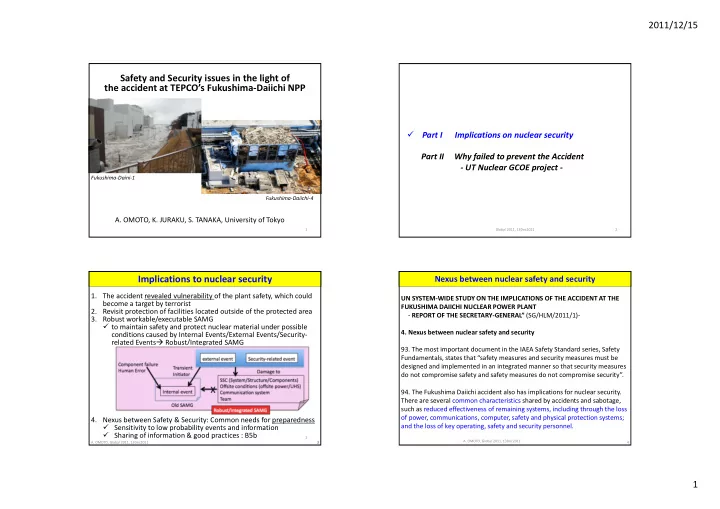
Implications to nuclear security

  • 1. The accident revealed vulnerability of the plant safety, which could

become a target by terrorist

  • 2. Revisit protection of facilities located outside of the protected area
  • 3. Robust workable/executable SAMG

 to maintain safety and protect nuclear material under possible conditions caused by Internal Events/External Events/Security‐ related Events Robust/Integrated SAMG

  • 4. Nexus between Safety & Security: Common needs for preparedness

 Sensitivity to low probability events and information  Sharing of information & good practices : B5b

3

Nexus between nuclear safety and security

4

UN SYSTEM‐WIDE STUDY ON THE IMPLICATIONS OF THE ACCIDENT AT THE FUKUSHIMA DAIICHI NUCLEAR POWER PLANT 
‐ REPORT OF THE SECRETARY‐GENERAL” (SG/HLM/2011/1)‐

  • 4. Nexus between nuclear safety and security
  • 93. The most important document in the IAEA Safety Standard series, Safety

Fundamentals, states that “safety measures and security measures must be designed and implemented in an integrated manner so that security measures do not compromise safety and safety measures do not compromise security”.

  • 94. The Fukushima Daiichi accident also has implications for nuclear security.

There are several common characteristics shared by accidents and sabotage, such as reduced effectiveness of remaining systems, including through the loss

  • f power, communications, computer, safety and physical protection systems;

and the loss of key operating, safety and security personnel.

  • A. OMOTO, Global 2011, 13Dec2011
slide-2
SLIDE 2

2011/12/15 2 Japanese AEC’s Expert Committee’s report on Nuclear Security

  • 1. Fundamentals document (September 6th)

 Consistent with Nuclear Security Fundamentals (GC(45)/INF/14)  Policy to be implemented by the Government and Industry  Further discussion on IAEA‐INFCIRC 225 rev5 (Nuclear Security Recommendations on Physical Protection of Nuclear Material and Nuclear Facilities, NSS‐13)

  • 2. WG report on security issues in the light of Fukushima Accident

and remedial actions (September 30th)highlighted;  Possible attention to nuclear facilities as targets  Protection of three key functions (power supply, cooling of fuel in reactor and SFP)  Protection of facilities located outside of protected area and sabotage  Response actions in harsh environment (radiation, loss of power)

5 Global 2011, 13Dec2011

Part I Implications on nuclear security  Part II Why failed to prevent the Accident ‐ UT Nuclear GCOE project ‐

6 Global 2011, 13Dec2011 7

Fact‐finding

7

Fact‐finding , LL and Changes

Analysis of mostly physical aspect & LL Root‐Cause Analysis & LL

Safety culture Interface with the Society , Science, Safety experts in other areas… Education of engineers to better social‐ literacy Societal safety goal Risk management by Owner/Operator

Changes

Designs

Accident Management Crisis Management Nuclear safety regulation

  • A. OMOTO, Global 2011, 13Dec2011

RCA to find vulnerability and strengthen safety

  • Technical issues leading to nuclear disaster: Mostly understood
  • RCA would help;

 Identify weakness in culture/organization/interface  Avoid accidents of different types but by similar root causes  Change

  • Changes in such areas as

Organizational Culture Interface with Natural Science and understanding of uncertainties

  • n the part of Natural Science

Risk management by Owner/Operator

  • University of Tokyo’s GONERI (Nuclear GCOE) project to

study “Why nuclear community in Japan failed to prevent this accident” A series of interviews by GCOE members to 24 recognized nuclear experts (University, Regulatory body, AEC, Utility, Industry, research institute, NPO critics)

8

  • A. OMOTO, Global 2011, 13Dec2011
slide-3
SLIDE 3

2011/12/15 3 Expressed views and discussions in the interviews

Accident was by unpredictable cause (Black Swan) Accident could have been prevented/should have been prevented

  • Degraded safety culture by Operator

(complacency, lack of sensitivity to information, delayed action to alert, over‐confidence on NPP safety)

  • Lack of tension between Regulators/Operators
  • Too busy in caring day‐by‐day problems
  • Inappropriate crisis management
  • Society takes risk‐related actions,

modifications as evidence of unsafe plants

  • Failure of safety regulation
  • No cross‐cutting safety experts in Japan
  • Why nuclear experts had accepted risks that

(in hindsight) the society cannot accept? Why cautious actions against Tsunami was not enough? WHY FAILED TO PREVENT (incl. accident progression & consequence) ? Why prevention/mitigation against BDBE was not enough or did not function well?

  • Focus on internal events
  • Not enough attention to

localization of designs from US

  • rigin, considering natural

environment, intensive use of coastal area

  • Lack of communication &

mutual understanding between natural science and engineering

  • n uncertainty and design margin

In the background

9

  • A. OMOTO, Global 2011, 13Dec2011
  • Isolation from global safety regime
  • Experts in a cacoon, lack of dialogue

with the society

  • No cross‐cutting safety experts
  • Lack of sense of responsibility as an

individual

What prevent taking corrective actions?

  • Operator is a King, no criticism
  • No question asked to NE programme

implemented under the National Policy

  • “Loose lips sink ships”
  • Too busy to care

If you had recognized such issues, what actions were taken?

  • Creation of JANTI for peer‐review
  • Improved Emergency preparation

in the light of 2007 KK earthquake such as construction of seismic isolation ERC

  • Rainey project, CAP
  • “Safety alert” reports
  • Creation of local committee at KK to

improve safety (equally manned by pro‐, anti‐ and neural)

Issues identifiable even before Fukushima Actions were taken but not enough Actions were not necessarily taken

Expressed views and discussions in the interviews

10

  • A. OMOTO, Global 2011, 13Dec2011

Safety regulation

  • Accident was caused by defects in regulatory system

Delay in reflecting new scientific/technical findings Delayed regulatory actions to review Tsunami Lack of sensitivity to international trends and incidents and delayed actions (Ex. IPEEE, B5b)  Focus on hardware and structural integrity issue (legacy of two regulatory authorities by METI and NSC) Inappropriate delineation of responsibility between NISA and NSC (Ex. Licensing criteria by NSC, while NISA to use it) Regulators’ poor technical expertise in NPP design and operation (frequent staff shuffling system in Japanese government)

  • Japanese regulatory body put emphasis on hardware, rather than

focus on elements raised in IAEA’s safety fundamentals (or INSAG‐12)

  • Heavy focus by NISA on QA drove NPP staff completely occupied by

documentation and no time to visit plants or to think about safety

11

  • A. OMOTO, Global 2011, 13Dec2011

Utility’s attitude to safety

  • Degraded safety culture

Appointing non‐technical staff to plant manager by placing high priority to interface with local community/government Lack of sensitivity and learning attitude from international trends and foreign incidents Not willing to take actions before something happens (Ex. 2007 KK Earthquake was an alarm signal, without which Utility would have taken no serious action to natural hazards) Lack of knowledge in operation by NPP staff members other than those in Operations Department

  • Complacency : 2007 KK Earthquake had proved that safety can be

maintained even by an earthquake exceeding Design Basis

  • Misunderstanding may existed that safety is assured by compliance to

regulatory requirements

12

  • A. OMOTO, Global 2011, 13Dec2011
slide-4
SLIDE 4

2011/12/15 4 Nuclear community’s attitude to safety

(Natural hazards)

  • Utility adhered to US‐origin design; delay in localization by paying

attention to Japanese unique conditions (natural hazard, highly‐ populated coastal line)

  • Focus on internal events, not on external or security‐related events
  • Lack of dialogue may have led to misunderstanding of “uncertainties”

by Natural Science and “design margin” by Engineering (Blinded by day‐by‐day business)

  • Blinded by day‐by‐day business and put safety issues aside
  • Less opportunity to think about design and safety. Increased focus on

day‐by‐day Operation & Maintenance, and on QA documentation (Experts of nuclear safety)

  • Decline in the Nr. of experts as SAM & SA research is completed
  • Defense‐in‐depth not appropriately interpreted, forgot residual risks
  • Focus on probability rather than consequence
  • No cross‐cutting safety experts in Japan

13

(Interface with Society)

  • Engineers are supposed to create societal value, but had limited

communication with the society on what the society expects

  • Continuous improvements by nuclear utility hindered by fear that the

society may take safety‐related modifications as evidence of unsafe plants (amid sharply polarized views on NP) (Utility business environment and organizational culture)

  • Deregulation changed Management attitude towards competitiveness
  • f nuclear power in power generation options
  • Giant cooperation. Delay in actions. Arrogant
  • Risk Management focused relationship with the local community, not

LPHC risk (Experts in nuclear community)

  • Weakness in taking responsibility as an individual
  • “Communication specialists” may have reduced opportunities for

experts dialogue with the society

14

Interface with Society, Culture, Organization

  • A. OMOTO, Global 2011, 13Dec2011

Collecting information from other analysis/statements

  • Prof. D. Klein (Former chariman of USNRC, Ripon Forum, Summer 2011)
  • The LL from Fukushima are many, but what may be surprising is how

few may actually apply to US plants.

  • In a culture where it is impolite to say “no” and where ritual must be
  • bserved before all else, I think that Western style “safety culture”

will be very hard for the Japanese to accept. But accept it they must if they want to achieve excellence. Ludger Mohrbach, VGB PowerTech (April 15, 2011)

  • Question: Is this accident a matter of residual risk of nuclear

energy?No, it is rather a matter of obviously having ignored a high specific risk

  • Prof. Oka (Waseda University, HP)
  • The accident is deeply rooted in Japanese society and culture; lack of

responsibility by the Government, lack of open dialogue, closed experts’s community

  • Prof. Yagawa (AESJ journal)
  • World‐class manufacturing but not built on basic R&D on NP

Professor Hatamura (in his book on “presumed”)

  • If you do not think beyond what is presumed, you are not prepared,

cannot make appropriate judgment and take actions

15

Collecting information from other analysis/statements

  • Prof. Shunpei Takemori (in his book on national nuclear policy and

utility)

  • “Implicit protection” by the Government (holding NP policy) over

utilities’ implementation of NP policy caused poor risk management by utilities and the financial market relied on this “protection”

  • Difference in the attitude of protection of human health and

environment of local between Onagawa (within its supply territory by Tohoku) and Fukushima (outside of TEPCo’s supply territory)

  • Prof. Takeo Kikkawa (in his book on TEPCo – the root cause of failure)
  • Poor risk management to nuclear accident, the largest threat to the

company

  • Expectation on “implicit protection” by the Government over utilities

implementing national NP policy

  • Prof. J. Ahn (UCB, Iwanami “Science”)
  • The way NE policy is determined and implemented needs scrutiny

16

  • A. OMOTO, Global 2011, 13Dec2011
slide-5
SLIDE 5

2011/12/15 5 Observations

17

ENGINEERING SYSTEM TO UTILIZE NUCLEAR ENERGY SCIENCE SOCIETY GLOBAL NUCLEAR REGIME Linkage with others Towards creation of societal value through innovation Towards creation of societal value By meeting societal safety goal Tension and sensitivity

  • 1. Need discussion based on cause‐effect analysis, rather speculation
  • 2. Weakness in Engineering and the system to use NE:

1) linkage with outside (society, scientific community, safety experts in other area, global nuclear safety regime) 2) Shared goal with the society 3) Tension and sensitivity in risk management

TRAFFIC SAFETY, MEDICAL SAFETY…

① ② ③

Future activities?

18

  • 1. Further study ;

 How seismologists are thinking about “Why failed to predict”?  Insights and further analysis from Sociology point of view  Cause‐effect analysis etc.

  • 2. “Social‐literacy” elements in education of engineers
  • 3. Recommendation based on this study for changes

 Nuclear safety regulation  Interface  Societal safety goal (beyond CDF/year and death/year, what the society requires as goal, considering incurred societal damage)  Risk management

  • A. OMOTO, Global 2011, 13Dec2011

CONCLUSIONS

19

  • 1. Implications on nuclear security

 Four points were recognized for actions  Nexus between safety and security: renewed concern

  • 2. Root cause analysis

 Ongoing UT study to identify why nuclear community had failed to prevent this Accident  Findings of root causes to be reflected on changes

  • A. OMOTO, Global 2011, 13Dec2011

20

Thank you for your attention

slide-6
SLIDE 6

2011/12/15 6

Three-level model of Safety Culture Artefacts‐Visible Signs

(greeting rituals, dress, housekeeping – visible)

Espoused Values

(values that are adopted and supported by a person or organization based on strategies/ goals)

Basic Assumptions

(Such as “human nature good or evil”)

Assumptions Espoused Values Artefacts

“Social Fabric” visible invisible

21

INSAG‐4 (1991):“Safety Culture is assembly of characteristics and attitudes in

  • rganizations and individuals which establishes that, as an overriding priority, nuclear

plant safety issues receive the attention warranted by their significance”.

[SOURCE] originally by Edgar Schein, former professor at the MIT Sloan School of Management, expert on organizational culture

Safety Culture

  • Complacency, nuclear power is safety
  • Safety is assured by satisfying regulatory requirements
  • NP must compete with alternatives in the environment of

electricity business deregulation

  • Plant manager’s priority is relationship with locals
  • Loose lips sink ships
  • Nuclear power is supported by a nationally endorsed policy

Priority on safety & “satisfied with safety by locals”

Use of time

  • Blinded by day-by-day business and became insensitive to

LPHC risks or put aside safety issues for later actions

  • Seal-in questions

Visible Signs

Espoused Values

Action pattern

  • Poor consideration of external event risks
  • Lack of learning attitude from outside
  • Not sensitive to criticism from outside

Observation: By way of analogy

Suspected “Basic Assumptions” Slogan